The Civil War was not the end, as is often thought, of reformist activism among abolitionists. After emancipation was achieved, they broadened their struggle to pursue equal rights for women, state medicine, workers' rights, fair wages, immigrants' rights, care of the poor, and a right to decent housing and a healthy environment. Focusing on the work of a key group of activists from 1835 to the dawn of the twentieth century, From Abolition to Rights for All investigates how reformers, linked together and radicalized by their shared experiences in the abolitionist struggle, articulated a core natural rights ideology and molded it into a rationale for successive reform movements.
The book follows the abolitionists' struggles and successes in organizing a social movement. For a time after the Civil War these reformers occupied major positions of power, only to be rebuffed in the later years of the nineteenth century as the larger society rejected their inclusive understanding of natural rights. The narrative of perseverance among this small group would be a continuing source of inspiration for reform. The pattern they established—local organization, expansive vision, and eventual challenge by powerful business interests and individuals—would be mirrored shortly thereafter by Progressives.
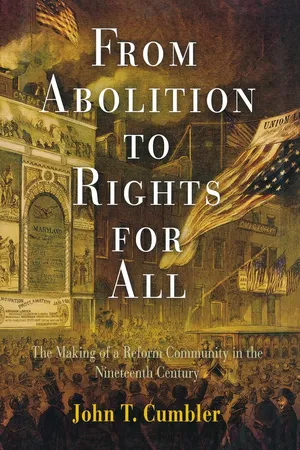
eBook - ePub
From Abolition to Rights for All
The Making of a Reform Community in the Nineteenth Century
- 256 pages
- English
- ePUB (mobile friendly)
- Available on iOS & Android
eBook - ePub
From Abolition to Rights for All
The Making of a Reform Community in the Nineteenth Century
About this book
Information
Publisher
University of Pennsylvania PressYear
2013Print ISBN
9780812240269
9780812240269
eBook ISBN
9780812203820
Chapter 1
The People and the Times
Freedom isn’t like the bird on the wing
Freedom isn’t like the summer rain
You have to work for it, fight for it
Live and die for it
And every generation has to win it again
—old folk song
A Life Long Earnest Worker in Every Good Cause
—Henry Ingersoll Bowditch about Samuel Sewall
On a wet November morning in 1868 Julia Ward Howe, author of numerous books of poetry, two plays, travel books, and the Battle Hymn of the Republic, set off for Boston’s Horticultural Hall wearing her “rainy-day suit.” She had not really wanted to go to the Horticultural Hall that morning. Earlier her old friend, Thomas Wentworth Higginson, had prodded her to lend her name to a call for a women’s rights meeting. But women’s rights was not where Julia Ward Howe wanted to put her energy in 1868. On her mind at the time were the condition of the freedman and the question of black suffrage and rights. She was also interested in the New England Women’s Club that she had helped found only six months earlier.1 However, Higginson was a very old friend, a member with her husband of the secret six, the Northern supporters of John Brown’s Harpers Ferry raid, and a fellow member with her in the intellectual circle behind the Atlantic Monthly. Julia just could not say no to Higginson, so she lent her name to the call for a woman’s rights meeting. Having done so, she felt she had to at least put in an appearance. “Nothing was further from my mind than the thought that I should take part in the day’s proceedings. . . . [She] hoped not to be noticed.”2
Unfortunately for Julia, she was noticed. Higginson spotted her in the back of the hall and insisted that she come up on the platform. She did so “very reluctantly.” Walking up to the platform she had an epiphany. “I was now face to face with a new order of things. Here, indeed were Phillips, Colonel Higginson, my dear pastor, James Freeman Clarke. But here was also Lucy Stone [along with her husband, Henry Blackwell]. . . . These champions, who had fought so long and so valiantly for the slave, now turned the searchlight of their intelligence upon the conditions of woman and demanded for the mothers of the community the civil rights which had recently been accorded to the Negro.”3 Seeing these old champions, Julia realized not only that they made up her community, but that their battle was also hers. She told her daughter that at that moment she felt that she “belonged with them, that she must help draw the car of progress not drag like a brake on its wheel.”4 When Lucy Stone finished talking she turned to Julia and asked her to speak. Julia “could only say, ‘I am with you.’” And she was “with them ever since.”5
Out of that meeting came the New England Woman Suffrage Association with Julia as its first president. She became the organization’s most effective and popular speaker and went on to help form the American Woman Suffrage Association. By the end of the century Julia Ward Howe was as famous for her struggle for women’s rights as for the Battle Hymn of the Republic.
Howe was perhaps more ready to join the women’s rights campaign on that wet November morning than she may have realized or remembered. Before 1868 she may not have seen herself as a women’s rights advocate, but her writings and behavior clearly indicate a woman ready to move in that direction. In a book manuscript begun in 1860 and finished in 1865, she noted “the primal truth, the intrinsic necessity from which the extrinsic necessities follow. The beauty and justice of all that depends upon this first necessity, out of which I hope to demonstrate the equality, the dignity, and the eternal dissimilarity of the two sexes.”6 In her diary in 1866, she noted that her “family” opposed her public lectures but that she would not give in. That same year she argued, “Slaves had no rights. Women have few.”7 Even so, her remembered experience of “a new light com[ing] to [her of a] new domain . . . of true womanhood, woman no longer in her ancillary relation to man, but . . . as a free agent fully sharing with man every human right and every human responsibility,” captures much about the world of New England reformers in the nineteenth century.8 In it we can see community, the role of friendship, loyalty, and love, and the power of a social justice ideal.
Born in 1819, Julia Ward Howe was strong-willed, well-educated, cultured, and very bright. She grew up in a prosperous New York family. Her father, Samuel Cutler Ward, banker and founder of New York University, was a harsh, domineering, though loving father. The death of Julia’s mother when Julia was five hardened him and increased his religious piety. Samuel Ward came to believe the outside world was corrupt and evil, and he attempted to guard his daughter from it. After his wife’s death he moved the family to Bond Street, where Julia’s grandfather and uncles also bought homes. There Samuel attempted to hold his children within the tight net of family and away from the influence of the outer world.
Although her father was conservative, he recognized Julia’s intense intellectual curiosity and ability and gave her, if not social freedom, space to develop her intellectual talents. Julia immersed herself in studies. She mastered French, Latin, and Italian, studied music, and wrote poetry. Mathematics eluded her, but she found philosophy exciting and stimulating. She also wrote drama, although her father frowned on performances as frivolous. Julia’s love of art, drama, and music were constantly rubbing up against her father’s rigidity. She did manage to persuade him to let her attend private school for seven years, but at sixteen she decided she had mastered all she could from school and turned to private study to advance her mind. Julia’s self-discipline and love of study never left her, and her children commented on how important study time (“precious time” she called it) was to her.
Although for Julia, Samuel Ward could be her “jailer” who “shut me up within an enchanted castle,” he was a failed jailer to his sons, who were committed to the “social tie.”9 With her brothers’ active social life dangling before her, Julia enlisted them in her campaign to enter the larger world. When she was nineteen her brother Sam’s marriage to Emily Astor opened a door to New York City Society. Her father’s death on November 27, 1839, allowed Julia and her sisters to walk in.
The excitement of New York Society was tempered by the death of her brother Henry a year later, which briefly plunged Julia into the conservative religion of her father. But her intellectual curiosity and romantic bent soon turned her away from strict orthodoxy and she again engaged in the wider world, both the social world of dances and theater and intellectual intercourse.10
Julia’s brothers opened doors of New York Society for Julia and her sisters, and they became known as the Three Graces of Bond Street. By her early twenties, Julia was intellectually accomplished, well read in several languages (especially poetry of the romantics and dissertations of philosophers), and eagerly involved in the social scene of the time.
The upper-class world of the northeast stretched from Philadelphia to Boston, and Julia was soon visiting friends in Boston, Newport, and Philadelphia. One summer in Boston she became part of a social set that included Charles Sumner, later a radical abolitionist senator, and Henry Wadsworth Longfellow. Samuel Gridley Howe was a close friend of Sumner and Longfellow. Howe was a dashing figure, a Byronesque hero of the failed Greek liberation struggle. Many considered him Boston’s most handsome bachelor. In Boston, Howe established an international reputation for his work with the blind, in particular a blind and deaf student named Laura Bridgman. Visiting Boston with her sisters, Julia accepted an offer from Sumner to visit Howe’s institute. During the visit, the dashing Howe galloped up on horseback and Julia was smitten, at least until the two were married in 1843.11
Married life did not prove to be what Julia had hoped. Although Howe was sexually attracted to women and Julia was an attractive woman, he preferred the company of men. On their honeymoon in Europe, the couple took with them Julia’s sister Annie and Howe’s closest friend Horace Mann and his new wife Mary. Julia was fortunate to have Annie along, for Howe regularly abandoned her for social engagements of his own with European reformers. On returning to Boston Julia and “Chev,” as she called him, now accompanied by their first child, Romana—named for the city of her birth—initially set up house at the Institute for the Blind, a bleak house set off from the city by two miles of rugged countryside.
Although during courtship Howe delighted in Julia’s accomplishments as a poet and intellectual, as a wife he wanted a subservient homemaker.12 As a companion, Julia noted that Howe would have happier married to Charles Sumner. She was not particularly interested in being a successful household manager, and the difficulties of managing a home that was also an institution for the blind and those who tended to them were compounded by Howe’s constant undermining of her authority with the staff. Even after they moved to their own place in South Boston, it was Howe’s dream home, not Julia’s. She continued to feel isolated from the social whirl of Boston itself.
Howe expected his wife to be devoted to him and avoid public life, to focus on raising the family and keeping house.13 He ceaselessly criticized her for her shortcomings in these affairs, at times punishing her by refusing to speak. In 1854 Julia published her first book of poetry, Passion Flowers. Correctly believing her husband would not approve of publishing her work for the general public, she did not tell him and published the book anonymously. The book was a success, but not with Howe. When he found out that Julia was the author and that some of the poems addressed conflicts in marriage, he exploded with rage.
There were other problems between them as well. Julia was terrified of childbirth and had three difficult deliveries between 1844 and 1848. By 1849 she was pregnant again. To avoid pregnancy she tried to avoid sex. Her husband responded with hostility, threatening to divorce her.14 Divorce meant the loss of the children, so Julia relented.
Although a critical thinker and intellectual, Julia shared many of the assumptions of her social class. She remembers arriving in Boston “supposing the abolitionists to be men and women of rather course fiber, abounding in cheap easy denunciations and seeking to lay rash hands on the complex machinery of government.”15 But she was also drawn to abolitionist Theodore Parker’s intellectual rigor, honesty, and friendship. (Parker’s library, Boston’s largest, was also an appeal.) Soon Parker and his wife were Julia’s closest friends and confidants. At social gatherings at the Parkers’, Julia met Wendell Phillips and his radical wife Ann, William Lloyd Garrison, abolitionist poet John Greenleaf Whittier, and other radical Boston abolitionists. Her husband’s closest friends, Henry Longfellow and Charles Sumner, were also committed to abolitionism. Sumner was a regular visitor to the Howe home, and the Howes and Longfellows, Henry and Fanny, spent significant time at each other’s homes and shared a summer cottage in Newport.
Despite these early associations, the Howes were not initially involved with the abolitionists. Julia thought them reckless and Samuel thought them ineffectual.16 But they were increasingly pulled into abolitionism. The formation of the Vigilance Committee to fight against slave renditions was too exciting for Howe to resist, and Julia’s social world immersed her in what she called “a community that was still forming” of abolitionists.17 Her friendships with the Parkers and Clarkes dispelled notions that abolitionists were irresponsible. Soon Julia “cast my lot with those who protested against new assumptions of the slave power.”18 And in doing so she found herself alienated from her “society friends.”19
Although alienated from Boston society by both the physical isolation of her home and her growing sympathy for abolitionism, Julia was developing links to a new community. Despite the hostility of her husband, she slowly developed a world independent of his domineering. She increasingly found companionship among Howe’s intellectual companions—Horace Mann, Sumner, Longfellow, and particularly Boston’s leading intellectual, Theodore Parker. Longfellow encouraged Julia’s poetry writing and Parker supported her study of philosophy. Among Boston intelligentsia Julia became the center of a vibrant literary scene that included not only Longfellow and Parker but also Thomas Wentworth Higginson and Harriet Beecher Stowe. When Samuel decided to take on publishin...
Table of contents
- Cover
- Title
- Copyright
- Dedication
- Contents
- Preface
- Introduction: “Till Every Yoke Is Broken”
- 1: The People and the Times
- 2: “With Other Good Souls”
- 3: “All the Great Men and Men of Respectability Stood Aloof”
- 4: “To Do Battle for Justice and the Oppressed”
- 5: “The Issue Is Universal Justice”
- 6: “Blessed Are They Who When Some Great Cause . . . Calls Them . . . Come”
- 7: Bringing Together the Professional and the Political
- 8: “Public Society Owes Perfect Protection”: The State and the People’s Rights
- 9: “A Relative Right”
- List of Abbreviations
- Notes
- Index
- Acknowledgments
Trusted by 375,005 students
Access to over 1.5 million titles for a fair monthly price.
Study more efficiently using our study tools.
Frequently asked questions
Yes, you can cancel anytime from the Subscription tab in your account settings on the Perlego website. Your subscription will stay active until the end of your current billing period. Learn how to cancel your subscription
No, books cannot be downloaded as external files, such as PDFs, for use outside of Perlego. However, you can download books within the Perlego app for offline reading on mobile or tablet. Learn how to download books offline
Perlego offers two plans: Essential and Complete
- Essential is ideal for learners and professionals who enjoy exploring a wide range of subjects. Access the Essential Library with 800,000+ trusted titles and best-sellers across business, personal growth, and the humanities. Includes unlimited reading time and Standard Read Aloud voice.
- Complete: Perfect for advanced learners and researchers needing full, unrestricted access. Unlock 1.5M+ books across hundreds of subjects, including academic and specialized titles. The Complete Plan also includes advanced features like Premium Read Aloud and Research Assistant.
We are an online textbook subscription service, where you can get access to an entire online library for less than the price of a single book per month. With over 1.5 million books across 990+ topics, we’ve got you covered! Learn about our mission
Look out for the read-aloud symbol on your next book to see if you can listen to it. The read-aloud tool reads text aloud for you, highlighting the text as it is being read. You can pause it, speed it up and slow it down. Learn more about Read Aloud
Yes! You can use the Perlego app on both iOS and Android devices to read anytime, anywhere — even offline. Perfect for commutes or when you’re on the go.
Please note we cannot support devices running on iOS 13 and Android 7 or earlier. Learn more about using the app
Please note we cannot support devices running on iOS 13 and Android 7 or earlier. Learn more about using the app
Yes, you can access From Abolition to Rights for All by John T. Cumbler in PDF and/or ePUB format, as well as other popular books in History & North American History. We have over 1.5 million books available in our catalogue for you to explore.