There were 26—not 13—British colonies in America in 1776. Of these, the six colonies in the Caribbean—Jamaica, Barbados, the Leeward Islands, Grenada and Tobago, St. Vincent; and Dominica—were among the wealthiest. These island colonies were closely related to the mainland by social ties and tightly connected by trade. In a period when most British colonists in North America lived less than 200 miles inland and the major cities were all situated along the coast, the ocean often acted as a highway between islands and mainland rather than a barrier.
The plantation system of the islands was so similar to that of the southern mainland colonies that these regions had more in common with each other, some historians argue, than either had with New England. Political developments in all the colonies moved along parallel tracks, with elected assemblies in the Caribbean, like their mainland counterparts, seeking to increase their authority at the expense of colonial executives. Yet when revolution came, the majority of the white island colonists did not side with their compatriots on the mainland.
A major contribution to the history of the American Revolution, An Empire Divided traces a split in the politics of the mainland and island colonies after the Stamp Act Crisis of 1765-66, when the colonists on the islands chose not to emulate the resistance of the patriots on the mainland. Once war came, it was increasingly unpopular in the British Caribbean; nonetheless, the white colonists cooperated with the British in defense of their islands. O'Shaughnessy decisively refutes the widespread belief that there was broad backing among the Caribbean colonists for the American Revolution and deftly reconstructs the history of how the island colonies followed an increasingly divergent course from the former colonies to the north.
eBook - ePub
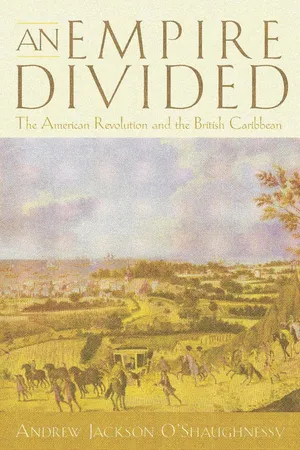
An Empire Divided
The American Revolution and the British Caribbean
- 376 pages
- English
- ePUB (mobile friendly)
- Available on iOS & Android
eBook - ePub
About this book
Information
PART I
FOUNDATIONS
OF LOYALTY
The Subjects of those islands [in the West Indies] must at all times depend upon the Parent State for protection, & for every Essential resourse. The mart of their Produce will ever be at home; & the Public credit is security for their acquired Wealth if established in our Bank or Funds. Their aim is only to get Fortunes & return to their native Land. Such is the consequence of an Empire over Islands to Britain. We have dearly experienced a contrary Effect in our Continental Colonists. Every Subject, My Lord, you ingage to Inhabit our Sugar Colonies, you acquire a valuable object to the State; every Subject that settles upon Continental America is eventually lost to the Mother-Country.
—John Drummond to Lord George Germain, secretary of state for America, March 24, 1778
1
British Sojourners
AT THE OUTSET OF the American Revolutionary War, a French visitor remarked on the differences between the island and mainland colonies of British America: “Far from settling in the islands,” the white colonists regarded them “as a land of exile, never as a place where they plan to live, prosper, and die.” In contrast, the Anglo-American colonists of the mainland were “permanent, born in the country and attached to it; they have no motherland save the one they live in.”1
Writing a century earlier, a Barbadian planter spoke of this umbilical attachment in which “by a kind of magnetic force England draws all to it. . . . It is the center to which all things tend. Nothing but England can we relish or fancy.” In 1760, Charles Townshend favorably contrasted West Indians to North Americans because they “never consider[ed] themselves at home” in the islands and they sent “their children to the Mother Country for education.” They eventually returned to Britain “to recover their health or enjoy their fortunes” for, if they had ambition, “tis hither they come to gratify it.”2
In 1764, following the end of the Seven Years’ War, a Nevis author reflected on the transient quality of white society in the islands: “Tho’ detained from their native land by mercenary Pursuits and Views of Interest, yet [they] consider their Absence from Britain as an Exile, and incessantly sigh for a return.” Upon joining his regiment in Jamaica, Lord Adam Gordon commented that “the generality of its inhabitants look upon themselves there as passengers only.” Bryan Edwards similarly described how “it is to Great Britain alone that our West India planters consider themselves as belonging.” He added that “even such of them as have resided in the West Indies from their birth, look on the islands as their temporary abode only, and the fond notion of being able to go home (as they emphatically term a visit to England) year after year animates their industry and alleviates their misfortune.”3
Colonists throughout British America spoke of Britain as their home. The expression was more meaningful in the British West Indies, however, where the white settlers were primarily a society of sojourners who aimed to return to Britain and identified themselves culturally with Britain. I shall argue that the strength of the social and cultural ties with Britain restrained the development of a nationalistic creole consciousness among whites and was a contributory factor in the failure of the British Caribbean to support the American Revolution.

Whites in the British Caribbean were creoles, if we mean simply that they made cultural adaptations to their new environment. Like European settlers elsewhere in the Americas, they possessed distinctive characteristics in their speech, diet, dress, architecture, values, and behavior that were peculiar to the Caribbean. They developed an attachment to their islands, which was reflected in the numerous prerevolutionary local histories and a literature praising the tropical landscape. They were often ambivalent about their British identity when they actually returned to the mother country.4
But West Indian whites were not committed to permanent settlement, and their ideal of returning home to the mother country gave white society a transient quality. They treated the islands as little more than temporary abodes to facilitate their spectacular reentry into British society. Throughout the eighteenth century, an increasing proportion of West Indian planters returned to live off the income of their plantations as absentees in Britain. The trend varied among islands, often in relation to the respective expansion and profitability of sugar production. It began in Barbados soon after the Restoration of Charles II (1660). In the last two decades of the seventeenth century, some three hundred West Indians were annually going back to Britain “with this advantage that their fathers went out poor and the children come home rich.” Over one-third of Jamaican planters were absentees by 1740.5
In the 1730s, absenteeism was still quite rare in the Leeward Islands (Antigua, St. Kitts, Montserrat, and Nevis). Thereafter it reached chronic levels in St. Kitts, where absentees owned half the property in 1745. Absenteeism was also prevalent in the Windward Islands (Grenada, St. Vincent, Dominica, and Tobago) from the time of their acquisition by Britain in 1763. Tobago had only twenty resident planters out of a total of seventy-seven proprietors. Absentee estates in Grenada were worth upward of a million pounds of sterling in 1778.6
On the eve of the American Revolution, planter-historian Edward Long estimated that there were some two thousand nonresidents, annuitants, and proprietors, “who of late years” and “beyond the example of former times” had flocked from Jamaica to Britain. A visitor found St. Kitts “almost abandoned to overseers and managers, owing to the amazing fortunes that belong to Individuals, who almost all reside in England.” Absentees made up 80 percent of the elite families of Antigua, and two-thirds of the planters in Jamaica were absentees by 1800.7 Absenteeism was also common among military officers, the clergy, and patent officeholders.
These British sojourners consequently bequeathed shamefully little toward developing an infrastructure in the islands, such as schools, colleges, roads, and missions. The most enduring visible monuments to the presence of the British in the Caribbean were those commemorating the deaths of individuals who died before achieving their ambition of returning home. Some were crafted by the best English sculptors, such as Henry Cheere and John Bacon. They all shared a common feature in the complete absence of any depiction of tropical life in the West Indies. The patrons clearly wanted to be commemorated by monuments exactly like those of an English country churchyard. These decaying monuments remain English corners of a foreign land.
The transience of white West Indian society was reflected in the paucity of architectural remains. Edward Long spoke of the “make-shift” appearance of the architecture in Jamaica, and Bryan Edwards described the “meanness of their houses and apartments.” There were “few of the Beauties of Architecture to be seen in Jamaica” despite the opulence of its planters. James Anthony Froude, a nineteenth-century historian, was appalled at the difference between Kingston, the largest town in the British West Indies, which “has not one fine building in it,” and Havana, the Spanish capital of Cuba, which “is a city of palaces, a city of streets and plazas, of colonnades and towers, and churches and monasteries.” The most impressive architectural eighteenth-century legacies were not private residences but fortresses, naval dockyards, and military barracks. “We English,” Froude concluded, “have built in those islands as if we were but passing visitors, wanting only tenements to be occupied for a time.”8
West Indian fortunes nurtured several noted writers and scholars, but they too were often sojourners. They included bibliophiles, historians, political pamphleteers, constitutional authorities, political economists, travel writers, natural historians, botanists, and agricultural commentators. There were West Indian members of the Royal Society, the Dilettante Society, and the Royal College of Physicians. The first complete oratorio in the Americas was composed and performed in Jamaica in 1775. There were also poets, landscape artists, actors, architects, and connoisseurs. Spanish Town in Jamaica had a theater, circulating libraries, a literary society, an agricultural society, and social clubs in the 1770s. West Indian literary and artistic work may indeed have “fostered local pride,” but most of these authors and scholars were either visitors, temporary residents, or absentees. They also were often transients, thereby creating the popular misconception that “in literature, science and the arts, the history of the British West Indies is almost a blank.”9
It was the ephemeral nature of white settlement that so concerned Edward Long, the most incisive of contemporary commentators. His History of Jamaica (1774) pleaded for greater self-sufficiency and the development of local institutions. He advocated legislative action to fund schools, a medical college, white immigration, improved military defenses, and a stronger church foundation. His emphasis on greater self-sufficiency was his most original intellectual contribution “not his political ideas per se” or his “constitutionalism.”10 However, even Long succumbed to the temptations of absenteeism and returned to Britain.
Only in Barbados did the British come close to developing a creole society of committed settlers in the Caribbean. This was due to the high proportion of whites, less reliance on immigration, the belief that the climate was more healthy, lower rates of absenteeism, lower sugar profits, lower rates of “miscegenation,” less danger from foreign attack (owing to the windward position), and complacence about the threat of a black rebellion. Barbados contained the largest proportion of small and middling planters, numbering some four thousand resident landowners in 1765. It had a better infrastructure with the oldest assembly in the British Caribbean, the first printing press, schools in every parish, the first newspaper, and a well-supported Anglican Church.11
Barbados has been used as a case study to show the early development of a creole mentality in the eighteenth-century British Caribbean.12 Even in Barbados, however, the white population was in a minority. Almost one-third of the planters were absentees like Samuel Estwick, Philip Gibbes, John Gibbons, and the Lascelles. The Barbadian elite preferred to be educated in Britain; thus Codrington College never “promised to make it unnecessary for Barbadian youths to travel to England for advanced education.”13 It closed as a school between 1775 and 1786 and was not a university or even a seminary until 1830. The yeoman class of small landholders lacked the confidence to politically challenge the planter elite until the early nineteenth century.
How do we explain the transience of British society in the Caribbean and the almost universal desire of whites to return home to Britain? Frank Wesley Pitman argued that the absence of religious motives among the first English settlers in the Caribbean created a transient society, which was in contrast to North America, where religion inspired ideals of a new society divorced from England. He also suggested that the settlers in the islands were drawn from “the capitalist class . . . [who] were often connected with the landed gentry, were Anglicans, and championed the social and political conceptions held by the rural aristocracy of England,” in contrast to the North Americans, “who came largely from the middle and nonconformist class in England . . . [and who] had imbibed democratic and republican ideas.”14
Pitman, in an error common among his generation, treated the history of colonial America as synonymous with the Puritan colonies of New England and ignored the more populous plantation colonies of the Chesapeake (Virginia and Maryland). There was in reality little difference in the motives and background of the early English emigrants to the Caribbean from those of the Chesapeake. The plantation colonies of the islands and the southern mainland shared a common ethos, which was materialistic, individualistic, competitive, exploitative, and comparatively secular. It was the universal aim of most settlers in all the plantation colonies to make quick fortunes and to return to a life of genteel leisure in Britain.
The peculiar transience of British society in the Caribbean can be attributed in part to demographic failure. The white population was not sustained by natural increase, unlike the mainland colonies where the white population was doubling every twenty-five years after 1700. Deaths exceeded births in the Caribbean. The migration of a little under half a million Europeans to the British Caribbean was “roughly comparable” to that of British North America before the American Revolution.15 Yet there were fewer than fifty thousand whites in the British Caribbean, compared to two million in North America, in 1776.
The demographic failure of white society in the islands was linked to the high mortality rates: “The low life expectancy of white men in the tropics goes far to explain the large number of absente...
Table of contents
- Cover
- Half title
- Title
- Copyright
- Contents
- List of Illustrations
- Preface
- Maps
- Part I: Foundations of Loyalty
- Part II: DIVERGENT PATHS
- Part III: The Imperial Civil War
- Part IV: The Division of British America
- List of Abbreviations
- Notes
- Select Bibliography
- Acknowledgments
- Index
Trusted by 375,005 students
Access to over 1.5 million titles for a fair monthly price.
Study more efficiently using our study tools.
Frequently asked questions
Yes, you can cancel anytime from the Subscription tab in your account settings on the Perlego website. Your subscription will stay active until the end of your current billing period. Learn how to cancel your subscription
No, books cannot be downloaded as external files, such as PDFs, for use outside of Perlego. However, you can download books within the Perlego app for offline reading on mobile or tablet. Learn how to download books offline
Perlego offers two plans: Essential and Complete
- Essential is ideal for learners and professionals who enjoy exploring a wide range of subjects. Access the Essential Library with 800,000+ trusted titles and best-sellers across business, personal growth, and the humanities. Includes unlimited reading time and Standard Read Aloud voice.
- Complete: Perfect for advanced learners and researchers needing full, unrestricted access. Unlock 1.5M+ books across hundreds of subjects, including academic and specialized titles. The Complete Plan also includes advanced features like Premium Read Aloud and Research Assistant.
We are an online textbook subscription service, where you can get access to an entire online library for less than the price of a single book per month. With over 1.5 million books across 990+ topics, we’ve got you covered! Learn about our mission
Look out for the read-aloud symbol on your next book to see if you can listen to it. The read-aloud tool reads text aloud for you, highlighting the text as it is being read. You can pause it, speed it up and slow it down. Learn more about Read Aloud
Yes! You can use the Perlego app on both iOS and Android devices to read anytime, anywhere — even offline. Perfect for commutes or when you’re on the go.
Please note we cannot support devices running on iOS 13 and Android 7 or earlier. Learn more about using the app
Please note we cannot support devices running on iOS 13 and Android 7 or earlier. Learn more about using the app
Yes, you can access An Empire Divided by Andrew Jackson O'Shaughnessy in PDF and/or ePUB format, as well as other popular books in History & Early American History. We have over 1.5 million books available in our catalogue for you to explore.