Elections are, and always have been, the lifeblood of American democracy. Often raucous and sharply contentious, sometimes featuring grand debates about the nation's future, and invariably full of dramatic moments, elections offer insight into the character and historical evolution of American politics. America at the Ballot Box uses the history of presidential elections to illuminate American political democracy and its development from the early Republic to the late twentieth century.
Some of the contributions in America at the Ballot Box focus on elections that resulted in dramatic political change, including Jefferson's defeat of Adams in 1800, the 1860 election of Lincoln, and Reagan's 1980 landslide victory. Others concentrate on contests whose importance lies more in the way they illuminate the broad, underlying processes of political change, such as the corruption controversy of Cleveland's acrimonious election in 1884 or the advent of television advertising during the 1952 campaign, when Eisenhower defeated Stevenson. Another set of essays takes a thematic approach, exploring the impact of foreign relations, Anglophobia, and political communications over long periods of electoral time. Uniting all of the chapters is the common conviction that elections provide a unique vantage point from which to view the American political system.
Ranging from landmark contests to less influential victories and defeats, the essays by leading political historians seek to rehabilitate the historical significance of presidential elections and integrate them into the broader evolution of American government, policies, and politics.
Contributors: Brian Balogh, Gareth Davies, Meg Jacobs, Richard R. John, Kevin M. Kruse, Jeffrey L. Pasley, Andrew Preston, Elizabeth Sanders, Bruce J. Schulman, Jay Sexton, Adam I. P. Smith, Sean Wilentz, Julian E. Zelizer.
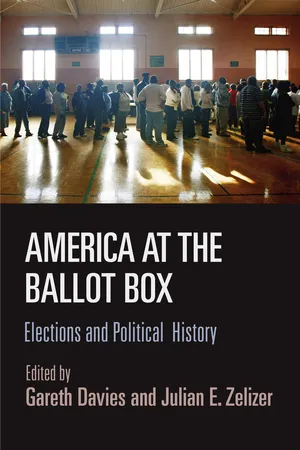
eBook - ePub
America at the Ballot Box
Elections and Political History
- 352 pages
- English
- ePUB (mobile friendly)
- Available on iOS & Android
eBook - ePub
America at the Ballot Box
Elections and Political History
About this book
Information
Publisher
University of Pennsylvania PressYear
2015Print ISBN
9780812247190
9780812247190
eBook ISBN
9780812291360
CHAPTER 1

The Devolution of 1800: Jefferson’s Election and the Birth of American Government
American presidential campaigns have never been known for understatement, but one of the very first ones, Thomas Jefferson’s victory over John Adams in 1800, has rarely been equaled for the epic sweep of its participants’ rhetoric: “Republicans Rejoice! Our Country is saved from . . . counter revolution—from the fangs of an usurper,” the New York American Citizen trumpeted. A song written to celebrate “Jefferson and Liberty” became an instant folk standard:
The gloomy night before us flies,
The reign of Terror now is o’er.
After several tense weeks of Electoral College deadlock, Jefferson’s supporters threw boozy festivals and banquets in every major city and town, toasting their hero and the “bloodless revolution” they believed that his accession to the presidency represented. On the day of his inauguration, March 4, 1801, a holiday spirit was in the air. Some Jeffersonians toasted the day as a political Christmas, lifting their glasses to “the friends of liberty throughout the Universe, ‘Peace on Earth, and good will Towards Men.’ ” Others, oddly, seemed to regard it more as Valentine’s Day: “Our next administration, undefended by terror, but supported by love.” Even in Connecticut, where Jefferson was righteously drubbed in the election, his acolytes held a “Republican Thanksgiving.”1
In later life, Jefferson somewhat infamously took to calling his own election “the revolution of 1800.” Historians and Adamses have scoffed at the phrase as an old man’s tall tale ever since, pointing to the fact that President Jefferson did not immediately wreck the institutions that the Federalists had created (like the Bank of the United States) or forswear the use of his executive authority in dealing with unexpected foreign policy challenges such as extortion by North African pirates and Napoleon Bonaparte’s offer to sell the French colony of Louisiana. Henry Adams, eager to vindicate his defeated ancestors, doubted that any Federalist president could have turned out “more Federalist than Jefferson himself.” Even the devoted Jeffersonian Dumas Malone, author of a six-volume biography, thought the “revolution of 1800” was more semantic than anything else. Indeed, if one judges historical events by the standards of bloody social upheavals such as the French and Russian revolutions, as most scholars do in one way or another, then the election of 1800 is guaranteed to fall short. Cold War–era “consensus” historians like Malone were eager to disassociate Thomas Jefferson and James Madison from that kind of revolution, and later, more socially oriented scholars were no more inclined to accord that status to an event that directly involved relatively few people, no immediate social changes, and the rise of another slaveholder to the presidency. Hence it has become the custom to treat 1800 as representing little more than a slight power shift south from one faction of Founders to another, and to take a fashionably jaded view of Jefferson’s “revolution.”2
Yet considered in both a wider view and the narrower one recorded in toasts, speeches, and newspaper essays just after the fact, the term was neither an anachronism nor one that the candidate invented to aggrandize himself. Contemporaries agreed that a momentous event had taken place and really only disagreed on its polarity, whether it was a revolution accomplished or a counterrevolution thwarted, and how one should feel about either of those options.3 Heads did not roll and society did not overturn, but the 1800 election was a revolution in political culture, the beginnings (if only the beginnings) of a popular if often not very admirable or honest democracy in which leaders tried to appear as friendly equals of the people who voted, rather than stern “Fathers of the State” like George Washington and John Adams. But while Jefferson certainly was the first president who came to power as “the People’s Friend,” what is striking upon returning to this campaign is how much about government it was; as Jefferson said, it represented “as real a revolution in the principles of our government as that of 1776 was in its form.” The oppositions that the celebratory toasts and songs set up between love and terror, morning and night, and democracy versus monarchy (and “priestcraft”) were all highly skewed and luridly colored encapsulations of two very real and very different visions of how the American government should operate under the Constitution.4
The emotional heat of Jefferson’s Democratic-Republicans was directed especially at what they somewhat bombastically called the “Reign of Terror” under the John Adams administration. While relatively soft by French revolutionary standards (no guillotines), by American ones, the Federalist reign was a remarkable burst of “Hamiltonian energy” that seemed to its critics untrammeled by constitutional restraints and unreserved in its political and cultural nationalism. Fearing French invasion and subversion, Alexander Hamilton’s followers in the Adams cabinet and Congress began building a navy, expanded the army and asserted national authority over the state militias, and created a kind of federal income tax, the Direct Tax of 1798, to pay for it all. This unexpected expansion of national power went along with a narrowing of national feeling, making citizenship and voting rights more difficult for immigrants and criticism of the government illegal. What seemed to be omissions or direct contradictions of the constitutional text were justified not only by the elastic clause that Hamilton had been using since the beginning of the government (“necessary and proper”), but also by using the rhetoric of the Preamble as a catchall, asserting the federal government’s powers to do anything it needed to do for the “common defense” and “general welfare” of the nation. The new security program was put to immediate use. Troops were deployed against German tax protesters in eastern Pennsylvania, while a gadfly congressman and printers of opposition newspapers were thrown in jail. Dominated by men from the Bible Belt of the Early Republic, New England, the government’s officials and supporters adopted an increasingly religious and nativist tone, declaring national days of prayer and smearing their opponents—often from the pulpit—as infidels, Illuminati, and “wild Irish.”5
The inescapable and often stated crux of Federalist terror, as its victims saw it, was its apparent goal of establishing a submissive relationship between the government and the people, a relationship that critics described as essentially monarchical. Federalists had questioned the legitimacy of organized opposition to the federal government as soon as it appeared in the form of the National Gazette newspaper and the so-called Democratic-Republican Societies, political clubs that George Washington saw fit to officially denounce. None of the major Founders approved the idea of permanent, ongoing political parties, but the passionate debates over Hamilton’s financial system and the proper American response to the French Revolution brought out starkly different approaches to opposition as a practical matter. Washington and most other Federalists took the position that in a government elected by the people, policy debates should be conducted by the people’s representatives alone, and any effort to influence government from the outside, in the name of the people, was dangerous and inherently revolutionary. “Self-created societies” like the Democratic-Republican clubs lacked the standing to criticize duly elected officials, and when they did, it led to troubles like the Whiskey and Fries Rebellions in rural Pennsylvania. Federalists blamed these uprisings on Republican agitators in the city-based clubs and the press, even though the urban democrats had virtually no connection to the rebels or in many cases even much sympathy for them. “To Federalists,” historian Johann Neem writes, “the rebels exemplified the danger of permitting organized opposition at any level,” and they sought to “eliminate [that danger] altogether.”6
The partisan intent of the Federalist crackdown on dissent was obvious. The Sedition Act targeting the opposition press was openly timed to coincide with the 1800 presidential campaign and set to expire just as the next president was inaugurated. By scaring off or silencing those inclined to speak, write, or organize against them, and fully using the constitutional leeway they gave themselves, Federalists allegedly hoped, as Democratic-Republican hyperbole put it, “to erect a Monarchy upon the ruins of [our] republican Constitution,” in the sense of installing a national leadership that would be as stable and unchallenged as possible. Some Republicans used the monarchy charge quite literally, but their more sober comments indicate a more relatable concern about whether a democratic republic could arm and gird and empower itself so quickly without fundamentally changing its character: “Some honest men fear that a republican government can not be strong, that this Government is not strong enough,” Jefferson said in his first inaugural address. Federalists had made their changes out of a “theoretic and visionary fear that this Government, the world’s best hope” now that revolutionary France had collapsed into Napoleonic dictatorship, “may by possibility want energy to preserve itself.” Here Jefferson had a point. Worried about a French invasion that never happened, the Federalists had convinced themselves that the opposition was the spearhead of a foreign conspiracy to engineer a bloody, atheistic revolution in the United States.7
What is particularly important for present purposes is the vindication that 1800-1801 represented for elections as a national institution. In question was just what presidential elections were going to be: genuine decision points where the voters rendered their judgment on the direction of national policy and the faithfulness of their constitutional officials or (in effect) plebiscites that reaffirmed the existing regime. Jefferson’s followers took extreme pride in the fact that they had managed to make the election of 1800 the former, despite the Federalists’ best efforts. “The Elective Franchise,” they toasted, was “the high court of appeal for insulted freemen,” and the Republicans had won their case, using only “representative democracy, with reason for its weapons and truth for its defence.” The campaign had been largely conducted in the press and in the streets, with little overt participation from the candidates, and while the newly installed President Jefferson tried to distance himself from the vitriol of the campaign, he praised elections as a cornerstone of republican government, “a mild and safe corrective of abuses” that could otherwise only be changed by force, “lopped by the sword of revolution where peaceable remedies are unprovided.” Jefferson and Madison liked the idea of ongoing political parties little more than Washington, Adams, and Hamilton—they hoped that the Federalists would fade away after they themselves took office—but they did not treat their Federalist critics as illegitimate participants in the political process.8
False equivalence can be as comfortable a myth for historians as it is for journalists, but it cannot stand in this case. The victorious Republicans largely stood by the First Amendment principles expressed during the 1800 campaign. No federal security legislation or sedition prosecutions were ever aimed at the Federalist opposition despite the overt disloyalty and obstruction that many New England Federalists displayed during the War of 1812. After the war, a Republican orator could boast with some accuracy that President James Madison had managed to get through a major foreign invasion (the only one any president has ever had to face) “without one trial for treason, or even one prosecution for libel.” Localized violence against the press and a handful of state-level prosecutions did occur during the Jefferson and Madison years, but they involved both parties at various times, and the federal government asserted no authority over political expression. Later wartime presidents would show less restraint, but seditious libel, the doctrine that criminalized political speech during the 1790s, went into “a long eclipse” after 1800.9
The successful resort to electoral change devolved the duties of enforcing the Constitution, defending the government, and defining the nation (meaning the national culture) back on the people themselves and the institutions they were thought to have a more direct hand in, the state and local governments. Of course, one dimension of this devolution was protecting the ability of local elites in the South to manage their own “domestic concerns”—allowing slaveholders to protect slavery, in other words—but that was only occasionally mentioned in the 1800 campaign and not the principle being asserted. Nor was defending slavery the only purpose for which popular sovereignty could or would be used. Chief among the stated principles were equality before the law and tolerance of political, cultural, and social diversity. The government’s watchword would be “equal and exact justice to all men, of whatever state or persuasion, religious or political,” Jefferson said, a universalistic formulation that incorporated the racial and gender limits of the time without officially and explicitly enshrining them, an omission that proved crucial in the long run.10
The point of rehearsing all of this is to show that, as loud and empty and disappointing as they often are, elections have fundamentally shaped the United States, determining how the constitutional system works in practice and even some basic features of American culture. The rest of this chapter will look in more detail at some of the many ways that the election of 1800 redirected the country from the more authoritarian and monocultural path—unfriendly to dissent, unwelcoming to immigrants, and overtly Protestant—that the Federalists had embarked it on in the 1790s.11
Two Constitutionalisms
Despite the modern debates between proponents of the “living Constitution” and advocates of “original intent,” Americans have long agreed that enforcing the Constitution is strictly a legal matter, something that lawyers argue and judges decide in the courts. But it was not so in the early years of the American Republic; before John Marshall, constitutional enforcement was a do-it-yourself project. (A Virginia Federalist appointed by John Adams just before the latter left office, Marshall began asserting the primacy of judicial review through the Supreme Court in direct response to the popular constitutionalism that had deposed his party, making the Court the Federalists’ final and longest-lasting redoubt.) Though Americans had pioneered the idea of writing down the fundamental rules of their governments and treating these documents as a form of law, almost no one thought courts were or could or should be the sole means of enforcing those rules, as is the case in the twenty-first century. Following the unwritten British constitutional tradition and their own instincts, early Americans believed that keeping government within its constitutional limits was a duty that fell ultimately upon the people themselves. The people elected officials to various branches and levels of government. If the competition among these different representatives and institutions could not check violations of the Constitution, or if the representatives proved unfaithful, it was up to the people to defend their own rights with their votes, their voices, and their bodies if necessary.12
Along with these more popular ideas of how constitutions were enforced was a distinct notion of what they were for: to protect rights, of individuals and of the people as a whole. The world’s first written constitutions were created by Pennsylvania and the other twelve original states at the beginning of American Revolution to replace a British regime the patriots believed had become abusive and tyrannical. These documents all included lengthy lists of the rights that their writers believed free governments were instituted to protect, but the unwritten British Constitution had not. With regard to the main rights at issue in the late 1790s, Pennsylvania’s 1776 constitution had stated that “the people have a right to freedom of speech, and of writing, and publishing their sentiments; therefore the freedom of the press ought not to be restrained.”13
If the early constitutions were all about asserting rights, the major purpose of the new federal Constitution framed in 1787 was quite different: creating a stronger central government that could finance itself and defend the country without depending on the states. The new goal of expanding the power of the national state—pushed by Alexander Hamilton and his coterie of wealthy, well-connected, mostly northeastern nationalists, later the core of the Federalist Party—led to a different, much less limiting form of const...
Table of contents
- Cover
- Half title
- Title
- Copyright
- Dedication
- Contents
- Introduction
- 1. The Devolution of 1800: Jefferson’s Election and the Birth of American Government
- 2. The Bombshell of 1844
- 3. Beyond the Realignment Synthesis: The 1860 Election Reconsidered
- 4. Markets, Morality, and the Media: The Election of 1884 and the Iconography of Progressivism
- 5. Anglophobia in Nineteenth-Century Elections, Politics, and Diplomacy
- 6. The War and Peace Election of 1916
- 7. Farewell to the “Smoke-Filled Room”: Parties, Interests, Public Relations, and the Election of 1924
- 8. The New Deal in 1940: Embattled or Entrenched?
- 9. “Why Don’t You Just Get an Actor?”: The Advent of Television in the 1952 Campaign
- 10. Giving Liberalism a Window: The 1964 Election
- 11. The 1980 Election: Victory Without Success
- 12. Beyond the Water’s Edge: Foreign Policy and Electoral Politics
- 13. From Corn to Caviar: The Evolution of Presidential Election Communications, 1960–2000
- Notes
- List of Contributors
- Index
- Acknowledgments
Trusted by 375,005 students
Access to over 1.5 million titles for a fair monthly price.
Study more efficiently using our study tools.
Frequently asked questions
Yes, you can cancel anytime from the Subscription tab in your account settings on the Perlego website. Your subscription will stay active until the end of your current billing period. Learn how to cancel your subscription
No, books cannot be downloaded as external files, such as PDFs, for use outside of Perlego. However, you can download books within the Perlego app for offline reading on mobile or tablet. Learn how to download books offline
Perlego offers two plans: Essential and Complete
- Essential is ideal for learners and professionals who enjoy exploring a wide range of subjects. Access the Essential Library with 800,000+ trusted titles and best-sellers across business, personal growth, and the humanities. Includes unlimited reading time and Standard Read Aloud voice.
- Complete: Perfect for advanced learners and researchers needing full, unrestricted access. Unlock 1.5M+ books across hundreds of subjects, including academic and specialized titles. The Complete Plan also includes advanced features like Premium Read Aloud and Research Assistant.
We are an online textbook subscription service, where you can get access to an entire online library for less than the price of a single book per month. With over 1.5 million books across 990+ topics, we’ve got you covered! Learn about our mission
Look out for the read-aloud symbol on your next book to see if you can listen to it. The read-aloud tool reads text aloud for you, highlighting the text as it is being read. You can pause it, speed it up and slow it down. Learn more about Read Aloud
Yes! You can use the Perlego app on both iOS and Android devices to read anytime, anywhere — even offline. Perfect for commutes or when you’re on the go.
Please note we cannot support devices running on iOS 13 and Android 7 or earlier. Learn more about using the app
Please note we cannot support devices running on iOS 13 and Android 7 or earlier. Learn more about using the app
Yes, you can access America at the Ballot Box by Gareth Davies, Julian E. Zelizer, Gareth Davies,Julian E. Zelizer in PDF and/or ePUB format, as well as other popular books in History & North American History. We have over 1.5 million books available in our catalogue for you to explore.