In the aftermath of Hurricane Katrina, as the citizens of New Orleans regroup and put down roots elsewhere, many wonder what will become of one of the nation's most complex creole cultures. New Orleans emerged like Atlantis from under the sea, as the city in which some of the most important American vernacular arts took shape. Creativity fostered jazz music, made of old parts and put together in utterly new ways; architecture that commingled Norman rooflines, West African floor plans, and native materials of mud and moss; food that simmered African ingredients in French sauces with Native American delicacies. There is no more powerful celebration of this happy gumbo of life in New Orleans than Mardi Gras. In Carnival, music is celebrated along the city's spiderweb grid of streets, as all classes and cultures gather for a festival that is organized and chaotic, individual and collective, accepted and licentious, sacred and profane.
The authors, distinguished writers who have long engaged with pluralized forms of American culture, begin and end in New Orleans—the city that was, the city that is, and the city that will be—but traverse geographically to Mardi Gras in the Louisiana Parishes, the Carnival in the West Indies and beyond, to Rio, Buenos Aires, even Philadelphia and Albany. Mardi Gras, they argue, must be understood in terms of the Black Atlantic complex, demonstrating how the music, dance, and festive displays of Carnival in the Greater Caribbean follow the same patterns of performance through conflict, resistance, as well as open celebration.
After the deluge and the finger pointing, how will Carnival be changed? Will the groups decamp to other Gulf Coast or Deep South locations? Or will they use the occasion to return to and express a revival of community life in New Orleans? Two things are certain: Katrina is sure to be satirized as villainess, bimbo, or symbol of mythological flood, and political leaders at all levels will undoubtedly be taken to task. The authors argue that the return of Mardi Gras will be a powerful symbol of the region's return to vitality and its ability to express and celebrate itself.
eBook - ePub
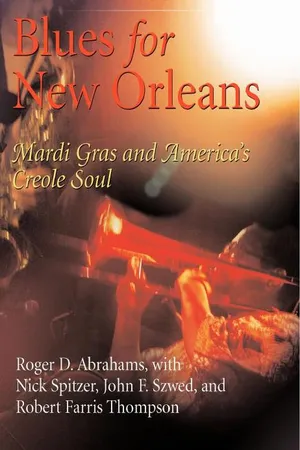
Blues for New Orleans
Mardi Gras and America's Creole Soul
- 112 pages
- English
- ePUB (mobile friendly)
- Available on iOS & Android
eBook - ePub
Blues for New Orleans
Mardi Gras and America's Creole Soul
About this book
Information
Publisher
University of Pennsylvania PressYear
2010Print ISBN
9780812239591
9780812239591
eBook ISBN
9780812201000
Carnival Along the Gulf Coast
Although smaller in scale and less widely known than the New Orleans Carnival, Mardi Gras in Mobile has been celebrated in various ways since the beginning of the nineteenth century. The Cowbellions were formed in the 1830s and later began ordering their costumes from Paris, but during the Civil War Mobile's public Mardi Gras was called off. In 1866, it was revived by a veteran named Joe Cain, who dressed that year as a mock Chickasaw Indian chief called “Slacabamorinico” and drove through the then-occupied city in a decorated wagon. On the Sunday before Carnival, Joe Cain is now commemorated with a jazz funeral procession. Various other Mobile krewes such as the Comic Cowboys and the Infant Mystics also date to the nineteenth century. The Order of Myths, the oldest krewe (1867), was modeled after the early Cowbellions. The symbol of the Order of Myths, the last krewe to parade on Mardi Gras, is Folly chasing Death around a broken neoclassical column and flailing him with a golden pig bladder. Though this imagery is officially interpreted as a symbol of mirth's triumph over gloom, some suggest that the broken column originally alluded to the broken dreams of the Confederacy.
Black Mardi Gras in Mobile provides some counterpoint to all the above. Costumes and sometimes papier-mâché figures worn or made by African Americans or Afro-Creoles often draw on male and female figures who are ragged but elegant. The female “Molly” figure looks part courtesan, part high society lady, with a wistful look of lost elegance in sometimes torn and out of style clothes. Her male counterpart may wear a wrinkled stovepipe hat, fancy but wornout shoes, tattered vest, and patched dress pants. The couple is sometimes seen at the Joe Cain parade and other white marches and also as part of a separate black Mardi Gras parade that runs the gamut from black Masons riding in antique cars to fully realized images of Molly and her gent in papier-mâché. Mobile also has a small contingent of black brass bands hired to accompany all parades. The favored bands also play at the black Carnival ball, where the primary event is a series of counterclockwise mass walk-abouts to the brass band music, with maskers juking their umbrellas in a way that both celebrates and mocks high society.
The large official float parades in the Mardi Gras celebrations of both Mobile and New Orleans primarily represent Mediterranean and Caribbean traditions. The Mardi Gras Indians, plus newly revived walking groups of “Baby Dolls” (women who dress as little girls and “fancy” prostitutes) and “Skeletons” (men in black with white bones on their clothing and large papier-mâché skulls), along with the Zulu parade, suggest African and Afro-Caribbean influences mingled with European sources.

The Cajun and black Creole courirs de Mardi Gras of rural southwest Louisiana are linked to the expression of country French traditions brought by Acadians of Nova Scotia who came to Louisiana in the latter part of the eighteenth century. In a manner not unlike Christmas mumming in Europe and the Virgin and Leeward Islands, a band of masked male revelers goes from house to house on the open prairie land of southwest Louisiana. The men, on horses or flatbed trucks, dress as clowns, thieves, women, and devils. Some wear the traditional pointed capuchon hats with bells and streamers. The group is led by a capitaine who may wear an elegant silk costume in the Cajun bands (or simple work clothes in some black Creole Mardi Gras bands). The Mardi Gras bands come as quasi-vigilantes in search of charité (charity) in the form of live chickens, rice, spices, cooling grease, sausages, and other ingredients for a gumbo supper.
The capitaine, standing apart from the group as a keeper of the law, tries to prevent the men from becoming too disorderly or drunk and make certain that they carry out their agreed-upon rounds for the day. At each farmstead visited, the capitaine or a flagman arrives ahead of the band to see if the household will receive the Mardi Gras. There is usually an affirmative response to the courtly request “Voulez-vous recevoir cette band des Mardi Gras?” (“Will you receive the Mardi Gras band?”), whereupon the clowns are waved on to charge the house on horseback. Men in costume pursue elusive chickens through the muddy rice fields of early spring, leaping fences and crossing pig sties. After a chicken is caught, it is killed and put with other spoils in a sack, which is sent back to the village, where the cooking begins at midday. As the Mardi Gras runners depart a house, they sing a word of thanks and invite the householders to the dance and communal supper to be held in town or at a rural club late in the night.
The Mardi Gras song is significant because it is sung in a minor mode, and is reminiscent of medieval French folk music, generally not found in Cajun music today. Sung in French and usually performed by musicians who ride in a sound truck, it also contains a description of the Mardi Gras band's activities. Translated into English, the song is as follows:
The Mardi Gras Song
The Mardi Gras riders come from everywhere
All around, around the hub.
They pass once a year
To ask for charity
Even if it's a potato.
A potato and some cracklins.
The Mardi Gras riders are on a long voyage
All around, around the hub.
They pass once a year
To ask for charity
Even if it's a skinny chicken
And three or four corn cobs.
Captain, captain, wave your flag.
Let's go to the other neighbor's place
To ask for charity.
You all come meet us.
You all come meet us.
Yes, at the gumbo tonight.
By the end of the afternoon the band heads back toward “the hub,” or starting point, in rice- and soybean-growing and cattle-raising towns like Mamou, Church Point, L'Anse Maigre, and Swords. The horseback riders may enter at a gallop. Those who are still sober enough entertain waiting crowds with stunts and various acts of bravado. The gumbo from the day's catch is served to the riders and the general public followed by a large dance ending at midnight and the beginning of the Lenten season.
The parallel black Creole Mardi Gras bands are often located near the Cajun towns in tiny rural settlements established in the nineteenth century by gens de couleur libres (free people of color), manumitted slaves, and other people of color. The black Creole Mardi Gras celebrations are usually smaller, involving ten to twenty men, more intimate and more traditional than today's Cajun courirs. The cowboy style of Cajun Mardi Gras has not taken hold in the black Creole community. For example, the black bands take great care not to trample house gardens or urinate in public while pursuing the fowl. Elders are helped down from their flatbed trucks by younger men, and the bands present themselves more as polite beggars than as vigilantes. The older men especially take great stock in such details and are critical of young ones who do not behave or sing properly. The black Creole Mardi Gras song is similar to that of the Cajuns, but is often performed in a call-response manner (revealing possible Afro-Caribbean influences commingled with Catholic chanting styles).
The usual response line to the leader's song is “Ouais mon/bon cher camarade” (“Yes my/good dear friend”).
The question of how the Cajun and black Creole courirs interrelate has been controversial on occasion. From the Creole point of view, the Cajun bands are unruly and lacking in politesse (politeness). The majoritarian style of the Cajuns is further regarded with suspicion and sometimes fear by Creoles out with their band of revelers as they encounter the Cajun groups. In part this is because Cajuns often hold positions of power over Creoles, tending to be sheriffs, landowners, bosses, store operators, and so on. The Cajun Mardi Gras may also evoke images of the nineteenth-century prairie vigilante and night-rider. Creoles, for their part, occasionally dress as whiteface clowns and “Klu-klucks,” and so parody the history of violence and dominance on the prairie.
The center of some local community and scholarly interpretive controversy has been the blackface figure in many (but not all) Cajun Mardi Gras called the negresse—a grotesque black female impersonator, usually with padded breasts, perhaps a “pregnant look,” and such features as a tight dress, a rolling pin as weapon, and hair curlers. The negresse, taken mostly from archaic “ugly man” travesties found throughout North America, is portrayed variously as apelike, aggressive, comic, unreasonable, sexually powerful, wily, and dumb. Anger or at least concern sometimes arises about the negresse figure. Some Cajun community leaders and local scholars have defended the figure as simply part of the tradition with no offense intended. However this defense has not been without controversy. At least one visiting parish priest has criticized the image to his congregation—only to find many of them in revolt, not inconsistent with Cajun anti-clericalism regardless of the issue.
Some Cajuns have pointed out that black Creole Mardi Gras groups are portraying the white stereotyped figure of the klansman; however, the Klan and related local variations did exist in rural French Louisiana, while the negresse is a wholly created stereotypical figure that addresses race and gender in a carnival setting. The controversy has been further enflamed on occasions when black outsiders less familiar with the rural French Louisiana rules of association have sought to attend Cajun Mardi Gras as riders or tourists on the band's hay wagons. A definitive, broadly acceptable treatment of the meaning of the negresse figure in Cajun Mardi Gras still seems unattainable to town folk and local scholars.
While old traditions and Carnival assemblies continue, new Mardi Gras groups, events, and locales continue to emerge to meet new social concerns and issues. And they continue to bend, twist, and toy with a variety of cultural heritages. In New Orleans, gay krewes and their French Quarter costume contests have become highly visible. The Krewe de Vieux in New Orleans and the Spanishtown Mardi Gras in Baton Rouge have sometimes become avant-garde satires, on Carnival itself and on Louisiana topics such as politics and pollution. In Uptown New Orleans, new groups of professionals with somewhat more progressive politics have formed the popular Krewe d'Etat, which mocks political figures in Louisiana and nationally. They make certain to call humorous attention to scandals and the bad behavior of public figures—elected or not. A women's krewe called Muses—of woman professionals and the next generation of middle and upper middle class—has surrounded itself with satirical symbols, including a red high heel as a float and an official medallion that at once mocks and embraces overly feminine style. Muses has made a move to a Doodah Parade-like sub-krewes that make fun of the black and white high school twirlers, flag corps, and cheerleaders.
During the 1980s, more clubs began to be formed for the sole purpose of “parading” and not the “social aid” aspect. A new wrinkle had been born in the culture. These clubs' purpose was not to render aid for burial, but to be the social affiliation fabric, the bonding agent, as it were, of their members. Clubs of the new era began to drop “aide” from their names and missions and were now strictly for the pleasure of the members. Therefore the tax category under which they operated also changed. Because they no longer rendered aid or benefit to themselves or others, they were now legally considered “Fraternal Orders, Brother and Sisterhoods,” and bound a different set of codes.
Starting in the late 1990s, another page was turned in the Main Line culture, when Kings and Queens started to appear on the parade routes with the groups. Most are from other clubs or older members who are honored by the club, but some clubs have taken to honoring the city's most influential and famous. Another aspect of the modern Main Line is the arrival of floats, whereas a few years ago there were none to be found in most parades. Whereas in years past, a Main Line may have only covered a block or two, it could now stretch for several blocks. These African American clubs cannot by ordinance parade or celebrate two weeks prior to or on Mardi Gras Day, and most do not heavily advertise beforehand that they will be marching. Instead, they spread the word in their neighborhoods and disseminate route sheets. Some may sport custom handkerchiefs, while others opt for just plain white ones. It is up to each club how elaborate it wants to be.
Each club has its membership stop at set bars along the “parade route.” This is not in order to drink alcohol, but rather to rest, drink some water, and take a restroom break if needed. More important, it brings patrons into the bars to allow the owner to take advantage of the opportunity to make a little profit from the Line. It is a holdover from the days long ago when the bars actually sponsored each and every float in the Tramp parade, which later was called the Zulu parade. Dixieland jazz or brass bands frequently join in the roving celebrations
Suburban Mardi Gras celebrations have become strong in recent decades. Children are included and excessive drunkenness or sexual suggestiveness is largely excluded. In the rural courir there is an increasing focus on using the event to teach young children—boys and girls—Cajun or Creole “heritage” rather than engaging in the trickery and drunken revelry of the all-male bands. Adjacent Anglo-American regions have also started Mardi Gras celebrations. Monroe, Louisiana., for example, held its first parade in 1985, and local fundamentalist preachers denounced the celebration as “devil worship.”
Many wonder what shape Mardi Gras will take in 2006 throughout the Gulf Coast. The country Mardi Gras, except perhaps in the far southwest Louisiana parishes, should be unaffected. But one Mardi Gras Indian tribe has announced it will parade in Austin, Texas, where several members now live. Others are adamant that they will use the occasion to return to the city and express a revival of community life in New Orleans. Among the larger float parade-based krewes and in Mobile, an underlying assumption is that many will parade, though not in the size and scale of the past. Surely Katrina will be satirized as villainess, bimbo, or symbol of mythological flood. Political leaders at all levels will be taken to task. Mardi Gras will doubtless be a powerful if conflicted expression of the region's return to some kind of vitality and ability to express itself to itself and the world in the annual festive occasion of chaos and order in all its temporal and spatial variations.
As the new Mardi Gras evolves, it is appropriate to explore other elements of its cultural tradition, especially the terrain, location, and economic history of New Orleans.
The world seems to agree: New Orleans is not really an American city. It is a Creole city. Its language, foods, ways of dancing, and songs are all unashamedly filled with a French flair, a Latin tinge, and an African Caribbean sense of body and soul. We see this most fully in the various musics and dances that emerged from Greater Caribbean entrepôts—ports with highly mobile populations already mobilized through the vagaries of the transatlantic experience. Such ports of call served as a magnet not only for slavers and their human cargoes sold at the docks, but for the vagrants of the sea who labored as sailors, often against their own will. These were tropical gatherings of fugitives and outsiders living sufficiently beyond the control of metropolitan authorities to set up, in makeshift fashion, informal marketplaces. The plantation agricultural enterprises inland were capable of producing large amounts of surplus crops of sugar, tobacco, coffee, cocoa, rice, and other grains in which informal marketplaces would be opened in lands in between. It is not American in another dimension. It is an outpost of Caribbean culture that just happens to be on the mainland. New Orleans is an international port of call that has accumulated, along with the goods and services that are offered in such places, a wide range of peoples, most of whom not only have learned to live with each other as part of the Big Easy mystique, but have created a welcome for those visitors willing to take the city on its own terms.
Its language is born not of the place but of the plural population. That is, its culture is, on its face, the result of the coming together of many people in an environment that doesn't seem permanent. Not only are there many people and languages there, but the mix has created a great number of stylistic developments that, while clearly born there, are easily exported.
Yet, for all its international flair, it is a city anchored in its own terrain, as we have been reminded since hurricanes Katrina and Rita. It was a terrain of cultural interaction and creolization at every level, and this was seen dynamically in the rise, spread, and removal of markets in New Orleans. These markets simultaneously were built by creolization and complicated it in numerous ways. They were grounds for cultural inventiveness and locations for many marginalized peoples to take center stage.
Everything that makes New Orleans different seems to be centered on Congo Square, a market square that, like others throughout the Caribbean, is an exhibit of how to turn the most important orders of civil society into seeming disorder. For here the slaves seem to have become free, the low to have risen without putting the plantocrats on alert, and the place of everyday exchange to have been transformed, at least for the day, into a showplace of vivid consumption. And there, too, were the women who dressed up for this party, using the brightest and showiest techniques for them to show out.
Townsfolk would gather on Sunday afternoons to witness what went on inside the square. In 1819, Benjamin Latrobe—an architect fresh from restoring the Capitol after the War of 1812 and then in New Orleans to build the water works—wrote about these celebrations in his journal. He was amazed at the sight of five or six hundred unsupervised slaves who had assembled to dance. He described them as ornamented with a number of tails of the smaller wild beasts, with fringes, ribbons, little bells, and shells and balls jingling about the performers' legs and arms. The women, one onlooker reported, according to their means, clothed themselves with the newest fashions in silk, gauze, muslin, and percale dresses. The men garbed themselves in oriental and Indian dress and or covered themselves only with a sash of the same sort wrapped around the body.
Another witness pointed out that several clusters of onlookers, musicians, and dancers represented tribal groupings, with each nation taking its place in a different part of the square. In addition to drums, gourds, banjo-like instruments, and quillpipes made from reeds strung together like panpipes, marimbas and European instruments like the violin, tambourines, and triangles were used.
Just how unique this marketplace was is difficult to ascertain. One glimpse from Philadelphia of a time earlier than Latrobe's description of the goings-on in Congo Square indicates how widespread these gatherings may have been. John Watson, in his Annals of Philadelphia, records a conversation with a woman describing earlier days in that city, and in one of the major squares:
It was the custom for the slave blacks, at the time of fairs and other great holidays, to go there to the number of one thousand, of both sexes, and hold their dances, dancing after the manner of their several nations in Africa and speaking and singing in the their native dialects, thus cheerily amusing themselves over the sleeping dust below. An aged lady, Mrs. H. S., has told me she had often seen the Guinea negroes, in the days of her youth, going to the graves of their friends early in the morning, and there leaving the victuals and rum. (Watson Annals, 1: 406)
Yet it is Congo Square, and not Washington Square or any other place north of Baton Rouge, that ...
Table of contents
- Cover Page
- Title Page
- Copyright Page
- Contents
- Introduction
- Strange Mergers and Deep Mixture Making
- The Spanish Tinge, Second-Line, and the Black Atlantic Origins of Jazz
- A Festival of Liberation, Protest, Affirmation, and Celebration
- Carnival Knowledge: Mardi Gras in and Beyond New Orleans
- Carnival along the Gulf Coast
- Conclusion: Mardi Gras Will Never Die
Trusted by 375,005 students
Access to over 1.5 million titles for a fair monthly price.
Study more efficiently using our study tools.
Frequently asked questions
Yes, you can cancel anytime from the Subscription tab in your account settings on the Perlego website. Your subscription will stay active until the end of your current billing period. Learn how to cancel your subscription
No, books cannot be downloaded as external files, such as PDFs, for use outside of Perlego. However, you can download books within the Perlego app for offline reading on mobile or tablet. Learn how to download books offline
Perlego offers two plans: Essential and Complete
- Essential is ideal for learners and professionals who enjoy exploring a wide range of subjects. Access the Essential Library with 800,000+ trusted titles and best-sellers across business, personal growth, and the humanities. Includes unlimited reading time and Standard Read Aloud voice.
- Complete: Perfect for advanced learners and researchers needing full, unrestricted access. Unlock 1.5M+ books across hundreds of subjects, including academic and specialized titles. The Complete Plan also includes advanced features like Premium Read Aloud and Research Assistant.
We are an online textbook subscription service, where you can get access to an entire online library for less than the price of a single book per month. With over 1.5 million books across 990+ topics, we’ve got you covered! Learn about our mission
Look out for the read-aloud symbol on your next book to see if you can listen to it. The read-aloud tool reads text aloud for you, highlighting the text as it is being read. You can pause it, speed it up and slow it down. Learn more about Read Aloud
Yes! You can use the Perlego app on both iOS and Android devices to read anytime, anywhere — even offline. Perfect for commutes or when you’re on the go.
Please note we cannot support devices running on iOS 13 and Android 7 or earlier. Learn more about using the app
Please note we cannot support devices running on iOS 13 and Android 7 or earlier. Learn more about using the app
Yes, you can access Blues for New Orleans by Roger Abrahams,Nick Spitzer,John F. Szwed,Robert Farris Thompson in PDF and/or ePUB format, as well as other popular books in Social Sciences & Cultural & Social Anthropology. We have over 1.5 million books available in our catalogue for you to explore.