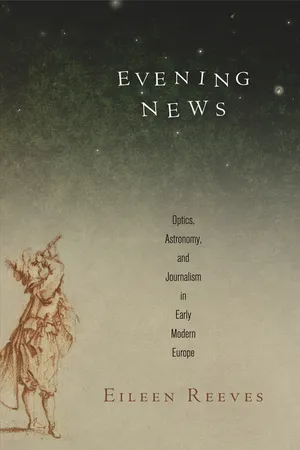
Eileen Reeves examines a web of connections between journalism, optics, and astronomy in early modern Europe, devoting particular attention to the ways in which a long-standing association of reportage with covert surveillance and astrological prediction was altered by the near simultaneous emergence of weekly newsheets, the invention of the Dutch telescope, and the appearance of Galileo Galilei's astronomical treatise, The Starry Messenger.
Early modern news writers and consumers often understood journalistic texts in terms of recent developments in optics and astronomy, Reeves demonstrates, even as many of the first discussions of telescopic phenomena such as planetary satellites, lunar craters, sunspots, and comets were conditioned by accounts of current events. She charts how the deployment of particular technologies of vision—the telescope and the camera obscura—were adapted to comply with evolving notions of objectivity, censorship, and civic awareness. Detailing the differences between various types of printed and manuscript news and the importance of regional, national, and religious distinctions, Evening News emphasizes the ways in which information moved between high and low genres and across geographical and confessional boundaries in the first decades of the seventeenth century.
- 320 pages
- English
- ePUB (mobile friendly)
- Available on iOS & Android
eBook - ePub
About this book
Information
Publisher
University of Pennsylvania PressYear
2014Print ISBN
9780812245745
9780812245745
eBook ISBN
9780812209488
CHAPTER 1

Jesuits on the Moon
Though his astronomical activity generated so much news, Galileo manifested little overt interest in current events. The correspondence of some of his closest friends, particularly Paolo Sarpi, Daniello Antonini, Gianfrancesco Sagredo, and Paolo Gualdo, by contrast, offers a varied budget of news ranging from international events, Venetian politics, and the endless skirmishes within clerical, university, and literary circles. Whether Galileo’s apparent silence is an index of circumspection or indifference is difficult to gauge, and it would be in any case unwise to assume that what remains to us of his correspondence is representative, especially in an era where news enjoyed oral as well as printed and manuscript circulation.1
An important exception to this seeming distance from current events, and one that survived the transition from private letter to published treatise, was Galileo’s curious comparison of an oversized lunar crater, generally identified as Albategnius, with Bohemia.2 The association first arose in his letter of January 7, 1610, best known not for its lengthy synopsis of his telescopic observations of the moon, but rather for its casual reference to phenomena newly encountered only that evening, the moons of Jupiter.3 Scholars then and now have rightly been more concerned with this latter and wholly unexpected discovery, for the detection of those satellites was an unrivaled novelty, unlike the observations of the moon’s rough surface and secondary light, or of the numberless new stars in particular constellations and in the Milky Way, or even of the eventual phases of Venus or the sunspots, all of which had been either seen or hypothesized prior to the invention of the telescope.
In terms of the popular imagination, however, the impact of telescopic observation of the moon was without parallel. A traditional symbol of the Church, its new depiction as an opaque and rugged sphere was startling, and was significantly complicated by the fact that Christendom itself was then such a fractious entity. To describe a large and centrally located crater as an “enormous round amphitheater,” and compare it to Bohemia, as Galileo did in his letter of January 7, 1610, and a few months later in the Starry Messenger, was to name the epicenter of confessional tension, and the eventual theater of war. As anticipated by most onlookers, the conflict that would become the Thirty Years’ War began in Bohemia.4
Galileo’s passing gesture to current events found considerable amplification in Johannes Kepler’s Discussion with the Starry Messenger in May 1610. That Kepler elaborated remarks of religious and political relevance is not surprising: he was living the complicated life of the Protestant imperial astronomer at the Catholic court in Rudolphine Prague; he had long been attracted to the notion of presenting a “moon state,” a commentary combining sociopolitical considerations with discussion of the physical features of our satellite; and while he inevitably came to privilege the latter alternative over the former in his posthumously published Somnium, it is clear that he could not always resist certain allusions to terrestrial rather than lunar situations. His references to satirical models such as Lucian of Samosata’s descriptions of imaginary voyages to the moon—narratives poised midway between sheer fancy and rigorous technical detail, and full of precise observations about the distant earth—in the context of the Discussion with the Starry Messenger confirms that he was ready to use the lunar globe as a vantage point for judging its terrestrial neighbor.5
There is much to suggest that Kepler intended to convey in certain details of his treatise a commentary on contemporary affairs, especially those involving confessional conflict. Such details are not, however, so substantive that they either articulate a full-fledged meditation on Bohemia’s crisis or displace the primary focus of the Discussion, an evaluation of Galileo’s telescopic arguments; it is rather that the insistence on current events in and near Prague complements the astronomical news borne by the Starry Messenger, one part of which had clearly involved the “enormous round amphitheater” of Bohemia. Given that Kepler was uncharacteristically restrained about religious matters, what he offered by way of commentary on confessional issues cannot necessarily be ascribed to him, but rather to a nebulous vox populi and to the news pamphlets that seemingly contributed to and reflected such views.
Apart from an outburst about the excesses of the Counter-Reformation in a letter of June 1607, Kepler’s criticisms of Catholic policy are few and mild.6 When writing in April 1607 to his former teacher, Michael Maestlin, who admired neither the Jesuit astronomer Christoph Clavius nor the Society of Jesus, he referred wryly to that priest’s description of Tübingen as “the city of the heretics in Germany,”7 and he received several letters from Protestant friends outside Bohemia inquiring darkly about his safety and his confessional liberties.8 “My most beloved Lord Kepler,” began Lutheran pastor and astronomer David Fabricius in fall 1608 before launching into one of his lengthy missives,
because of your long and unusual silence, I believe you have either died or left [Prague] on account of the Bohemian uprisings, which you may have ominously attracted through your endless Archimedean speculations about the martial planet; as the saying goes, “Imagination creates the event.” If you’re dead, this letter is my final farewell; if you’re living, it’s a warning. Break your silence, and whatever is bothering you, spit it out.9
Kepler does not appear to have followed Fabricius’s bidding in this or in many other matters, replying mildly that “the causes of my silence are the idleness of age. You’re an astrologer; you should have seen my sun besieged by Saturn, so I ought to say nothing of public problems.”10 When he described himself as one who lived “like a private individual on the world’s stage,” and who “served not Caesar, but all men and posterity,” in a letter of 1605 to Maestlin, the point seems to have been to diminish his mentor’s envy over his appointment as imperial astronomer, but it also suggests the kind of self-effacement and separation from his particular historical circumstances upon which Kepler insisted in most matters concerning his religious liberties.11 In an age obsessed with questions of the appropriation of roles and the proper degree of display—one where Sarpi implied that he, his Jesuit enemies, the emperor Rudolph, and all Italians went about in their various disguises, and where, more trivially, the imperial ambassador to Venice believed that the suggestion that certain elements of the Starry Messenger were not new somehow “snatched the mask” from Galileo’s face—Kepler claimed under certain circumstances to have no real part to play.12 As I will argue below, however, this silence becomes in certain passages of the Discussion with the Starry Messenger a kind of ventriloquism, for what one hears is the raucous vox populi associated with the press. To adopt the humble terms of David Fabricius’s proposal, Kepler’s solution was not to “spit out whatever was bothering him,” but rather to speak more covertly “from the gut,” in the voice of another, that provided by tabloid journalism.
Kepler made clear, both in the extraordinary rapidity of his response to Galileo and in the breathless tone of the work itself, that he took seriously the Italian astronomer’s presentation of his observations as news, and imagined his answer to fit within this genre. His posture is in some way at odds with the reactions of other readers, who tended to note in Galileo’s claims to primacy the clear echo of efforts already made by others; Kepler, for his part, appeared content to point out, when possible, those instances in which Galileo’s telescopic observations confirmed what he himself had offered as conjecture years before.13 But this is not to say that the Starry Messenger seemed to Kepler definitive in its disclosures; indeed, part of its newsworthy aspect lay in the new debates to which it gave rise. These coming struggles, Kepler suggested in an astonishing passage in his “Address to the Reader,” would surely be ardent, but strictly philosophical in tenor:
I imagine, for intellectual pleasure, a quarrel between adversaries, then struggles, the victor’s triumph, the awful threats and torment of the vanquished party, his shame, chains, imprisonment, and exile, all of which promise a certain seriousness: both are fighting for their views as if “for altar and hearth.”14 And it is hardly necessary to remind academics what it means “to defend one’s position”—and others in any event can imagine it—for when one does this, he adopts as his own not just true and received opinions, but even absurd and false notions, and indeed, within academia, impious, pernicious, and blasphemous views.15
Though presented in parodic fashion, and as a sketch of the absurdities that characterized the academic debate, the sort of exchange Kepler described was a crucial one, and its excesses of some consequence. First of all, a letter Kepler had written in 1598 to Maestlin suggests that he viewed the tactic of defending all manner of nonsense—some version of those “absurd and false notions”—as a Jesuit specialty, albeit one which others were free to adopt, and which he chose studiously to avoid.16 As the phrase pro aris et focis, “for altar and hearth,” conveys, the focus of these quarrels often shifted from matters of no confessional import to questions of worship and of private property, the loss of one’s home or the dramatic decrease in its value being a means frequently used by Catholic authorities to punish or persuade recalcitrant Protestants.17 At the same time, the Catholic renewal in the Habsburg lands in the mid-sixteenth century had seen the transfer of large amounts of ecclesiastical properties lost during the Reformation, formerly held by neighborhood committees or entirely without maintenance or ownership, back into the hands of the Church, where it was available for resale, lease, or commercial development; it is no accident that during the Prague Uprising of February 1611, the most vicious attacks were reserved for the altars, hearths, and personnel of two cloisters that had been renewed in just this fashion.18
The fact that ambiguities in Emperor Rudolph II’s Letter of Majesty of 1609 had further facilitated the transfer of crown lands to Catholic prelates, were vigorously protested, and eventually led to the Defenestration of Prague would leave little doubt about the importance and inevitability of defending one’s position in matters of altar and hearth. Predictably, the period immediately after the Battle of White Mountain in November 1620 was characterized by a certain imperial clemency regarding the “life and honor” of the defeated Protestant faction, but also by a massive confiscation of their property.19 It is worth noting that Kepler’s odd conflation of academic quarrels with confessional differences and with the eventual loss of property was emblematized by an actual Jesuit with whom he had frequent correspondence, the mathematician Johannes Reinhard Ziegler. It was Ziegler who had edited one of Father Christoph Clavius’s several responses to Joseph Scaliger’s attack on the Gregorian calendar in 1609, who was overseeing the edition of Clavius’s opus in 1611–1612, and who by the mid-1620s would become the originator and a prime force behind the movement for an even larger restoration of all property acquired by the Protestants since 1555.20
It is also clear that Kepler saw a connection between inflammatory academic rhetoric, confessional antagonisms, and the loss of property, as that had been his experience in the Styrian city of Graz.21 He had complained, in fact, in a private letter of 1607 that the perilous position of non-Catholic subjects in Styria, where he lived from 1594 until he and his fellow non-Catholics were expelled in 1600, had been exacerbated because there was no one to show “the young people in the universities the manner and way to behave in such places without offending one’s conscience and with the necessary ‘cleverness of serpents’ so that rulers who are of a different faith may not be disquieted.”22 The statement itself may be either laden with serpentine cleverness or overburdened with the mildness of doves, for Kepler does not mention that the Styrian ruler of a different faith who was so disquieted by his non-Catholic subjects, Archduke Ferdinand II, was strongly influenced by his own Jesuit education in Ingolstadt, and especially by his subsequent contact with members of the society at the college in Graz.23
Kepler’s preoccupations about the role of education in fomenting civil unrest were if anything greater in Prague.24 From 1599 to 1600, and again from 1603 to 1612, his close friend Martin Bachazek served as rector of Charles University, a difficult position that another of the astronomer’s associates, Johannes Jessenius, would occupy from 1617 until his execution in 1621.25 The rivalry between Charles University, or the Carolinum, and the Jesuit college at Prague, the Clementinum, was pronounced; Catholics associated the former institution, particularly under Jessenius, with sedition, a ch...
Table of contents
- Cover
- Half title
- Title
- Copyright
- Contents
- Introduction
- Chapter 1. Jesuits on the Moon
- Chapter 2. Medici Stars and the Medici Regency
- Chapter 3. Galileo Gazzettante
- Chapter 4. Cameras That Don’t Lie
- Chapter 5. Cameras That Do
- Chapter 6. Rapid Transport
- Conclusion
- Notes
- Bibliography
- Index
- Acknowledgments
Trusted by 375,005 students
Access to over 1.5 million titles for a fair monthly price.
Study more efficiently using our study tools.
Frequently asked questions
Yes, you can cancel anytime from the Subscription tab in your account settings on the Perlego website. Your subscription will stay active until the end of your current billing period. Learn how to cancel your subscription
No, books cannot be downloaded as external files, such as PDFs, for use outside of Perlego. However, you can download books within the Perlego app for offline reading on mobile or tablet. Learn how to download books offline
Perlego offers two plans: Essential and Complete
- Essential is ideal for learners and professionals who enjoy exploring a wide range of subjects. Access the Essential Library with 800,000+ trusted titles and best-sellers across business, personal growth, and the humanities. Includes unlimited reading time and Standard Read Aloud voice.
- Complete: Perfect for advanced learners and researchers needing full, unrestricted access. Unlock 1.5M+ books across hundreds of subjects, including academic and specialized titles. The Complete Plan also includes advanced features like Premium Read Aloud and Research Assistant.
We are an online textbook subscription service, where you can get access to an entire online library for less than the price of a single book per month. With over 1.5 million books across 990+ topics, we’ve got you covered! Learn about our mission
Look out for the read-aloud symbol on your next book to see if you can listen to it. The read-aloud tool reads text aloud for you, highlighting the text as it is being read. You can pause it, speed it up and slow it down. Learn more about Read Aloud
Yes! You can use the Perlego app on both iOS and Android devices to read anytime, anywhere — even offline. Perfect for commutes or when you’re on the go.
Please note we cannot support devices running on iOS 13 and Android 7 or earlier. Learn more about using the app
Please note we cannot support devices running on iOS 13 and Android 7 or earlier. Learn more about using the app
Yes, you can access Evening News by Eileen Reeves in PDF and/or ePUB format, as well as other popular books in History & European History. We have over 1.5 million books available in our catalogue for you to explore.