While the American founders fully expected parties to form in a free society, they were far less certain that opposing parties would peacefully transfer power from one to another. Party formation presented a confounding problem for the new republic: party rivalries could not be prevented, but they might, nonetheless, catalyze civil disorder or fracture the union of the states. The status of political parties has come a long way in American society and politics, however, and today American democracy is inconceivable without them.
How did party competition become a regular and "normal" feature of the American political landscape? Why did American political leaders, who viewed such rivalry as a harbinger of the new republic's destruction, come to terms with party opposition? Embracing Dissent tells this story of political transformation, making the case that the status of party gained ground as the notion that party competition might instigate class violence, secession, or civil war, receded. From the American founding and the appearance of the Jacksonian Democratic party, to Lincoln's management of party politics during the Civil War, Jeffrey S. Selinger presents a careful reconsideration of American political development.
Embracing Dissent also provides historical perspective on today's polarized political condition. Too often, pundits exaggerate the significance of partisan differences and minimize the depth of political consensus that permeates American politics. Political observers casually use expressions like "party conflict," forgetting, as the famed political scientist Giovanni Sartori noted, that public consensus on fundamental legal and constitutional norms makes party competition "something less than conflict, as we endlessly if often too late rediscover whenever we are confronted with the reality of a people shooting at each other." Embracing Dissent reminds readers of the long history of Americans "shooting at each other" and describes the political events that disarmed them.
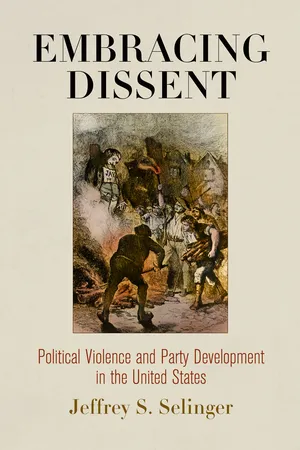
eBook - PDF
Embracing Dissent
Political Violence and Party Development in the United States
- 263 pages
- English
- PDF
- Available on iOS & Android
eBook - PDF
About this book
Information
Publisher
University of Pennsylvania PressYear
2016Print ISBN
9780812247978
9780812247978
eBook ISBN
9780812292589
Table of contents
- Cover
- Contents
- Chapter 1. Legitimate Party Opposition and the Early American State
- Chapter 2. Economic Collapse and the Constitutional Construction of Party Politics
- Chapter 3. The French Revolutionary Wars and the Ordeal of America’s First Party System
- Chapter 4. The Second Party System and the Politics of Displacing Conflict
- Chapter 5. Union, Emancipation, and Party Building as Military Strategy
- Chapter 6. Redrawing the Limits of Legitimate Party Opposition: Party Politics and Its Discontents at the Turn of the Twentieth Century
- Epilogue. Party Legitimacy, Then and Now
- Notes
- Index
- Acknowledgments
Trusted by 375,005 students
Access to over 1.5 million titles for a fair monthly price.
Study more efficiently using our study tools.
Frequently asked questions
Yes, you can cancel anytime from the Subscription tab in your account settings on the Perlego website. Your subscription will stay active until the end of your current billing period. Learn how to cancel your subscription
No, books cannot be downloaded as external files, such as PDFs, for use outside of Perlego. However, you can download books within the Perlego app for offline reading on mobile or tablet. Learn how to download books offline
Perlego offers two plans: Essential and Complete
- Essential is ideal for learners and professionals who enjoy exploring a wide range of subjects. Access the Essential Library with 800,000+ trusted titles and best-sellers across business, personal growth, and the humanities. Includes unlimited reading time and Standard Read Aloud voice.
- Complete: Perfect for advanced learners and researchers needing full, unrestricted access. Unlock 1.5M+ books across hundreds of subjects, including academic and specialized titles. The Complete Plan also includes advanced features like Premium Read Aloud and Research Assistant.
We are an online textbook subscription service, where you can get access to an entire online library for less than the price of a single book per month. With over 1.5 million books across 990+ topics, we’ve got you covered! Learn about our mission
Look out for the read-aloud symbol on your next book to see if you can listen to it. The read-aloud tool reads text aloud for you, highlighting the text as it is being read. You can pause it, speed it up and slow it down. Learn more about Read Aloud
Yes! You can use the Perlego app on both iOS and Android devices to read anytime, anywhere — even offline. Perfect for commutes or when you’re on the go.
Please note we cannot support devices running on iOS 13 and Android 7 or earlier. Learn more about using the app
Please note we cannot support devices running on iOS 13 and Android 7 or earlier. Learn more about using the app
Yes, you can access Embracing Dissent by Jeffrey S. Selinger in PDF and/or ePUB format, as well as other popular books in Politics & International Relations & Political Parties. We have over 1.5 million books available in our catalogue for you to explore.