World War I constituted a milestone in the development of the United States as a world power. As the European powers exhausted themselves during the conflict, the U.S. government deployed its growing economic leverage, its military might, and its diplomacy to shape the outcome of the war and to influence the future of international relations.
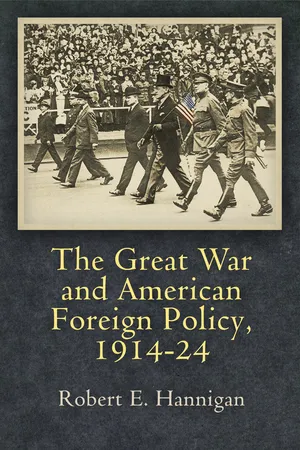
In The Great War and American Foreign Policy, 1914-1924, Robert E. Hannigan challenges the conventional belief that the United States entered World War I only because its hand was forced, and he disputes the claim that Washington was subsequently driven by a desire to make the world "safe for democracy." Democratic President Woodrow Wilson's rhetoric emphasized peace, self-determination, and international cooperation. But his foreign policy, Hannigan claims, is better understood if analyzed against the backdrop of American policy—not only toward Europe, but also toward East Asia and the rest of the western hemisphere—as it had been developing since the turn of the twentieth century. On the broadest level, Wilson sought to shore up and stabilize an international order promoted and presided over by London since the early 1800s, this in the conviction that under such conditions the United States would inevitably ascend to a global position comparable to, if not eclipsing, that of Great Britain. Hannigan argues, moreover, that these fundamental objectives continued to guide Wilson's Republican successors in their efforts to stabilize the postwar world.
The book reexamines the years when the United States was ostensibly neutral (1914-17), the subsequent period of American military involvement (1917-18), the Paris Peace Conference of 1919, the ensuing battle for ratification of the Treaty of Versailles (in 1919-20), and the activities of Wilson's successors—culminating with the Dawes Plan of 1924.
- 368 pages
- English
- ePUB (mobile friendly)
- Available on iOS & Android
eBook - ePub
The Great War and American Foreign Policy, 1914-24
About this book
Information
Publisher
University of Pennsylvania PressYear
2016Print ISBN
9780812248593
9780812248593
eBook ISBN
9780812293289
PART I
Background (1890s–1914)
[Americans are] part of one great English-speaking family whose proud destiny it is to lead and control the world.
—Former Secretary of State Richard Olney, 1897
I think the twentieth century will still be the century of the men who speak English.
—Vice President Theodore Roosevelt, 1901
If the existence of the British Empire should be called in question there is no knowing what constellation might then make its appearance among the powers.
—Secretary of State John Hay, c. 1900
[Should Britain suffer a serious disaster] in five years it will mean a war between us and some one of the great continental European nations, unless we are content to abandon the Monroe Doctrine for South America.
—New York Governor Theodore Roosevelt, 1900
The Anglo-Saxon people have undertaken to reconstruct the affairs of the world, and it would be a shame upon them to withdraw their hand.
—President of Princeton University, Woodrow Wilson, 1904
It is confidently expected that the initiative of the United States will lead to the early establishment at The Hague of a permanent court of arbitration. Such an eventuality will be the realization of one of the aspirations of all the centuries. The ideal is as old as the Roman altar of peace.
—Secretary of State Philander C. Knox, 1910
CHAPTER 1
The United States Steps Out
Washington had a definite world policy in 1914, the year the Great War broke out in Europe. Understanding what it was is critical for grasping the nature of the U.S. response to that conflict. While the members of the Wilson administration, which had come to power in early 1913, had certainly brought with them their own particular ideas and emphases, they operated broadly within a set of fundamental tenets most of whose origins dated back to the end of the nineteenth century. This chapter provides a summary overview of this all-important background.
Foreign policy activism was not something new for the republic at the turn of the century. Indeed, Massachusetts senator Henry Cabot Lodge was on fairly safe ground when he asserted in 1895 that the United States had “a record of conquest, colonization, and territorial expansion unequalled by any people of the nineteenth century.”1 But earlier activity had been focused overwhelmingly on the acquisition, occupation, and development of the most valuable portions of North America. What was different, starting in the late nineteenth century, was that a growing number of influential political, military, and business figures, taking stock of the U.S. rapid industrial expansion and growing might, were now focused outward on the world beyond that continent.2
In many ways the model was England, this particularly insofar as prominent Americans, following the lead of the naval strategist Alfred Thayer Mahan, were now coming to think of their home continent as a kind of gigantic analog of the British Isles. America here was reconceptualized as a kind of oversized island whose future destiny was to be shaped by its ability to expand its economic activity and project its influence out across the surrounding seas. In widely read books and articles, Mahan, the celebrator of sea power of the sort that Britain historically had practiced, encouraged the American national elite to pursue what he called its future “wealth and greatness” via comparable naval and maritime means.3
The way this subsequently was pursued owed yet more to the British example. In the broadest terms, influential U.S. political, business, and military leaders had, by the end of the nineteenth century, come strongly to identify with key elements of an international order that had taken shape over the course of the previous fifty to one hundred years, largely under the aegis of the policy and power of Britain, “the first industrial nation.” They were convinced that if essential elements of that international order—as they saw it, that natural international order—could be sustained, America would in the coming century ascend to a rightful global position of leadership, responsibility, and influence comparable to, if not exceeding, that of its “mother country.”
As was the case with the other large industrial and industrializing powers at this time (including England), which it saw as its rivals, the policy of the United States was driven by the idea that America’s future depended on its standing in the broader world.4 In turn, this was seen to depend on the success with which it could assert its leadership and expand its economic activity in less industrial regions in competition with those other powers. (Such extensive activity had of course become possible only over the course of the nineteenth century because the industrial revolution had given rise to new forms of power, especially military power, and to new methods of transport, communications, and protection from disease for people from northern climes who were sent to undertake tasks in other parts of the globe.)5
At this point, American leaders looked in particular to the rest of the Americas and to China as lands that were valuable and in which they had a strong chance to fare well, this partly because of what they felt were geographic advantages they had relative to their European (British and continental) rivals in accessing those areas. The United States also had a greater domestic resource base than any of the other industrial states and growing supplies of capital. Its manufacturing output was in the 1890s already exceeding that of England. So long as this growing economic competitiveness, stemming from these factors, could be brought to bear, U.S. leaders felt every reason to be optimistic that American trade and influence would ultimately come to dominate in both regions.6
Yet, there was the rub. The future that American leaders envisioned for other lands was not necessarily that desired by the leaders of other, rival states (or by the people who lived in those lands themselves). If the earlier expansion of the United States across North America had led many Europeans (starting at least as early as Alexis de Tocqueville) to sit up and take notice, turn-of-the-century American leaders took alarm at the rapid European partition of Africa in the 1880s and 1890s. To them it was axiomatic that the whole world would benefit by American leadership in the twentieth century. But if such dividing up of the less industrialized world continued elsewhere, the prospect of that would be diminished.
American leaders wanted to discourage that trend in general. But they were especially anxious to prevent any interference with the expansion of American activity in the Americas and in China. To avoid that they sought to shore up and make permanent the existing political boundaries and open door (equal access) commercial framework in both regions. To a large degree, those arrangements had been set up and upheld by London during the nineteenth century. They dated back to Britain’s efforts (in the post-Napoleonic era) to undermine the control over South America exercised by Spain and Portugal and (in the era of the Opium War and after) to break the Qing Empire’s resistance to the involvement of others in China. Now they were to become the hallmark of Washington’s two most fundamental turn-of-the-century foreign policies, known in shorthand as the Monroe Doctrine and the “open door policy.”
These aspirations carried obvious implications for U.S. policy toward its neighbors in North America. If Washington was going to enter into rivalry with the other major powers of the world, it seemed increasingly important that its strategic priorities also become those of the Dominion of Canada to the north and the (after 1910) increasingly nationalistic Republic of Mexico to the south. The former was largely achieved as a consequence of a major confrontation (with both Ottawa and London) over the boundary between Alaska and British Columbia in 1903. As shall be seen, Mexican-American relations were, by contrast, to be in considerable turmoil throughout the period of the Great War. For both Canada and Mexico, relations with Washington were also impacted by the latter’s desire to see their food and raw materials become an extension of the resource base of the United States.
Of especial pertinence to this story, America’s extracontinental aspirations ultimately seemed also to require greater attention to affairs in Europe. The possibility of war there, among intensely rivalrous, increasingly globally oriented major powers, many of whom shared common boundaries, seemed to American leaders to be something they should not ignore. Not only might such conflict jeopardize a very important trade, mostly in farm products, that the United States continued to conduct with that continent. It also might bring about rearrangements of power that could affect adversely a broader international order that American leaders wished to maintain. As noted, throughout the early to mid-nineteenth century the U.S. posture had repeatedly been that of a state testing existing boundaries and challenging the status quo. Perhaps ironically, as the United States emerged as a rising power on the world stage, it did so in important ways as a defender of the status quo.
American leaders were particularly anxious that Britain’s predominant influence in the eastern hemisphere not be overturned (this by contrast with the western hemisphere where they were eager to see Britain’s role reduced). Washington saw itself as a rival of London. At the same time, it believed that Britain’s posture and key policies were often aligned with those the United States desired. Such policies included relatively equal trade access for all nations to British markets. “[T]hrough what agency,” former Secretary of State Richard Olney asked an audience at Harvard rhetorically in 1898, “are we so likely to gain new outlets for our products as through that of a Power whose possessions girdle the earth and in whose ports equal privileges and facilities of trade are accorded to the flags of all nations?” (For this among other reasons, Olney described Americans as “part of one great English-speaking family whose proud destiny it is to lead and control the world.”) They included as well London’s avowed support for existing political boundaries and for the open door policy in China and South America.7
U.S. leaders did not want to face a situation where the power of Britain and its fleet in the eastern hemisphere was eclipsed by that of one or more rivals who might be less attached to a global order seen to work to America’s advantage. Anxious to head off the turmoil and possible rearrangements of power that might accompany a European war, Washington, beginning at the turn of the century, gradually began to promote better relations with England and, when called for, to bolster that power’s position in the eastern hemisphere. Simultaneously, American leaders sought, often in conjunction with their British counterparts, to promote reforms in the conduct of international affairs, particularly mechanisms for the settlement of disagreements that would diminish the prospects for wars and upheavals.
In the late nineteenth and early twentieth centuries, U.S. leaders commonly explained their overseas activities and ambitions, both to themselves and to anyone else who would listen, by recourse to social evolutionary thought.8 Variants of such thought had become popular in both Europe and America in the wake of the rise to prominence of theories of evolution in the field of biology in the nineteenth century. At bottom they involved the misapplication of those scientific ideas to society.
Such thought initially gained currency in the United States as much for reasons of domestic as foreign policy. In a society that was coming increasingly to be marked by inequality during the Gilded Age and after, social evolutionary ideas became especially popular among those who wished to defend from criticism what they saw as the fundamental fairness of the way the social and economic system was organized. In this telling, huge disparities of wealth and power in America were principally to be explained by the fact that the country was filling up with more and more people who were not of old-stock, Protestant, Northwestern European background. Such latter folk were the ones who largely controlled wealth and power in America, it was maintained, because they had evolved further than other people beyond the nasty, brutish creatures that all humans originally had been. Above all they were endowed with a superior character, specifically a self-mastery, that fitted them for accomplishments and responsibilities that others were incapable of. (In this view, the idea that “all men are created equal” was simply seen as quaint and naive.)
Such conceits, dressed up as science, were easily transferred to the global scene. Seemingly without exception, every American policy maker in the late nineteenth and early twentieth centuries accepted a social evolutionary view that presented the world as a place composed of an enormous array of differently endowed “races,” each of which, it was held, occupied a specific evolutionary position somewhere back down the “path of progress” behind the elements who led the United States. In this view, America was the seat of the most mature and civilized men in the world. It was axiomatic that they had an obligation to exercise leadership and, most importantly, prevent “irresponsible” or “selfish” people, who lacked their self-controlled wisdom, from interfering with the world as it should be.
Strikingly, U.S. policy makers found one of the biggest threats to such international custodianship to actually be the American people. For— “irresponsibly” or perhaps “selfishly”—sizable numbers of them often voiced objections to the overseas activities American statesmen wanted U.S. resources to be used for. Indeed, these views were often articulated in Congress. Many Americans felt that the new activities inappropriately broke with tradition. A still quite widely shared sentiment, dating back to the early republic, held in suspicion a large military establishment, an executive branch with wide latitude in foreign affairs, or any other of what were seen as the trappings associated with empire. These were considered counter to the ideals the country had been founded on and were seen as a potential threat to citizens’ liberties.
Large numbers of Americans were particularly opposed to any “entanglement” by the United States in European affairs. Political or military involvement in Europe, or alliances with European powers, was held to be contrary to sage advice that Washington had given in his Farewell Address. More to the point, such activity was thought dangerous. It could draw the United States into costly conflicts among the seemingly always quarreling Old World powers.
Still others incorporated foreign policy into a critique of corporate power that was widely held in turn-of-the-century America. Many argued that the new “trusts” were coming to exercise a dangerous degree of power over the economy and the political system of the country. A move toward a more active overseas policy, they thought, represented an effort by those same business and financial entities to get the nation to promote and protect their economic interests abroad. Such criticism was voiced in Congress by numerous southern Democrats and, after 1909, by insurgent midwestern Republicans.9
Proponents of a more active overseas policy sought to counter such opposition in a variety of...
Table of contents
- Cover
- Half title
- Title
- Copyright
- Dedication
- Contents
- Preface
- Part I. Background (1890s–1914)
- Part II. American “Neutrality” (1914–17)
- Part III. Military Intervention (1917–18)
- Part IV. The Paris Settlement (1919–20)
- Part V. The Republicans Try Their Hands (1921–24)
- Notes
- Index
- Acknowledgments
Trusted by 375,005 students
Access to over 1.5 million titles for a fair monthly price.
Study more efficiently using our study tools.
Frequently asked questions
Yes, you can cancel anytime from the Subscription tab in your account settings on the Perlego website. Your subscription will stay active until the end of your current billing period. Learn how to cancel your subscription
No, books cannot be downloaded as external files, such as PDFs, for use outside of Perlego. However, you can download books within the Perlego app for offline reading on mobile or tablet. Learn how to download books offline
Perlego offers two plans: Essential and Complete
- Essential is ideal for learners and professionals who enjoy exploring a wide range of subjects. Access the Essential Library with 800,000+ trusted titles and best-sellers across business, personal growth, and the humanities. Includes unlimited reading time and Standard Read Aloud voice.
- Complete: Perfect for advanced learners and researchers needing full, unrestricted access. Unlock 1.5M+ books across hundreds of subjects, including academic and specialized titles. The Complete Plan also includes advanced features like Premium Read Aloud and Research Assistant.
We are an online textbook subscription service, where you can get access to an entire online library for less than the price of a single book per month. With over 1.5 million books across 990+ topics, we’ve got you covered! Learn about our mission
Look out for the read-aloud symbol on your next book to see if you can listen to it. The read-aloud tool reads text aloud for you, highlighting the text as it is being read. You can pause it, speed it up and slow it down. Learn more about Read Aloud
Yes! You can use the Perlego app on both iOS and Android devices to read anytime, anywhere — even offline. Perfect for commutes or when you’re on the go.
Please note we cannot support devices running on iOS 13 and Android 7 or earlier. Learn more about using the app
Please note we cannot support devices running on iOS 13 and Android 7 or earlier. Learn more about using the app
Yes, you can access The Great War and American Foreign Policy, 1914-24 by Robert E. Hannigan in PDF and/or ePUB format, as well as other popular books in History & North American History. We have over 1.5 million books available in our catalogue for you to explore.