Education is useless because it destroys our common sense, because it isolates us from the rest of humanity, because it hardens our hearts and swells our heads. Bookish persons have long been subjects of suspicion and contempt and nowhere more so, perhaps, than in the United States during the past twenty years.
Critics of education point to the Nazism of Martin Heidegger, for example, to assert the inhumanity of highly learned people; they contend that an oppressive form of identity politics has taken over the academy and complain that the art world has been overrun by culturally privileged elitists. There are always, it seems, far more reasons to disparage the ivory tower than to honor it. The uselessness of education, particularly in the humanities, is a pervasive theme in Western cultural history.
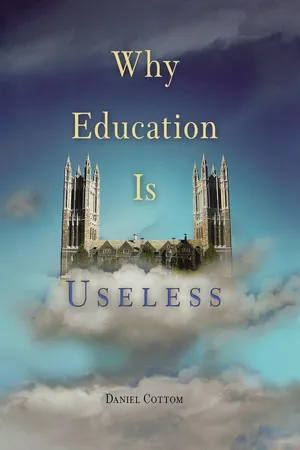
With wit and precision, Why Education Is Useless engages those who attack learning by focusing on topics such as the nature of humanity, love, beauty, and identity as well as academic scandals, identity politics, multiculturalism, and the corporatization of academe. Asserting that hostility toward education cannot be dismissed as the reaction of barbarians, fools, and nihilists, Daniel Cottom brings a fresh perspective to all these topics while still making the debates about them comprehensible to those who are not academic insiders.
A brilliant and provocative work of cultural argument and analysis, Why Education Is Useless brings in materials from literature, philosophy, art, film, and other fields and proceeds from the assumption that hostility to education is an extremely complex phenomenon, both historically and in contemporary American life. According to Cottom, we must understand the perdurable appeal of this antagonism if we are to have any chance of recognizing its manifestations—and countering them.
Ranging in reference from Montaigne to George Bush, from Sappho to Timothy McVeigh, Why Education Is Useless is a lively investigation of a notion that has persisted from antiquity through the Renaissance and into the modern era, when the debate over the relative advantages of a liberal and a useful education first arose. Facing head on the conception of utility articulated in the nineteenth century by John Stuart Mill, and directly opposing the hostile conceptions of inutility that have been popularized in recent decades by such ideologues as Allan Bloom, Harold Bloom, and John Ellis, Cottom contends that education must indeed be "useless" if it is to be worthy of its name.
- 256 pages
- English
- ePUB (mobile friendly)
- Available on iOS & Android
eBook - ePub
Why Education Is Useless
About this book
Information
Publisher
University of Pennsylvania PressYear
2013Print ISBN
9780812237207
9780812237207
eBook ISBN
9780812201680
Topic
EducationSubtopic
Education GeneralCHAPTER ONE
Humanity
A SHORT AND EASY WAY WITH EDUCATORS
Having led Hillsdale College since 1971, George P. Roche, III resigned his presidency in 1999. He did so in the wake of allegations by his daughter-in-law that he had carried on a sexual relationship with her for the past nineteen years. It did not help matters that after making her allegations she had committed suicide.
Hillsdale is an institution beloved of conservatives such as the writer and television personality William F. Buckley, Jr., former Secretary of Education William Bennett, Supreme Court Justice Clarence Thomas, and George Will, the columnist and erstwhile lapdog to Nancy Reagan. It is known for its commitment to the principles of free enterprise and limited government and for its corresponding antipathy to doctrines such as multiculturalism and postmodernism, which are said to have corrupted many other campuses. As its website advertises, Hillsdale offers a “traditional liberal arts” curriculum. Whatever the truth of this presidential affair, then—Roche was not talking, at least in public—the allegations were bound to be a huge embarrassment to an institution that had so earnestly professed the purity of its ideals. Given Hillsdale’s trumpeted support of “Judeo-Christian values,” this event might remind one of the spectacular meltdowns in the previous two decades of religious figures such as Jim Bakker, Jimmy Swaggart, and Billy James Hargis, which were also occasioned by accusations of sordid sexual improprieties. Alternatively, one might compare it to the events that led to Representative Newt Gingrich’s divorce and to Representative Bob Livingston’s resignation from his position as Speaker of the House, in which case it would figure as yet another ironic sideshow to the right-wing attacks that led to the impeachment of that sorry excuse for a liberal, William Jefferson Clinton.
Times being what they are and the United States what it is, media coverage of the Roche affair was very different from what was accorded to the two great academic scandals of the previous decade. The headlines in these cases resulted from renewed attention to the Nazism of Martin Heidegger, the eminent German philosopher, and from the discovery that an influential Yale professor of comparative literature and literary theory, Paul de Man, had also been tainted by Nazi associations. (When he was a young man first trying to establish himself in the literary world of Belgium, he had contributed articles, including at least one that was unequivocally anti-Semitic, to a collaborationist newspaper.) Mainstream periodicals such as Newsweek as well as journalists such as Jon Wiener, writing for The Nation, a left-wing cult publication to which I confess to being a subscriber, were quick to pounce on the stories of de Man and Heidegger. These stories were taken as evidence that could be used to indict all sorts of people and whole schools of philosophy and literary theory, such as the “deconstruction” closely associated with de Man’s name. In contrast, no one in the media, as far as I am aware, took the Roche affair as evidence that Judeo-Christian values must be fundamentally corrupt or that conservative economic principles inevitably lead people into sexual congress with their in-laws.1
Spitting into the wind tends to be a tiresome pastime, and my purpose here is not to bewail the methods, mentality, and ethics of the popular media in the contemporary United States. I also have no interest in rehashing the controversies that arose around these particular figures, which, in the cases of Heidegger and de Man, have already been addressed in numerous works.2 Instead I turn to a question that is more basic, at least in relation to my concerns in this book. The question is this: why would anyone be shocked to learn that a revered educator may be a horrible person?
The response that leaps to mind is that there is a story here because education is meant to make us better human beings. It must represent certain ideals, and those who profess these ideals are expected to embody them in their character and behavior. To most people the very idea of education connotes a bettering of the self distinct from any possible acquisition of skills. Beyond “mere” training and knowledge, as we might put it, education is supposed to offer students an opportunity for a qualitative enrichment of their character. It is no wonder that people should think in this way, for they have been taught to do so by sappy movies, college catalogues, and devoted teachers and parents, not to mention centuries of humanist propaganda. Trifle with this image of education and there will be hell to pay, as the professor in David Mamet’s Oleanna (1992) must learn. Accordingly, like Mamet’s fictitious prof, Roche had to be driven out of the temple of learning so that it could remain a place in which students may find role models who embody the humanizing potential of education.
The only problem with this response is that it is stupid, as we all know full well. We do not really trust educators to be better than the rest of us in any substantive way; simple observation, common sense, and democratic sensibilities all dismiss any such idealization. Nonetheless, this idea is endlessly reiterated, and its stupidity is so spectacular, pernicious, and obstinate that it threatens to render all forms of intelligence extinct. Therefore, I must address it here—and first of all by justifying my characterization of it, which my readers might otherwise take to be wildly excessive.
WHEN BAD PEOPLE HAPPEN UPON GOOD IDEAS
In a 1998 essay, “In Memoriam,” the Argentinian writer Alberto Manguel tells of a high school teacher who changed his life. He gives this teacher the pseudonym Rivadavia, and he says of his introduction to him, “The way I thought, the way I felt, the person I was in the world, and the other darker person I was all alone by myself, were for the most part born on that first afternoon in which Rivadavia read to my class.”3 Not everyone will have had conversion experiences this dramatic, but in writing this account Manguel surely knew that he could count on his readers’ understanding of such an event. Even if our lives were never transformed by a particularly wonderful teacher, we can call up treasured moments in which this or that one gave us a hint, showed us some small invaluable kindness. Or even if we have not had that sort of experience, we have dreamed that we have had it, our imaginations aided by films such as Goodbye, Mr. Chips (1939), To Sir, With Love (1967), and Dead Poets Society (1989), not to mention TV shows such as Room 222 and The Paper Chase. Despite predictions that the written word is becoming obsolete as visual culture takes over, some people today still read, of course; and these readers will also have absorbed this image of the teacher who enters one’s life with a magical power to transform the whole world and one’s self along with it. They may even have read the novels by James Hilton, E. R. Braithwaite, and Muriel Spark on which three of the aforementioned movies were based.
As Manguel also must have known, the life-changing teacher is a figure especially dear to the fantasies of people in the humanities. These people like to believe that their interests are more fundamentally a matter of love than of skills or data, which might seem to take pride of place in the sciences and the professions. Therefore, they often celebrate the power of personality in the transmission of culture. The quasi-religious notion of schools as temples of learning is another context we are all expected to bring to Manguel’s tale of the scales falling from his eyes when Rivadavia first reads to his class. Looking back, for instance, I can remember comparing notes with fellow students in graduate school about how many of us had clergymen among our ancestors. We, too, were “people of the book,” and it was easy for us to see the close relation between teaching and preaching. It only seemed fitting to us that some of the colleges and universities most laden with tradition in the United States had originally been established as religious institutions.
Manguel’s essay goes on to describe, briefly, the consequences for the students at his school of a military dictatorship that took command of his country in the 1960s. While Manguel himself went into exile, others from his school were tortured and murdered. In fact, it almost seemed as if students from his school had been especially singled out for such treatment. Manguel then tells of how he came to learn that Rivadavia was an informant for the military and evidently had been instrumental in betraying the students who were tortured and slain. He concludes,
In my mind, I have three options:
- I can decide that the person who was of the uttermost importance in my life, who in a way allowed me to be what I am now, who was the very essence of the illuminating and inspiring teacher, was in fact a monster and that everything he taught me, everything he had encouraged me to love, was corrupt.
- I can try to justify his unjustifiable actions and ignore the fact that they led to the torture and death of my friends.
- I can accept that Rivadavia was both the good teacher and the collaborator of torturers and allow that description to stand, like water and fire.4
Just as Manguel’s conception of Rivadavia is left suspended in uncertainty—“I don’t know which one of these options is the right one,” he says5—so, too, does this essay leave him torn between historical particularity and allegorical universality. To this double duty bound, Manguel learns that suffering is an experience that is peculiarly private and yet implicitly and imperatively general. If I feel pain and you refuse to acknowledge its existence, you seem inhuman, for you have treated me as if I were inhuman insofar as my pain is irrelevant to you.6 The historical fact of private suffering demands recognition through an allegorical structure of universal application. On the one hand, then, we see the private side of this story in Manguel’s relationship with Rivadavia, for Rivadavia’s actions would figure very differently in his thoughts if it had not been for the extraordinary impact he had on Manguel as an individual at a particular time in his life. Yet Manguel also writes of Rivadavia, first and foremost, as a teacher, and of himself as a student, with literature as the bond between them, and through these roles the private suffering is released toward allegorical significance. Rivadavia’s actions would not have carried the same significance if he had been an Alcoholics Anonymous counselor, for instance, and Manguel a souse whose life he had turned around.
Manguel presents this as a true story, and I have no reason to doubt that it is such. At the same time it is powerfully and, one must assume, intentionally reminiscent of Franz Kafka’s parables, such as “Before the Law” (1919), which in fact is referred to in the essay as the first work to which Rivadavia introduced him. Kafka’s parable about the baffling contradictions in the image of law is reenacted, to dreadful effect, in Rivadavia’s actions, but his actions are not simply the stuff of a parable: they led to real suffering and death. On the other hand, the suffering and death are not merely historical, for if they were there would be no story. In that case they would have become meaningless, anonymous, as so many of the crimes of that era have been disappeared despite the efforts of various activists, memoirists, historians, and truth commissions. (For a homely example of how this process works, consider the bemusing fact that a most respectable creator and upholder of laws, Margaret Thatcher, saw no contradiction in proclaiming her personal friendship and political support for Augusto Pinochet, the former Chilean dictator, torturer, and murderer, when a Spanish judge indicted him for his crimes against humanity.) Manguel’s essay tells of split identities, ambivalent feelings, and generic paradoxes as it evokes the unthinkability of acts committed by monsters who are supposed to be not only human beings but cultured human beings, persons of the very best kind. Education cannot resolve these complexities, for education is implicated within them, as Lady Thatcher, that proud reformer of Britain’s universities, so beautifully has demonstrated. Education, it seems, is useless—is at best useless. Quite possibly, it is all a horribly destructive lie.
Manguel’s essay is also torn between history and allegory by the broader contexts of Western literary, cultural, and social traditions, which furnish us with a record of experiences that we are bound to compare with his. Among these, in the second half of the twentieth century, perhaps none has figured more largely in the public imagination than the Holocaust. Theodor Adorno, the Frankfurt School philosopher, suggested that “it is no longer possible to write poems” after Auschwitz, and Primo Levi said that “if for no other reason than that an Auschwitz existed, no one in our age should speak of Providence.”7 Similarly, others have wondered whether this event did not exterminate, along with its millions of victims, the image of humanistic learning as the source of betterment in character.
This is the question, for instance, of Thomas Mann’s Doctor Faustus (1947). In this novel the Second World War appears conclusively to indicate what the aftermath of World War I had already suggested, that “an epoch was coming to an end, an epoch that embraced not just the nineteenth century, but also reached back to the end of the Middle Ages, to the shattering of scholastic ties, to the emancipation of the individual and the birth of freedom... in short, the epoch of bourgeois humanism.” At first the narrator, a classicist, does seem to cling to the humanist credo—“In my opinion, the only help comes from literature, the humanistic sciences, the ideal of the free and beautiful human being”-but this opinion proves impossible to maintain.8 In the allegorical correspondence between Hitler’s war and the Faustian life of the musical genius Adrian Leverkühn, whose fictional biography this is, we are made witness to the hopelessness of this sort of humanistic faith. Adorno analyzed the extent to which humanistic thought might be “in the nature of the musical accompaniment with which the SS liked to drown out the screams of its victims”; similarly, Manns cultured narrator must come to recoil before his own faith, his own love, his own symbol of life-changing inspiration.9 As Omer Bartov has put it, the question is how “we as educators and scholars confront the fact that education and knowledge have been shown, in the Germany of 1933–45, to be anything but morally elevating” and, indeed, to have been “easily transformed into ready tools in the service of evil.”10 Presumably, it is for this reason that Jean-François Lyotard began and ended his book on the distress of thinking, Heidegger and “the jews” (1990), with references to Kafka’s “Before the Law,” arguing therein that “the denial of this distress, cloaked by a withdrawal to humanist values, will change nothing.”11
Another who has seemed compelled to focus on the implications of the Holocaust for our conceptions of education, art, and life is George Steiner, a polymathic scholar of comparative literature who might himself be taken to symbolize the tradition of humanistic learning. Writing of both Nazism and Stalinism in the preface to Language and Silence (1967), but with particular attention to the former, he made reference to the condescension of cultured Europeans toward so-called primitive peoples. In doing so, he insisted that the heart of darkness now had to be seen in the very hearth, fire, and inspiration of Western civilization: “The blackness of it did not spring up in the Gobi Desert or the rain forests of the Amazon. It was from within, and from the core of European civilization. The cry of the murdered sounded in earshot of the universities; the sadism went on a street away from the theaters and museums.” He added, “It is not only the case that the established media of civilization—the universities, the arts, the book world—failed to offer adequate resistance to political bestiality; they often rose to welcome it and to give it ceremony and apologia.” In the essays in the first half of this book, he repeatedly returned to this issue. At one point, having dwelt on the uselessness of literary study as any kind of defense against the worst sort of barbarism, he even paused to wonder whether it might not be a positive evil. In other words, having concluded that the humanities do not make us better people, he wondered whether they might actually make us worse: “There is some evidence that a trained, persistent commitment to the life of the printed word, a capacity to identify deeply and critically with imaginary personages or sentiments, diminishes the immediacy, the hard edge of actual circumstances.” In that essay, at least, he concluded that literary study is not of “only marginal significance” and that it does not “detract from more urgent and responsible uses of time and energy of spirit”; but this opinion was presented as just that, an opinion, and one that could not hope to put an end to the discussion. The question of literary study, he bluntly insisted, “must be asked and explored without cant.”12
To Steiner’s meditations on this point could be added those of many others, such as Victor Klemperer, who was a professor of Romance languages and literature at the Dresden Technical University from the 1920s to the early 1930s, when his Jewish origins led to his dismissal. His wartime diaries testify to his growing disillusionment not only with German culture (“how unbelievably I have deceived myself my whole life long, when I imagined myself to belong to Germany”) but also...
Table of contents
- Cover
- Title
- Copyright
- Dedication
- Contents
- Introduction: Why Education Is Useless
- Chapter One: Humanity
- Chapter Two: Love
- Chapter Three: Beauty
- Chapter Four: Identity
- Chapter Five: Survival
- Chapter Six: Utility
- Notes
- Index
- Acknowledgments
Trusted by 375,005 students
Access to over 1.5 million titles for a fair monthly price.
Study more efficiently using our study tools.
Frequently asked questions
Yes, you can cancel anytime from the Subscription tab in your account settings on the Perlego website. Your subscription will stay active until the end of your current billing period. Learn how to cancel your subscription
No, books cannot be downloaded as external files, such as PDFs, for use outside of Perlego. However, you can download books within the Perlego app for offline reading on mobile or tablet. Learn how to download books offline
Perlego offers two plans: Essential and Complete
- Essential is ideal for learners and professionals who enjoy exploring a wide range of subjects. Access the Essential Library with 800,000+ trusted titles and best-sellers across business, personal growth, and the humanities. Includes unlimited reading time and Standard Read Aloud voice.
- Complete: Perfect for advanced learners and researchers needing full, unrestricted access. Unlock 1.5M+ books across hundreds of subjects, including academic and specialized titles. The Complete Plan also includes advanced features like Premium Read Aloud and Research Assistant.
We are an online textbook subscription service, where you can get access to an entire online library for less than the price of a single book per month. With over 1.5 million books across 990+ topics, we’ve got you covered! Learn about our mission
Look out for the read-aloud symbol on your next book to see if you can listen to it. The read-aloud tool reads text aloud for you, highlighting the text as it is being read. You can pause it, speed it up and slow it down. Learn more about Read Aloud
Yes! You can use the Perlego app on both iOS and Android devices to read anytime, anywhere — even offline. Perfect for commutes or when you’re on the go.
Please note we cannot support devices running on iOS 13 and Android 7 or earlier. Learn more about using the app
Please note we cannot support devices running on iOS 13 and Android 7 or earlier. Learn more about using the app
Yes, you can access Why Education Is Useless by Daniel Cottom in PDF and/or ePUB format, as well as other popular books in Education & Education General. We have over 1.5 million books available in our catalogue for you to explore.