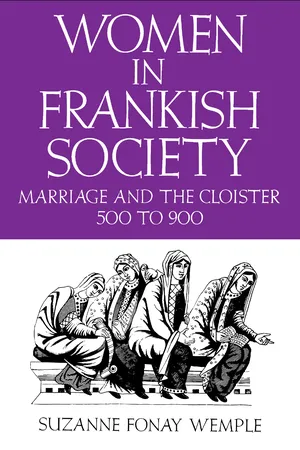
Women in Frankish Society is a careful and thorough study of women and their roles in the Merovingian and Carolingian periods of the Middle Ages. During the 5th through 9th centuries, Frankish society transformed from a relatively primitive tribal structure to a more complex hierarchical organization. Suzanne Fonay Wemple sets out to understand the forces at work in expanding and limiting women's sphere of activity and influence during this time. Her goal is to explain the gap between the ideals and laws on one hand and the social reality on the other. What effect did the administrative structures and social stratification in Merovingian society have on equality between the sexes? Did the emergence of the nuclear family and enforcement of monogamy in the Carolingian era enhance or erode the power and status of women?
Wemple examines a wealth of primary sources, such deeds, testaments, formulae, genealogy, ecclesiastical and secular court records, letters, treatises, and poems in order to reveal the enduring German, Roman, and Christian cultural legacies in the Carolingian Empire. She attends to women in secular life and matters of law, economy, marriage, and inheritance, as well as chronicling the changes to women's experiences in religious life, from the waning influence of women in the Frankish church to the rise of female asceticism and monasticism.
- 368 pages
- English
- ePUB (mobile friendly)
- Available on iOS & Android
eBook - ePub
About this book
Information
PART ONE
Women in Secular Life
“We see women of noble birth and richly endowed becoming indigent because of a lack of self-restraint, ending their lives as beggars. We also hear of many being killed because of fornication. On the other hand, we see others of less noble birth rising from poverty to wealth because of their intelligence and self-restraint.”
Christian of Corbie (PL 106, 1414)
1
The Triple Heritage of Merovingian Women
The Merovingian era was a period of rapid social change. The structure of society in the Frankish Kingdom, established by Clovis in the last decades of the fifth century, differed from that of both the moribund Roman Empire and the old Germanic tribes. Clovis had recognized the value of the Roman social and economic system at the same time that he had accepted his wife’s suggestion to convert to Catholic Christianity, and hence, in governing his kingdom, he could rely on support from both the Gallo-Roman senatorial aristocracy and the Catholic church. Frankish customs, however, were so different from Roman and Christian ones that, despite Clovis’s intention to conform to the Roman way of life, radical transformations took place in all aspects of life. Under Clovis’s successors the Roman institutions were gradually obliterated while the assimilation of Roman and Germanic peoples and customs continued. By 751, when the Merovingian era came to an end with the removal of the last member of Clovis’s dynasty, a new society with its own distinct legal conventions and economic systems had evolved.
Women played an important role in the creation of this new society although they seldom had access to the sources of public power. By marrying across ethnic lines and converting their husbands to Christianity, then bearing children and transmitting to them a mixed cultural heritage, they were instrumental in bringing about the demographic and cultural amalgamation of the people living in the Merovingian kingdom.
Intermarriage took place first between the leading families of the Gallo-Romans, residing mainly south of the Loire, and of the Franks, settled by Clovis in the depopulated areas of Gaul north of the Loire or living in the Rhineland around Cologne and spreading as far north of the Rhine as the river Somme. Eventually all the subject people intermarried, including the Visigoths, who remained in Aquitaine, the Burgundians, who were conquered and annexed in 534, and the Alemans, Thuringians, and Bavarians, who retained a semblance of autonomy while subject to Frankish domination during the sixth century.
The status of Merovingian women in their families of birth and in their husbands’ families was thus governed by a complex set of customs originating in the markedly different Germanic and Roman social systems. Even if a woman married within the same ethnic group, her relationship to her husband was influenced by practices followed in other parts of the Frankish Kingdom. This chapter will analyze the conflicting legal, social, and religious traditions shaping the lives of Merovingian women and defining the spheres of their action and the extent of their influence. It will examine the situation of women first in the Germanic tribes and then in the late Roman Empire. Finally, it will outline the most essential aspects of Christian teachings on the role of women and the relationship between the sexes.
GERMANIC TRIBES
They are almost unique among barbarians in being satisfied with one wife each. The exceptions, which are exceedingly rare, are of men who receive offers of many wives because of their rank. . . . The dowry is brought by husband to wife, not by wife to husband. Parents and kinsmen attend and approve of the gifts, gifts not chosen to please a woman’s whim or gaily deck a young bride, but oxen, horse with reins, shield, spear and sword. For such gifts a man gets his wife, and she in turn brings some present of arms to her husband. . . . She is coming to share a man’s toils and danger.1
These observations by Tacitus provide the earliest glimpse of the relationship between the sexes in the warring Germanic tribes. Because the social structure of the Germanic people before their appearance in the Roman Empire is hidden in the darkness of their own illiteracy, the historian must rely on the chance testimony of Roman authors to supplement the mute archaeological evidence.
Both Caesar and Tacitus testified that the most cohesive bond of the Germanic tribes was kinship. The clans or kindred composing the tribes provided the basic security for their members; revenge for an injury and retribution for a crime were considered the responsibility of the entire kin. “The larger a man’s kin and the greater number of his relations by marriage,” Tacitus noted in Germania, “the stronger is his influence when he is old.” The close ties between a mother’s son and a mother’s brother, which according to Tacitus were regarded by some as sacred, suggest that at one time Germanic clans may have been matrilineal.2 By the end of the first century, however, the Germanic kindred included both the agnates of male descent and the cognates of female descent, and the rules of inheritance favored the males among the agnates. If a man had no children, first in the line of succession came his brothers and then his uncles, first on his father’s and then on his mother’s side.3
Women were valued in this society because they not only provided a network of kinship ties as wives and mothers but also gave inspirational support and were nurturers and providers. Tacitus praised the wives of the barbarians for accompanying their husbands to the battlefield, tending to the wounds of their men, and bringing food and encouragement to them.4 Two and a half centuries later, Ammianus Marcellinus maintained that Germanic wives took an active part in the fighting itself.5 Tacitus also testified that the Germans “believe that there resides in women an element of holiness and prophecy, and so they do not scorn to ask their advice or lightly disregard their replies.”6 This special regard, however, must have been limited to a few prophetesses, for women were excluded from the assemblies.
More essential was the contribution of women to the care of hearth, fields, and children. Disdained by able-bodied men, the heavy work was relegated to women, according to Tacitus. Only old men and weaklings assisted in cultivating the fields.7 Citing archaeological evidence on the introduction of the horse-drawn plow, E. A. Thompson has argued that the responsibility for tillage was transferred to men by the end of the first century.8 Even if Tacitus exaggerated the contempt Germanic men had for laboring in the fields, his comments suggest that women continued to be responsible for agricultural production. The slaves the Germans had by this time may have assisted women in the fields.9 On the other hand, German women were not relieved of household chores by slaves. Tacitus stressed that the wives of barbarians had no servants or wet nurses: they did their own housework and nursed their children at the breast.10
Tacitus, seeking to rebuke the Romans for their immorality, glorified the purity and stability of German family life. Caesar also noted the honor accorded chastity by the Germans.11 Both authors undoubtedly painted a misleading idealistic picture of German matrimonial arrangements. Tacitus clearly indicated that chastity was required only from women. In addition to his observation that there was polygyny among those of high rank, Tacitus enumerated humiliating penalties for adultery, which applied only to wives. The female corpse found by archaeologists in the peat bog at Windeby in Domland, buried naked with a blindfold over her eyes, a hide collar on her neck, and her hair shaven, lends credence to Tacitus’ description of how a cuckold husband punished his wife. “He shaves off his wife’s hair,” Tacitus wrote, “strips her in the presence of kinsmen, thrusts her from his house and flogs her through the whole village.”12 Cruel punishment was also inflicted upon the wife’s partner in crime.13
Tacitus’ remark that the dowry was brought by husbands to wives rather than by wives to husbands, as was the custom in Rome, has not escaped the attention of historians. Some have interpreted it as a misunderstanding or idealization of the nature and disposition of the Germanic brideprice, a settlement the groom had to pay to the bride’s kinsmen.14 Others have accepted Tacitus’ comment as it stands. For example, Diana Hughes has argued that Tacitus’ remark referred to the morgengabe, a gift the groom gave to the bride on the consummation of the marriage. Tacitus’ failure to mention the brideprice, according to Hughes, “may indicate that by the end of the first century the brideprice had been replaced by the husband’s gift to the bride among those tribes that lived on the fringes of the Empire.”15 An equally valid conclusion is that the brideprice had already been transformed into a dos among these tribes. Pledged or given by the groom before the marriage, the dos rather than the morgengabe was upheld in the Germanic codes as the legal form of marriage settlement. In some of the early codes the dos appeared in a transitional stage between the brideprice and the bridegift with only a part of the settlement being turned over to the bride and the rest being retained by her kin.
The matrimonial arrangements of the early Germans remain controversial because of insufficient documentation, and various scholars have proposed different theories. By comparing the laws of all Germanic people, including the Danes, Norwegians, and Swedes, and drawing evidence from their sagas, nineteenth-century German scholars distinguished three patterns of wedlock among the early Germans. Through marriage by capture (Raubehe) and marriage by purchase (Kaufehe), a woman became the chattel of her husband; in a marriage by mutual consent (Friedelehe), she remained, together with her children, under the power of her own kin. As her husband’s fridila, friend or beloved, she received from him a gift (morgengabe) after the consummation of their union. The concept of Friedelehe as a romantic match was reaffirmed in German scholarly circles by Heinrich Meyer’s study published in 1927.16
Historians writing under the National Socialist regime tried to deny that their ancestors had ever been so barbarous as to sell women. Without adducing new evidence, they maintained that the only form of Germanic marriage was Friedelehe, a union among equals inspired by love and concluded through mutual consent. In this arrangement the woman retained her free status and became the mistress of her husband’s household.17 In a carefully researched study published in 1946, Noel Senn refuted this thesis, isolating remnants of the old purchase price in the Germanic codes.18 The romantic aspects of Friedelehe were minimized by K. A. Eckhardt in 1967 when he described Friedelehe as an endogamous marriage, as opposed to Kaufehe and Raubehe, which were exogamous unions.19 More recently, in 1970, the very concept of Friedelehe as a separate form of marriage was questioned by S. Kalifa’s thesis that it constituted a marriage by capture, accomplished through the cooperation of the woman.20
It may help our understanding of Germanic marriages if, instead of concentrating on the different forms of marriage, a habit historians have acquired by comparing Germanic and Roman marriages, we examine the function of women in Germanic societies and the choices available to the familial group in determining the type of marriage for a daughter. Among the early Germans, marriage was not, as it is today, a legal relationship created by the fulfillment of prescribed procedures. Rather, it was an arrangement, accepted as a social fact, whereby a man cohabited with a woman for the purposes of copulation, procreation, and the division of labor.
In the Germanic tribes, although social gradations were not absent by the end of the first century, the division of labor was determined not by class but by sex. Men served their society as warriors; women bore and raised children, worked in the fields, and looked after the home. Apparently, by the time of Tacitus, marriages were normally patrilocal, which meant that the suitor brought a bride to his own house. Hence the marriage of a daughter was both a gain and a loss, creating a new network of kinship but also depleting the number of workers in the familial group. Although daughters could be replaced by daughters-in-law, families did not have equal numbers of marriageable daughters and sons. Valuable livestock, probably the kind Tacitus said the groom gave the bride, was used to recompense the Germanic family for the loss of a daughter’s labor.
On the other hand, if a bridegroom was a well placed man, a king or a chieftain, he probably did not have to present either a brideprice or a bridegift.21 Tacitus mentioned that wives were offered to men of high rank without any compensation, the kinship ties resulting from such a union apparently outweighing all other considerations. It is also possible to surmise from Tacitus’ remark about the occasional “sacred ties” between nephews and uncles on the mother’s side that, in exceptional cases, marriages were matrilocal. A king or a chieftain might reward one of his military companions with the hand of his daughter. In this case, although he might give the woman presents, the suitor would not provide either a brideprice or a bridegift, the couple would live with the wife’s family, and the w...
Table of contents
- Cover
- Half title
- Title
- Copyright
- Dedication
- Contents
- Acknowledgments
- Introduction
- Part One: Women in Secular Life
- Part Two: Women in Religious Life
- Conclusion
- Appendix
- Abbreviations
- Notes
- Bibliography
- Index
Trusted by 375,005 students
Access to over 1.5 million titles for a fair monthly price.
Study more efficiently using our study tools.
Frequently asked questions
Yes, you can cancel anytime from the Subscription tab in your account settings on the Perlego website. Your subscription will stay active until the end of your current billing period. Learn how to cancel your subscription
No, books cannot be downloaded as external files, such as PDFs, for use outside of Perlego. However, you can download books within the Perlego app for offline reading on mobile or tablet. Learn how to download books offline
Perlego offers two plans: Essential and Complete
- Essential is ideal for learners and professionals who enjoy exploring a wide range of subjects. Access the Essential Library with 800,000+ trusted titles and best-sellers across business, personal growth, and the humanities. Includes unlimited reading time and Standard Read Aloud voice.
- Complete: Perfect for advanced learners and researchers needing full, unrestricted access. Unlock 1.5M+ books across hundreds of subjects, including academic and specialized titles. The Complete Plan also includes advanced features like Premium Read Aloud and Research Assistant.
We are an online textbook subscription service, where you can get access to an entire online library for less than the price of a single book per month. With over 1.5 million books across 990+ topics, we’ve got you covered! Learn about our mission
Look out for the read-aloud symbol on your next book to see if you can listen to it. The read-aloud tool reads text aloud for you, highlighting the text as it is being read. You can pause it, speed it up and slow it down. Learn more about Read Aloud
Yes! You can use the Perlego app on both iOS and Android devices to read anytime, anywhere — even offline. Perfect for commutes or when you’re on the go.
Please note we cannot support devices running on iOS 13 and Android 7 or earlier. Learn more about using the app
Please note we cannot support devices running on iOS 13 and Android 7 or earlier. Learn more about using the app
Yes, you can access Women in Frankish Society by Suzanne Fonay Wemple in PDF and/or ePUB format, as well as other popular books in History & European Medieval History. We have over 1.5 million books available in our catalogue for you to explore.