From the creation of newspapers with national reach in the late nineteenth century to the lightning-fast dispatches and debates of today's Internet, the media have played an enormous role in modern American politics. Scholars of political history universally concede the importance of this relationship yet have devoted scant attention to its development during the past century. Even as mass media have largely replaced party organizations as the main vehicles through which politicians communicate with and mobilize citizens, little historical scholarship traces the institutional changes, political organizations, and media structures that underlay this momentous shift.
With Media Nation, editors Bruce J. Schulman and Julian E. Zelizer seek to bring the media back to the center of scholarship on the history of the United States since the Progressive Era. The book's revealing case studies examine key moments and questions within the evolution of the media from the early days of print news through the era of television and the Internet, including battles over press freedom in the early twentieth century, the social and cultural history of news reporters at the height of the Cold War, and the U.S. government's abandonment of the Fairness Doctrine and the consequent impact on news production, among others.
Although they cover a diverse array of subjects, the book's contributors cohere around several critical ideas, including how elites interact with media, how key policy changes shaped media, and how media institutions play an important role in shaping society's power structure. Highlighting some of the most exciting voices in media and political history, Media Nation is a field-shaping volume that offers fresh perspectives on the role of mass media in the evolution of modern American politics.
Contributors: Kathryn Cramer Brownell, David Greenberg, Julia Guarneri, Nicole Hemmer, Richard R. John, Sam Lebovic, Kevin Lerner, Kathryn J. McGarr, Matthew Pressman, Emilie Raymond, Michael Schudson, Bruce J. Schulman, Julian E. Zelizer.
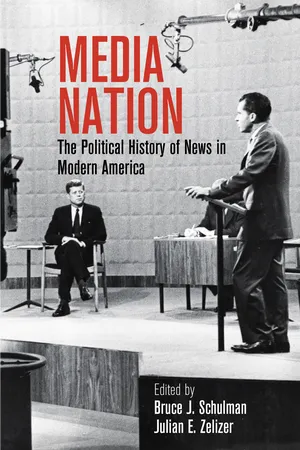
eBook - PDF
Media Nation
The Political History of News in Modern America
- 273 pages
- English
- PDF
- Available on iOS & Android
eBook - PDF
Media Nation
The Political History of News in Modern America
About this book
Information
Publisher
University of Pennsylvania PressYear
2017Print ISBN
9780812248883
9780812248883
eBook ISBN
9780812293746
Table of contents
- Cover
- Media Nation
- Title
- Copyright
- CONTENTS
- Introduction
- 1. Proprietary Interest: Merchants, Journalists, and Antimonopoly in the 1880s
- 2. Progressive Political Culture and the Widening Scope of Local Newspapers, 1880–1930
- 3. The Ominous Clang: Fears of Propaganda from World War I to World War II
- 4. When the “Mainstream Media” Was Conservative: Media Criticism in the Age of Reform
- 5. “ We’re All in This Thing Together”: Cold War Consensus in the Exclusive Social World of Washington Reporters
- 6. Objectivity and Its Discontents: The Struggle for the Soul of American Journalism in the 1960s and 1970s
- 7. “No on 14”: Hollywood Celebrities, the Civil Rights Movement, and the California Open Housing Debate
- 8. From “Faith in Facts” to “Fair and Balanced”: Conservative Media, Liberal Bias, and the Origins of Balance
- 9. Abe Rosenthal’s Project X: The Editorial Process Leading to Publication of the Pentagon Papers
- 10. “Ideological Plugola,” “Elitist Gossip,” and the Need for Cable Television
- 11. How Washington Helped Create the Contemporary Media: Ending the Fairness Doctrine in 1987
- 12. The Multiple Political Roles of American Journalism
- Notes
- List of Contributors
- Index
Trusted by 375,005 students
Access to over 1.5 million titles for a fair monthly price.
Study more efficiently using our study tools.
Frequently asked questions
Yes, you can cancel anytime from the Subscription tab in your account settings on the Perlego website. Your subscription will stay active until the end of your current billing period. Learn how to cancel your subscription
No, books cannot be downloaded as external files, such as PDFs, for use outside of Perlego. However, you can download books within the Perlego app for offline reading on mobile or tablet. Learn how to download books offline
Perlego offers two plans: Essential and Complete
- Essential is ideal for learners and professionals who enjoy exploring a wide range of subjects. Access the Essential Library with 800,000+ trusted titles and best-sellers across business, personal growth, and the humanities. Includes unlimited reading time and Standard Read Aloud voice.
- Complete: Perfect for advanced learners and researchers needing full, unrestricted access. Unlock 1.5M+ books across hundreds of subjects, including academic and specialized titles. The Complete Plan also includes advanced features like Premium Read Aloud and Research Assistant.
We are an online textbook subscription service, where you can get access to an entire online library for less than the price of a single book per month. With over 1.5 million books across 990+ topics, we’ve got you covered! Learn about our mission
Look out for the read-aloud symbol on your next book to see if you can listen to it. The read-aloud tool reads text aloud for you, highlighting the text as it is being read. You can pause it, speed it up and slow it down. Learn more about Read Aloud
Yes! You can use the Perlego app on both iOS and Android devices to read anytime, anywhere — even offline. Perfect for commutes or when you’re on the go.
Please note we cannot support devices running on iOS 13 and Android 7 or earlier. Learn more about using the app
Please note we cannot support devices running on iOS 13 and Android 7 or earlier. Learn more about using the app
Yes, you can access Media Nation by Bruce J. Schulman, Julian E. Zelizer, Bruce J. Schulman,Julian E. Zelizer in PDF and/or ePUB format, as well as other popular books in History & North American History. We have over 1.5 million books available in our catalogue for you to explore.