In the late sixteenth century, as England began to assert its integrity as a nation and English its merit as a literate tongue, vernacular writing took a turn for the eccentric. Authors such as John Lyly, Edmund Spenser, and Christopher Marlowe loudly announced their ambitions for the mother tongue—but the extremity of their stylistic innovations yielded texts that seemed hardly English at all. Critics likened Lyly's hyperembellished prose to a bejeweled "Indian," complained that Spenser had "writ no language," and mocked Marlowe's blank verse as a "Turkish" concoction of "big-sounding sentences" and "termes Italianate." In its most sophisticated literary guises, the much-vaunted common tongue suddenly appeared quite foreign.
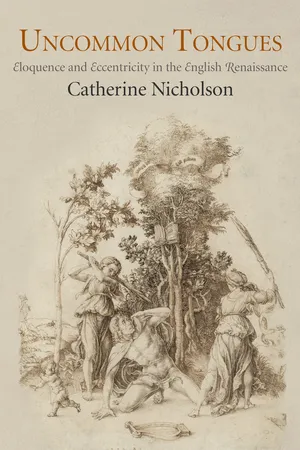
In Uncommon Tongues, Catherine Nicholson locates strangeness at the paradoxical heart of sixteenth-century vernacular culture. Torn between two rival conceptions of eloquence, savvy writers and teachers labored to reconcile their country's need for a consistent, accessible mother tongue with the expectation that poetic language depart from everyday speech. That struggle, waged by pedagogical theorists and rhetoricians as well as authors we now recognize as some of the most accomplished and significant in English literary history, produced works that made the vernacular's oddities, constraints, and defects synonymous with its virtues. Such willful eccentricity, Nicholson argues, came to be seen as both the essence and antithesis of English eloquence.
eBook - ePub
Uncommon Tongues
Eloquence and Eccentricity in the English Renaissance
- 224 pages
- English
- ePUB (mobile friendly)
- Available on iOS & Android
eBook - ePub
About this book
Information
Publisher
University of Pennsylvania PressYear
2013Print ISBN
9780812245585
9780812245585
eBook ISBN
9780812208801
Table of contents
- Cover
- Title Page
- Copyright
- Contents
- Introduction: Antisocial Orpheus
- Chapter 1. Good Space and Time: Humanist Pedagogy and the Uses of Estrangement
- Chapter 2. The Commonplace and the Far-Fetched: Mapping Eloquence in the English Art of Rhetoric
- Chapter 3. “A World to See”: Euphues’s Wayward Style
- Chapter 4. Pastoral in Exile: Colin Clout and the Poetics of English Alienation
- Chapter 5. “Conquering Feet”: Tamburlaine and the Measure of English
- Coda: Eccentric Shakespeare 164
- Notes
- Index
- Acknowledgments
Trusted by 375,005 students
Access to over 1.5 million titles for a fair monthly price.
Study more efficiently using our study tools.
Frequently asked questions
Yes, you can cancel anytime from the Subscription tab in your account settings on the Perlego website. Your subscription will stay active until the end of your current billing period. Learn how to cancel your subscription
No, books cannot be downloaded as external files, such as PDFs, for use outside of Perlego. However, you can download books within the Perlego app for offline reading on mobile or tablet. Learn how to download books offline
Perlego offers two plans: Essential and Complete
- Essential is ideal for learners and professionals who enjoy exploring a wide range of subjects. Access the Essential Library with 800,000+ trusted titles and best-sellers across business, personal growth, and the humanities. Includes unlimited reading time and Standard Read Aloud voice.
- Complete: Perfect for advanced learners and researchers needing full, unrestricted access. Unlock 1.5M+ books across hundreds of subjects, including academic and specialized titles. The Complete Plan also includes advanced features like Premium Read Aloud and Research Assistant.
We are an online textbook subscription service, where you can get access to an entire online library for less than the price of a single book per month. With over 1.5 million books across 990+ topics, we’ve got you covered! Learn about our mission
Look out for the read-aloud symbol on your next book to see if you can listen to it. The read-aloud tool reads text aloud for you, highlighting the text as it is being read. You can pause it, speed it up and slow it down. Learn more about Read Aloud
Yes! You can use the Perlego app on both iOS and Android devices to read anytime, anywhere — even offline. Perfect for commutes or when you’re on the go.
Please note we cannot support devices running on iOS 13 and Android 7 or earlier. Learn more about using the app
Please note we cannot support devices running on iOS 13 and Android 7 or earlier. Learn more about using the app
Yes, you can access Uncommon Tongues by Catherine Nicholson in PDF and/or ePUB format, as well as other popular books in Literature & Literary Criticism of Shakespeare. We have over 1.5 million books available in our catalogue for you to explore.