American anthropologist Ernestine McHugh arrived in the foothills of the Annapurna mountains in Nepal, and, surrounded by terraced fields, rushing streams, and rocky paths, she began one of several sojourns among the Gurung people whose ramro hawa-pani (good wind and water) not only describes the enduring bounty of their land but also reflects the climate of goodwill they seek to sustain in their community. It was in their steep Himalayan villages that McHugh came to know another culture, witnessing and learning the Buddhist appreciation for equanimity in moments of precious joy and inevitable sorrow.
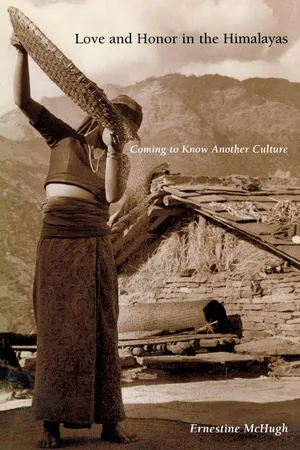
Love and Honor in the Himalayas is McHugh's gripping ethnographic memoir based on research among the Gurungs conducted over a span of fourteen years. As she chronicles the events of her fieldwork, she also tells a story that admits feeling and involvement, writing of the people who housed her in the terms in which they cast their relationship with her, that of family. Welcomed to call her host Ama and become a daughter in the household, McHugh engaged in a strong network of kin and friendship. She intimately describes, with a sure sense of comedy and pathos, the family's diverse experiences of life and loss, self and personhood, hope, knowledge, and affection. In mundane as well as dramatic rituals, the Gurungs ever emphasize the importance of love and honor in everyday life, regardless of circumstances, in all human relationships. Such was the lesson learned by McHugh, who arrived a young woman facing her own hardships and came to understand—and experience—the power of their ways of being.
While it attends to a particular place and its inhabitants, Love and Honor in the Himalayas is, above all, about human possibility, about what people make of their lives. Through the compelling force of her narrative, McHugh lets her emotionally open fieldwork reveal insight into the privilege of joining a community and a culture. It is an invitation to sustain grace and kindness in the face of adversity, cultivate harmony and mutual support, and cherish life fully.
- 200 pages
- English
- ePUB (mobile friendly)
- Available on iOS & Android
eBook - ePub
About this book
Information
1.
Reaching Tebas
Why did I go there? It is hard to say. I was looking for a home. There had been so many gaps in my life, empty spaces. I wanted to go somewhere where I could start over and be knit together whole.
In the early 1970s, I lived on the campus among the great, dark redwoods at the University of California at Santa Cruz. There at the gate was the big wooden seal proclaiming something like “Let there be Light,” as though the chancellor were God. I liked it there, though I felt different from the other kids. My roommate Helen grew up in a rustic planned community outside San Francisco and had gone to school in the East with Caroline Kennedy. She felt no one should be allowed to build a house on less than four acres of land and insisted that her life was not unusual in any way. I had come to campus on a Greyhound bus, having been ejected from the house by my father who felt it was snobbish of me to want to go to a university when the community college was nearby. It was a long trip from southern California, and a gentle, middle-aged African-American man befriended me along the way. He was going to Monterey to work in a shoe repair shop. The bus stopped for the night in Salinas, and he sat next to me on one of the molded plastic chairs joined together in a row, and bought me a movie magazine. His presence kept other men away, though they walked by and stared, and when morning came we boarded the bus again. He got off in Monterey and wished me luck. I was crumpled, rumpled, and tired when I got to Santa Cruz and made my way to campus with my backpack of belongings. Parents were unloading their kids and tucking them into their new college rooms, carrying their luggage and setting up their stereos. I felt terrible.
In time I made friends, and it was through one of them, Kathy, that I learned about Nepal. She had lived there with her parents the year before she came to college. She told me stories of trekking in the hills and being surrounded in villages by women who would examine her clothes and finger her long braid. She talked of the city people she knew, and how their sophistication was so different from ours. I had lived that year in England, on a scholarship as an exchange student. England had been a refuge for me, being part of a kind, harmonious family who lived in an old stone farmhouse in the middle of rolling fields. They had a dog and a cat and several cows, and our evenings had been filled with conversation and laughter. My childhood had been ragged and difficult, and I was happy there. After being out with my friends I would walk home late at night through the country lanes, enjoying the crunch of my footsteps and the shadows of the trees. I liked the idea of going abroad again. I recognized that during the first few months in a new place I saw it from an old perspective, then after a painful period of confusion I understood it in different terms, terms that changed my point of view entirely and made my old life look strange. When I went away again, I knew I would stay for a long time, and I wanted to live with a family, to be wholly involved and without the buffer of solitude. I wanted to melt into an unfamiliar world and be shaped by it, to see life in a new, unknown way. Kathy and I talked. I studied, worked at my job cleaning tables in the dining hall, and spent time with friends. I slept half the summer in a bedroll in a meadow so I could save enough money to return to England to see my family there, and I decided to go live in Nepal.
At that time I loved the theater and wanted to become an actress. At nineteen, for me that meant standing on stage, surrendering one’s self, and embodying truth. I felt this required a broad education. One day a friend told me about a seminar he thought I should take. He said it was small, as not many people knew about it, and was taught by a really interesting man named Gregory Bateson. It was called “Aesthetic Process,” which seemed right for me, and I went along.
I walked into a room with a long rectangular table and windows overlooking a lawn. Gregory was in his seventies by then, tall and stooped with eyes like a bird of prey and a hooked nose. His clothes were so casual and worn that my friend Melita mistook him for the janitor. The seminar was intimate and conversational in style. In the seminar as in his written work, Gregory made ideas immanent. He presented them with irony and engaged them with passion. I was compelled. I was entranced. I was converted to intellectual life, his kind: alive, intimate, humorous, persevering, and hungry to know. His intellectual approach was not about grasping and controlling, a “command” or “mastery” of knowledge, but about relationship and insight. One day he gave us each a Rilke poem and sent us into the forest to find a leaf with the same structure. He believed there was a pattern that connected all life and that with careful sustained attention it could be understood. Gregory and I liked each other, shared certain childhood tragedies and certain sensibilities, and he took me in hand as his student. We met week after week in his office to discuss ways of knowing: poetry, art, science, and I crafted a project to look at how rituals about death might convey understandings about life in the Himalayas.
I spent a year working with Gregory on this and going up to Berkeley to study the Nepali language. A Nepalese psychology professor at Santa Cruz, Bhuwan Lal Joshi, invited me to come home and be with his family on Sundays so that I could practice the language with his children. Each week he came to my place to pick me up and I sat in the backyard with him and his two sons, near a playhouse painted and labelled “Toad Hall,” after Wind in the Willows. The little boys and I struggled to converse in Nepali, the boys staging frequent revolts and running off to play ball. Bhuwan Lal gave me advice, scolded me (saying projects like mine were generally a bad idea), and treated me with every kindness. His wife made delicious lunches and told me how he had decided to marry her after seeing her walking with college friends on a street in Darjeeling. (She was sweetly and delicately beautiful.) My life developed a rhythm built around Nepal.
By summer, it was time for me to go. After spending a week with a friend in Maine, I went to New York and boarded the plane at JFK. The tunnel into it was dim after the florescent lights of the terminal, gray and dusky. The Kuwait Airlines plane was even dimmer and smaller than the big jet I had crossed the country in. I buckled my seatbelt and looked out at the dark runway, marked by blue lamps. I wondered what I was doing, going so far away alone. There was a stewardess standing in a blue suit in the middle of the narrow aisle. She had black hair and a small round hat. I heard the thump as they closed the door, the click of the lock that secured it. I looked out into the dark again and began to cry. The engines whirred and rumbled and the plane sped down the runway and cut through the night. The buildings below got small and disappeared, and the city became patterns of light as we circled upward.

I live in Rochester, New York now. It is leafy and lush in the summer and in the winter the sky is vast and bare, framed by snowy branches. I have a nine-year-old daughter who looks like a Botticelli madonna in miniature, slim with long hair and very blue eyes. She asks me questions at the dinner table, like “What is infinity?” This began early, when she was three or four and wanted to know about death and God. She likes me to come to her school once a year, wearing my most glamorous sari, and tell the children about Nepal. I bring food and show slides. One boy, duly impressed, touched me last time and said, “This arm was really there?” I am wonder-mother, the exotic and resplendent, who comes with flavors and photos of strange lands.
After my talk there on a warm spring day, we walked to the museum where three Tibetan Buddhist monks were making an intricate design out of colored grains of sand. It was a mandala representing the divine palace of Kalachakra, a deity of time and transformation. The monks held small metal cylinders and stood around a square black table tapping the cylinders so that grains of sand fell out in precise and intricate patterns, recreating in minute perfection the exact features of the mandala. The constant scraping tap was hypnotic, like the hum of insects in a forest. After six weeks of work, the mandala was completed and lay in ornate magnificence on the table. As hundreds of people came to view it for the final time, walking in a long steady line around the table, the monks began to dismantle it, destroying the design and brushing the sand into a clay urn. At the end, the monks invited assistance, and children and adults took turns sweeping the sand into a pile. The security guard pushed an old woman in a wheelchair through the crowd and she, too, brushed the grains toward the center of the table. Then with drums, trumpets, and flags, the urn was carried in procession three miles to the river, where the monks chanted prayers and onlookers pressed near as they poured the sand through a long white tube into the river. Red and yellow flags flapped against the sky. The sun reflected on the river as the colored grains floated, dispersed, then disappeared slowly into the water. The palace of the god of time was gone; time that consumes all, consumed. A while later, the riverbank was empty of people and the river flowed quietly on. One of my daughter’s friends slipped on the steps the lamas had come down and scraped her knee.
In fifty years I will be gone too. Now Gregory is dead. He died at the San Francisco Zen Center, where friends and family sat with him and read his favorite passage about God coming down in the whirlwind in the Book of Job. Bhuwan Lal collapsed of a heart attack in his office just before class, and died in the ambulance, leaving his wife and two sons and a small daughter. My friends from Santa Cruz have dispersed across the country. Nepal is there, but it is a long time since I have been. Like most people in middle age, my life is weighted with responsibilities. My time in Nepal did not make me more whole. It made me more complex, and perhaps more fragmented. I am not the same as I would have been had I not gone. It is not the same as it was when I was there.
The plane for Kathmandu left Delhi at four in the morning. It was a small jet labeled Royal Nepal Airlines, with a picture of the abominable snowman on the outside. The air hostess passed out candies. As we flew, the plain below flowed into hills, then mountains. We crossed the Mahabharata range and saw valleys and undulating ridges below. The pilot announced that the Himalayas could be seen from the left side of the plane. I looked down: vast stretches of green, no snowy mountains. How could I not find the Himalayas? People at other windows murmured in appreciation. I searched the ground. Then, resting my eyes, I looked out rather than down, and there they were, white and stately across the sky. The plane turned into a valley ringed by mountains and began the descent into Kathmandu. Terraces took shape along the mountainsides, green with new rice, and the red brick houses of the city came into view.
There were fields around the small airport and a few taxis in front. I had a note from the wife of the Peace Corps director inviting me to stay with them and giving directions to a shop she was starting, where she could be found during the day. Her husband had succeeded Kathy’s father in that position and she had responded with kindness to a letter about my trip. The taxi dodged cows in the road and sped past vegetable vendors. As we got nearer the city the road narrowed, houses on either side, some with shops at street level, cloth or brass pots in sight, small terrace gardens on the roof. The taxi stopped in front of a wooden door opening into a courtyard. I stepped inside. An American woman with auburn hair and blue eyes approached me and slipped a bracelet of jasmine onto my wrist. “Welcome,” she said. “Please feel free to look around and enjoy our shop.” She looked at my luggage and at me again. “Oh!” she said, “you must be Ernestine. I’m Jane Martin. I mistook you for a tourist. You must be very tired. Just a moment and I’ll take you home.”
Jane and her husband Jim lived in a large house in a neighborhood called Ganeswar, because it was near a temple to the god Ganesh, the elephant-headed son of Siva. Their two daughters, eleven and fourteen, were soon to return to the United States and Jane planned to stay on for six months to see that the shop got established. This was the second venture she had started in Kathmandu, providing capital and going in with a Nepalese partner, then withdrawing after the business was running well and the initial capital had been returned. At forty-three, Jane had never lived independent of husband or parents and was excited that she would be on her own for a time. She had rented a large, airy apartment at the top of an old building in the bazaar. The house she brought me to was Western in style, surrounded by a lawn. Peace Corps volunteers were in and out, and talking with them I learned about the areas in which they lived and began to think about where I might go to study. Some new language teachers were in training and I became the sample student and greatly improved the Nepali I had learned in California. The monsoon rains swept in and water filled the streets, then drained away leaving the air moist and fresh, smelling of damp earth. Plants grew everywhere, hibiscus and bougainvillea that I had known at home, but huge, growing over walls and twining up trees. I walked through the bazaars, getting lost in the narrow streets and crushed by evening crowds, and sometimes coming across a square that enclosed a temple, steps going up to the deity and pagoda roofs supported by struts carved with demons or celestial couples making love under the eaves. I knew I wanted to live away from the city in the hills, but I could not travel until the rains stopped, and in the meantime happily continued my language study and enjoyed Kathmandu. Jane invited me to stay with her in her apartment overlooking the bazaar until it was time for me to go.
Jane was pretty, with a shapely body and a vivacious face. Her apartment was elegant, with low furniture and Nepali textiles and large windows looking out on the fields on one side and the narrow street on the other. A maid, Golma, came each day to cook and clean and often brought her small son. When Jane had parties, I often stayed in the kitchen with Golma, shy among the art dealers, writers, and world travelers who stopped by. Jane was a devout Christian Scientist. She spent the early morning reading religious selections, and talked with me about the ultimate wholeness and goodness of life and her belief that illness was only an illusion. She said she had never been ill and had always cured her children through prayer healings. She talked about this time as one of discovery and growth, saying that she had always been sheltered and now, at last, she was beginning to know her own strength. Once she told me pointedly she was tired of the long train of people, especially young ones, who passed through her house without showing a trace of gratitude. I realized I, too, had taken her hospitality quite for granted, apologized and offered to leave. She cried and asked me to stay, and I cried, and we held each other, and I got in the habit of bringing flowers or other small gifts from time to time. It rained and I studied, and eventually I decided I would go to the area near the Annapurna mountains, where people called Gurungs lived. They were known for their warmth and kindness, and for the elaborate Buddhist funeral rituals they performed.
As the rains began to taper off and the air became crisp and clear, I prepared to leave for the mountains. Jane was giving a party for some friends. It got late and three women stayed the night on the living room floor. In the morning, Jane stayed in her room, reading, I thought, or sleeping in. Finally at midmorning, after her friend John had come looking for her and said he would come back again in a little while, I went in to wake Jane. The bright morning light was pouring in through the windows, made even brighter by her orange curtains. She was lying half off the bed with her mouth partly open and her face tinged with blue. I called the others and ran out to get the Peace Corps doctor. It was the day of the most important Hindu holiday in Nepal and there was no public transportation anywhere, not even a rickshaw. Desperate, I began to run. A man driving a jeep filled with family members stopped and asked what was wrong, then loaded me in and sped off to the Peace Corps compound. When we returned to Jane’s apartment, the doctor pronounced her dead. People came by all day, asking what had happened, but we had little to say that satisfied them. No one ever knew how Jane had died. John wired her husband, who gave instructions to have her cremated in Nepal, saying he preferred to celebrate what her life had been rather than officiate at her death.
I can still remember, twenty-eight years later, what it was like to step into that room and feel, even before I looked at Jane, that I was in the presence of something large and frightening. The room felt still in a way that I had never known stillness. The only other body I had ever seen was that of my own mother, when at fourteen after her sudden death, I was told to walk with my older brother to the front of the funeral home where people were circling what looked to me like a pile of pillows. This was the satin lid of the coffin, and inside was my mother, with a mask-like made-up face. I was shocked and stood there engulfed by a feeling of total emptiness while my brother sobbed. “You must not have loved your mother,” another child told me later, “People say you didn’t even cry.” For weeks at night afterward, I was left alone in our trailer up on the hill while the winter wind and rain drove round and gently rocked it. I did not cry then either, though the world seemed vast and terrifying and filled with pain.
Jane’s friends and I all stayed together the first few nights after she died. We took her body to Pasupatinath temple, a place sacred to Siva that draws pilgrims from all over Nepal and India. It is a blessing to die there and there are shelters near the river in which those near death can stay with family members. Outside the gates of the temple complex in stalls and on mats scattered on the ground are vendors selling offerings and the brown rudrasi beads sacred to Siva, which one can bring home as remembrance. Inside the complex, the gates of the temple itself are golden and the temple rises high above the river, topped with a shining golden roof. As a non-Hindu, I was not allowed inside, but would sometimes sit on the hill on the opposite bank of the river and look down on the activities in the outer courtyard, listening to the bells and prayers among the hundreds of stone lingam, sacred to Siva, that covered the hillside. Near the river there are wisps of smoke and the acrid smell of burning bodies wafts through the air. Flames lick the air and a few close mourners stand by as the fire slowly consumes the corpse. Ashes and the little bits of bone left are offered to the river Bagmati, a branch of the great river system that becomes the Ganges in India, and a deity in her own right, like Mother Ganges who cleanses all. Further from the temple, there are platforms on the river where the bodies of non-Hind...
Table of contents
- Cover
- Half title
- Title
- Copyright
- Dedication
- Contents
- List of Illustrations
- The People
- Preface
- 1. Reaching Tebas
- 2. Ways of Life Unfolding
- 3. The Fate of Embodied Beings
- 4. The Intimate Darkness of Shadows and Margins
- 5. Paths Without a Compass: Learning Family
- 6. Creating Selves, Crafting Lives
- 7. Shattered Worlds and Shards of Love
- 8. Return
- Conceptual Context and Related Readings
- Index
- Acknowledgments
Trusted by 375,005 students
Access to over 1.5 million titles for a fair monthly price.
Study more efficiently using our study tools.
Frequently asked questions
Yes, you can cancel anytime from the Subscription tab in your account settings on the Perlego website. Your subscription will stay active until the end of your current billing period. Learn how to cancel your subscription
No, books cannot be downloaded as external files, such as PDFs, for use outside of Perlego. However, you can download books within the Perlego app for offline reading on mobile or tablet. Learn how to download books offline
Perlego offers two plans: Essential and Complete
- Essential is ideal for learners and professionals who enjoy exploring a wide range of subjects. Access the Essential Library with 800,000+ trusted titles and best-sellers across business, personal growth, and the humanities. Includes unlimited reading time and Standard Read Aloud voice.
- Complete: Perfect for advanced learners and researchers needing full, unrestricted access. Unlock 1.5M+ books across hundreds of subjects, including academic and specialized titles. The Complete Plan also includes advanced features like Premium Read Aloud and Research Assistant.
We are an online textbook subscription service, where you can get access to an entire online library for less than the price of a single book per month. With over 1.5 million books across 990+ topics, we’ve got you covered! Learn about our mission
Look out for the read-aloud symbol on your next book to see if you can listen to it. The read-aloud tool reads text aloud for you, highlighting the text as it is being read. You can pause it, speed it up and slow it down. Learn more about Read Aloud
Yes! You can use the Perlego app on both iOS and Android devices to read anytime, anywhere — even offline. Perfect for commutes or when you’re on the go.
Please note we cannot support devices running on iOS 13 and Android 7 or earlier. Learn more about using the app
Please note we cannot support devices running on iOS 13 and Android 7 or earlier. Learn more about using the app
Yes, you can access Love and Honor in the Himalayas by Ernestine McHugh in PDF and/or ePUB format, as well as other popular books in Social Sciences & Anthropology. We have over 1.5 million books available in our catalogue for you to explore.