Named "one of the best books of 2006" by The New York Sun
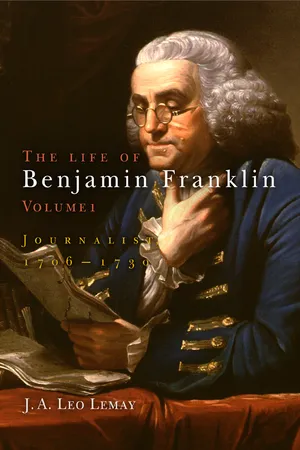
Described by Carl Van Doren as "a harmonious human multitude," Benjamin Franklin was the most famous American of his time, of perhaps any time. His life and careers were so varied and successful that he remains, even today, the epitome of the self-made man. Born into a humble tradesman's family, this adaptable genius rose to become an architect of the world's first democracy, a leading light in Enlightenment science, and a major creator of what has come to be known as the American character. Journalist, musician, politician, scientist, humorist, inventor, civic leader, printer, writer, publisher, businessman, founding father, and philosopher, Franklin is a touchstone for America's egalitarianism.
The first volume traces young Franklin's life to his marriage in 1730. It traces the New England religious, political, and cultural contexts, exploring previously unknown influences on his philosophy and writing, and attributing new writings to him. After his move to Philadelphia, made famous in his Autobiography, Franklin became the Water American in London in 1725, where he was welcomed into that city's circle of freethinkers. Upon his return to the colonies, the sociable Franklin created a group of young friends, the Junto, devoted to self-improvement and philanthropy. He also started his own press and began to edit and publish the Pennsylvania Gazette, which became the most popular American paper of its day and the first to consistently feature American news.
- 568 pages
- English
- ePUB (mobile friendly)
- Available on iOS & Android
eBook - ePub
About this book
Information
Publisher
University of Pennsylvania PressYear
2013Print ISBN
9780812238549
9780812238549
eBook ISBN
9780812209112
PART I
Boston: Youth
1706–1723

PROLOGUE
Quandary
In August 1723 seventeen-year-old Franklin found himself jobless and ostracized. He had been working for his older brother, James Franklin, who was now twenty-six. Six months before, when James was forbidden by the authorities to continue printing his newspaper unless it were first supervised by the secretary of Massachusetts, he brought out the newspaper under the name of Benjamin Franklin. Since Franklin was apprenticed to James, the latter returned him the cancelled indenture so that he could, if challenged, show it to the Massachusetts authorities. At the same time, Franklin and James signed another, secret indenture, whereby Franklin agreed to continue his apprenticeship with James. But the brothers often argued, and when they next quarreled, James beat his young brother, and Franklin quit. He could do so, for he knew that James could not produce the new indenture to the authorities and force Franklin to come back to work. Later, in the Autobiography, Franklin ruminated: “It was not fair in me to take this Advantage, and this I therefore reckon one of the first Errata of my Life: But the Unfairness of it weigh’d little with me, when under the Impressions of Resentment, for the Blows his Passion too often urg’d him to bestow upon me. Tho’ He was otherwise not an ill-natur’d man. Perhaps I was too saucy and provoking” (20).
Franklin knew that he was as fast and efficient a printer as his brother or any Boston journeyman, and he assumed that he could find work at one of the several other Boston printers. He probably first went to Thomas Fleet, a young printer whom he knew well, but Fleet refused to hire him. Since Fleet’s business was expanding and since good journeymen printers were rare in Boston, Franklin was puzzled. But when the printers John Allen and Samuel Kneeland also refused to hire him, he began to suspect the truth. Old Bartholomew Green, his father’s friend and fellow member of the Old South Church, a person whom Franklin had known all his life, also turned him down. Franklin realized that his brother had told every local printer that Franklin was really still apprenticed to him. No Boston printer would hire him. What was he to do? There were no printers in the surrounding towns, and he could not sail from Boston, for his father and his brother could force him back if he tried to book passage. Besides, he had little money, not enough to pay for a voyage.
Worse, he had become notorious in Boston as an infidel. He enjoyed arguing and practiced a Socratic method of asking questions and having his opponents agree with statements that gradually led them to conclusions they had not foreseen. He confessed in the Autobiography that his “indiscrete Disputations about Religion began to make me pointed at with Horror by good People, as an Infidel or Atheist” (20). Moreover, he was infamous as a radical, whose newspaper writings insulted the best-known ministers of Boston, Cotton and Increase Mather, and who satirized the old, greatly respected chief justice, Samuel Sewall. The sensitive adolescent found that his writing and his private Socratic arguments had ostracized him from many good people in Boston. Some parents told their children to have nothing to do with him. How did he find himself in this predicament, and how did he make such a mess of his life by age seventeen? And what could he do?
ONE
Boston
It would certainly . . . be a very great Pleasure to me, if I could once again visit my Native Town, and walk over the Grounds I used to frequent when a Boy, and where I enjoyed many of the innocent Pleasures of Youth, which would be so brought to my Remembrance, and where I might find some of my old Acquaintance to converse with. . . . The Boston Manner, turn of phrase, and even tone of voice, and accent in pronunciation, all please, and seem to refresh and revive me.—Franklin to the Reverend John Lathrop, 31 May 1788
Boston was a small town of fewer than 8,000 persons at the edge of the wilderness, but it was the largest city in English North America in 1706 and had an excellent harbor. During the seventeenth and early eighteenth centuries, it dominated colonial American trade. Most of New England shipped via Boston to overseas ports, making shipping the key to the town’s flourishing economy. Shipbuilding was the most important local industry. In 1698, Massachusetts Governor Lord Bellomont classed the ships belonging to Boston, listing twenty five of the largest category, one hundred to three hundred tons. He wrote: “I may venture to say there are more good vessels belonging to the town of Boston than to all Scotland and Ireland.”1 The three largest towns in the English colonies during Franklin’s youth were Boston, New York, and Philadelphia. By 1720 Boston had a population of 11,000; New York, 6,000; and Philadelphia, 4,900.2 Boston had numerous maritime communities surrounding it; although Philadelphia and New York also had nearby ports, they were few and minor in comparison to those near Boston.
Most people came to Boston by water. When Franklin was three, a sea captain visited, describing the port and town. Captain Nathaniel Uring mentioned the lighthouse on an island on the north side of the peninsula and the fort on another island “two Miles and an Half below the Town; the Channel for Ships lies very near it, so that no Ships can pass by it but what the Fort is able to command: It is a strong, regular, well built Fort, mounted with about 100 Pieces of Cannon, where they keep a Garrison, who are paid by the Country.” Boston was built upon a peninsula connected to the mainland by an isthmus about forty yards broad, “so low, that the Spring Tides sometimes washes the Road. . . . The Town is near two Miles in length, and in some Places three Quarters of a Mile broad,” with most of the houses “built with Brick.”
Like other commentators, Uring was impressed by Boston’s wealth and by its main wharf: “Some of the richest Merchants have very stately, well built, convenient Houses.” The wharfs “jut into the Harbour for the Conveniency of Shipping; one of which goes by the Name of the Long Wharf, and may well be called so, it running about 800 Foot into the Harbour, where large Ships, with great Ease, may both lade and unlade: On one side of which are Warehouses, almost the whole Length of the Wharf . . . where more than 50 Sail of Vessels may lade or unlade at the same Time with great Conveniency.” He took the public jakes on the wharves for granted, and concluded with appreciation, “The town altogether is most excellently situated for Trade and Navigation.”3
Dr. Alexander Hamilton’s 1744 description showed that the town remained essentially unchanged thirty-five years later. Hamilton presented a better overall view and noted the local divisions of North End and South End Boston. As we will see, during Franklin’s youth these divisions were keys to the town’s pageantries and rivalries. Hamilton said: “The town is built upon the south and southeast side of the peninsula and is about two miles in length, extending from the neck of the peninsula northward to that place called North End, as that extremity of the town next the neck is called South End.”4 From the town hall on Marlborough or Cornhill Street, King’s (now State) Street led down to the harbor and continued into the bay as the Long Wharf.
POLITICS
The government of Massachusetts emerged from an early seventeenth-century trading company, with a governor, deputy governor, and eighteen assistants elected annually by the stockholders. The Massachusetts Bay colonists gradually transformed the trading company’s 1628 charter into a semi-theocracy, with an executive, a judiciary, and a two-house legislature. The name for the whole government was the General Court. The system functioned fairly well but not for all constituents. Women could not vote (nor could they in England). The franchise was given only to church members, and the only church was Puritan New England Congregationalism. Even Anglicans were disenfranchised. Further, the Massachusetts authorities persecuted Quakers and other religious sects.
More upsetting to Great Britain, Massachusetts resisted or ignored the Acts of Trade and Navigation (a series of parliamentary economic acts that started in 1650 and favored England). British officials found the government of Massachusetts too independent and too intolerant. In 1684 England’s Court of Chancery (to the disgust of most Massachusetts citizens) annulled the old Massachusetts charter. James II established the Dominion of New England, an administrative unit stretching from New Jersey to Maine. England’s Glorious Revolution in 1688 overthrew the Catholic James II and installed the Protestant William and Mary on the throne. This provided New Englanders a chance to revolt against the former authorities. In 1689, Bostonians imprisoned the British-appointed governor, Edmund Andros, and the other Royal appointees, Joseph Dudley (a Massachusetts native) and Edward Randolph. The three were sent back to England. The Reverend Increase Mather returned with them, intending to have the old charter restored. Mather found that impossible, but he did secure a new one with two major changes. First, the new charter provided for a governor to be appointed by the crown (i.e., the English authorities) rather than elected by the Massachusetts General Court. Second, it made property rather than religion the basis of suffrage.
There were additional changes. The representatives were elected by popular vote from the towns and other organized units. Though the upper house, or council, was elected by the General Court (i.e., by vote of the former council members and the representatives), the choice of councilmen was subject to the governor’s veto. The new charter also allowed appeals to the British authorities. After 1691, the General Court of Massachusetts consisted of the British-appointed governor, the council, and representatives. Under the new charter, Massachusetts lost much of its autonomy—or, to say it more directly, it was made more subservient to England.
The popular party in Massachusetts that grew up in opposition to the governor and other English appointees came to be called the Old Charter Party. Increase Mather was blamed by many for not securing the full benefits of the old charter. His fall from grace was symbolized by his removal from the presidency of Harvard ostensibly because the president was supposed to reside in Cambridge. But Elisha Cooke and Nathaniel Byfield, political leaders of the Old Charter Party, put in the Reverend Samuel Willard, who lived in Boston, as vice president of Harvard on 6 September 1701. The technicality that permitted Cooke and Byfield to oust President Mather and put in Vice President Willard was that though the president was required to live in Cambridge, the vice president was not.5 Of course Willard served thereafter as the acting president.
Politics in Franklin’s Boston followed the forms that had developed during the seventeenth century. The council and the House alternatively chose the minister who would preach the election sermon.6 According to the new charter, Election Day would be the last Wednesday in May. Election Day itself was the third and last of three key annual elections. First came the election of the Boston selectmen in March. One could usually judge from that election what group was in power and would win in the following election of representatives. Next, representatives were elected in mid-May. Election Day came third, a major Massachusetts holiday. Though it was the ceremonial high point, it was in some ways the least significant of the three. Politics after the election of the Boston selectmen in March was relatively predictable.
As Nathaniel Hawthorne makes clear in The Scarlet Letter, the minister had an important role on Election Day. Not only was it an occasion with an invariably large audience, but the minister had an opportunity to declare what could be considered the coming year’s political platform. On Wednesday, 29 May 1706, in the year Franklin was born, the General Court met and listened to the annual election sermon, which the Reverend John Rogers of Ipswich preached on 1 Kings 8:57–58: “The Lord Our God be with us, as he was with our Fathers: Let him not leave us, nor forsake us: that he may encline our hearts unto him, to walk in all his ways, and to keep his Commandments, and his Statutes, and his Judgments, which he commanded our Fathers.”
After the sermon, the new assembly members elected the Speaker of the House. Then the assembly and former council met together and elected the new council members. If the governor did not approve of a council member, he could veto (in colonial usage, “negative”) him. In that case, the General Court usually elected another. Sometimes, however, it reelected the same person. The governor could either negative him again or could dissolve the assembly—whereupon the towns customarily reelected the same representatives.
The governor usually opened the first session of the legislature for the year with a brief state-of-the-province speech, with a request for new legislation (in 1706, for defense from a powerful French fleet in the West Indies that was thought to be making its way up the coast), and with the usual invocations of loyalty to Britain: “Every Body will agree that it is our Duty . . . to do the just Honour we owe to the Crown of England, to Her Majesty the best of Princes” (Boston News-Letter, 3 June 1706).
The popular attitude toward Election Day is documented in an anecdote concerning the Reverend Mather Byles, Franklin’s contemporary, who became eighteenth-century Boston’s most famous wit: “Mather Byles, one Election day, in Boston, a day of frolic, being in the Mall, he saw two of his acquaintances (one a very corpulent, and the other a slender man) walking arm in arm. Byles thrust himself between, and having parted them, went on observing, ‘it was always the fashion to go through thick and thin on Election day.’ ”7
RE...
Table of contents
- Cover
- Title
- Copyright
- Contents
- List of Illustrations
- Preface
- Part I: Boston: Youth, 1706–1723
- Part II: Adrift: Age Seventeen to Twenty-four, 1723–1730
- Appendix: New Attributions
- Sources and Documentation
- List of Abbreviations
- Notes
- Index
- Acknowledgments
Trusted by 375,005 students
Access to over 1.5 million titles for a fair monthly price.
Study more efficiently using our study tools.
Frequently asked questions
Yes, you can cancel anytime from the Subscription tab in your account settings on the Perlego website. Your subscription will stay active until the end of your current billing period. Learn how to cancel your subscription
No, books cannot be downloaded as external files, such as PDFs, for use outside of Perlego. However, you can download books within the Perlego app for offline reading on mobile or tablet. Learn how to download books offline
Perlego offers two plans: Essential and Complete
- Essential is ideal for learners and professionals who enjoy exploring a wide range of subjects. Access the Essential Library with 800,000+ trusted titles and best-sellers across business, personal growth, and the humanities. Includes unlimited reading time and Standard Read Aloud voice.
- Complete: Perfect for advanced learners and researchers needing full, unrestricted access. Unlock 1.5M+ books across hundreds of subjects, including academic and specialized titles. The Complete Plan also includes advanced features like Premium Read Aloud and Research Assistant.
We are an online textbook subscription service, where you can get access to an entire online library for less than the price of a single book per month. With over 1.5 million books across 990+ topics, we’ve got you covered! Learn about our mission
Look out for the read-aloud symbol on your next book to see if you can listen to it. The read-aloud tool reads text aloud for you, highlighting the text as it is being read. You can pause it, speed it up and slow it down. Learn more about Read Aloud
Yes! You can use the Perlego app on both iOS and Android devices to read anytime, anywhere — even offline. Perfect for commutes or when you’re on the go.
Please note we cannot support devices running on iOS 13 and Android 7 or earlier. Learn more about using the app
Please note we cannot support devices running on iOS 13 and Android 7 or earlier. Learn more about using the app
Yes, you can access The Life of Benjamin Franklin, Volume 1 by J. A. Leo Lemay in PDF and/or ePUB format, as well as other popular books in History & Historical Biographies. We have over 1.5 million books available in our catalogue for you to explore.