It is not uncommon to hear states and their leaders criticized for "mixing oil and politics." The U.S.-led Iraq War was criticized as a "war for oil." When energy exporters overtly use energy as a tool to promote their foreign policy goals, Europe and the United States regularly decry the use of energy as a "weapon" rather than accept it as a standard and legitimate tool of diplomacy.
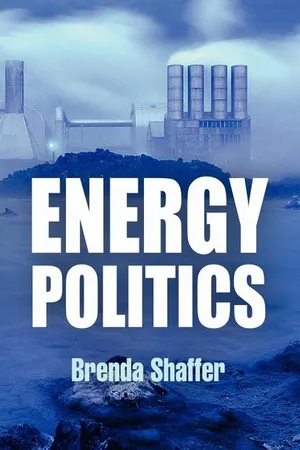
In Energy Politics, Brenda Shaffer argues that energy and politics are intrinsically linked. Modern life—from production of goods, to means of travel and entertainment, to methods of waging war—is heavily dependent on access to energy. A country's ability to acquire and use energy supplies crucially determines the state of its economy, its national security, and the quality and sustainability of its environment. Energy supply can serve as a basis for regional cooperation, but at the same time can serve as a source of conflict among energy seekers and between producers and consumers.
Shaffer provides a broad introduction to the ways in which energy affects domestic and regional political developments and foreign policy. While previous scholarship has focused primarily on the politics surrounding oil, Shaffer broadens her scope to include the increasingly important role of natural gas and alternative energy sources as well as emerging concerns such as climate change, the global energy divide, and the coordinated international policy-making required to combat them. Energy Politics concludes with examinations of how politics and energy interact in six of the world's largest producers and consumers of energy: Russia, Europe, the United States, China, Iran, and Saudi Arabia.
- 200 pages
- English
- ePUB (mobile friendly)
- Available on iOS & Android
eBook - ePub
Energy Politics
About this book
Information
Table of contents
- Cover
- Half title
- Title
- Copyright
- Contents
- Introduction
- Chapter One: Energy and Regime Type
- Chapter Two: Foreign Policy
- Chapter Three: Pipeline Trends and International Politics
- Chapter Four: Conflict
- Chapter Five: Security
- Chapter Six: Climate Change
- Chapter Seven: Russia
- Chapter Eight: Europe
- Chapter Nine: The United States
- Chapter Ten: China
- Chapter Eleven: Iran
- Chapter Twelve: Saudi Arabia
- Conclusion
- Notes
- Index
- Acknowledgments
Trusted by 375,005 students
Access to over 1.5 million titles for a fair monthly price.
Study more efficiently using our study tools.
Frequently asked questions
Yes, you can cancel anytime from the Subscription tab in your account settings on the Perlego website. Your subscription will stay active until the end of your current billing period. Learn how to cancel your subscription
No, books cannot be downloaded as external files, such as PDFs, for use outside of Perlego. However, you can download books within the Perlego app for offline reading on mobile or tablet. Learn how to download books offline
Perlego offers two plans: Essential and Complete
- Essential is ideal for learners and professionals who enjoy exploring a wide range of subjects. Access the Essential Library with 800,000+ trusted titles and best-sellers across business, personal growth, and the humanities. Includes unlimited reading time and Standard Read Aloud voice.
- Complete: Perfect for advanced learners and researchers needing full, unrestricted access. Unlock 1.5M+ books across hundreds of subjects, including academic and specialized titles. The Complete Plan also includes advanced features like Premium Read Aloud and Research Assistant.
We are an online textbook subscription service, where you can get access to an entire online library for less than the price of a single book per month. With over 1.5 million books across 990+ topics, we’ve got you covered! Learn about our mission
Look out for the read-aloud symbol on your next book to see if you can listen to it. The read-aloud tool reads text aloud for you, highlighting the text as it is being read. You can pause it, speed it up and slow it down. Learn more about Read Aloud
Yes! You can use the Perlego app on both iOS and Android devices to read anytime, anywhere — even offline. Perfect for commutes or when you’re on the go.
Please note we cannot support devices running on iOS 13 and Android 7 or earlier. Learn more about using the app
Please note we cannot support devices running on iOS 13 and Android 7 or earlier. Learn more about using the app
Yes, you can access Energy Politics by Brenda Shaffer in PDF and/or ePUB format, as well as other popular books in Economics & Economic Policy. We have over 1.5 million books available in our catalogue for you to explore.