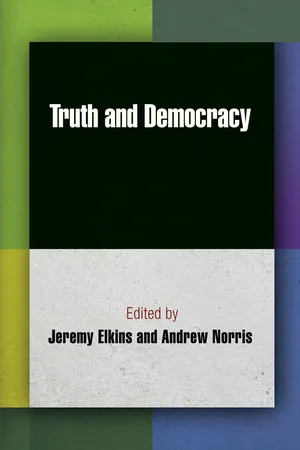
Political theorists Jeremy Elkins and Andrew Norris observe that American political culture is deeply ambivalent about truth. On the one hand, voices on both the left and right make confident appeals to the truth of claims about the status of the market in public life and the role of scientific evidence and argument in public life, human rights, and even religion. On the other hand, there is considerable anxiety that such appeals threaten individualism and political plurality. This anxiety, Elkins and Norris contend, has perhaps been greatest in the humanities and in political theory, where many have responded by either rejecting or neglecting the whole topic of truth.
The essays in this volume question whether democratic politics requires discussion of truth and, if so, how truth should matter to democratic politics. While individual essays approach the subject from different angles, the volume as a whole suggests that the character of our politics depends in part on what kinds of truthful inquiries it promotes and how it deals with various kinds of disputes about truth. The contributors to the volume, including prominent political and legal theorists, philosophers, and intellectual historians, argue that these are important political and not merely theoretical questions.
- 352 pages
- English
- ePUB (mobile friendly)
- Available on iOS & Android
eBook - ePub
Truth and Democracy
About this book
Information
Publisher
University of Pennsylvania PressYear
2012Print ISBN
9780812243796
9780812243796
eBook ISBN
9780812206227
PART I
Opinion and Agreement
Chapter 1
Concerning Practices of Truth
Nothing is more inconsistent than a political regime that is indifferent to truth; but nothing is more dangerous than a political system that claims to lay down the truth. The function of “telling the truth” must not take the form of law, . . . [but] it would [also] be pointless to believe that it resides by right in the spontaneous interplay of communication. . . . The task of telling the truth is an endless labor.
—Michel Foucault, “The Concern for Truth”
In politics, truth has taken a beating in recent years, and from two directions. From one side, the very idea of truth has been attacked as, at best, an unnecessary, grandiose, and distracting superfluity and, at worst, a remnant of metaphysical foundationalism, an enemy of democracy, and a tool of political domination. From the other side, we have seen truth, never very secure to begin with on the battlefield of ordinary politics, suffer a series of especially cruel beatings: at the hands of a previous presidential administration—perhaps the most contemptuous of truth of any in American history, for whom “reality,” as one of its senior members famously boasted, was not a constraint on but only an artifact of the exercise of political power;1 in the increasing success—and hubris—of partisan propagandists in and out of government in being able to create public narratives ranging from the marginally plausible to the outright absurd; and in the frequent refusal of the “responsible press” to assess these narratives rather than merely report on them—to name just a few of the most significant of these recent assaults.
Neither the philosophical nor the partisan attacker of truth is likely to want to identify very closely with the other, and this only partly because in recent years (this has not always been the case) the first sort of attack has come primarily from the left and the second primarily from the right. More important, the partisan attackers will need to deny, at least publicly, that truth is a target, while the theoretical attackers of truth-talk will insist that the politics of deception—and especially of that special variety of deception with which Harry Frankfurt’s now famous essay was concerned2—are not what they had in mind: that the critique of truth-talk was never meant to deny the simple and politically important virtue of not lying, of “truthfulness” (as it is sometimes put) in contrast to “truth.”
Yet for political theorists who have an interest in taking the world seriously, the problem of truth can no longer be dismissed as though it were merely a vestige of vulgar philosophical realism and the obsession of political naïfs. To the extent that our thinking about political life is meant to have a serious relationship with our political life, it can no longer be sufficient merely to reiterate, over and again, the kinds of sins that have been committed in the name of truth. We have heard—and rightly so—much about the harms that certain claims of truth have caused to politics. But in light of what our politics have become, now is as good an occasion as any to revisit the question of whether the theoretical deprecation of truth-talk may not have stated its case too strongly; whether the only important political virtue in relation to truth is that of not lying, or whether there is more to it than that; and whether the question itself of truth is not one that is necessary for our political life.
Truth and Knowledge
Hanging over much of the theoretical discussion of truth in politics is, as I have just said, a concern with the uses to which the language of truth has sometimes been put, and it is important to begin by recognizing the general and legitimate grounds of that concern. What is the danger that a focus on truth might pose for democratic politics and from which the abandonment of truth-talk is meant to deliver us?
One kind of answer to that question would take us straightaway to the metaphysical or ontological: that such a focus must necessarily take us in the wrong direction because there can be no such thing as truth in political life. Few people, however, hold such a view in just that form, among the reasons for which is that it is self-defeating: one would need to have the same access to truth—or to the realm that truth would occupy—to know that it is, as it were, not there. But that difficulty itself suggests a better version of the answer, which is also the more common one. This answer focuses not on the possibility of truth, but on the conceit of knowing it—or, more precisely, knowing, with respect to the matter at issue, all that there is to know. That conceit is indeed an ancient one, at least as old as there are records of humans speaking about such matters as truth and knowledge. And as far as we know just as old is the recognition of it as a conceit, the wariness about it, and the sense of its danger, both to the individual soul and to the city. The sense of that danger and the felt need to restrain it are at the very basis of most religions: in the Western biblical tradition, for example, history begins precisely with this conceit, and the Messianic age characterized in part by its overcoming. The concern with this conceit is equally at the origin of the Western philosophical tradition: in the figure of Socrates, who sought to undermine the certainty of those who claimed true knowledge and who sought to show why it is that in “political practice [politikē praxei]” “knowledge cannot be our guide.”3 Yet so powerful is the tendency toward that conceit that both religion and philosophy have themselves often succumbed to it, and in the many examples that could easily be cited of the harms that truth has inflicted on politics, the dogmas of various religious and philosophical systems would figure prominently.
The nature of this conceit concerning truth, and the basis for recognizing it as a conceit, depend centrally on the disjunction between truth and knowledge: between the impersonality inherent in the idea of truth (as that term is usually understood) and the necessary particularity of any individual person who would claim knowledge of it. The attempt to deflate claims to truth-knowledge thus commonly involves pressing, in one form or another, on this disjunction. And it is not surprising that deflationary projects should thus so often direct our attention back from the impersonal object that is claimed to be known to the agent who claims to know, and to her particular relationship to the knowledge that she claims—her perspective, her motives, her desires, and so on. Nietzsche’s version is only one of many, but it is among the most naked.
The will to truth which will still tempt us to many a venture, that famous truthfulness of which all philosophers so far have spoken with respect . . . Is it any wonder that we should finally become suspicious, lose patience, and turn away impatiently? . . . What in us really wants “truth”?4
Nietzsche himself suggests a number of specific answers: for some, the “prefer[ence for] even a handful of ‘certainty’ [over] . . . a whole cartload of beautiful possibilities”; for others, the desire to re-create the world in the image of one’s own personal “memoir,” and to impose one’s own “moral[ity] (or immoral[ity]) over the whole of being.”5 But common to all such desires is the urge to objectify one’s particularity:
Anyone who considers the basic drives of man . . . will find that . . . every single one of them would like only too well to represent just itself as the ultimate purpose of existence and the legitimate master of all the other drives. For every drive wants to be master—and it attempts to philosophize in that spirit.
The will to knowledge is thus not
the father of philosophy; but rather . . . another drive has, here as elsewhere, employed knowledge [Erkenntniss] (and mis-knowledge [Verkenntniss]) as a mere instrument.6
It is easy enough to be reminded here of Paul:
For sin, taking occasion by the commandment, deceived me . . . 7
And for good reason. For the Christian narrative is also a deflationary story, an attempt to unmask the will to truth-knowledge. Sin (hamartía: “missing the mark”) is brought into the world by a willfulness, born of, in Milton’s telling of the tale,
Vain hopes, vain aimes, inordinate desiresBlown up with high conceits ingendring pride . . .to know of things above this world . . .. . . to make Gods of Men.8
It is the conceit of being able to know the truth that in the Christian narrative continues to corrupt mankind’s relationship with what is divine—including, ironically, its relation to the “truth in the [divine] law.”9
Politics and Truth
The concern with the conceit of truth-knowledge is indeed ancient and perennial. Our focus here, however, is the political. And if we ask in that context what precisely is thought to be the harm caused by this will and this conceit, we can identify two common answers. The first is what we might call the traditionalist or conservative account, which refers here not to a particular partisan identification, but to a strand of thought that in various forms is widely shared, and that was given perhaps its most famous expression in modern Western thought by Edmund Burke. For Burke, the claim of individual reason to possess the truth of society was, indeed, one of the great political conceits, and some of his most virulent criticism was directed at the “self-sufficiency and arrogance” of those who, “never experienc[ing] a wisdom greater than their own,” imagine that they can craft a political order on the basis of their own reason. Such attempts, Burke insisted, are, in fact, “wanton caprice” and “arbitrary will” masquerading as truth. The alternative for Burke was not blind, mechanistic adherence to social convention (which would simply be a preference for a different form of conceit to possess the truth—namely, that our existing social arrangements are necessarily the best they can be for us), but rather an attitude of diffidence toward social institutions and practices, one characterized by the rejection of abstract reason as the basis for political decisions in favor of understanding. While those who approach society from the perspective of abstract reason “act as if they were [its] entire masters . . . changing the state as often and as much and in as many ways as there are floating fancies or fashions,” “destroying at their pleasure the whole original fabric of their society,” and breaking the “link” of “one generation . . . with the other,” those whose judgments and deliberation are guided by a desire to understand the “commonwealth and the laws” approach them rather with the deferential respect of “temporary possessors and life-renters,” guardians of an “inheritance” and of “a partnership . . . not only between those who are living, but between those who are living, those who are dead, and those who are to be born.” This stance toward society does not “at all,” Burke emphasized, “exclud[e] a principle of improvement,” for institutions of the state clearly may need reform, and the law may need to grow. The disposition to understand means rather that “no man should approach to look into” the state’s “defects or corruptions but with due caution, that he should never dream of beginning its reformation by its subversion, that he should approach to the faults of the state as to the wounds of a father, with pious awe and trembling solicitude.” And it means that one ought not to treat the law as though it were “a heap of old exploded errors,” to be “subject to” nothing more than “will” and one’s own reason as if starting fresh, but ought rather to recognize that “with all its defects, redundancies, and errors,” it is the repository of “the collected reason of ages, combining the principles of original justice with the infinite variety of human concerns.” “By adhering in this manner and on those principles to our forefathers, we are guided not by the superstition of antiquarians, but by the spirit of philosophic analogy,” through which we “fortify the fallible and feeble contrivances of our reason” and “[temper] with an awful gravity” “the spirit of freedom” that would “[lead] in itself to misrule and excess.”10
If in this view, then, the great harm of the truth-knowledge conceit is that it fails to appreciate the wisdom embedded in inherited institutions and practices, a second answer to the question of the harm of that conceit—these are by no means exclusive of one another—also involves a failure of understanding, but of a different sort. We can refer to this as the pluralist answer, and we have already touched on one version of it in Nietzsche’s reference to the “whole cartload of beautiful possibilities” that the “will to ‘truth’” may preclude.11 A somewhat different version—and one that has influenced many of the political theorists who have argued recently for setting aside questions of truth in politics—is given by Hannah Arendt in essays such as “Philosophy and Politics.” Arendt’s focus in that essay is on Plato and Socrates, but in this, as in all of her political writings, her eye is ultimately on the present; and her portrait of a Socrates who “had made new demands on philosophy precisely because he did not claim to be wise” is meant to suggest what political discourse—dialegesthai, or “talking through”—might look like when it is freed from the “tyranny of truth.” For Socrates, the aim of (what we would call) philosophical inquiry was not, as Arendt puts it, to discover “truth as the very opposite of opinion.” Rather,
to Socrates, as to his fellow citizens, doxa [opinion] was the formulation in speech of what dokei moi, that is, of what appears to me. This doxa had as its topic . . . the world as it opens itself to me. The assumption was that the world opens up differently to every man, according to his position in it. . . .[Socrates’] method had its significance in a twofold conviction: every man has his own doxa, his own opening to the world, and Socrates therefore must always begin with questions; he cannot know beforehand what kind of dokei moi, of it-appears-to-me, the other possesses. He must make sure of the other’s position in the common world. Yet, just as nobody can know beforehand the other’s doxa, so nobody can know by himself and without further effort the inherent truth of his own opinion. Socrates wanted to bring out this truth that everyone potentially possesses. If we remain true to his own metaphor of maieutic [midwifery], we may say: Socrates wanted to make the city more truthful by delivering each of the citizens of their truths.12
Pluralism comes in many varieties, not all of them as fundamentally perspectival with respect to the idea of truth itself as the Nietzschean or Arendtian. But at least for those forms of pluralism for which plurality is both part of the human condition and itself an affirmative good, the worry has been that a politics that rests on the belief that one can know the truth and that is focused on discerning absolute standards will result in a failure to understand the complexity of the world and the situation of human beings within it. It will too easily lead into the temptation to mandate for others a particular way of life and too often end up restraining political dialogue by privileging those who are thought to have special access to truth while circumscribing the kinds of voices that are recognized as legitimate: privileging the “rational” over the “affective,” the articulate, formally crafted argument over the sometimes clumsy attempts to articulate novel and incipient ideas, the voices of the well-educated over the less well-educated, of those accustomed to the space of the public and the rhetoric of power over those who have been excluded from it, and so forth. More generally, the fear is that an emphasis on truth will too often promote insularity in our thought and an unwillingness to take seriously the perspective of others, for if we believe that we know the truth or what reason demands, the point of our speech will be to bring others over or to coerce them into compliance; we will be, as it were, evangelicals not ecumenists. Our task, as one common version of the pluralist argument goes, ought rather be to promote a society in which various kinds of diversity are not only tolerated, but understood as ways of being human and living a human life, and to cultivate a more open and “mult...
Table of contents
- Cover
- Title
- Copyright
- Dedication
- Contents
- Introduction: Politics, Political Theory, and the Question of Truth
- From Nobel Lecture: Art, Truth, and Politics
- Part I. Opinion and Agreement
- Part II. Authority and Justification
- Part III. Decision and Deliberation
- Part IV. Truth and Public Reasons
- Notes
- Index
- List of Contributors
Trusted by 375,005 students
Access to over 1.5 million titles for a fair monthly price.
Study more efficiently using our study tools.
Frequently asked questions
Yes, you can cancel anytime from the Subscription tab in your account settings on the Perlego website. Your subscription will stay active until the end of your current billing period. Learn how to cancel your subscription
No, books cannot be downloaded as external files, such as PDFs, for use outside of Perlego. However, you can download books within the Perlego app for offline reading on mobile or tablet. Learn how to download books offline
Perlego offers two plans: Essential and Complete
- Essential is ideal for learners and professionals who enjoy exploring a wide range of subjects. Access the Essential Library with 800,000+ trusted titles and best-sellers across business, personal growth, and the humanities. Includes unlimited reading time and Standard Read Aloud voice.
- Complete: Perfect for advanced learners and researchers needing full, unrestricted access. Unlock 1.5M+ books across hundreds of subjects, including academic and specialized titles. The Complete Plan also includes advanced features like Premium Read Aloud and Research Assistant.
We are an online textbook subscription service, where you can get access to an entire online library for less than the price of a single book per month. With over 1.5 million books across 990+ topics, we’ve got you covered! Learn about our mission
Look out for the read-aloud symbol on your next book to see if you can listen to it. The read-aloud tool reads text aloud for you, highlighting the text as it is being read. You can pause it, speed it up and slow it down. Learn more about Read Aloud
Yes! You can use the Perlego app on both iOS and Android devices to read anytime, anywhere — even offline. Perfect for commutes or when you’re on the go.
Please note we cannot support devices running on iOS 13 and Android 7 or earlier. Learn more about using the app
Please note we cannot support devices running on iOS 13 and Android 7 or earlier. Learn more about using the app
Yes, you can access Truth and Democracy by Jeremy Elkins, Andrew Norris, Jeremy Elkins,Andrew Norris in PDF and/or ePUB format, as well as other popular books in Politics & International Relations & Democracy. We have over 1.5 million books available in our catalogue for you to explore.