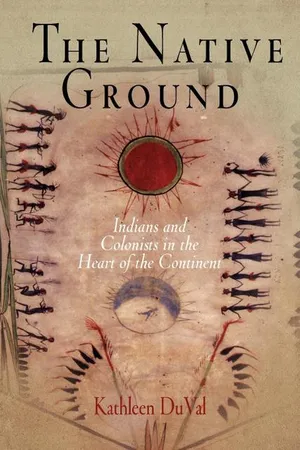
In The Native Ground, Kathleen DuVal argues that it was Indians rather than European would-be colonizers who were more often able to determine the form and content of the relations between the two groups. Along the banks of the Arkansas and Mississippi rivers, far from Paris, Madrid, and London, European colonialism met neither accommodation nor resistance but incorporation. Rather than being colonized, Indians drew European empires into local patterns of land and resource allocation, sustenance, goods exchange, gender relations, diplomacy, and warfare. Placing Indians at the center of the story, DuVal shows both their diversity and our contemporary tendency to exaggerate the influence of Europeans in places far from their centers of power. Europeans were often more dependent on Indians than Indians were on them.
Now the states of Arkansas, Oklahoma, Kansas, and Colorado, this native ground was originally populated by indigenous peoples, became part of the French and Spanish empires, and in 1803 was bought by the United States in the Louisiana Purchase. Drawing on archaeology and oral history, as well as documents in English, French, and Spanish, DuVal chronicles the successive migrations of Indians and Europeans to the area from precolonial times through the 1820s. These myriad native groups—Mississippians, Quapaws, Osages, Chickasaws, Caddos, and Cherokees—and the waves of Europeans all competed with one another for control of the region.
Only in the nineteenth century did outsiders initiate a future in which one people would claim exclusive ownership of the mid-continent. After the War of 1812, these settlers came in numbers large enough to overwhelm the region's inhabitants and reject the early patterns of cross-cultural interdependence. As citizens of the United States, they persuaded the federal government to muster its resources on behalf of their dreams of landholding and citizenship.
With keen insight and broad vision, Kathleen DuVal retells the story of Indian and European contact in a more complex and, ultimately, more satisfactory way.
- 336 pages
- English
- ePUB (mobile friendly)
- Available on iOS & Android
eBook - ePub
About this book
Information
Chapter 1
A Bordered Land, to 1540
The Arkansas River begins in the West, high up in the Rocky Mountains. For hundreds of miles, it crosses dry plains and prairies, now the states of Kansas and north-central Oklahoma. In the central Arkansas Valley, the channel narrows to cut between the blue-green Boston Range of the Ozark Mountains and the rolling green Ouachita Mountains, now eastern Oklahoma and western Arkansas. Finally, in the marshy lower Arkansas Valley, smaller creeks and ox-bow lakes merge with the main stream, as it winds along the lowlands to the Mississippi. The White River flows sharply southeast to meet the Arkansas's mouth. Other deltas lie to the north and south, all part of the lower Mississippi Alluvial Valley. The St. Francis River enters the Mississippi at the current state border of Arkansas and Missouri. Farther north, the Missouri River runs roughly parallel to the Arkansas River from the Rockies to the Mississippi. The Ouachita River crosses southern Arkansas and northeastern Louisiana, and the Red River lies farthest south. Across the Mississippi, the Ohio River, and from it the Wabash, Cumberland, and Tennessee rivers, connect the Mississippi to the eastern half of the continent.
Archaeological evidence indicates that at least 10,000 years ago people lived along the Arkansas River and in surrounding hills and mountains. It is difficult to reconstruct the history of people who left no written or oral records. Still, archaeological findings combined with written accounts from the Hernando de Soto and Francisco Vázquez de Coronado expeditions of 1541 reveal some of the ways the native peoples of earlier centuries lived and interacted with one another and make it possible to imagine how those practices developed. Historians of the colonial period often assume that Europeans brought unprecedented change. In reality, change and cross-cultural exchange are as old as human residence in the Americas.
* * *
We do not know why the first people settled in the mid-continent. They may have come to hunt the region's giant bison, mammoth, mastodon, and deer. The earliest settlers may also have come for reasons we can only imagine, pushed by conflict or overpopulation wherever they had lived before or pulled by prophecies or charismatic leaders. Whatever their reasons for coming, by 7000 B.C. their population had grown through immigration and natural increase. The region certainly abounded in natural resources. For food and apparel, the upper Arkansas Valley provided bison, which wandered eastward from the Plains in the hot summer to cool themselves in the shaded woods of the central valley. In the mountains and valleys, deer, elk, turkeys, beavers, bears, wildcats, woodchucks, foxes, squirrels, rabbits, opossums, muskrats, and raccoons fed the central valley's people. In fields and forests, people found hickory nuts, acorns, black walnuts, pecans, poke, lamb's-quarter, wild potatoes, sunflower seeds, mulberries, Jerusalem artichokes, and wild onions. The river and the lower valley's swamps provided fish, mussels, turtles, and frogs. Ducks and geese migrated along the marshlands of the Mississippi flyway. People established hundreds of settlements, from the Mississippi to the Plains, and from the Ozark Mountains north of the Arkansas to the Ouachita Mountains in the south.1
As the population increased, different groups of people began encountering one another more often as they visited seasonal resource bases. Fall and winter ranges for hunting began to overlap. If one band burned brush at the edge of a forest to clear space for plants that deer liked to eat, those hunters would have been frustrated to find others killing deer that their own practices had lured there. Seasonal harvests probably brought groups into contact and potential conflict. Discovering that another group had picked clean one's summer blackberry, raspberry, dewberry, or muscadine patch must have been particularly disappointing. Arkansas Valley persimmons grow and ripen in the summer and fall, staying unbearably tart until first frost opens a short window for harvesting the sweet fruit before it rots on the ground. Bands who knew the place and time for the persimmon harvest had to determine how to share or win the fruit. High-quality chert for knife and spear blades pervades mountains above the central Arkansas Valley but is hard to find farther downriver. When the land became warmer and drier after about 6000 B.C., people began to cluster near the region's rivers, bringing them into closer contact. Living, hunting, harvesting, and quarrying at the same places and times created the potential for conflict among groups of people and the need for establishing ways of communicating and negotiating with neighbors, ways that were established and surely repeatedly transformed over the millennia before A.D. 1500. Thus, borders and land use rights were negotiated.2
North Americans developed common methods of establishing and maintaining connections across cultural and spatial borders. The centerpiece of native North American interactions was exchange. By no means sporadic or inconsequential, exchange was regular, formalized, and ritualized. Friendly peoples exchanged food, raw materials, manufactured goods, news, marriage partners, religious practices, technological innovations, and philosophical, economic, political, and diplomatic ideas. In contrast, enemies refused to exchange in mutually beneficial ways but rather raided one another for non-consensual and non-reciprocal exchange items, including captives. And enemies and friends were not permanent categories. A peace ceremony could transform enemies into friends, and a surprise raid or unresolved murder could do the opposite.3
By the time that Europeans arrived, certain cross-cultural practices were so widespread that it is reasonable to surmise that they developed during these earlier millennia of interaction. One of the earliest needs must have been to establish friendly intentions with those speaking a different language and practicing inscrutable customs. Experiments with sharing food and a smoke, singing songs that the singers hoped sounded friendly, and giving gifts probably grew in complexity and standardization through repetition. Residents surely instructed newcomers in the methods of diplomacy. As societies rubbed against one another across the continent, North Americans generally came to recognize distinct signs as proposals for communication or for combat. Leaders, negotiators, and guests probably gave one another blankets, skins, fish, venison, and even sexual partners as signs of good will for centuries before their descendants gave similar goods to Europeans.4
As natives of the mid-continent walked and canoed to and from perennial food-gathering and hunting sites, these paths became routes of trade as well. A need for allies and a desire for a variety of foods, tools, apparel, and information must have brought representatives from various peoples into exchange relationships that transformed initial gift exchanges into perpetual, reciprocal trading partnerships. People living near the mountains would have found it convenient to give their local ores to a riverside people in exchange for feathers and dried fish, and a trade in food could insure against times of famine. In addition to efficiency, regional specialization furthered communication and mutual reliance, reducing violent clashes over resources or territory.5
Trade both lessened conflict over borders and made them more evident. If one group became known as a purveyor of quartz, for example, its geographic borders and identity became more distinct. This group became identified as the people whose lands included the quarries and who operated as quartz miners and processors.
Desire for goods was part of the reason for trade, but power probably played an even greater role, especially over time. North Americans came to believe that power resulted from extensive connections. A wide network of diplomatic exchange brought in powerful goods and knowledge and could potentially raise allied armies in times of war. Self-sufficiency—material or spiritual—was anathema to most North Americans. The common conception of Indians as isolated before colonization and then “dependent” once tempted by European goods is grossly inaccurate. To be isolated was always to court disaster.
Perhaps through contact with neighbors who had trade connections in the opposite direction, exchange routes expanded. Seashells from the Gulf of Mexico and copper from the Great Lakes reached the Arkansas Valley by 3000 B.C. Arkansas Valley residents probably received copper and shells in exchange for chert, quartz, deerskins, mussels, and freshwater pearls. Some traders traveled long distances, but most goods probably spread through reciprocal trades from society to society, as local traders exchanged both exotic and indigenous goods. Local and long-distance trade passing through the Arkansas Valley eventually included, at various times, stone axe heads and spear blades, cloth woven from plant fibers and animal hairs and colored with plant dyes, finely crafted wooden bowls, cane baskets, conch shell cups, rattles made by sealing pebbles in turtle shells, ceramic figurines, animal skins and furs, dried meat and fish, corn, beans, salt, engraved and polished beads, necklaces and breastplates made of copper and shell, carved stone animal pendants, raw materials such as North Carolina mica and obsidian from the West, and human exchanges, including marriage partners and captives.6
Over time the network stretched from the Great Lakes, down the Mississippi, out the Arkansas, Missouri, and Red rivers to the Plains and the Rockies, up the Ohio and Tennessee rivers to the Appalachians, and across the Southeast. It spanned thousands of square miles and reached, at the least, hundreds of thousands of people. The large volume of goods, including many of heavy stone, required the dugout canoes that European explorers saw in the sixteenth century. The largest canoes could carry scores of people and probably hundreds of pounds of goods up and down the rivers of the Mississippi basin and possibly around the Gulf. As they were to do with Europeans in later centuries, Indians exchanged goods that they wanted and needed.7
By 1500 B.C., the region that is now northern Louisiana began to manufacture goods on a large scale. Archaeologists have given this society the unfortunate name of Poverty Point (certainly not what its people called their home). In response to this new society's demand for raw materials, people living in the mountains around the Arkansas Valley became some of the largest exporters of minerals in North America. The Ozarks provided chert for blades and dart points and red and black iron oxide ores, which were ground into a powder to color tattoos or to mix with grease for body paint. The Ouachita Mountains south of the Arkansas yielded sandstones, various iron oxides, and bauxite. People of both mountain ranges mined vast amounts of silvery galena to make decorative sparkles and silvery paint. Arkansas Valley miners distributed quartz crystals, prisms, and pyramids in a variety of shapes and colors—clear, white, rose, purple, smoky gray, black, and dark red. Goods traveled back and forth on the path later called the Natchitoches Trail.8
In addition to goods, people also made exchanges that were less tangible and harder to reconstruct from archaeological remains. Because groups spoke different languages, some individuals learned other languages, thereby facilitating exchange of information. They may also have exchanged craftworkers, students, apprentices, and items that have not occurred to us. Commonalities across contemporary cultures reveal that cross-cultural conversation spread ideas about technology. Neighbors shared information about what plants could be eaten and how they tasted best. Innovative fishermen showed others how to construct sturdy nets and to bait multiple hooks on trotlines. An arrow in the body was an abrupt and painful way to learn of one's neighbor's technological innovation. Due to their evident utility for hunting and warfare, the bow and arrow were ubiquitous by the eighth century, and manufacturers adapted bow technology to create a new drill for bead-making.9
Similarly, over thousands of years, the ancestors of the women whom Europeans observed farming in the colonial period developed new ways of preparing food. Several thousand years B.C., women who had previously simply cooked directly in or over a fire began to heat stones and drop them into wooden containers filled with water to boil vegetables and meat products. The use of cooking stones spread, but using them was a laborious business, requiring the cook repeatedly to heat and add stones. By 1300 B.C. in the lower Mississippi River bottoms, women adopted a new kind of vessel, coiled pots. Baking the clay made the vessels sturdy and fireproof so that they could sit directly in the fire for boiling or roasting foods, but they cracked at high temperatures. With countless trials and errors and advice from other experimenters, potters developed methods of tempering clay to prevent cracking by adding plant fibers, sand, or finely ground minerals.10
As ceramics and ideas about their manufacture spread, so did a new technology that would have even more significant effects, agriculture. First, gourds and advice on growing them reached the Arkansas Valley. By 2000 B.C., women in the Mississippi Valley began to apply domesticating techniques, gathering and replanting seeds and weeding around them, to local plants—greens, sunflowers, and possibly tobacco. They found that the rivers of the mid-continent provided annual floods that replenished the soil, making their banks ideal for hoe agriculture. And they learned plant selection. Farmers extracted and planted seeds from the largest gourds in order to grow large containers. They chose seeds from the fleshiest squashes to cultivate better food. They planted the largest sunflower seeds for plentiful oil and eating.11
In the early centuries of the first millennium A.D., farmers in the midcontinent added corn, a crop developed in Mexico that spread to the Southwest before the turn of the millennium. Across the Americas, farmers gradually expanded corn production and developed different varieties to increase kernel and cob size and yields and to fit regional water and sunlight conditions. Farmers learned that reused fields declined in productivity over the years and, in response, developed methods of renewing depleted fields. Each spring, they burned the previous year's debris and tilled the ashes into the soil. Cooks developed ways of preparing corn, including grits and cornbread, sometimes flavored with persimmons and other dried fruit.12
Manufacturing and using new inventions in turn necessitated new trade goods, such as the strong and supple wood of the Osage Orange tree, which made an excellent bow. Cornstalks supported a new crop, beans, which complemented the nutritional value of corn by completing its protein and warding off pellagra, for which purpose North Americans also began to trade lime to cook with corn to make hominy. Squash plants provided weed control and additional vitamins and flavor. Field agriculture spawned at least one strikingly centralized manufacturing and distribution process, the great Mill Creek hoe and spade industry. Beginning around A.D. 700, miners quarried the hills of southern Illinois for stone to craft into hoe and spade blades, which they exported up and down the Mississippi to farmers throughout central and southeastern North America, as far northeast as Lake Erie and as far west as the eastern Plains. Farmers strapped the blades onto wooden handles, used them to cultivate and harvest their crops, sharpened them when they became dull, and carefully stored them in pits during the winter. Strong and well-crafted, these hoes and spades edged out older shell and limestone hoes and established for the Mill Creek people a monopoly and a reputation as the manufacturers of hoes and spades. Within other societies, possession of a Mill Creek hoe may have signified status and power over agricultural distribution.13
One of the most commonly exchanged articles served ritual and diplomacy as well as pleasure, the pipe. When the French first came to the Mississippi Valley, nearly every Indian they met knew the calumet—a feathered shaft attached to a pipe bowl—as a symbol with so much symbolic power that Europeans began to carry their own to use for the same purpose, either making peace or sealing an alliance against a common enemy. The thousands of pipes found in ancient remains across the region reveal that the pipe became an important cross-cultural symbol in the Arkansas Valley by at least A.D. 1500. If the visitors brought the calumet, they may have expected that their generosity in leaving the beautiful symbol behind would commemorate the alliance for years to come.14
None of this is to say that exchange continuously increased in variety and volume from 8000 B.C. until the sixteenth century. In reality, trade ebbed and flowed in different places, as societies rose and fell and as culture and politics changed. For example, when the Poverty Point culture declined around 700 B.C., demand for Ozark and Ouachita Mountain natural resources fell. Goods likely served many and changing purposes, including utility, fashion, prestige, and spirituality. Scarcity and distance increased the goods’ value. Much of the jewelry and decorative objects that archeologists have uncovered in the South is copper, far from the Great Lakes copper mines. In contrast, in the northern Mississippi Valley far from the sea, artifacts are more often of shell. In many archaeological sites in the Arkansas Valley, halfway between, both copper and shell abound.15
Long before the sixteenth century, standardized practices of cross-cultural relations had spread widely, including the link between diplomacy and exchange. It seems likely that people quickly found that, when they lived in proximity to other peoples, stable trading and gifting relationships could maintain peace along their borders. For Arkansas Valley residents and their neighbors, exchange both reflected and proved friendly intentions, and friendly relations involved goods exchange. By de Soto's and Coronado's 1541 visits, sharing food and gifts clearly expressed friendship between distinct peoples, an especially important function when language differences complicated spoken communication. Visitors gave presents to express their friendship and their gratitude for the hospitality.16
At some point in the evolution of diplomacy in North America, cross-cultural negotiation became a generally male role, while the material aspects of hosting beca...
Table of contents
- Cover Page
- Title Page
- Copyright Page
- Dedication Page
- Contents
- List of Illustrations
- Introduction
- 1 - A Bordered Land
- 2 - Hosting Strangers
- 3 - Negotiators of a New Land
- 4 - An Empire in the West
- 5 - New Alliances
- 6 - Better at Making Peace Than War
- 7 - A New Order
- 8 - The End of the Native Ground?
- Conclusion
- List of Abbreviations
- Notes
- Index
- Acknowledgments
- Back Cover
Trusted by 375,005 students
Access to over 1.5 million titles for a fair monthly price.
Study more efficiently using our study tools.
Frequently asked questions
Yes, you can cancel anytime from the Subscription tab in your account settings on the Perlego website. Your subscription will stay active until the end of your current billing period. Learn how to cancel your subscription
No, books cannot be downloaded as external files, such as PDFs, for use outside of Perlego. However, you can download books within the Perlego app for offline reading on mobile or tablet. Learn how to download books offline
Perlego offers two plans: Essential and Complete
- Essential is ideal for learners and professionals who enjoy exploring a wide range of subjects. Access the Essential Library with 800,000+ trusted titles and best-sellers across business, personal growth, and the humanities. Includes unlimited reading time and Standard Read Aloud voice.
- Complete: Perfect for advanced learners and researchers needing full, unrestricted access. Unlock 1.5M+ books across hundreds of subjects, including academic and specialized titles. The Complete Plan also includes advanced features like Premium Read Aloud and Research Assistant.
We are an online textbook subscription service, where you can get access to an entire online library for less than the price of a single book per month. With over 1.5 million books across 990+ topics, we’ve got you covered! Learn about our mission
Look out for the read-aloud symbol on your next book to see if you can listen to it. The read-aloud tool reads text aloud for you, highlighting the text as it is being read. You can pause it, speed it up and slow it down. Learn more about Read Aloud
Yes! You can use the Perlego app on both iOS and Android devices to read anytime, anywhere — even offline. Perfect for commutes or when you’re on the go.
Please note we cannot support devices running on iOS 13 and Android 7 or earlier. Learn more about using the app
Please note we cannot support devices running on iOS 13 and Android 7 or earlier. Learn more about using the app
Yes, you can access The Native Ground by Kathleen DuVal in PDF and/or ePUB format, as well as other popular books in History & Early American History. We have over 1.5 million books available in our catalogue for you to explore.