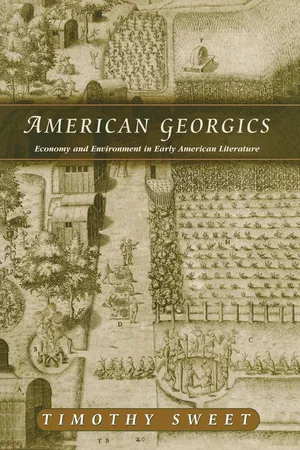
In classical terms the georgic celebrates the working landscape, cultivated to become fruitful and prosperous, in contrast to the idealized or fanciful landscapes of the pastoral. Arguing that economic considerations must become central to any understanding of the human community's engagement with the natural environment, Timothy Sweet identifies a distinct literary mode he calls the American georgic.
Offering a fresh approach to ecocritical and environmentally-oriented literary studies, Sweet traces the history of the American georgic from its origins in late sixteenth-century English literature promoting the colonization of the Americas through the mid-nineteenth century, ending with George Perkins Marsh's Man and Nature (1864), the foundational text in the conservationist movement.
- 232 pages
- English
- ePUB (mobile friendly)
- Available on iOS & Android
eBook - ePub
About this book
Information
Publisher
University of Pennsylvania PressYear
2013Print ISBN
9780812236378
9780812236378
eBook ISBN
9780812203189
Chapter 1
Economy and Environment in Sixteenth-Century Promotional Literature
We owe the first recorded moment of ecological insight in British North America to Stephen Parmenius, intended chronicler of Sir Humphrey Gilbert’s ill-fated second voyage of 1583.1 Gilbert, hoping to establish a colony in what is now New England, stopped off for provisions at St. John’s harbor, Newfoundland, where an international fishing fleet had made its base. According to the terms of his patent, Gilbert took possession of the territory on which the fishermen had established drying stations and let these lands back to them as his tenants. Anxious to search for ores and other resources that could support a colony, Gilbert and company found it difficult to get inland. Parmenius reported, in a letter to the younger Richard Hakluyt, that the thick pine forest, clogged with trees “fallen by reason of their age, doth so hynder the sighte of the Lande, and stoppe the way of those that seeke to travell, that they can goe no whither.” 2 To gain an unobstructed view and entry into the interior, Parmenius urged Gilbert to burn the woods near shore, but Gilbert refused, “for feare of great inconvenience that might thereof insue: for it was reported and confirmed by verie credible persons, that when the like happened by chance in another Port, the fish never came to the place about it, for the space of 7. whole yeere after, by reason of the waters made bytter by the turpentyne, and rosen of the trees, which ranne into the ryvers upon the fyring of them.” 3 We can infer that it was not pine sap but soil erosion from the burned-off shore that polluted the estuary for seven years, until new growth stabilized the banks.4 Gilbert and his crew, however, interpret this “verie credible” story of environmental interaction in a different way, seeing therein a relationship among the commodities of the New World. They imagine so much sap being released in a fire that it cannot burn off but instead renders enormous amounts of “turpentyne” and “rosen.”5 The superfluity of these commodities courses down the banks, turning the water “bytter” and obstructing the harvest of another commodity, fish.
Reading Parmenius’s letter from Newfoundland, we imagine what Gilbert imagined—a narrative of environmental change—but we understand its causal mechanism differently. This difference alerts us to Gilbert’s interest in the economic dimension of environmental representation. Economy enters Gilbert’s environmental understanding under the category of “commodity,” which to him means both a specific good or resource and, more generally, due measure, fitness, or convenience. As the younger Hakluyt would argue in the “Discourse of Western Planting” (1584), the “manifolde comodyties that are like to growe to this Realme of Englande by the Westerne discoveries lately attempted” included economic recovery, full employment, trade with indigenous Americans, discovery of a northwest passage, geopolitical advantage relative to Spain and other European nations, the extension of Christendom, the glory of the Crown, and so on, as well as the particular natural resources that might be found there (O, 2:211). Promising new possibilities for commodity in the most general sense, then, the American environment invited the English to develop a new mode of political economy, one that theorized economics in terms of environmental capacity in a way that the then dominant mode, agrarianism, had not yet done.
Early promotional literature’s fundamental linkage of economics and environment invites us to read the genre in terms of steady-state or sustainable economic theory.6 Sustainable economics works in systemic terms, describing the economy as an open subsystem of the ecosystem: the economy “tak[es] in useful (low-entropy) raw material and energy” from the natural environment while “giving back waste (high-entropy) material and energy” for the natural environment to absorb and, to some extent, “reconstitute . . . into reusable raw materials.”7 Sixteenth-century promoters anticipated such concerns about inputs, outputs, and boundaries. Participating in the consolidation of economics as a distinct field during the latter part of the sixteenth century, the promoters began to define the English nation as an economy and to understand that nation-economy as a system.8 In tracts promoting colonization, they argued that the well-being of the realm depended on opening this system to New World environments and, in certain respects, closing it off from other Old World economic systems.9 Speculating on the expansion, boundaries, and limits of the economy, they redefined existing economic terms such as “commodity,” “waste,” and “vent” in relation to the capacities of this newly discovered environmental context. With respect to input, one of the primary concerns of sustainable economics, the early promoters argued that more resources—more oil, more timber, more wine and gold, and so on—had to be brought into the English economy, but now from New World environments rather than Old World trading partners. As for output, the early promoters were not in a position to theorize the accumulation of antiproductive waste, since early modern technologies did not stress the environment’s absorptive capacity in the way that today’s technologies do.10 Even so, in both seeing the New World as an outlet for one kind of “waste,” people, and speculating on the transformation of waste into productive resources, they pointed toward sustainable economics’ understanding of output in relation to environmental absorption and transformation.
Where subsequent economic thought would separate the domain of economy from that of the environment in order to enable the analysis of economies as closed systems (as I will indicate in the conclusion to this chapter), early promotional texts theorize a systemic relationship between the two domains. Seen in this light, these texts compel the attention of anyone interested in ecocritical and environmental issues, even though they are not what we would call “green” texts.11 They are not “ecocentric.”12 Nor are they antigrowth; on the contrary, in a proto-Lockean recognition that wealth derives from the human transformation of the environment, the sixteenth-century promoters articulated the paradigm of growth that has since become naturalized in political and economic discourse.13 However, they did not promote economic growth as an end in itself, but always directed growth toward a larger social end, a public good such as relieving poverty, providing full employment, or maintaining sociopolitical stability. Since sustainable economics is primarily interested in determining the environmental limits on growth in a way that will promote the public good, it provides a useful apparatus for understanding the colonial promoters’ own theorization of growth and Americans’ subsequent economic engagements with the environment.
The early promoters describe the late sixteenth-century English economy as entropie, requiring new capacities for input and output. Sustainable economics defines potential inputs and outputs as ultimately finite, arguing that the economy cannot continue to grow indefinitely without detrimental results for the public good, but “may continue to develop qualitatively” without growing; defining the nature of this “qualitative” development poses the one of the discipline’s central problematics.14 Thus while one critique of reading these early texts in relation to sustainable economics is obvious—for it is not clear whether the promoters recognized absolute environmental limits as such—this point should not dissuade us from thinking through their originating insight. This insight, which became invisible to subsequent economists until sustainable economics brought it into view again, was to theorize the link between economic development and environmental capacities and to assess that link in terms of the public good.
Colonization Theory
England’s first theoretical text on colonization, Sir Thomas More’s Utopia (1516), found its inspiration in the Columbian discovery and located its idealized political economy in the New World but showed little interest in the material specificity of New World environments. In one respect anticipating the arguments of Thomas Jefferson and Frederick Jackson Turner, More developed a theory of the frontier as safety valve, describing colonization as the best solution to overpopulation and thus a means by which an ideal society could be maintained. When the population of More’s Utopia exceeds a fixed quota, citizens colonize the “nexte lande where the inhabitauntes haue muche waste and vnoccupied grounded15 The Utopian economic base, which resembles that of agrarian England in important respects, is replicated on this “waste” land. Such a view of colonization established an assumption that would become crucial in legitimating the appropriation of indigenous Americans’ land: it is assumed the natives have not cultivated the land; they can either join with the Utopians, who will make the land abundantly productive, or they can resist colonization, in which case they are driven off by war. The Utopians consider it just to wage war to bring “voyde and vacaunt” land into cultivation, for “bye the lawe of nature” such land ought to “nowryshe” and “relieue” human life rather than being allowed to remain “to no good nor profitable vse” (U, 67). While it would be some time before the English prosecuted such a war of conquest in America, More’s passage on colonization registers the important characterization of New World land as waste, even though inhabited, which was taken up by the late sixteenth-century promoters.
More’s Utopians do not colonize to gain commodities for import or trade, since the realm produces abundant quantities of all goods which are free for the taking in the marketplaces. Nevertheless, complications introduced by their import of iron, gold, and silver suggest a conflict between two ideologies of national wealth in sixteenth-century England, the dominant agrarianism and emergent mercantilism.16 Like the natives in More’s source text, Vespucci’s account of the New World, the Utopians are supposed to regard gold and silver as valueless within their own society.17 They use these metals to fashion chamber pots and chains for slaves, storing them in these forms in case they should need them to pay tribute to avoid a war. Yet the paradox involved in their “ritual debasement” of these metals suggests, as numerous commentators have pointed out, the repression of a desire for their evidently innate value.18 Thus while More advances the Utopian theory of colonization in the name of agrarianism—here an ideology of pure use value in which iron is valuable but gold and silver are not—the Utopians’ import of precious metals hints, if only by way of prohibition, at an ideology in which trade is the primary source of wealth. Even on the surface, however, it is clear that they need to import gold and silver in order to conduct their foreign policy. These metals in fact acquire value in protecting the Utopians’ national sovereignty, thus enabling them to maintain the stability of their agrarian political economy. Importing the iron necessary for agriculture and manufacturing seems less politically charged, but in one respect it is even more revealing; it indicates that their agrarian economy is fundamentally dependent on trade, though the Utopians do not fully realize this dependence.19
To pursue the analogues in contemporary England: colonization practice embodied agrarian theory during most of the sixteenth century in the effort to colonize Ireland, which the English represented as a waste region inhabited by an uncivilized people.20 At the same time, mercantilism was beginning to describe the English economy’s dependence on trade, but had not yet theorized colonialism as a means of securing new sources of inputs. The most important sixteenth-century mercantilist text, A Discourse of the Commonweal (written 1549, revised c. 1576, published 1581), identified a negative balance of trade in England. Yet even in the face of evidence that Spanish gold from the New World was a significant cause of the problem, this treatise proposed purely domestic means to correct the imbalance, “first, by staying of wares wrought beyond the sea which might be wrought within us from coming to be sold; secondly, by staying of our woolens, tins, and fells, and other commodities from passing over unwrought,” and finally by instilling good order among the laboring classes.21 Some commodities must always be imported, “since men will needs have silks, wine, and spice,” but if England’s manufactures were sufficiently developed, the overall balance of trade with other Old World nations would promote economic recovery.22
Input: “Commodity”
Beginning in the late 1570s, the elder and younger Hakluyts and their cohort grafted this emergent mercantilist ideology onto the existing agrarian theory of colonization in order to articulate, in the new literary genre of the promotional tract, a new practice that would redress the balance of trade and related problems. These writers shared a particular economic narrative regarding New World environments. England, they argued, was suffering from the decline of its textile industry. More raw wool and less finished cloth was being exported to uncertain and diminishing markets, while imports of other goods had remained steady or increased. Moreover, in the absence of disease and war, the population was increasing. The result was widespread unemployment and unrest, and the general impoverishment of the realm. Colonization would provide a solution to all of these interlinked problems: America’s indigenous population could be induced to trade for finished cloth and/or a large enough colony of English settlers would provide such a New World market. In return for cloth, the New World promised to supply all the commodities that England was currently importing or hoping to import from their enemies or doubtful friends (Spain, Portugal, France, the Levant, Russia, etc.) and at cheaper rates. Some of the poor could be transported to the colonies, where they would find employment in commodity production, while those who remained in England would find employment in both a revitalized wool trade and new industries based on adding value to import commodities from New World environments.
The promoters’ first and most obvious step was to identify specific new sources of input. Thus the memorandum that the elder Richard Hakluyt prepared in 1578 for Sir Humphrey Gilbert’s first voyage advises prospective colonists to “discover al the naturall commodities” of the country and then proceeds to discuss means of production (O, 1:118). If, for example, “the soyle and clymate bee such as may yeelde you the Grape as good as that” in Portugal, Spain, or the Canaries, “then there resteth but a woorkeman to put in execution to make wines, and to dresse Resigns of the sunne” (O, 1:118).
Unlike More’s Utopians, the Hakluyts and their cohort see colonizable environments as both empty and full. The Utopians replicated their agrarian political economy by colonizing the “waste,” “voyde and vacaunt” land held by less civilized peoples. The promoters similarly propose colonizing what they called the “waste Contries” of the New World, but they emphasize not the vacancy but the fullness of these new environments (O, 2:319). They regard the indigenous inhabitants less as people to be conquered than as prospective trading partners. They value the physical environment for what it produces naturally as well as for what it could be made to produce. Following classical climatology, the promoters assume that latitude predicts weather and other environmental factors (climata being the classical geographic term for latitudinal bands of the globe), so that Old World environments could simply be mapped laterally onto New.23 Surveying extant reports on climate in his compendious “Discourse of Western Planting,” the younger Hakluyt argues “that this westerne voyadge will yelde unto us all the commodities of Europe, Affrica and Asia, as farr as we were wonte to travell” in p...
Table of contents
- Cover
- Title
- Copyright
- Dedication
- Contents
- Introduction
- 1. Economy and Environment in Sixteenth-Century Promotional Literature
- 2. “God Sells Us All Things for Our Labour”: John Smith’s Generall Historie
- 3. “Wonder-Working Providence” of the Market
- 4. “Admirable Oeconomy”: Robert Beverley’s Calculus of Compensation
- 5. Ideologies of Farming: Crèvecoeur, Jefferson, Rush, and Brown
- 6. Cherokee “Improvements” and the Removal Debate
- 7. “Co-Workers with Nature”: Cooper, Thoreau, and Marsh
- Notes
- Works Cited
- Index
- Acknowledgments
Trusted by 375,005 students
Access to over 1.5 million titles for a fair monthly price.
Study more efficiently using our study tools.
Frequently asked questions
Yes, you can cancel anytime from the Subscription tab in your account settings on the Perlego website. Your subscription will stay active until the end of your current billing period. Learn how to cancel your subscription
No, books cannot be downloaded as external files, such as PDFs, for use outside of Perlego. However, you can download books within the Perlego app for offline reading on mobile or tablet. Learn how to download books offline
We are an online textbook subscription service, where you can get access to an entire online library for less than the price of a single book per month. With over 1.5 million books across 990+ topics, we’ve got you covered! Learn about our mission
Look out for the read-aloud symbol on your next book to see if you can listen to it. The read-aloud tool reads text aloud for you, highlighting the text as it is being read. You can pause it, speed it up and slow it down. Learn more about Read Aloud
Yes! You can use the Perlego app on both iOS and Android devices to read anytime, anywhere — even offline. Perfect for commutes or when you’re on the go.
Please note we cannot support devices running on iOS 13 and Android 7 or earlier. Learn more about using the app
Please note we cannot support devices running on iOS 13 and Android 7 or earlier. Learn more about using the app
Yes, you can access American Georgics by Timothy Sweet in PDF and/or ePUB format, as well as other popular books in Literature & North American Literary Criticism. We have over 1.5 million books available in our catalogue for you to explore.