Though debates over immigration have waxed and waned in the course of American history, the importance of immigrants to the nation's identity is imparted in civics classes, political discourse, and television and film. We are told that the United States is a "nation of immigrants," built by people who came from many lands to make an even better nation. But this belief was relatively new in the twentieth century, a period that saw the establishment of immigrant quotas that endured until the Immigrant and Nationality Act of 1965. What changed over the course of the century, according to historian Robert L. Fleegler, is the rise of "contributionism," the belief that the newcomers from eastern and southern Europe contributed important cultural and economic benefits to American society.
Early twentieth-century immigrants from southern and eastern Europe often found themselves criticized for language and customs at odds with their new culture, but initially found greater acceptance through an emphasis on their similarities to "native stock" Americans. Drawing on sources as diverse as World War II films, records of Senate subcommittee hearings, and anti-Communist propaganda, Ellis Island Nation describes how contributionism eventually shifted the focus of the immigration debate from assimilation to a Cold War celebration of ethnic diversity and its benefits—helping to ease the passage of 1960s immigration laws that expanded the pool of legal immigrants and setting the stage for the identity politics of the 1970s and 1980s. Ellis Island Nation provides a historical perspective on recent discussions of multiculturalism and the exclusion of groups that have arrived since the liberalization of immigrant laws.
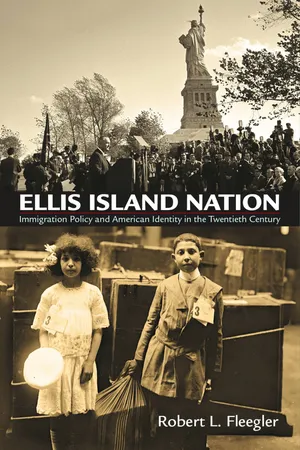
eBook - ePub
Ellis Island Nation
Immigration Policy and American Identity in the Twentieth Century
- 280 pages
- English
- ePUB (mobile friendly)
- Available on iOS & Android
eBook - ePub
Ellis Island Nation
Immigration Policy and American Identity in the Twentieth Century
About this book
Information
Chapter 1
The Beginning of the Era of Restriction
During the debate over immigration restriction in 1924, Representative Samuel McReynolds (D) of Tennessee declared, “This country can no longer be the melting pot for foreign nations. There was a time when that could be done, when conditions were different, but this time has long since passed.” Senator Arthur Capper (R) of Kansas, like many of McReynolds’s colleagues, echoed this concern, saying, “the experience of the last quarter century warns us that the capacity of the ‘melting pot’ is sadly over taxed, and that the fusing has all but ceased.”1 These comments summarized congressional thinking concerning the nation’s ability to assimilate immigrants from southern and eastern Europe in the 1920s. Believing that the newcomers who had arrived since the 1880s could not be integrated into American culture, many demanded that the open door to immigration be closed. Passage of the Johnson-Reed Act of 1924, which dramatically restricted immigration from southern and eastern Europe and Asia, demonstrated that this philosophy had become part of American law.
Only a few objected to the view outlined by restrictionists such as McReynolds and Capper. Even those who tried to “Americanize” the newcomers thought that the “new” immigrants needed virtually to abandon their native culture to assimilate. Some congressmen from the immigrant-heavy cities in the Northeast and Midwest, as well as a few intellectuals and ethnic organizations, dissented from the consensus and praised immigrants from southern and eastern Europe in contributionist terms, arguing that they strengthened the American economy and culture. At the same time, all sides used contributionist language with regard to the Irish and German Americans whose ancestors had arrived in the mid-nineteenth century. While the 1924 immigration law expanded the “nation of immigrants” to include Irish and German Americans, the Ellis Island immigrants remained excluded throughout the 1920s. Asians and Latinos lay even farther outside its boundaries.

During and immediately after World War I, government and private agencies supported efforts to “Americanize” recent immigrants. Various organizations designed programs to ensure that immigrants learned English and understood American traditions. Seeking to make English the de facto official language of the country, the Department of the Interior, through the Americanization section of its Bureau of Education, urged immigrants to take night school classes and suggested employers teach the language in their factories.2 Summarizing the primary aims of the Americanizers, Philander Claxton, commissioner of education, instructed immigrants to “learn the English language and study about the United States. You should study its geography and the location of its states and cities, its history and lives of its great men, its industries and varied business activities, its institutions and the purposes for which they were created, and above all, its government.”3
Americanizers also sought to ensure loyalty among the recent arrivals. Concerned about the ties immigrants maintained to their countries of origin, a wide range of individuals, groups, and organizations expressed grave concerns about potential subversion in immigrant communities during World War I. These fears persisted following the conflict as the Syracuse Americanization League declared its intention “to combat anti-Americanization propaganda activities and schemes and to stamp out sedition and disloyalty wherever found.”4
Though the advocates of these programs broke with the most extreme restrictionists by suggesting that recent newcomers could be assimilated, they took a one-sided view of this transition. In their minds, immigrants must abandon virtually all of their previous traditions to adapt to American culture. Consequently, Americanization programs featured little discussion of how immigrants benefited and reshaped the United States. According to one pamphlet written by a Massachusetts group, Americanization meant learning “a common language, common governmental, social and economic ideals and a common relationship of the aims of the United States in and after the War.”5 Echoing this view, the Syracuse Americanization League advocated the abolition of “racial prejudices, barriers, discriminations and immigrant colonies and sections which keep people in America apart; to maintain an American standard of living through the proper use of American foods.”6
These efforts continued into the early 1920s and followed a similar narrow definition of assimilation. For example, the U.S. Army, under the auspices of the American Legion, worked to incorporate foreign-born soldiers into American society under a program called “Americans All.” This initiative taught recent immigrants English, American history, and civics and saw little place for contributionism. “In this school,” program materials noted, “racial distinctions disappear almost over night—they are all Americans…. Every day, all day, the men live and work in an American atmosphere”7
While most educational programs did not pay respect to immigrant culture, one exception featured elements of contributionism. The Chicago Citizens’ Committee, which was composed of community leaders, wanted to hold an “All-American Exposition” in 1919 to improve relations among all citizens.8 In particular, the organizers wanted “to win for foreign-born citizens of the United States from their fellow-citizens of longer standing recognition and appreciation of their service to this nation through their great contribution to the upbuilding of this country and its institutions.”9
To achieve this goal, the exposition displayed a number of exhibits that would promote the accomplishments of different immigrants. Each ethnic group would have its own day to display its cultural material, though only naturalized citizens would be allowed to participate. The exposition would include “exhibits of works of arts created by Americans of foreign birth and of the arts and crafts that may be a part of our own culture by giving protection and encouragement to those who have brought with them from other lands the knowledge and skill to create these things.”10
The organizers understood that the All-American Exposition represented a departure from previous efforts to incorporate immigrants. According to the group’s internal documents, “No work similar to this in principle has been done hitherto; it constitutes a reversal of the customary attitude toward the foreign-born.”11 Nevertheless, the Bureau of Education approved of the exposition and considered using it as a model for the other large cities. “Our own native born people must widen their sympathies if they ever expect to assimilate these people,” declared Fred Butler, head of the Americanization Division, “They now form the great part of the labor in all our great industries yet we have not considered it worthwhile to make Americans of them.”12
Despite the more inclusive message, not every group appeared to be welcome, as controversy emerged regarding German American involvement in the exposition. Organizers planned to set aside a day for German Americans, just as they did for other ethnic groups. On this day, among a series of events, German American singers would perform “American” songs.13
Coming less than a year after the end of World War I, one participant balked, exclaiming, “German day? Count me out.” In response, one of the organizers defended their involvement in the exposition, arguing that German Americans had made a vital contribution to the war effort. While this response seemed to suggest that wartime passions were fading, the planners officially changed German day to Army day, though German Americans were still allowed to perform the same songs.14
As a commercial enterprise, the All-American Exposition was unsuccessful. Local employers did not provide enough money to support the venture and native-born citizens did not attend in significant numbers. Some suggested that the end of the war had diminished interest in the program, which barely had enough money to complete its run as creditors demanded payment.15 While bemoaning the failure of the event to stimulate interest, a representative of the Department of the Interior praised the spirit of the show, remarking that “the attempt to bring the foreign born and the native born citizens into closer touch, to bring about full public sympathy and understanding between the various peoples of Chicago, is worthy of the highest recommendation.”16
While the All-American Exposition may not have been typical of post-World War I Americanization campaigns, its tactics would be emulated throughout the late 1930s and early 1940s. Government and private agencies would promote contributionism through a series of events using similar techniques, sponsoring festivals where each immigrant group displayed its culture in fairs, radio programs, and other forums.
The same divisions could be observed during the 1924 congressional debate over immigration restriction, as the supporters of restriction espoused a conception of American identity that excluded eastern and southern European migrants. These representatives believed that these groups weakened the nation, both culturally and economically. Only a small minority disagreed and expressed the contributionist viewpoint.
Some congressmen espoused versions of the scientific racism of the time. “We have admitted the dregs of Europe until America has been orientalized, Europeanized, Africanized, and mongrelized,” announced Representative John Tillman (D) of Arkansas, “to that insidious degree that our genius, stability, and greatness, and promise of advancement, and achievement are actually menaced.” Representative Ira Hersey (R) of Maine concurred: “We have thrown open wide our gates and through them have come other alien races, of alien blood, from Asia and southern Europe, the Malay, the Mongolian, the oriental with their strange and pagan rites, their babble of tongues.”17
Others invoked concepts of racial superiority in a slightly more subtle fashion, declaring that northern and western Europeans were solely responsible for the achievements of the United States. Representative William Vaile (R) of Colorado declared, “What we do claim is that the northern Europeans and particularly Anglo-Saxons, made this country.” Earl Michener (R) of Michigan agreed: “The Nordic people laid the foundations of society in America. They have builded this Republic, and nothing would be more unfair to them and their descendants than to turn over this Government and this land to those who had so little part in making us what we are.”18
Representative Charles Stengle (D) of New York reiterated the concerns of McReynolds and Capper: “The fire has apparently gone out under the melting pot and the original American stock is not absorbing these insoluble elements.”19 What evidence was there that the melting pot had failed? To the restrictionists, the mere existence of ethnic communities in the major eastern and midwestern cities was proof enough. To many congressmen, particularly those from the South and the West, any residue of an immigrant’s native traditions proved they had not assimilated into American culture. Restrictionists often cited the proliferation of foreign language newspapers and magazines as evidence of the melting pot’s failure. “One thousand four hundred foreign language newspapers, printed in 40 different languages,” declared Capper, “foster the alien racial solidarity of these groups and set up barriers against Americanization by encouraging and perpetuating foreign customs and alien prejudices.”20
Restrictionists also feared that the large concentration of “new” immigrants would eventually be able to outvote native-born citizens. Representative Jasper Tincher (R) of Kansas presented this argument in its most extreme form: “On the one side is beer, Bolshevism, unassimilating settlements, and perhaps many flags. On the other side is constitutional government; one flag, the Stars and Stripes; America, ‘a government of, by, and for the people’; America, our country.”21 Immigrant political power particularly concerned the staunch restrictionists because they were convinced that the new arrivals were disloyal. Vaile even questioned the allegiances of his congressional colleagues: “Now of course the 9 percent of the population of crowded New York City which sent our friends, Mr. Sullivan and Mr. Dickstein, to Congress are Americans, and I am sure they are good Americans. But they have the interests of other countries in mind.”22
To the restrictionist, any remaining affection on the part of immigrants for their compatriots or display of ethnic solidarity was simply evidence of a lack of patriotism. The restrictionists were particularly disturbed by the presence of ethnic organizations such as the Sons of Italy. Representative James Taylor (R) praised the willingness of the small number of immigrants in his native Tennessee to completely abandon Old World ties: “Our foreign born immediately and in good faith renounces his allegiance to the fatherland; he learns our language, adopts our customs, sends his children to our public schools.”23
Outside Congress, some interest groups sympathized with the restrictionists. American Federation of Labor (AFL) president Samuel Gompers, like Taylor, questioned the patriotism of recent arrivals who opposed new limits, suggesting they were behaving “not as Americans, but as aliens, loyal only to the country of their birth.” “The plain truth,” the aging labor leader added, “is that the attitude of a large number of racial groups in the United States toward restrictive immigration furnishes the best and most ...
Table of contents
- Cover
- Title
- Copyright
- Contents
- Introduction
- Chapter 1. The Beginning of the Era of Restriction
- Chapter 2. Contributionism in the Prewar Period
- Chapter 3. The Quest for Tolerance and Unity
- Chapter 4. How Much Did the War Change America?
- Chapter 5. The Reemergence of Contributionism
- Chapter 6. The Cold War and Religious Unity
- Chapter 7. The Triumph of Contributionism
- Epilogue: “How great to be an American and something else as well”
- Notes
- Bibliography
- Index
- Acknowledgments
Trusted by 375,005 students
Access to over 1.5 million titles for a fair monthly price.
Study more efficiently using our study tools.
Frequently asked questions
Yes, you can cancel anytime from the Subscription tab in your account settings on the Perlego website. Your subscription will stay active until the end of your current billing period. Learn how to cancel your subscription
No, books cannot be downloaded as external files, such as PDFs, for use outside of Perlego. However, you can download books within the Perlego app for offline reading on mobile or tablet. Learn how to download books offline
Perlego offers two plans: Essential and Complete
- Essential is ideal for learners and professionals who enjoy exploring a wide range of subjects. Access the Essential Library with 800,000+ trusted titles and best-sellers across business, personal growth, and the humanities. Includes unlimited reading time and Standard Read Aloud voice.
- Complete: Perfect for advanced learners and researchers needing full, unrestricted access. Unlock 1.5M+ books across hundreds of subjects, including academic and specialized titles. The Complete Plan also includes advanced features like Premium Read Aloud and Research Assistant.
We are an online textbook subscription service, where you can get access to an entire online library for less than the price of a single book per month. With over 1.5 million books across 990+ topics, we’ve got you covered! Learn about our mission
Look out for the read-aloud symbol on your next book to see if you can listen to it. The read-aloud tool reads text aloud for you, highlighting the text as it is being read. You can pause it, speed it up and slow it down. Learn more about Read Aloud
Yes! You can use the Perlego app on both iOS and Android devices to read anytime, anywhere — even offline. Perfect for commutes or when you’re on the go.
Please note we cannot support devices running on iOS 13 and Android 7 or earlier. Learn more about using the app
Please note we cannot support devices running on iOS 13 and Android 7 or earlier. Learn more about using the app
Yes, you can access Ellis Island Nation by Robert L. Fleegler in PDF and/or ePUB format, as well as other popular books in History & North American History. We have over 1.5 million books available in our catalogue for you to explore.