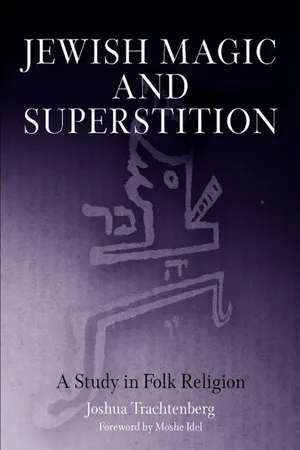
Alongside the formal development of Judaism from the eleventh through the sixteenth centuries, a robust Jewish folk religion flourished—ideas and practices that never met with wholehearted approval by religious leaders yet enjoyed such wide popularity that they could not be altogether excluded from the religion. According to Joshua Trachtenberg, it is not possible truly to understand the experience and history of the Jewish people without attempting to recover their folklife and beliefs from centuries past.
Jewish Magic and Superstition is a masterful and utterly fascinating exploration of religious forms that have all but disappeared yet persist in the imagination. The volume begins with legends of Jewish sorcery and proceeds to discuss beliefs about the evil eye, spirits of the dead, powers of good, the famous legend of the golem, procedures for casting spells, the use of gems and amulets, how to battle spirits, the ritual of circumcision, herbal folk remedies, fortune telling, astrology, and the interpretation of dreams.
First published more than sixty years ago, Trachtenberg's study remains the foundational scholarship on magical practices in the Jewish world and offers an understanding of folk beliefs that expressed most eloquently the everyday religion of the Jewish people.
- 392 pages
- English
- ePUB (mobile friendly)
- Available on iOS & Android
eBook - ePub
About this book
Information
Topic
Teología y religiónSubtopic
Teología judíaNOTES
All Talmudic references are to the Babylonian Talmud except where a prefixed J. indicates the Jerusalem Talmud
CHAPTER I
THE LEGEND OF JEWISH SORCERY
1. See B. Monod, REJ, XLVI (1903), 237 ff., referring to Guibert de Nogent; Aronius, §757; according to Luther, “Ein Jüde stickt so vol Abgötterey und zeuberey, als neun Küe har haben, das ist: unzelich und unendlich” (Werke, LIII [Weimar 1920], “Vom schem Hamphoras,” p. 602).
2. Lea, III, 429; Güd. I, 79. In 1254 Louis IX issued a decree commanding the Jews of his realm to abstain from the practice of magic. Philippe le Bel, in 1303, found it necessary, in order to retain control over “his Jews,” to forbid the Inquismon to proceed against them on the charge of sorcery (Lea, III, 449). On the other hand, in 1409, Pope Alexander V ordered the Inquisitor of Avignon, Dauphiné, Provence and Comtat Venaissin to proceed against several categories of persons “including Jews who practised magic, invokers of demons, and augurs” (Thorndike, III, 37).
3. This is based on the contemporaneous account of Matthew Paris, Hist. Angl. ad An. 1188, f. 108b, cited by Prynne, I, 7-8; Schudt, IV, 2, p. 331; Jacobs, Jews of Angevin England, 342. The Hebrew version of this persecution in the account of Ephraim of Bonn, while not specifying the nature of the charge which prompted the attack, makes it clear that some such unwarranted accusation was responsible; see Neubauer and Stern, 69, and Wiener’s edition of ‘Emek Ha-Bachah, Leipzig 1858, p. 9.
4. Maḥ. Vit., §280, p. 247; see also REf, III (1881), 9, n. 1. On Moses b. Jeḥiel see Gross, Gallia Judaica, 513, and Jacobs, op. cit., 225, 229.
5. Maḥ. Vit., loc. cit.; Stössel, in Kroner Festschrift, p. 47; Kol Bo, §114; Tos. M.K. 21a; Yore Deah 387:2; Pes. 8b and Rashi, ad loc; Responsa of Ḥayim Or Zarua, §144; Güd. Ill, 153; Zimmels, 82; HaOrah, II, 127, p. 219.
6. Or Zarua, II, §53, p. 12a; S. Ḥas. Tinyana, 7a; Asufot, 113b, cited in Güd. I, 136; Maharil, Hil. Mez.; Yore Deah, 291:2; but see pp. 146 ff. above.
7. On this subject see I. Münz, 45 ff., 107 ff.; S. Krauss, Gesch. jüd. Ärzte, 43, 54 ff.; JE, VIII, 417, Scherer, 41, §6.
8. S. Krauss, op. cit., 26 ff.; cf. E. Adler, Jewish Travellers, London 1930, pp. 2-3; Thorndike, III, 525-6.
9. Luther, Werke, LI (Weimar ed.), “Eine vermanung wider die Juden,” p. 195; S. Dubnow, History of the Jews in Russia and Poland, I, 243 (Phila. 1916); Aronius, §724-5; JE, III, 233; Thorndike, III, 234; Scherer, 45, 53, 333, 369 ff., 577 ff. “So stand es im 13. und 14. Jahrhundert mit den Juden in der Nähe der Stadt Bonn. Hatte man früher die Juden mit den bösen Hexen in ursächlichen Zusammenhang gebracht, so mussten sie nunmehr für den Ausbruch ansteckender Krankheiten und Seuchen, wie die Pest, verantwortlich gemacht werden” (Joesten, 10-11); cf. Wickersheimer, Les Accusations d’Empoisonnement, etc., Anvers 1927. In some places the Black Death was attributed to the incantations as well as to the poisons of the Jews (Lea, III, 459).
10. Wuttke, 140; Strack, 59; Lowenthal, A World Passed By, 54-5; G. Caro, Sozial-und Wirtschafts geschichte der Juden, II, 196, 204; Aronius, §330; Scherer, 349 f., 411 ff.
11. I. Lévi, REJ, XXII (1891), 232 ff.; Aronius, §160.
12. See H. L. Strack, The Jew and Human Sacrifice, N. Y. 1909; I. Scheftelowitz, Das stellvertretende Huhnopfer, ch. 12: “Gibt es im Judentum Ritual-mord?”; D. Chwolson, Die Blutanklage und sonstige mittelalterliche Beschul-digungen der Juden, Fkft. 1901; S. W. Baron, A Social and Religious History of the Jews, N. Y. 1937, III, 38, 106.
13. See the works cited in preceding note, and Thorndike, I, 62, 249, 418-19, 629, etc. This belief is not yet altogether dead. It was until recently (if not still today) believed by many people in the vicinity of Graz that the doctors of the local hospital annually executed a young patient, boiled his body to a paste and utilized this as well as the fat and charred bones in concocting their drugs (Summers, 161).
14. Aronius, §749; JE, III, 261; Strack, 174-5; Anton Bonfis, Rerum Hungaricum decades, Decad V, Book 4, ed. C. A. Bel, Leipzig 1771, 728, cited in Strack, 202; J. W. Wolf, Beiträge zur deutschen Mythologie, Leipzig 1852, p. 249, cited in Güd. III, 119, n. 1; Prynne, I, 30; Wiener, Regesten, pp. 236 f.; Graetz, History (Eng.) V, 177, quoting John Peter Spaeth of Augsburg; Summers, 195. Scherer, p. 435, quotes from an anonymous fifteenth-century lampoon:
Es wer vil mer zu schreiben not,
Wie wir den christen tuen den tod
Mit mancher wunderlicher pein
An iren clein kinderlein.
Wir fressen dann ir fleisch und pluet
Und glauben, es kumb uns wol zu guet.
15. See Lea, III, 432 ff.; M. Summers, History of Witchcraft (see also the chapter on Germany in his work The Geography of Witchcraft, London 1927); M. A. Murray, The Witch-Cult of Western Europe; J. Français, L’Eglise et la Sorcellerie; Grimm, II, 890; cf. also Güd. I, 220 ff.
16. On Christian ritual and the host in the witch-cults see: Summers, 89, 145 ff.; Murray, 148; Lea, III, 500; on cannibalism and the use of blood: Summers, 144-5, 160, 161; Murray, 100, 129, 156, 158; Lea, III, 407, 468 ff., 502; on poison, Murray, 124, 125, 158, 279-80; and see also Thorndike under these items in his index. It is even recorded that “in the strife, waged at Bern in 1507, between the Dominicans and the Franciscans, the assertion was made that the Dominicans had used the blood and eyebrows of a Jewish child for secret purposes” (JE, III, 264).
17. Luther, Werke (ed. Jrmischer), 62, 375, cited in Güd. I, 225-6; Yeven Meẓulah, 15.
CHAPTER II
THE TRUTH BEHIND THE LEGEND
1. On Biblical magic see J. G. Frazer, Folk-Lore in the Old Testament, 3 vols., London 1918; T. W. Davies, Magic, Divination and Demonology Among the Hebrews and Their Neighbors, London 1898; B. Jacob, Im Namen Gottes, Berlin 1903; A. Jirku, Materialien zur Volksreligion Israels, Leipzig 1914; on Talmudic magic see L. Blau, Das altjüdische Zauberwesen, Budapest 1898; D. Joel, Der Aberglaube und die Stellung des Judenthums zu demselben, Breslau 1881-3 (Part I devotes some space to the Biblical period); G. Brecher, Das Transcendental, Magie und magische Heilarten im Talmud, Vienna 1850. Very...
Table of contents
- Cover
- Half title
- Title
- Copyright
- Dedication
- Table of Contents
- Foreword
- Preface
- I. The Legend Of Jewish Sorcery
- II. The Truth Behind The Legend
- III. The Powers Of Evil
- IV. Man And The Demons
- V. The Spirits Of The Dead
- VI. The Powers Of Good
- VII. “In The Name Of . . .”
- VIII. The Bible In Magic
- IX. The Magical Procedure
- X. Amulets
- XI. The War With The Spirits
- XII. Nature And Man
- XIII. Medicine
- XIV. Divination
- XV. Dreams
- XVI. Astrology
- Appendix I—The Formation Of Magical Names
- Appendix II—Ms. Sefer Gematriaot On Gems
- Abbreviations And Hebrew Titles
- Notes
- Bibliography
- Glossary Of Hebrew Terms
- Index
Trusted by 375,005 students
Access to over 1.5 million titles for a fair monthly price.
Study more efficiently using our study tools.
Frequently asked questions
Yes, you can cancel anytime from the Subscription tab in your account settings on the Perlego website. Your subscription will stay active until the end of your current billing period. Learn how to cancel your subscription
No, books cannot be downloaded as external files, such as PDFs, for use outside of Perlego. However, you can download books within the Perlego app for offline reading on mobile or tablet. Learn how to download books offline
Perlego offers two plans: Essential and Complete
- Essential is ideal for learners and professionals who enjoy exploring a wide range of subjects. Access the Essential Library with 800,000+ trusted titles and best-sellers across business, personal growth, and the humanities. Includes unlimited reading time and Standard Read Aloud voice.
- Complete: Perfect for advanced learners and researchers needing full, unrestricted access. Unlock 1.5M+ books across hundreds of subjects, including academic and specialized titles. The Complete Plan also includes advanced features like Premium Read Aloud and Research Assistant.
We are an online textbook subscription service, where you can get access to an entire online library for less than the price of a single book per month. With over 1.5 million books across 990+ topics, we’ve got you covered! Learn about our mission
Look out for the read-aloud symbol on your next book to see if you can listen to it. The read-aloud tool reads text aloud for you, highlighting the text as it is being read. You can pause it, speed it up and slow it down. Learn more about Read Aloud
Yes! You can use the Perlego app on both iOS and Android devices to read anytime, anywhere — even offline. Perfect for commutes or when you’re on the go.
Please note we cannot support devices running on iOS 13 and Android 7 or earlier. Learn more about using the app
Please note we cannot support devices running on iOS 13 and Android 7 or earlier. Learn more about using the app
Yes, you can access Jewish Magic and Superstition by Joshua Trachtenberg in PDF and/or ePUB format, as well as other popular books in Teología y religión & Teología judía. We have over 1.5 million books available in our catalogue for you to explore.