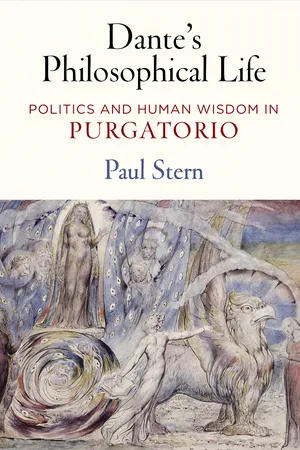
When political theorists teach the history of political philosophy, they typically skip from the ancient Greeks and Cicero to Augustine in the fifth century and Thomas Aquinas in the thirteenth, and then on to the origins of modernity with Machiavelli and beyond. Paul Stern aims to change this settled narrative and makes a powerful case for treating Dante Alighieri, arguably the greatest poet of medieval Christendom, as a political philosopher of the first rank.
In Dante's Philosophical Life, Stern argues that Purgatorio's depiction of the ascent to Earthly Paradise, that is, the summit of Mount Purgatory, was intended to give instruction on how to live the philosophic life, understood in its classical form as "love of wisdom." As an object of love, however, wisdom must be sought by the human soul, rather than possessed. But before the search can be undertaken, the soul needs to consider from where it begins: its nature and its good. In Stern's interpretation of Purgatorio, Dante's intense concern for political life follows from this need, for it is law that supplies the notions of good that shape the soul's understanding and it is law, especially its limits, that provides the most evident display of the soul's enduring hopes.
According to Stern, Dante places inquiry regarding human nature and its good at the heart of philosophic investigation, thereby rehabilitating the highest form of reasoned judgment or prudence. Philosophy thus understood is neither a body of doctrines easily situated in a Christian framework nor a set of intellectual tools best used for predetermined theological ends, but a way of life. Stern's claim that Dante was arguing for prudence against dogmatisms of every kind addresses a question of contemporary concern: whether reason can guide a life.
- 304 pages
- English
- ePUB (mobile friendly)
- Available on iOS & Android
eBook - ePub
About this book
Information
Publisher
University of Pennsylvania PressYear
2018Print ISBN
9780812250114
9780812250114
eBook ISBN
9780812295016
Topic
PhilosophyCHAPTER 1

Politics, Poetry,
and Philosophy in Purgatorio
I came to Dante’s Commedia already well into my career.1 Preparing to teach it in a first-year course, I, like many readers, was captivated by the poem’s sheer imaginative power. As a student of classical political philosophy, I was also impressed—and puzzled—by how frequently Dante uses this power for a political end. In particular, I wondered why politics should have such prominence in a poem about the Christian afterlife, especially a conception of it that chimes so clearly and insistently with a classical understanding. This wonder motivates my study. Its primary aim is not to explicate Dante’s political views, a task ably accomplished by others.2 Rather, it seeks to account for the philosophic importance of politics in the poem, to explain why in an intellectual milieu shaped by Christianity and Neoplatonism, a religion and a philosophic school united in their diminishment of politics, the political realm should occupy such a significant place in the Commedia’s vision. My thesis is that the poem’s political surface provides the key to its depths. More specifically, I argue that the prominence and meaning Dante accords politics are crucial to the vindication of rational inquiry into the human good, which, I also argue, is his poem’s intent.
American Dante scholarship of the past fifty years maintains a different view. With a few notable exceptions, this scholarship understands the poem’s intent as religious.3 Charles Singleton supplies this reading’s principle: “Dante sees as poet and realizes as poet what is already conceptually elaborated and established in Christian doctrine.”4 For Singleton, the poem’s purpose as versified Christian doctrine is plain.
Yet, precisely the Christian character that makes Singleton’s characterization credible renders anomalous the meaning and prominence the poem gives to politics. The Commedia repeatedly highlights a political life significantly more robust than “Christian doctrine” is at all likely to endorse. A few examples suffice to make the point: though one searches the New Testament in vain for a legal code, in Purgatorio Dante maintains that positive law, informed by but not deduced from a higher order, is essential to a well-lived life; furthermore, though Augustine insists on the gulf between Rome’s pride-driven greatness and the genuine virtue of humility, it is prideful virtue, exemplified by Cato and celebrated by Virgil, that wins Dante’s praise; finally, despite Aquinas’s significant alteration of the place of politics in the Christian world, Purgatorio reveals an unbridgeable divide between his view and Dante’s regarding the notion of natural law (XVI. 94–96; I. 48, 66; VI. 118–20).5
Singleton’s position could be vindicated were the status and meaning politics has in Purgatorio altered in Paradiso. But Dante’s distinctive political concerns intrude even in heaven, disturbing its serenity in some particularly prominent locations (e.g., Par. VI. 1–142, X. 109–14, XIII. 46–49, 88–96, XVI. 34–154, XVII. 13–142, XXX. 127–48).6 There, too, Dante cares deeply about politics, and his preferred brand still takes its bearings from models that clash with Christian doctrine. The question of the relationship between his religious vision and his political concerns persists beyond the poem’s conclusion.
The difficulty has not gone unnoticed. Objections to the view Singleton summarizes, although never in the majority, are not all of recent vintage.7 In fact, doubts about Dante’s orthodoxy arose contemporaneously with the poem’s publication. While for some the Commedia quickly earned the status of sacred scripture, others were skeptical.8 As Anthony Cassell remarks, Dante’s son Pietro felt “perpetual dread” that “his father’s Commedia could be found heterodox.”9 He adds that Pietro produced his commentaries on the Commedia “to explain away its controversial views.”10 And, in 1335, the Roman province of the Dominicans forbade study of the poem. Their fear is not unfounded. One of its sources is the friction between Dante’s treatment of politics, on the one hand, and established Christian doctrine, on the other, especially given the work’s specific poetic form.
As Dante’s treatment of his poetic predecessors in Purgatorio indicates, poetry, notwithstanding critiques such as Aquinas’s, did have a place in Dante’s world.11 Thus, when Boccaccio praises Dante as “the first to open the way for the return to Italy of the banished Muses,” he cannot be referring to poetry as such.12 Rather, Boccaccio’s statement echoes what Virgil, Dante’s initial guide, writes of his own political poetry: “I first, if life but remain, will return to my country, bringing the Muses with me in triumph from the Aeonian peak.”13 In the poem that Virgil brings to his native land he addresses “Roman affairs,” as does Dante in his.14 Both repatriate epic poetry with its nation-founding sagas of the hero who epitomizes the community’s way of life—one of several precious objects Dante appropriates from the classical treasury (IX. 136–38).15
But Calliope, the banished Muse of epic poetry, was particularly unwelcome in Dante’s pervasively Christian world (I. 8–10). As Robert Hollander writes, “It is the sin of the poet, in Augustinian-Aquinian eyes, to claim for secular literature a license for a higher form of truth-telling that is explicitly reserved to the Bible and to the writings of its anointed interpreters.”16 The persistent worry is that a poet might not only regard himself but, through poetry’s persuasive power, come to be regarded by others as a prophet (XXIX. 104–5).17 Yet what need is there for the prophet’s new revelation and correspondingly new way of life when the true, universal, and permanent teaching has already been promulgated? A claim such as Dante’s, to express a true vision of the next world, could only be, in the words of a church authority, “ ‘vainglorious heresy.’ ”18 Nevertheless, Dante’s epic provides just such a justificatory vision, and Dante insists throughout on its veracity.
As evident in his poem’s novel hero, Dante adopts the epic form to new circumstances. Still, the present point is that, like Homer, “the sovereign poet,” “to whom the Muses gave more milk than ever to any other,” and like Virgil, Dante’s “sweetest father,” he too undertakes to shape a people’s way of life (Inf. IV. 88; XXII. 101–2, XXX. 50). Dante’s poem, as do theirs, conveys a notion of good that informs the entire community, intertwining ethics and politics in a shared view of a choiceworthy life. In the epic manner, the Commedia makes this view compelling through vivid portrayals of the hero who founds the community and of the divinity that substantiates its goodness. Plato’s Socrates vouches for this link between epic poetry and great politics when, to found Kallipolis, he reconceives Homer’s gods and heroes, engaging in what he calls “theology.”19
Dante’s definition of poetry—“verbal invention composed according to the rules of rhetoric and music”—indicates why poetry is such an effective tool with which to undertake a “reformation for the whole of humanity on earth,” as John Scott characterizes Dante’s political project (DVE II. iv. 2–3).20 Like rhetoric, poetry aims to persuade, even if to achieve that goal it needs to “speak a truth that has the face of a lie” (Inf. XVI. 124). Like music, poetry exerts its persuasive power through an appeal to the passions as it “attracts to itself the human spirits” (Conv. II. xiii. 23).21 As the multitude of Dante’s contemporary readers attests, his epic poetry retains its compelling power.
In choosing to write an epic, and in taking Virgil as his initial guide, Dante signals his seriousness about effecting a far-reaching political change. Every proposal for such change presupposes a critique of the existing order, the more far-reaching the proposed change, the more fundamental the critique. Underlying all such critiques is a vision of how we ought to live together, some standard of justice that is not being met. Furthermore, every standard of justice appeals to a conception of a well-lived life.22 To answer the question about the elevation of politics by Dante requires therefore that we grasp his notion of such a life.
In this regard, it is useful to note that Augustine, for one, would find Dante’s aim misguided and, most pertinent to the present purpose, Dante’s seriousness misplaced. The divergence between Augustine and Dante about politics reflects, however, a still deeper divide, a difference that concerns, ultimately, the meaning of philosophy. To be more specific, it is Dante’s understanding of philosophy, decisively distinct from Augustine’s, that expresses Dante’s view of the best life and, accordingly, provides the ultimate rationale for Dante’s political concern—or so I shall argue.
For Augustine, philosophy is properly identified with metaphysics, a view that underlies the deep affinity between Christian theology and Neoplatonism. He can thus praise the Platonists for their adherence to Plato’s so-called doctrine of Ideas, those immutable intelligibles that are taken to constitute the order that structures all existence, including human life.23 In the view of this expression of theologia, principles of human action are deducible directly from the order of the whole, a possibility perfectly captured in Aquinas’s notion of natural law. But just so far as this is possible, politics must be diminished, its importance inversely proportional to the orderliness of the whole; if the order of the whole does directly structure human life, there is no reason to consider the political realm as a home for deliberation about the human good or to accord it the autonomy and significance it would thereby deserve (XVI. 106–8).24
Yet Dante does both. He thereby signals his opposition to the identification of philosophy and metaphysics that underlies the depreciation of politics. And, with his opposition, he challenges the harmony between humanity and the whole that this identification presumes.
The absence of this presumed harmony decisively alters the character of philosophy. In particular, as a result of humanity’s consequent distance from an understanding of the whole, the investigation of human nature and its good rightly occupies the heart of philosophic inquiry; if we need to seek knowledge, clarity regarding the origin of and obstacles to that search is of crucial importance. Accordingly, when Dante deems the Commedia a work of “philosophy,” he specifies it as a work of “ethics,” not metaphysics (Ep. XIII. 40).25
With this specification, Dante rehabilitates what Aristotle, in linking the Nicomachean Ethics with his Politics, calls “the philosophy of human affairs.”26 This philosophic consideration of ethics and politics has as its goal the self-knowledge that informs the “unequaled seeing” called prudence (Par. XIII. 104).27 Philosophy so understood is neither a body of doctrines easily situated in a Christian framework nor a set of intellectual tools best used for predetermined theological ends. It is, instead, a way of life.28 As such, philosophy requires politics: for its nurture, as its greatest spur, and as the most reliable guide for its central inquiry. Thus does the significance Dante finds in politics follow from his distinctive understanding of philosophy.
In this understanding there remains “vital nourishment” for us who “call [Dante’s] time ancient” (Par. XVII. 131, 119–20). For to revive the “philosophy of human affairs” Dante must show that inquiry regarding human good is necessary and possible, a matter of great contemporary concern. Currently, there is doubt on both these counts. One of the two contemporary intellectual authorities, modern science, rejects this inquiry’s necessity; the other, postmodernism, its possibility. The former does so believing there to be unquestionable certitude regarding our good, the latter because we know, again with certainty, that knowledge of good is unavailable. In either case, reason’s capacity to guide life is in doubt. Prior to accepting this conclusion, however, we should note that these certitudes, if only by their opposition, suggest the need for further inquiry. To the extent that Dante’s vindication of rational inquiry confronts obstacle...
Table of contents
- Cover
- Half title
- Title
- Copyright
- Dedication
- Contents
- Chapter 1. Politics, Poetry, and Philosophy in Purgatorio
- Chapter 2. “What Good Would Climbing Do?”: The Rationale and Impetus for the Pursuit of Self-Knowledge (Cantos I–IX)
- Chapter 3. “To a Better Nature You Lie Subject”: The Political Character of Humanity and Nature (Cantos X–XVII)
- Chapter 4. Disrobing the Siren: The Zealous Pursuit of Clarity (Cantos XVII–XIX)
- Chapter 5. “When Love Breathes Within Me”: The Desirability of Desire (Cantos XIX–XXVII)
- Chapter 6. “The Nest for Human Nature”: Earthly Paradise and the “Happiness in This Life” (Cantos XXVIII–XXXIII)
- Chapter 7. Dante’s Human Wisdom
- Notes
- Index
- Acknowledgments
Trusted by 375,005 students
Access to over 1.5 million titles for a fair monthly price.
Study more efficiently using our study tools.
Frequently asked questions
Yes, you can cancel anytime from the Subscription tab in your account settings on the Perlego website. Your subscription will stay active until the end of your current billing period. Learn how to cancel your subscription
No, books cannot be downloaded as external files, such as PDFs, for use outside of Perlego. However, you can download books within the Perlego app for offline reading on mobile or tablet. Learn how to download books offline
Perlego offers two plans: Essential and Complete
- Essential is ideal for learners and professionals who enjoy exploring a wide range of subjects. Access the Essential Library with 800,000+ trusted titles and best-sellers across business, personal growth, and the humanities. Includes unlimited reading time and Standard Read Aloud voice.
- Complete: Perfect for advanced learners and researchers needing full, unrestricted access. Unlock 1.5M+ books across hundreds of subjects, including academic and specialized titles. The Complete Plan also includes advanced features like Premium Read Aloud and Research Assistant.
We are an online textbook subscription service, where you can get access to an entire online library for less than the price of a single book per month. With over 1.5 million books across 990+ topics, we’ve got you covered! Learn about our mission
Look out for the read-aloud symbol on your next book to see if you can listen to it. The read-aloud tool reads text aloud for you, highlighting the text as it is being read. You can pause it, speed it up and slow it down. Learn more about Read Aloud
Yes! You can use the Perlego app on both iOS and Android devices to read anytime, anywhere — even offline. Perfect for commutes or when you’re on the go.
Please note we cannot support devices running on iOS 13 and Android 7 or earlier. Learn more about using the app
Please note we cannot support devices running on iOS 13 and Android 7 or earlier. Learn more about using the app
Yes, you can access Dante's Philosophical Life by Paul Stern in PDF and/or ePUB format, as well as other popular books in Philosophy & Medieval & Early Modern Literary Criticism. We have over 1.5 million books available in our catalogue for you to explore.