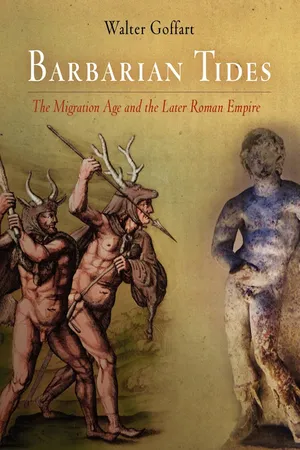
The Migration Age is still envisioned as an onrush of expansionary "Germans" pouring unwanted into the Roman Empire and subjecting it to pressures so great that its western parts collapsed under the weight. Further developing the themes set forth in his classic Barbarians and Romans, Walter Goffart dismantles this grand narrative, shaking the barbarians of late antiquity out of this "Germanic" setting and reimagining the role of foreigners in the Later Roman Empire.
The Empire was not swamped by a migratory Germanic flood for the simple reason that there was no single ancient Germanic civilization to be transplanted onto ex-Roman soil. Since the sixteenth century, the belief that purposeful Germans existed in parallel with the Romans has been a fixed point in European history. Goffart uncovers the origins of this historical untruth and argues that any projection of a modern Germany out of an ancient one is illusory. Rather, the multiplicity of northern peoples once living on the edges of the Empire participated with the Romans in the larger stirrings of late antiquity. Most relevant among these was the long militarization that gripped late Roman society concurrently with its Christianization.
If the fragmented foreign peoples with which the Empire dealt gave Rome an advantage in maintaining its ascendancy, the readiness to admit military talents of any social origin to positions of leadership opened the door of imperial service to immigrants from beyond its frontiers. Many barbarians were settled in the provinces without dislodging the Roman residents or destabilizing landownership; some were even incorporated into the ruling families of the Empire. The outcome of this process, Goffart argues, was a society headed by elites of soldiers and Christian clergy—one we have come to call medieval.
- 384 pages
- English
- ePUB (mobile friendly)
- Available on iOS & Android
eBook - ePub
About this book
Information
Chapter 1
A Clarification: The Three Meanings of “Migration Age”
Not long ago my mail brought news of four DVDs called “The Wandering Tribes of Europe.” The individual disk titles are a little history in themselves: (1) “From the Mists of the North, the Germanic Tribes”; (2) “Furor Teutonicus, Pax Romana”; (3) “Storm over Europe: The Huns Are Coming”; (4) “The End of Rome, the Birth of Europe.” The “wandering tribes” package is obtainable from Films for the Humanities, in Princeton, for $640.1 This effort at lucrative popular education is probably no worse than others, but one feature struck me as being specially mischievous, namely, the collective reference to “wandering tribes.” The peoples to the north and east of the Roman frontier were no more “wandering” than the Celts or Greeks or Thracians. They were agrarian villagers like the other sedentaries mentioned, and like them, and us, they moved every now and then. Whoever decided to speak of “wandering tribes” badly misunderstood the meaning of “migration” in reference to the peoples usually called “Germanic.”
The term “Migration Age” is the English counterpart of the German “Völkerwanderung” or Latin “migratio gentium” both meaning “migration of peoples.” In whatever language, “Migration Age” is a concept in everyday academic use, similar, as such, to “the Crusades” or “the Hundred Years War.” It involves selecting a set of events out of a long period and connecting them up into an explanatory whole, as though to say: here, in a nutshell, is what was going on. Such concepts are useful in the classroom or in ordering narrative; we cannot do without them. But they inject anachronism into the events. In 1095, Pope Urban was unaware of setting the Crusades in motion and, in 1337, no one anticipated that the war between France and England would last a hundred years. The vocabulary of late antiquity did not include “barbarian invasions” or “migratio gentium” as everyday concepts. For us, the phrase “barbarian invasions” has the virtue of being earthbound: if armed foreign forces transgress their neighbors’ borders, they may be factually described as “barbarian invaders.” There is a difference when the neutral term “migration” enters the picture. “Migration Age” or “Völkerwanderung” are more artistic constructions; they associate a certain set of events with timeless anthropological, sociological, historical, and biblical processes of human movement.
It is often said that, whereas modern German uses the neutral “Völkerwanderung” the Romance languages refer to pointed “invasions barbares.” The actual practices of authors do not bear out this ostensibly plausible contrast; the polarity of “migration” vs. “invasion” is not reflected in any systematic or consistent way in the historical literature of whatever languages.2 French and Italian authors frequently refer to “migrations,” and Germans do not guard themselves against occasionally adverting to “invasions.” Context tends to determine which of the two words is invoked. No ethnic or political fault line has been methodically demonstrated to exist, or (I believe) can be.
As used by scholars today, the term “Migration Age” has three meanings, comprising at least three different complexes of historical phenomena. Its primary or core meaning is identical to its blunter counterpart “the Barbarian Invasions.” It might be described as follows:
In the mid-fourth century, various peoples were parked, perhaps enduringly, on the Roman frontier. They ranged from the Saxons in northwest Europe to the Quadi and Vandals on the middle Danube to the Goths on the lower Danube. Two centuries later, these foreigners had moved to new positions in a process of conquest, settlement, and kingdom foundation—in German, Eroberung, Landnahme, and Reichsgründung. Saxons had established themselves in Britain, Franks and Burgundians in Gaul, Goths in southwestern Gaul and Spain, Sueves in Lusitania, and Lombards in Italy. The Western Roman Empire was gone and the outlines of modern Western Europe had become faintly discernible. Movement in these cases began near the imperial border and ended, after relatively limited displacements, in settlement somewhere within the former frontiers of the Empire or (in quite a few cases) in annihilation.
“Migration Age” in this first sense was already described in 1515 in a brief summary by the humanist Konrad Peutinger. Since then, it has been restated in prose, as well as drawn on maps, hundreds of times.3 The course of events from the 370s to 568 forms the solid underpinning of what is meant by “Migration Age.” Its distinguishing feature, rarely observed, is that it starts from a position of tranquility or rest. The northern frontier of the Roman Empire, from Scotland to the Danube mouths, is unlikely to have ever been quiet along its whole course. But the premise of having Wanderung begin in the 370s is that, prior to this, in the decades after the emperor Diocletian and his partners brought the imperial frontiers under control in the early fourth century, an equilibrium had prevailed; no one was going anywhere. This equilibrium was ended by the onrush of Huns.4
Users of the term “Migration Age” have found it hard to limit it narrowly. Even contemporaries raised the question of where their alien neighbors came from, and the later one advances down the centuries, the more elaborate the answers become. As a result, the core meaning is often supplemented by an expansion.
The extended, looser, and peripheral concept of “Migration Age”/Völkerwanderung includes the core meaning as its chronological end point but stretches backward more or less broadly into time and space. It comes in at least two major varieties—Asian and Germanic.
Its more mysterious form—the Asian version—reaches across Eurasia and identifies the familiar Huns with the Hsiung-nu bordering northern China. One much abbreviated account runs as follows (the quotation comes from a recent historical atlas):
The Centuries which saw the crisis and fall of the Roman Empire in the West coincided with a period of great upheaval in the heart of Asia: for reasons still largely unknown, huge populations began moving from Central Asia towards the West, pushing before them the peoples they found settled on their routes. The groups which took part in these large-scale migrations can generally be identified with the Mongolian peoples of Hsiung-nu and Juan-Juan, well known in the West as the Huns and the Avars. It was these peoples, and the populations that they absorbed en route, that descended upon the Roman Empire and demolished its already tottering structure.5
An obvious goal of this version is to explain how the Huns came to burst into European space in the 370s. The sweep of the Asian version recommends it to world or universal historians, and its visual possibilities appeal to compilers of historical atlases. On the other hand, its vast Eurasian and multiempire setting makes the core sense of “Migration Age” dwindle to an incidental detail. The upshot is that this version seldom intrudes into works concerned with the European barbarians or late Roman antiquity.6
The alternate extended version—the Germanic expansion—is much more widely represented than its Asian cousin. This expansion fills in the pre-fourth-century past, real or legendary, of the peoples participating in the core migration, and sometimes even of the peoples deemed archaeologically to have preceded them. In its restrained (and oldest) form, the Germanic expansion starts with the emigration from our Denmark of the Cimbri and Teutons in the second century B.C. and strives to trace movements by central European peoples from that time to the fourth century A.D. Not long ago, a distinguished historian of Rome described a form of it as follows: “The so-called Völkerwanderung was no abrupt event set loose only by the attack of the Huns. Rather, it is the turbulent last stage of a Germanic expansion that is visible ever since early in the first millennium B.C. Proceeding from south Scandinavian/north German space, the Germans expanded in all directions.”7 The privileged geographical setting in this case is not China or Central Asia but Scandinavia, out of which the Goths, Vandals, Burgundians, Gepids, Herules, Lombards, and others are thought to have “originally” emigrated. Time is at least as important as space to the Germanic expansion. Some scholars uncover Germans as early as the Bronze Age if not earlier still. In this inflated perspective, the pluri-millennial development comprising the expanded Völkerwanderung witnesses many vicissitudes and attains only its climax in the Migration Age of late antiquity.8
In brief, the commonplace period name “Migration Age” presupposes three distinct schemes—narrow (core), Asian, and Germanic. All three call for additional comments.
The narrow or core Migration Age retains traces of its martial origins as the defanged counterpart of “barbarian invasions.” Eighteenth-century historians inside and outside Germany conceived of the end of the Western Roman Empire as a conquest and settlement by Germanic peoples. “Migration” was already used in this context in the sixteenth century, as we saw Konrad Peutinger doing in 1515; it is not a recent refinement. The famous eighteenth-century Göttingen historian Johann Christoff Gatterer and his contemporary, the great French cartographer Bourguignon d’Anville, envisaged the end of the Western Roman Empire as a conquest and settlement by Germanic peoples. Their views were presumably typical of what was believed in their time. The vocabulary of conquest, settlement, and kingdom foundation—Eroberung, Landnahme, and Reichsgründung—betrays its descent from this basically bellicose scenario of conquest by outsiders.9 What allowed and still allows the neutral notion of “migration” to be substituted for “invasions” is the irruption of the Huns in the 370s. Their unexpected attack on the Goths shattered the relative stability of the frontiers, set the northern peoples in motion, and precipitated the multiple events resulting by 568 in the fall of the Western Empire and the panorama of Reichsgründungen outlined above. The Goths did not “invade” the Empire in 376: they “migrated” into it under Hunnic pressure and, some years later, continued to “migrate” under the leadership of Alaric.
A comprehensive and well-argued rejuvenation of the core Migration Age was offered a few years ago by Peter Heather in an article centering on the Huns rather than the “Germanic peoples.”10 Insisting that the end of the Western Roman Empire had nothing to do with internal problems but came from outside, Heather outlined three steps by which the Huns brought about its fall.11 His story is basically identical to the normal scheme of the core Migration Age except in its causative focus. In the traditional version, though the Huns set migrations in motion, the active agents continue to be “Germanic peoples” led by such heroes as Alaric, Geiseric, Theoderic, and Clovis.
Since the nineteenth century (and even before), the explanatory waters have been muddied by an awakened sensitivity to conditions inside the Roman Empire. The agent of change in relations between barbarians and Romans has seemed increasingly, in the opinion of some observers, to come from the imperial rather than the northern side of the border. A measured appreciation of the peaceful contacts of “Germans” with Romans forces us to qualify the one-sided vision of “conquests” and “land seizures” resulting from “barbarian invasions.” The incomparable Theodor Mommsen observed, “The last phase of the Roman state is remarkable for its barbarization and especially its Germanization.”12 Roman armies were filled with barbarian recruits and Roman headquarters with barbarian officers; whole peoples fought for Rome as treaty allies or “federates.” Franks and Goths were the shock troops in Roman civil wars. Franks, Vandals, and others married into the Roman aristocracy and even the imperial family. The new religion of the Empire was promptly adopted by the foreigners. Land grants to barbarians in southern Gaul and Italy were made pursuant to law and not by seizure.13 To judge from legal, institutional, and religious structures, “barbarian” kingdoms are better termed “sub-Roman.” From the angle of “progressive fusion,” even the tempered appeal to “migration” may well be inappropriate and one-sided.14 Immigrant Goths, Franks, Lombards, and others were few in number, and a Roman and Catholic population continued preponderant in Spain, Gaul, and Italy. There was a compelling logic in Heather’s turning his sights entirely on the Asiatic Huns and making them, rather than migrating “Germans,” the dominant agents of political rupture. The “northern barbarians” may have become too tainted by compromises with the Roman world to be held responsible any longer for its fall. The expression “Migration Age” is still on everyone’s lips but, owing to an enhanced sense of Roman survivals in the West, it has lost the simple, straightforward meaning it used to have in the days when Völkerwanderung was the polite way of saying “barbarian invasions.”
The narrow sense of “Migration Age,” though basic, rarely exists uncontaminated to some degree by one or the other expanded definition.
About the Asian version there is little to say since it seldom communicates with the two others. Although very ambitious and far-ranging in its own appearances, it has had virtually no impact on accounts of early medieval Europe. The Asian version was born in the mid-eighteenth century in the work of a pioneering Sinologist, Joseph de Guignes, who observed the similarity between the names Hun and Hsiung-nu and connected them to each other (1756). The visual potential of his theory was grasped at once by the distinguished cartographer Nicolas Bellin, who designed a map to complement de Guignes’s work (1759).15 De Guignes’s link between Chinese events and the Hunnic irruption into Europe attracted the attention of later historians. The connection greatly impressed Gibbon and influenced Gatterer’s 1775 “maps for the history of the Völkerwanderung’16 Opinion was less favorable in the next century. Dc Guignes’s argument was carefully retraced by Thomas Hodgkin, who, at the same time, recognized the frail, merely verbal connection between the two peoples’ names, and emphasized the three-century period “of quiescence and of obscurity” that separates the fading of the Hsiung-nu and the first stirrings of the Huns. He concluded that “the hypothesis though looked upon with much less favour than it received a century ago, does not seem to be yet absolutely disproved.”17 Sustained by this wisp of a doubt, the theory has withstood refutation and even gathered strength, so that some form of it or other is regularly encountered in recent atlases of world history, and more rarely in world histories.18 However that may be, almost all historians who deal with the Migration Age as a story of basically northern peoples obstinately refuse to be drawn into Central Asian wastes. Like the contemporary observer Ammianus Marcellinus, they are content to have the Huns break into Europe for their own reasons without needing to be pushed from farther east.19
The Germanic expansion of “Migration A...
Table of contents
- Cover
- Title
- Copyright
- Contents
- Preface
- Introduction
- 1 A Clarification: The Three Meanings of “Migration Age”
- 2 A Recipe on Trial: “The Germans Overthrow the Roman Empire”
- 3 An Entrenched Myth of Origins: The Germans before Germany
- 4 Jordanes’s Getica and the Disputed Authenticity of Gothic Origins from Scandinavia
- 5 The Great Rhine Crossing, A.D. 400–420, a Case of Barbarian Migration
- 6 The “Techniques of Accommodation” Revisited
- 7 None of Them Were Germans: Northern Barbarians in Late Antiquity
- 8 Conclusion: The Long Simplification of Late Antiquity
- 1. Alexander Demandt on the Role of the Germans in the End of the Roman Empire
- 2. Chronicle Evidence for the Burgundian Settlement
- 3. The Meaning of agri cum mancipiis in the Burgundian Kingdom
- List of Abbreviations
- Notes
- Bibliography
- Index
Trusted by 375,005 students
Access to over 1.5 million titles for a fair monthly price.
Study more efficiently using our study tools.
Frequently asked questions
Yes, you can cancel anytime from the Subscription tab in your account settings on the Perlego website. Your subscription will stay active until the end of your current billing period. Learn how to cancel your subscription
No, books cannot be downloaded as external files, such as PDFs, for use outside of Perlego. However, you can download books within the Perlego app for offline reading on mobile or tablet. Learn how to download books offline
Perlego offers two plans: Essential and Complete
- Essential is ideal for learners and professionals who enjoy exploring a wide range of subjects. Access the Essential Library with 800,000+ trusted titles and best-sellers across business, personal growth, and the humanities. Includes unlimited reading time and Standard Read Aloud voice.
- Complete: Perfect for advanced learners and researchers needing full, unrestricted access. Unlock 1.5M+ books across hundreds of subjects, including academic and specialized titles. The Complete Plan also includes advanced features like Premium Read Aloud and Research Assistant.
We are an online textbook subscription service, where you can get access to an entire online library for less than the price of a single book per month. With over 1.5 million books across 990+ topics, we’ve got you covered! Learn about our mission
Look out for the read-aloud symbol on your next book to see if you can listen to it. The read-aloud tool reads text aloud for you, highlighting the text as it is being read. You can pause it, speed it up and slow it down. Learn more about Read Aloud
Yes! You can use the Perlego app on both iOS and Android devices to read anytime, anywhere — even offline. Perfect for commutes or when you’re on the go.
Please note we cannot support devices running on iOS 13 and Android 7 or earlier. Learn more about using the app
Please note we cannot support devices running on iOS 13 and Android 7 or earlier. Learn more about using the app
Yes, you can access Barbarian Tides by Walter Goffart in PDF and/or ePUB format, as well as other popular books in History & European Medieval History. We have over 1.5 million books available in our catalogue for you to explore.