At supermarkets across the nation, customers waiting in line—mostly female—flip through magazines displayed at the checkout stand. What we find on those magazine racks are countless images of food and, in particular, women: moms preparing lunch for the team, college roommates baking together, working women whipping up a meal in under an hour, dieters happy to find a lowfat ice cream that tastes great. In everything from billboards and product packaging to cooking shows, movies, and even sex guides, food has a presence that conveys powerful gender-coded messages that shape our society.
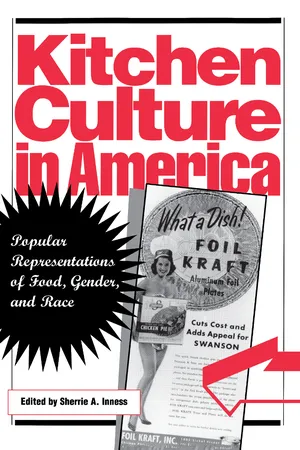
Kitchen Culture in America is a collection of essays that examine how women's roles have been shaped by the principles and practice of consuming and preparing food. Exploring popular representations of food and gender in American society from 1895 to 1970, these essays argue that kitchen culture accomplishes more than just passing down cooking skills and well-loved recipes from generation to generation. Kitchen culture instructs women about how to behave like "correctly" gendered beings. One chapter reveals how juvenile cookbooks, a popular genre for over a century, have taught boys and girls not only the basics of cooking, but also the fine distinctions between their expected roles as grown men and women.
Several essays illuminate the ways in which food manufacturers have used gender imagery to define women first and foremost as consumers. Other essays, informed by current debates in the field of material culture, investigate how certain commodities like candy, which in the early twentieth century was advertised primarily as a feminine pleasure, have been culturally constructed. The book also takes a look at the complex relationships among food, gender, class, and race or ethnicity-as represented, for example, in the popular Southern black Mammy figure. In all of the essays, Kitchen Culture in America seeks to show how food serves as a marker of identity in American society.
eBook - ePub
Kitchen Culture in America
Popular Representations of Food, Gender, and Race
- 296 pages
- English
- ePUB (mobile friendly)
- Available on iOS & Android
eBook - ePub
About this book
Information
Topic
SozialwissenschaftenSubtopic
Popkultur
Bonbons, Lemon Drops, and Oh Henry! Bars
Candy, Consumer Culture, and the Construction of Gender, 1895–1920
Life without candy is unfathomable for Americans living today. Per capita rates in the United States continue to rise with recent figures indicating that the average American consumed twenty-two pounds of candy in 1993 as compared to seventeen pounds in 1982.1 Highlighting this hunger for candy, a front-page New York Times article on May 4, 1998, warned chocoholics that their “beloved bean” was in jeopardy due to crop failure and that a resulting shortage could develop into a “disaster of gigantic proportions.”2 A week later, another reporter offered a futuristic, tongue-in-cheek interpretation of this impending chocolate candy shortage. Writing as if he were living in the year 2098, the author reflected back on the “Great Chocolate Panic” of the previous century. In this account, refrigerator sales soared as candy lovers searched for space to store their cherished chocolate Easter bunnies, and with the resolution of this crisis in 2075, Israelis and Palestinians learned to live together peacefully.3 Offering even more convincing evidence of candy’s importance in the American diet, a Food and Drug Administration spokeswoman announced in 1994 that “candy is food” and followed up this declaration by stating: “We don’t recommend shunning any food.”4 Such an endorsement of candy by a government agency and the intense desire that Americans express for this commodity raises several questions for scholars. Has candy always occupied a central place in the consciousness of Americans? What forces brought candy into the mainstream? How was the desire for candy created and shaped?
At the center of this present-day desire for candy are tensions surrounding shifting meanings of femininity and masculinity. Our everyday experiences confirm that most people enjoy candy, yet magazines and newspapers are filled with headlines that underscore a feminine fondness for Hershey’s kisses, licorice, and truffles. Some articles encourage women to ignore feelings of guilt while eating chocolates and portray these cravings as biologically predetermined. Everything from low levels of endorphins and estrogen after ovulation to “premenstrual mood changes such as irritability, impulsive behavior, and anger” have been cited as reasons why women crave candy.5 Other periodicals warn women that candy eating can become addictive, and they offer inspirational tips on how to “break the habit.”6 One woman was even reported to have a “dark obsession” with licorice as she “rummaged” through a Safeway store one afternoon in search of her favorite sweet.7 Implicit in these discussions is the notion that candy eating represents weakness and reveals a cultural need to portray American women as incapable of controlling their own desires and impulses.8
Informed by current debates among cultural and gender historians, and the field of material culture, this essay argues that candy was a culturally constructed commodity. Of central importance will be how candy consumption became gendered between 1895 and 1920. For the purposes of this chapter, candy will be treated as a historical artifact embedded with the beliefs, ideas, and fears of those individuals who fabricated and consumed candy.9 Although it would be shortsighted to argue that any artifact provides a complete cultural picture, candy does provide a window into the past. By utilizing candy as a historical document, my hope is to shed light on how Americans, living at the turn of the century, related to a material world filled with an ever-increasing quantity of factory-produced goods. This chapter illustrates how an ideology of gender became materialized in everyday life.
While candy has experienced an unwavering loyalty from Americans for over one hundred years, it has remained outside the realm of scholarly inquiry. Culinary “experts” and historians who have studied the eating habits of Americans often ignored candy and at best mentioned candy eating as a childhood activity. Until recently, historians have taken a positivist approach, describing how a linear march toward greater abundance and quality of food sources has influenced the course of history and affected the health of all citizens.10 Food critics have constructed narratives full of anecdotal information, producing accounts of how, when, and what foods were eaten. Eating in America: A History, the most exhaustive work of this genre, begins with a romanticized account of American Indians saving white settlers from sure starvation and ends by condemning the effects of modernity on eating customs in the United States.11 Surprisingly, the authors never mentioned candy, even though they devoted an entire chapter to “the great American sweet tooth.” Instead, America’s thirst for Coca Cola and appetite for cakes, cookies, and pies takes center stage.
Although many Americans perceive their appetite for candy as natural and immutable, it was not until the Gilded Age, with the rise of a culture based on consumption, that candy emerged as a distinct product. Candy eating was initially viewed as a feminine activity best suited to women of better means. Images of white middle-class women as indulgent, seductive bonbon consumers aided in resolving tensions surrounding the clash between conventional Victorian ideals and hedonistic values associated with the Gilded Age. Once women had been converted into faithful and dedicated bonbon eaters, candy would be recast as a commodity that men desired. Candy as a substitute for alcohol and the portrayal of soldiers sustaining themselves on chocolate creams and lemon drops during battle would transform candy into an appropriate treat for men. Not surprisingly, during the second decade of the twentieth century, the popular press and advertisements directed at men began characterizing candy as a valuable fuel rather than a feminine indulgence. Soldiers, sailors, and businessmen would discover hidden power and stamina in Life Savers, lemon drops, and chocolate. As candy eating became legitimized for men, candy would acquire a new shape. Manly candy bars began to be marketed alongside round, voluptuous bonbons. Who was eating candy transformed not only the meaning attached to this commodity but also its physical properties.12
Candy’s Beginnings in America
During the last half of the nineteenth century, America’s primary association with sweetness began a slow, uneven transformation from “sweet dishes” made in the home to candy produced in factories. Before this time, candy was a luxury item and its consumption was limited even among the wealthy. In Victorian cookbooks and domestic economy manuals, the word candy rarely appeared.13 Puddings, cakes, preserves, doughnuts, and popcorn balls made with molasses and maple syrup satisfied early nineteenth-century appetites for sweetness. However, during the late 1800s, domestic encyclopedias began including sections about candy, and books devoted exclusively to candy making emerged extolling the virtues and benefits of this product.14 In 1875, a Philadelphia publisher acquired the rights to a British candy cookbook, which resembled a technical manual more than a collection of recipes. The author pleaded with readers to use the correct ingredients and to avoid “low class sugars,” which could destroy the purity and value of the end product.15 After having published a book on candy making for professional confectioners, George Frye “received letters of inquiry from ladies all over the country asking why [he] did not prepare a work especially adapted for the use of the housewife.”16 A lengthy book resulted, offering exacting instructions on how to make hundreds of candies from coconut and maple caramels to lemon comfits, chocolate logs, and cream mint drops. Echoing similar sentiments, an author who referred to himself simply as Perfecto promised readers perfect domestic candies if his instructions were carefully followed.17
To advertise the magical powers of sarsaparilla, C. I. Hood and Company published an eighteen-page candy recipe booklet in 1888. Each page of Hood’s Book of Homemade Candies was divided in half with a line running down the middle. On one side the reader found candy recipes. On the opposite side was a list of diseases described in agonizing detail. Explicitly linking lemon taffy, vanilla cream sticks, and peppermint lozenges with the supposed medicinal and scientific properties of their own product, Hood and Company advised readers to purchase candy-making supplies from qualified druggists. Without the knowledge of a scientist, domestic candy makers risked “considerable difficulty and perhaps [even] failure.”18 Just like Hood’s sarsaparilla, candy appeared to contain rejuvenating and mystical powers. More important, the sudden appearance of cookbooks such as Hood’s served notice that candy was gaining acceptance in America. Providing evidence that only hindsight could produce, the New York Times reported in 1903: “Within twenty-five years the candy industry has increased from almost nothing to about $150,000,000 a year. A quarter of a century ago there was not an exclusive candy manufacturer in a large way of business.”19
As candy became popularized, candy eating was an activity ...
Table of contents
- Cover
- Half title
- Title
- Copyright
- Dedication
- Contents
- Introduction: Thinking Food/Thinking Gender
- 1 Bonbons, Lemon Drops, and Oh Henry! Bars: Candy, Consumer Culture, and the Construction of Gender, 1895–1920
- 2 Campbell’s Soup and the Long Shelf Life of Traditional Gender Roles
- 3 “Now Then — Who Said Biscuits?” The Black Woman Cook as Fetish in American Advertising, 1905–1953
- 4 The Joy of Sex Instruction: Women and Cooking in Marital Sex Manuals, 1920–1963
- 5 “The Enchantment of Mixing-Spoons”: Cooking Lessons for Girls and Boys
- 6 Home Cooking: Boston Baked Beans and Sizzling Rice Soup as Recipes for Pride and Prejudice
- 7 Processed Foods from Scratch: Cooking for a Family in the 1950s
- 8 Freeze Frames: Frozen Foods and Memories of the Postwar American Family
- 9 She Also Cooks: Gender, Domesticity, and Public Life in Oakland, California, 1957–1959
- 10 “My Kitchen Was the World”: Vertamae Smart Grosvenor’s Geechee Diaspora
- 11 “If I Were a Voodoo Priestess”: Women’s Culinary Autobiographies
- List of Contributors
- Index
- Acknowledgments
Trusted by 375,005 students
Access to over 1.5 million titles for a fair monthly price.
Study more efficiently using our study tools.
Frequently asked questions
Yes, you can cancel anytime from the Subscription tab in your account settings on the Perlego website. Your subscription will stay active until the end of your current billing period. Learn how to cancel your subscription
No, books cannot be downloaded as external files, such as PDFs, for use outside of Perlego. However, you can download books within the Perlego app for offline reading on mobile or tablet. Learn how to download books offline
Perlego offers two plans: Essential and Complete
- Essential is ideal for learners and professionals who enjoy exploring a wide range of subjects. Access the Essential Library with 800,000+ trusted titles and best-sellers across business, personal growth, and the humanities. Includes unlimited reading time and Standard Read Aloud voice.
- Complete: Perfect for advanced learners and researchers needing full, unrestricted access. Unlock 1.5M+ books across hundreds of subjects, including academic and specialized titles. The Complete Plan also includes advanced features like Premium Read Aloud and Research Assistant.
We are an online textbook subscription service, where you can get access to an entire online library for less than the price of a single book per month. With over 1.5 million books across 990+ topics, we’ve got you covered! Learn about our mission
Look out for the read-aloud symbol on your next book to see if you can listen to it. The read-aloud tool reads text aloud for you, highlighting the text as it is being read. You can pause it, speed it up and slow it down. Learn more about Read Aloud
Yes! You can use the Perlego app on both iOS and Android devices to read anytime, anywhere — even offline. Perfect for commutes or when you’re on the go.
Please note we cannot support devices running on iOS 13 and Android 7 or earlier. Learn more about using the app
Please note we cannot support devices running on iOS 13 and Android 7 or earlier. Learn more about using the app
Yes, you can access Kitchen Culture in America by Sherrie A. Inness in PDF and/or ePUB format, as well as other popular books in Sozialwissenschaften & Popkultur. We have over 1.5 million books available in our catalogue for you to explore.