Affective meditation on the Passion was one of the most popular literary genres of the high and later Middle Ages. Proliferating in a rich variety of forms, these lyrical, impassioned, script-like texts in Latin and the vernacular had a deceptively simple goal: to teach their readers how to feel. They were thus instrumental in shaping and sustaining the wide-scale shift in medieval Christian sensibility from fear of God to compassion for the suffering Christ.
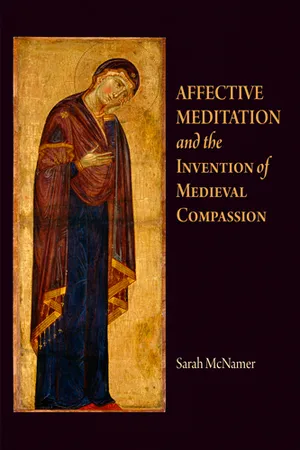
Affective Meditation and the Invention of Medieval Compassion advances a new narrative for this broad cultural change and the meditative writings that both generated and reflected it. Sarah McNamer locates women as agents in the creation of the earliest and most influential texts in the genre, from John of Fécamp's Libellus to the Meditationes Vitae Christi, thus challenging current paradigms that cast the compassionate affective mode as Anselmian or Franciscan in origin. The early development of the genre in women's practices had a powerful and lasting legacy. With special attention to Middle English texts, including Nicholas Love's Mirror and a wide range of Passion lyrics and laments, Affective Meditation and the Invention of Medieval Compassion illuminates how these scripts for the performance of prayer served to construct compassion itself as an intimate and feminine emotion. To feel compassion for Christ, in the private drama of the heart that these texts stage, was to feel like a woman. This was an assumption about emotion that proved historically consequential, McNamer demonstrates, as she traces some of its legal, ethical, and social functions in late medieval England.
- 318 pages
- English
- PDF
- Available on iOS & Android
eBook - PDF
Affective Meditation and the Invention of Medieval Compassion
About this book
Information
Publisher
University of Pennsylvania PressYear
2011Print ISBN
9780812242119
9780812242119
eBook ISBN
9780812202786
Table of contents
- Cover
- Contents
- Introduction: Intimate Scripts in the History of Emotion
- PART I: The Origins of an Affective Mode
- PART II: Performing Compassion in Late Medieval England
- Notes
- Works Cited
- Index of Manuscripts
- Index
- Acknowledgments
Trusted by 375,005 students
Access to over 1.5 million titles for a fair monthly price.
Study more efficiently using our study tools.
Frequently asked questions
Yes, you can cancel anytime from the Subscription tab in your account settings on the Perlego website. Your subscription will stay active until the end of your current billing period. Learn how to cancel your subscription
No, books cannot be downloaded as external files, such as PDFs, for use outside of Perlego. However, you can download books within the Perlego app for offline reading on mobile or tablet. Learn how to download books offline
Perlego offers two plans: Essential and Complete
- Essential is ideal for learners and professionals who enjoy exploring a wide range of subjects. Access the Essential Library with 800,000+ trusted titles and best-sellers across business, personal growth, and the humanities. Includes unlimited reading time and Standard Read Aloud voice.
- Complete: Perfect for advanced learners and researchers needing full, unrestricted access. Unlock 1.5M+ books across hundreds of subjects, including academic and specialized titles. The Complete Plan also includes advanced features like Premium Read Aloud and Research Assistant.
We are an online textbook subscription service, where you can get access to an entire online library for less than the price of a single book per month. With over 1.5 million books across 990+ topics, we’ve got you covered! Learn about our mission
Look out for the read-aloud symbol on your next book to see if you can listen to it. The read-aloud tool reads text aloud for you, highlighting the text as it is being read. You can pause it, speed it up and slow it down. Learn more about Read Aloud
Yes! You can use the Perlego app on both iOS and Android devices to read anytime, anywhere — even offline. Perfect for commutes or when you’re on the go.
Please note we cannot support devices running on iOS 13 and Android 7 or earlier. Learn more about using the app
Please note we cannot support devices running on iOS 13 and Android 7 or earlier. Learn more about using the app
Yes, you can access Affective Meditation and the Invention of Medieval Compassion by Sarah McNamer in PDF and/or ePUB format, as well as other popular books in History & European Medieval History. We have over 1.5 million books available in our catalogue for you to explore.