Almost fifty years ago, America's industrial cities—Detroit, Philadelphia, Cleveland, Baltimore, and others—began shedding people and jobs. Today they are littered with tens of thousands of abandoned houses, shuttered factories, and vacant lots. With population and housing losses continuing in the wake of the 2007 financial crisis, the future of neighborhoods in these places is precarious. How we will rebuild shrinking cities and what urban design vision will guide their future remain contentious and unknown.
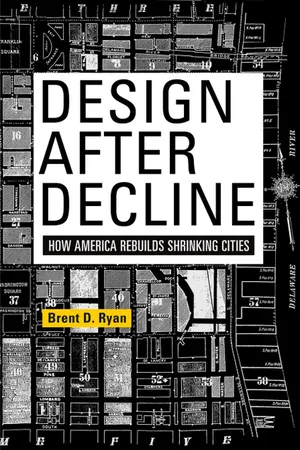
In Design After Decline, Brent D. Ryan reveals the fraught and intermittently successful efforts of architects, planners, and city officials to rebuild shrinking cities following mid-century urban renewal. With modern architecture in disrepute, federal funds scarce, and architects and planners disengaged, politicians and developers were left to pick up the pieces. In twin narratives, Ryan describes how America's two largest shrinking cities, Detroit and Philadelphia, faced the challenge of design after decline in dramatically different ways. While Detroit allowed developers to carve up the cityscape into suburban enclaves, Philadelphia brought back 1960s-style land condemnation for benevolent social purposes. Both Detroit and Philadelphia "succeeded" in rebuilding but at the cost of innovative urban design and planning.
Ryan proposes that the unprecedented crisis facing these cities today requires a revival of the visionary thinking found in the best modernist urban design, tempered with the lessons gained from post-1960s community planning. Depicting the ideal shrinking city as a shifting patchwork of open and settled areas, Ryan concludes that accepting the inevitable decline and abandonment of some neighborhoods, while rebuilding others as new neighborhoods with innovative design and planning, can reignite modernism's spirit of optimism and shape a brighter future for shrinking cities and their residents.
- 280 pages
- English
- ePUB (mobile friendly)
- Available on iOS & Android
eBook - ePub
About this book
Information
Table of contents
- Cover Page
- Title Page
- Copyright Page
- Dedication Page
- Contents
- Preface
- Chapter 1. “The Burden has Passed”: Urban Design After Urban Renewal
- Chapter 2. Shrinkage or Renewal? The Fate of Older Cities, 1950–90
- Chapter 3. “People Want these Houses”: The Suburbanization of Detroit
- Chapter 4. “Another Tradition in Planning”: The Suburbanization of North Philadelphia
- Chapter 5. Toward Social Urbanism for Shrinking Cities
- Notes
- Works Cited
- Index
- Acknowledgments
Trusted by 375,005 students
Access to over 1.5 million titles for a fair monthly price.
Study more efficiently using our study tools.
Frequently asked questions
Yes, you can cancel anytime from the Subscription tab in your account settings on the Perlego website. Your subscription will stay active until the end of your current billing period. Learn how to cancel your subscription
No, books cannot be downloaded as external files, such as PDFs, for use outside of Perlego. However, you can download books within the Perlego app for offline reading on mobile or tablet. Learn how to download books offline
Perlego offers two plans: Essential and Complete
- Essential is ideal for learners and professionals who enjoy exploring a wide range of subjects. Access the Essential Library with 800,000+ trusted titles and best-sellers across business, personal growth, and the humanities. Includes unlimited reading time and Standard Read Aloud voice.
- Complete: Perfect for advanced learners and researchers needing full, unrestricted access. Unlock 1.5M+ books across hundreds of subjects, including academic and specialized titles. The Complete Plan also includes advanced features like Premium Read Aloud and Research Assistant.
We are an online textbook subscription service, where you can get access to an entire online library for less than the price of a single book per month. With over 1.5 million books across 990+ topics, we’ve got you covered! Learn about our mission
Look out for the read-aloud symbol on your next book to see if you can listen to it. The read-aloud tool reads text aloud for you, highlighting the text as it is being read. You can pause it, speed it up and slow it down. Learn more about Read Aloud
Yes! You can use the Perlego app on both iOS and Android devices to read anytime, anywhere — even offline. Perfect for commutes or when you’re on the go.
Please note we cannot support devices running on iOS 13 and Android 7 or earlier. Learn more about using the app
Please note we cannot support devices running on iOS 13 and Android 7 or earlier. Learn more about using the app
Yes, you can access Design After Decline by Brent D. Ryan in PDF and/or ePUB format, as well as other popular books in Politics & International Relations & Urban Planning & Landscaping. We have over 1.5 million books available in our catalogue for you to explore.