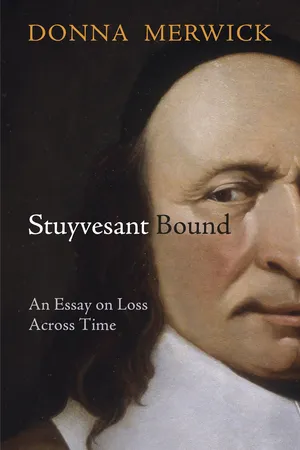
Stuyvesant Bound is an innovative and compelling evaluation of the last director general of New Netherland. Donna Merwick examines the layers of culture in which Peter Stuyvesant forged his career and performed his responsibilities, ultimately reappraising the view of Stuyvesant long held by the majority of U.S. historians and commentators.
Borrowing its form from the genre of eighteenth- and nineteenth-?century learned essays, Stuyvesant Bound invites the reader to step into a premodern worldview as Merwick considers Stuyvesant's role in history from the perspectives of duty, belief, and loss. Stuyvesant is presented as a mid-seventeenth-century magistrate obliged by his official oath to manage New Netherland, including installing Calvinist politics and belief practices under the fragile conditions of early modern spirituality after the Protestant Reformation. Merwick meticulously reconstructs the process by which Stuyvesant became his own archivist and historian when, recalled to The Hague to answer for his surrender of New Netherland in 1664, he gathered together papers amounting to almost 50,000 words and offered them to the States General. Though Merwick weaves the theme of loss throughout this meditation on Stuyvesant's career, the association culminates in New Netherland's fall to the English in 1664 and Stuyvesant's immediate recall to Holland to defend his surrender. Rigorously researched and unabashedly interpretive, Stuyvesant Bound makes a major contribution to recovery of the cultural and religious diversity that marked colonial America.
- 248 pages
- English
- ePUB (mobile friendly)
- Available on iOS & Android
eBook - ePub
About this book
Information
Publisher
University of Pennsylvania PressYear
2013Print ISBN
9780812245035
9780812245035
eBook ISBN
9780812208023
NOTES

Preface: The Outcast
1. Berthold Fernow and E. B. O’Callaghan, eds., Documents Relative to the Colonial History of the State of New York, 14: Council Minutes, Jan. 7, 1664, 540 (hereafter CHSNY).
2. CHSNY, 2: Memorial of the West India Company, Jan. 21, 1664, 224.
3. CHSNY, 2: Observations of the West India Company on the Report of Ex-Director Stuyvesant, Jan. 11, 1666, 420.
4. Ganguly 2005: 2, vii. It is useful to note the rich conversation about modernity developing between medieval/premodern and postcolonial scholars—see Davis 2008: 20, 99, and Spiegel 2011: 617–25.
5. Ganguly 2005: viii.
6. Lloyd 2005: 156. In agreement, see Ganguly 2005: 25. In this volume I have called on history and memory, recognizing them as interconnected domains of study central to this essay. Historiography has, however, undoubtedly dominated over memory studies. For excellent contributions to the so-called “turn to memory” in historical scholarship, see Margalit 2002; Ricoeur 2004; Wyshogrod 1998; and Bernstein 2004: 165–78. For Paul Connerton’s remarks on forgetting, see Chapter 10.
7. Merwick 2008: 699; for further usage, CHSNY, 2: 452–59. For “Laus Deo” on eight pages from Book of Monthly Payments, Extracts, 1661–1664, 452–69.
8. See Lowell 2000: 300, 301.
9. Altieri 2007: 88.
Chapter 1. Magistracy and Confessional Politics
1. CHSNY, 1: Resolutions of the States General, July 26 and 28, 1646; Minute of Stuyvesant Sworn in as Director, July 28, 1646; Commission of Stuyvesant, July 28, 1646, 177, 178; see also Oath of Stuyvesant as Director, July 28, 1646, 492; and West India Company’s Commission to Director Stuyvesant, May 5, 1645, 493. Hereafter, I generally use “States” for States General, “WIC” for West India Company, and “Peter” for Petrus. I have tried to make the text intelligible for readers without reference to the notes. They are here for validation and additional information and references. In the final chapter, a number of them offer material ordinarily found in a Reflective Essay.
2. Corwin 1: Johannes Megapolensis and Samuel Drisius to Classis of Amsterdam, Oct. 6, 1653, 318 (hereafter “Classis”). In his 2005 essay on Stuyvesant’s immediate predecessor as director, Frijhoff cites Willem Kieft’s great personal pride in his commission. It has not been found in the registers of the States General, 198.
3. CHSNY, 1: Remonstrance of New Netherland, July 28, 1649, 293 (hereafter Remonstrance).
4. Gehring 2000, Stuyvesant to Goodyear, Dec. 16, 1647, 25. For rumors in Boston of Cornelis Melijn’s claim that he could remove Stuyvesant at any time, Scott and Stryker-Rodda 1974a, Deposition of Laurens Cornelissen van der Wel, Mar. 30, 1649, 85.
5. Boxer 1957: 69; Merwick 1990: 151. For Curaçao salary as 1,200 guilders and 1,000 table money, plus allowances and fines, Goslinga 1985: 80.
6. Gehring 2000, Stuyvesant to Goodyear, Dec. 16, 1647, 26; Goodyear to Stuyvesant, undated, ca. Oct. 15, 1647, 18, my italics; Stuyvesant to Eaton, May 28, 1648, 31. Stuyvesant to Winthrop [Ap. 3, 1648], 27.
7. CHSNY, 12: Alrichs to Stuyvesant, May 14, 1659, 239.
8. Games 2006: 679 and see 683.
9. See, for example, Gehring and Schiltkamp 1987, Resolution, Aug. 20, 1643 regarding Aruba natives, and Rodenburgh to Dirs., Ap. 2, 1654, 61, Beck to Dirs., July 28, 1657 and July 21, 1664, 107, 188.
10. For Craacke Bay on Curaçao, CHSNY, 2: Instructions for Carsten Jeroesen, June 24, 1654, 45. For “Den Nieuw Nederlandsche Indiaen,” Gehring and Schiltkamp 1987: 176–81, and Records of New Amsterdam, 4: Mar. 21, 1662, 55. Hereafter RNA.
11. Gehring and Schiltkamp 1987: xiv; Declaration of Stuyvesant, June 9, 1655, 79; Resolutions, Aug. 20, 1643 and Feb. 26, 1643, 27, 11.
12. Jacobs 2005a offers well-founded speculations regarding Stuyvesant’s departure from Franeker as well as details of his student years, 221–36. For my return to Stuyvesant’s youthful and later spirituality, see Chapter 11.
13. CHSNY, 13: Dirs. to Stuyvesant, Mar. 21, 1651, 28; Stoler 2009: 40.
14. For reproaches, Middleton 2010: 66; CHSNY, 12: Stuyvesant to Dirs., Dec. 26, 1659, 288.
15. Gehring 2000, Stuyvesant to Governor of Massachusetts, [undated], ca. Ap. 1651, 122.
16. I am reluctant to use “province” because it suggests a territory of settler colonization with well-defined limits rather than a place mapped with a recognized degree of territorial uncertainty and thinly populated in widely dispersed trading centers. Frijhoff 1998 also urges caution in its use, identifying a difference in the way citizens in the Dutch Republic used the term and New Netherlanders used it. Whereas Dutch citizens took each province as a fatherland, the colonists developed a common value: that of “a fatherland overseas,” 31. The alternative to “province” might be “district” or “country,” both in use at the time. But “province,” I believe, best answers the needs of today’s readers.
17. See, inter alia, CHSNY, 1: Advice of Chamber of Accounts, WIC, Ap. 19, 1647, 242, and Gehring 2003, Dirs. to Stuyvesant, Mar. 13, 1656, 85. Stuyvesant later uses “on the spot,” CHSNY, 13: Order to Magistrates of Fort Orange, June 1, 1655, 39.
18. Gehring 2000, Dirs. to Stuyvesant, July 24, 1650, 92.
19. CHSNY, 14: for example, Stuyvesant to Dirs., Jan. 8, 1663, 520.
20. Gehring and Schiltkamp 1987: xvii; for Stuyvesant later advising that his government and the city’s officers take adequate defensive measures “to relieve ourselves from blame,” RNA 1: Stuyvesant to Burgomasters and Schepenen, July 28, 1653, 91.
21. Gehring 1995: xv; see also Gehring 1991: xvi. In agreement, inter alia, Otto 2006, 133, 135, 137 and Jacobs 2005b: 63. For Stuyvesant continuing to “demonstrate qualities of leadership” from 1654 to 1658 “as in his first six years,” Gehring 2003: xviii. It should be noted here that Gehring, who knows the New Netherland records better than any other scholar, offers a consistently positive interpretation of Stuyvesant’s administration.
22. Gehring 2000, Testimony of Domine Wilhelmus Grasmeer, Feb. 14, 1652, 130; for Cornelis Melijn on Staten Island, Gehring 2000, Deposition of Michiel Bergier, Feb. 8, 1652, 128; for Stuyvesant’s alleged murderous intent, Testimony of Grasmeer, Feb. 14, 1652, 130.
23. Gehring 1991, Ordinance for Assessing Vacant Lots in New Amsterdam, Jan. 15, 1657, 92, 93, passim., my italics; for reliance in Holland on the “empirical,” Frijhoff 1999: 140. For proof resting on “before two pairs of eyes,” CHSNY, 1: Remonstrance, 310.
24. CHSNY, 14: Council Minute Regarding Backerus, May 8, 1649, 114.
25. For “Director and primary judge of this country,” Scott and Stryker-Rodda 1974b, Declaration Signed by Stuyvesant, Ap. 21, 1649, 595.
26. Gehring 1991, Ordinance Against Practicing Religion Other Than Reformed, Feb. 1, 1656, 55 and CHSNY, 14: Sentence of William Hallett, Nov. 8, 1656, 369.
27. Davis 2008: 2. For Director General Willem Kieft’s conviction that “his authority . . . stemmed from God,” Jacobs 2005b, 280.
28. CHSNY, 1: Remonstrance, 305.
29. For Frijhoff’s discussion of structural fragmentation (“De gecultiveerde verdeeldheid”) as a fundamental and traditional Dutch modus operandi, 1999, 126, and for the frequent blurring of boundaries, Elton 1963: 28. “The Genevan ideal” was that members of the consistory be the city’s magistrates, Crew 1978: 13. Nooter’s 1994 data support acceptance of the local magistrate as also a church official, 16, passim.
For Calvin’s rejection of “church-state separation,” Paul 2010, 180. Reeves 2009 argues that insofar as in Catholic and Protestant countries alike in the sixteenth and seventeenth centuries “there was a lack of differentiation between civil and ecclesiastical institutions, there was a politicization of religion,” making this period “an age of radical de-secularization,” 61.
30. Corwin, 1: Domine Jonas Michaëlius to Domine Adrianus Smoutius, Aug. 11, 1628, 55; for Michaëlius’s position quoted, Jacobs 2005b: 275. The WIC directors commented on the interrelated roles of minister and magistrate regarding Indian conversions, CHSNY, 1: Answer to Remonstrance, Jan. 31, 1650, 340, and for magistrates of Wiltwijck collecting church money, Jacobs 2005b: 164.
31. Frijhoff 1995: 764; Gehring 1995, Council Minute, Mar. 1, 1656, 252.
32. Scott and Stryker-Rodda 1974b: 600 and for further accounts of disputes before Stuyvesant’s time, 603, 612; see...
Table of contents
- Cover
- Title
- Copyright
- Contents
- Preface: The Outcast
- I. Duty
- II. Belief
- III. Loss
- Notes
- Bibliography
- Index
- Acknowledgments
Trusted by 375,005 students
Access to over 1.5 million titles for a fair monthly price.
Study more efficiently using our study tools.
Frequently asked questions
Yes, you can cancel anytime from the Subscription tab in your account settings on the Perlego website. Your subscription will stay active until the end of your current billing period. Learn how to cancel your subscription
No, books cannot be downloaded as external files, such as PDFs, for use outside of Perlego. However, you can download books within the Perlego app for offline reading on mobile or tablet. Learn how to download books offline
Perlego offers two plans: Essential and Complete
- Essential is ideal for learners and professionals who enjoy exploring a wide range of subjects. Access the Essential Library with 800,000+ trusted titles and best-sellers across business, personal growth, and the humanities. Includes unlimited reading time and Standard Read Aloud voice.
- Complete: Perfect for advanced learners and researchers needing full, unrestricted access. Unlock 1.5M+ books across hundreds of subjects, including academic and specialized titles. The Complete Plan also includes advanced features like Premium Read Aloud and Research Assistant.
We are an online textbook subscription service, where you can get access to an entire online library for less than the price of a single book per month. With over 1.5 million books across 990+ topics, we’ve got you covered! Learn about our mission
Look out for the read-aloud symbol on your next book to see if you can listen to it. The read-aloud tool reads text aloud for you, highlighting the text as it is being read. You can pause it, speed it up and slow it down. Learn more about Read Aloud
Yes! You can use the Perlego app on both iOS and Android devices to read anytime, anywhere — even offline. Perfect for commutes or when you’re on the go.
Please note we cannot support devices running on iOS 13 and Android 7 or earlier. Learn more about using the app
Please note we cannot support devices running on iOS 13 and Android 7 or earlier. Learn more about using the app
Yes, you can access Stuyvesant Bound by Donna Merwick in PDF and/or ePUB format, as well as other popular books in History & Historical Biographies. We have over 1.5 million books available in our catalogue for you to explore.