In 1484, humanist philosopher and theologian Marsilio Ficino published the first complete Latin translation of Plato's extant works. Students of Plato now had access to the entire range of the dialogues, which revealed to Renaissance audiences the rich ancient landscape of myths, allegories, philosophical arguments, etymologies, fragments of poetry, other works of philosophy, aspects of ancient pagan religious practices, concepts of mathematics and natural philosophy, and the dialogic nature of the Platonic corpus's interlocutors. By and large, Renaissance readers in the Latin West encountered Plato's text through Ficino's translations and interpretation.In Plato's Persona, Denis J.-J. Robichaud provides the first synthetic study of Ficino's interpretation of the Platonic corpus. Robichaud analyzes Plato's works in their original Greek and in Ficino's Latin translations, as well as Ficino's non-Platonic writings and correspondence, in the process uncovering new aspects of Ficino's intellectual work habits. In his letters and works, Ficino self-consciously imitated a Platonic style of prose, in effect devising a persona for himself as a Platonic philosopher. Plato's dialogues are populated with a wealth of literary characters with whom Plato interacts and against whom Plato refines his own philosophies. Reading through Ficino's translations, Robichaud finds that the Renaissance philosopher seeks an understanding of Plato's persona(e) among all the dialogues' interlocutors. In effect, Ficino assumed the role of Plato's Latin spokesperson in the Renaissance. Plato's Persona is grounded in an extensive study of scholarship in Renaissance humanism, classics, philosophy, and intellectual history, and contextualizes Ficino's intellectual achievements within the contemporary Christian orthodox view of Platonism. Ficino was an influential figure in the early Italian Renaissance: the key intermediary between Greek and Latin, and between manuscript and print, giving voice to Plato and access to the ancient frameworks needed to interpret his dialogues.
eBook - PDF
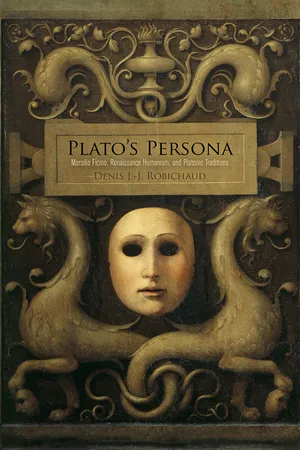
Plato's Persona
Marsilio Ficino, Renaissance Humanism, and Platonic Traditions
- 353 pages
- English
- PDF
- Available on iOS & Android
eBook - PDF
About this book
Information
Publisher
University of Pennsylvania PressYear
2018Print ISBN
9780812249859
9780812249859
eBook ISBN
9780812294729
Topic
PhilosophyTable of contents
- Cover
- Contents
- Introduction
- Chapter 1. Prosopon/Persona: Philosophy and Rhetoric
- Chapter 2. Ficino and the Platonic Corpus
- Chapter 3. Socrates
- Chapter 4. Pythagoras and Pythagoreans
- Chapter 5. Plato
- Conclusion
- Appendix. Heuristic Prosopography of Ficino’s Pythagoreans
- Notes
- Bibliography
- General Index
- Index Locorum
- Acknowledgments
Trusted by 375,005 students
Access to over 1.5 million titles for a fair monthly price.
Study more efficiently using our study tools.
Frequently asked questions
Yes, you can cancel anytime from the Subscription tab in your account settings on the Perlego website. Your subscription will stay active until the end of your current billing period. Learn how to cancel your subscription
No, books cannot be downloaded as external files, such as PDFs, for use outside of Perlego. However, you can download books within the Perlego app for offline reading on mobile or tablet. Learn how to download books offline
We are an online textbook subscription service, where you can get access to an entire online library for less than the price of a single book per month. With over 1.5 million books across 990+ topics, we’ve got you covered! Learn about our mission
Look out for the read-aloud symbol on your next book to see if you can listen to it. The read-aloud tool reads text aloud for you, highlighting the text as it is being read. You can pause it, speed it up and slow it down. Learn more about Read Aloud
Yes! You can use the Perlego app on both iOS and Android devices to read anytime, anywhere — even offline. Perfect for commutes or when you’re on the go.
Please note we cannot support devices running on iOS 13 and Android 7 or earlier. Learn more about using the app
Please note we cannot support devices running on iOS 13 and Android 7 or earlier. Learn more about using the app
Yes, you can access Plato's Persona by Denis J.-J. Robichaud in PDF and/or ePUB format, as well as other popular books in Philosophy & Medieval & Renaissance Philosophy. We have over 1.5 million books available in our catalogue for you to explore.