The mute gestures of advertising images are frozen for posterity by photographers and illustrators, gestures that, for better or worse, perpetuate a certain aesthetic and eventually become emblematic of a period. The images of today display the values of a society that has more interest in the body than the mind. They are technoenhanced labyrinths of unattainable appearances that leave women and men feeling horrified, estranged, and restricted by unrealistic, silent mandates. Measuring Up looks at advertising as more than just a way to extract money from unsuspecting people but as a vehicle for conveying the larger views of a confining, body-obsessed culture.
By weaving theoretical and textual insights from feminist and cultural studies with the voices of real women and men, Measuring Up offers a unique reception analysis of the effects of repetitious exposure to advertisements of perfect bodies in our everyday lives. Shields examines a particular, complex relationship between the idealized images of gender we see in advertising and our own thoughts, feelings, and behavior in relation to these images. The study is unique in presenting audience reception in terms of ethnographic data, not textual interpretations alone.
Measuring Up engages with and informs current theoretical debates within these sometimes complementary and sometimes contradictory literatures: feminist media studies, feminist film theory, critical social theory, cultural studies, and critical ethnography. This is an important work that explores the forms and channels of power used in one of the most insidious and overt means of mass influence in popular culture.
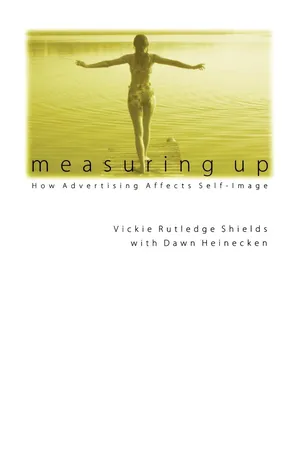
eBook - ePub
Measuring Up
How Advertising Affects Self-Image
- 224 pages
- English
- ePUB (mobile friendly)
- Available on iOS & Android
eBook - ePub
Measuring Up
How Advertising Affects Self-Image
About this book
Information
1. Theory and Method
A particular challenge faces researchers interested in how real people experience media in their everyday lives. There is often an overwhelming gap between our theories about how particular media affect us (from a production and content standpoint, for example), and figuring out how media weave through people’s lives (Abercrombie and Longhurst 1998; Lull 1995; Moores 1993; Press 1996, 1991; Seiter 1998). As Colin Sparks points out, “Boundaries in actual social life are inevitably messy and blurred. Actual social formations always display a greater richness and complexity than the theoretical abstractions we use to understand them”; however, “We are forced to use those abstractions because we cannot hope to understand reality simply by observing its surface features” (1998, 29). Most of the time theoretical insights guide us in a particular way toward a better understanding of how the discourses of people might be interpreted.
Advertising permeates our everyday lives insisting we be its audience. Marketers have made a fine-tuned science out of targeting particular demographic groups to position products. Furthermore, there is now little dispute that the content of commercial television is primarily a vehicle to deliver audiences to advertisers and that glossy magazines serve the same purpose. However, real people do not experience their lives as target audience members. Sometimes we are audiences of many media at once; at other times we choose to tune out altogether (if this is really possible). Sometimes we are passive: the television is on in the background, but we are having a phone conversation, or we have it on just to pass an hour. At other times we are highly attentive, playing along with every question on Who Wants to Be a Millionaire? and talking back to the television set.
A useful way to think about the active or passive positions we take up with media comes from Stuart Hall’s concept of encoding/decoding (1980). Cultural studies in the past has approached the reader/media text relationship as a series of positions viewers take up given their ideological predisposition to the media message they are attending to. Viewers may be seen as taking up either preferred/dominant, negotiated/resistant or oppositional subject positions in regard to the text (Johnson 1986; Morley 1980, 1986, 1989). To illustrate, consider examples of possible dominant, negotiated, and oppositional readings of the popular television series Ally McBeal. A dominant reading of this show might see Ally as a hip professional woman, trying to make it in the cut-throat world of litigation and law practices. She is quirky and unlucky in love, but she shows a lot of gumption, spirit and hope. She’s a real ’90s woman, trying to have it all (Heywood 1998).
A negotiatied reading of the show might find many elements believable and others not. For instance, the fact that Ally, a young single woman, has achieved success in a prominent law firm may seem very real and believable. Her yearning for love in the midst of a single life may ring true for many also. Yet, an audience member may think many of the silly choices she makes and things she does wouldn’t actually be tolerated in such a competitive field, or they might feel that the female competition on the show is really unnecessary and detracts from the show’s potential.
Finally, an oppositional reading of Ally McBeal might read a lot like some of the critical reviews the show received in the popular press. In her article for USA Today, “Ally, Real Life Has No Commercial Breaks,” Colleen D. Ball (1998, 27a) talks back to Ally (the way many of us talk back to our television sets) about what would actually happen to her career if her yearnings for Mr. Right and a baby came true right away. Ball explains that having a baby will involve daycare choices and perhaps even part-time work arrangements. Ally’s boss probably wouldn’t understand, she would be slow-tracked and probably would never make partner—or she can keep up her current work schedule, never see her family, risk divorce from Mr. Right, and maybe even lose custody of dancing baby because she works too much! In TV Guide’s “Insider: Smart Women, Foolish Choices” (1998), Beth Brophy called these foolish choices the “Ally McBeal-ization” of TV. “Like the Harvard-trained lawyer—who often wins in court but loses control outside of it—these women share a startling disconnect between professional competence and personal ditziness” (6).
Popular TV shows are certainly not the only media we take up various subject positions with. We even take up active “subject positions” with our favorite commercials. Sometimes we don’t get a snack or change the station when they come on. We sit in our chairs to watch and sing along. However, generally we experience advertising not as something we actively seek out, as we do a TV program, magazine, newspaper, or website. Even billboards by the side of the road are encountered because we are driving by them, not driving to them. Advertising comes to us “bundled” with these media and we think of viewing ads as secondary to the medium we seek out.
Ethnography and Sense-Making
Ethnographic methods provide many of the best tools for studying media and everyday life. A methodology used in anthropology, ethnography in the authentic sense of the word is a research methodology that involves extended periods of participant observation and emphasizes extensive field notes and the final ethnography produced (Seiter 1998). “Ethnography is the work of describing a culture” (Spradley 1979, 3). The aim of ethnography is to grasp a way of life from “the Natives’ point of view” (Geertz 1983), and to understand a way of living that is usually different from but sometimes a part of the researcher’s own experience. It is a method more concerned with learning from people than with studying them.
Cultural studies scholars have held up ethnography as a methodology best suited for studying popular culture’s “elusive audience” (see Ang 1989, 1990; Ang and Hermes 1991; Bacon-Smith 1992; Bird 1992a, b; Erni 1989; Fejes 1984; Press 1996, 1991; Radway 1989). Media reception analysis studies by cultural studies and communication scholars tend to be hybrids of ethnography and qualitative interviewing. Influential examples include David Morley’s research on lower-middle-class London families and television use (1986); Janice Radway’s study of female readers of romance novels (1984); Ien Ang’s analyses of fan’s letters about the television show Dallas (1985); and Ann Gray’s research on video cassette recorder use (1992).
More recent influences in feminist reception analysis have built upon this tradition of using ethnographic and qualitative interviewing approaches to study media use in everyday life. Such studies include Camille Bacon-Smith’s study of U.S. Star Trek fans (1992); Jacqueline Bobo’s study of black women’s readings of The Color Purple (1988); Elizabeth Bird’s examination of tabloids and their faithful readers (1992); Robin Means Coleman’s in-depth research on African American viewers of black situation comedies (2000); Andrea Press’s study of female television viewing and social class (1991); and Ellen Seiter’s research on children’s television and computer use (1998).
In studying men and women’s relationship with gender representations in advertising I made methodological choices based on what would most effectively draw out people’s experiences in their own words and on their own terms. At the same time the methods needed to be informed by theoretical advances in audience reception research and feminist media studies. An ethnographic approach guided the sampling of participants and the coding and writing up of transcripts which resulted, ultimately, in a “writing of culture” that attempts to present a portrait of how men and women experience advertising in their everyday lives, and how they decode the repetitious, ubiquitous image of the idealized female body in advertising in particular.
The Interview Participants
The pool of participants totaled 73. The men and women who lend their insights and voices to this book do not come from one discrete sample, however. The core sample is a group of 15 women and 15 men who were interviewed during a three-month period in the late fall and early spring of 1993. The remaining 43 men and women are from two other studies. The first was conducted as part of a gender and communication class at a major midwestern research university. The second was an independent study I conducted in the fall of 1995 at my current university. In actuality, more than these 73 voices will be speaking. Over the past six years in the undergraduate and graduate university courses I teach on women, mass media, and culture, I have witnessed numerous recountings of students’ relationships to gender images in media as well as their explanations of how they see media images affecting other significant individuals in their lives. These testimonies weave their way into the discourse of this book also.
The 73 men and women represent a fairly culturally diverse group, although not representative of the larger population. Their ages ranged from 18 to 45. The sample included 6 African American women and 2 Hispanic women; it also included 3 gay men and 5 lesbians. Obviously the second sample for the gender and communication class were university students. But, the core sample and the independent study sample were drawn from the university area, not from university students exclusively. Some men and women in the sample were not students at the time of the interviews, but working in such self-reported positions as receptionist, psychologist, house painter, artist, and “between gigs.”
The Interviews
All the interviews were conducted using ethnographic methods and interviewing techniques from Sense-Making, a set of theory-driven methods developed by communication theorist Brenda Dervin (see Clark and Dervin 1999; Shields and Dervin 1993). Sense-Making assumptions have been used to generate a series of interviewing approaches useful in a wide variety of research settings, for in-depth as well as brief contacts, in formal research as well as informal episodes where one person wants to understand another, in two-person as well as group settings (see Dervin 1983, 1990, 1991a, b, 1993; Dervin and Clark 1993, Shields 1996). Fundamental to all Sense-Making data collection approaches is the assumption that, no matter how much like another human being one person may be, there are always differences between the two, and there is always potential for these differences to change over time.
In the interview, the interviewer always starts by having the respondent identify a real situation the respondent experienced. The interviewer then asks questions that deliberately and systematically implement the Sense-Making metaphor. What happened in this situation—what happened first, second, and so on? What was important to you about the situation? What was difficult about it? What led you to see it in this way? What questions did you have? What kind of answer(s) were you looking for? What understandings did you get? Did the understandings help? Did they hinder? How? What ideas did you create? Did these ideas help? Did they hinder? How? Did they have an impact on your later behavior? thinking? feeling? How? It is assumed that we can better hear what others have to say about their worlds by systematically addressing their views of how they bridge gaps, of how they invent their worlds even in the most externally constrained of situations.
The interviewing protocol used with the core sample of participants was carefully designed to provide a methodological alternative to traditional unstructured, open-ended interview techniques. The protocol presented the viewing of ads to men and women in three different ways. First, they discussed ads they chose for themselves, simulating a natural viewing situation. The men and women browsed through their choice of the five magazines provided, and chose three ads with females in them that stood out for them in some way (because the ad is attractive, eye-catching, pleasing, disgusting, intriguing, repulsive, persuasive, etc.). The five magazines were Time, Cosmopolitan, Rolling Stone, Sports Illustrated, and People. These magazines were listed as the five most popular magazines of a freshman-level university class that consisted of approximately 130 students.
The second and third portions of the interview protocol were designed to tap into the relationship between how men and women see society’s view of the ideal female body in advertising and how they personally see, or experience, the ideal female body in advertising. By rank order...
Table of contents
- Cover
- Title
- Copyright
- Contents
- Preface
- 1. Theory and Method
- 2. Stereotypes and Body Parts Advertising Content
- 3. What Do Ads Teach Us About Gender?
- 4. Signs of the Times: A Semiotics of Gender Ads
- 5. Weighing In and Measuring Up
- 6. Elizabeth’s Story
- 7. Differences Within Gender: Manufacturing Distance
- 8. Interventions and Changes
- 9. Final Thoughts
- References
- Index
- Acknowledgments
Trusted by 375,005 students
Access to over 1.5 million titles for a fair monthly price.
Study more efficiently using our study tools.
Frequently asked questions
Yes, you can cancel anytime from the Subscription tab in your account settings on the Perlego website. Your subscription will stay active until the end of your current billing period. Learn how to cancel your subscription
No, books cannot be downloaded as external files, such as PDFs, for use outside of Perlego. However, you can download books within the Perlego app for offline reading on mobile or tablet. Learn how to download books offline
Perlego offers two plans: Essential and Complete
- Essential is ideal for learners and professionals who enjoy exploring a wide range of subjects. Access the Essential Library with 800,000+ trusted titles and best-sellers across business, personal growth, and the humanities. Includes unlimited reading time and Standard Read Aloud voice.
- Complete: Perfect for advanced learners and researchers needing full, unrestricted access. Unlock 1.5M+ books across hundreds of subjects, including academic and specialized titles. The Complete Plan also includes advanced features like Premium Read Aloud and Research Assistant.
We are an online textbook subscription service, where you can get access to an entire online library for less than the price of a single book per month. With over 1.5 million books across 990+ topics, we’ve got you covered! Learn about our mission
Look out for the read-aloud symbol on your next book to see if you can listen to it. The read-aloud tool reads text aloud for you, highlighting the text as it is being read. You can pause it, speed it up and slow it down. Learn more about Read Aloud
Yes! You can use the Perlego app on both iOS and Android devices to read anytime, anywhere — even offline. Perfect for commutes or when you’re on the go.
Please note we cannot support devices running on iOS 13 and Android 7 or earlier. Learn more about using the app
Please note we cannot support devices running on iOS 13 and Android 7 or earlier. Learn more about using the app
Yes, you can access Measuring Up by Vickie Rutledge Shields,Dawn Heinecken, Dawn Heinecken in PDF and/or ePUB format, as well as other popular books in Social Sciences & Popular Culture. We have over 1.5 million books available in our catalogue for you to explore.