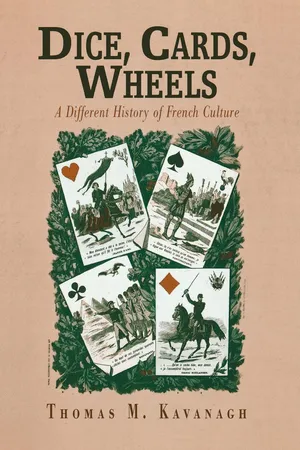
Gambling has been a practice central to many cultures throughout history. In Dice, Cards, Wheels, Thomas M. Kavanagh scrutinizes the changing face of the gambler in France over a period of eight centuries, using gambling and its representations in literature as a lens through which to observe French culture. Kavanagh argues that the way people gamble tells us something otherwise unrecognized about the values, conflicts, and cultures that define a period or class. To gamble is to enter a world traced out by the rules and protocols of the game the gambler plays. That world may be an alternative to the established order, but the shape and structure of the game reveal indirectly hidden tensions, fears, and prohibitions.
Drawing on literature from the Middle Ages to the present, Kavanagh reconstructs the figure of the gambler and his evolving personae. He examines, among other examples, Bodel's dicing in a twelfth-century tavern for the conversion of the Muslim world; Pascal's post-Reformation redefinition of salvation as the gambler's prize; the aristocratic libertine's celebration of the bluff; and Balzac's, Barbey d'Aurevilly's, and Bourget's nineteenth-century revisions of the gambler.
Dice, Cards, Wheels embraces the tremendous breadth of French history and emerges as a broad-ranging study of the different forms of gambling, from the dice games of the Middle Ages to the digital slot machines of the twenty-first century, and what those games tell us about French culture and history.
- 264 pages
- English
- ePUB (mobile friendly)
- Available on iOS & Android
eBook - ePub
About this book
Information
Publisher
University of Pennsylvania PressYear
2013Print ISBN
9780812238600
9780812238600
eBook ISBN
9780812202458
1
Toward a Cultural History of Gambling
Why, the question must be asked, is there no cultural history of gambling? At the level of fact, of the actual social practices through which men and women interact with one another, gambling has existed and continues to exist in all societies from the primitive to the most advanced, from the most temporally distant to the most contemporary. Be it the Hindu Bhagavad-Gita, Greek mythology, or the Judeo-Christian Bible, all foundational narratives include moments when a conflict, a dispute over domains, possessions, or privileges is resolved or transformed by recourse to the impartiality of a chance event upon which stakes are placed. As a form of social interaction that draws the attention of cultural historians, however, gambling seems hardly to exist. There are anecdotal biographies of famous gamblers. There are numerous more or less fantastical reflections on the origins of specific gambling games. There are topical studies of a particular regime’s attempts to control or eliminate gambling. There are numerous exotic geographies of such gambling meccas as Paris’s Palais Royal, Venice’s Ridotto, and the Las Vegas Strip. Few of these, however, look at gambling as a significant social practice, as a form of conviviality both anchored in and revelatory of its broader cultural context.
To a certain extent, this state of affairs is a product of exclusions endemic to scholarly investigation. At an obvious level, gambling falls on the wrong side of scholarship’s well policed dividing line between the serious and the frivolous. Even those rare scholars who look seriously at gambling tend to treat it as an embarrassing digression, a practice usually dismissed as a hybrid or degraded form of something more important. The most widely read and influential twentieth-century study of play (and, by association, of gambling), is Johan Huizinga’s Homo Ludens.1 Writing in the ideologically charged context of Europe in the mid-1930s, Huizinga sets out to redraw the frontier between the serious and the frivolous, between culture and play. For Huizinga, play is not what culture surpasses, not some lingering residue of childish frivolity, but the origin and hidden impulse behind everything we call culture: “Law and order, commerce and profit, craft and art, poetry, wisdom and science, all are rooted in the primeval soil of play” (5). It is only, Huizinga argues, when we recognize the primacy of play that we can begin to understand the real nature and implications of culture itself. An eminent cultural historian of the Middle Ages, Huizinga offers numerous examples drawn from that period of European history to defend his thesis that play is distinguished by three fundamental characteristics: it is gratuitous; it is autotelic; and it creates its own distinctive temporality. As a gratuitous activity, Huizinga’s play is characterized by a profound disinterestedness, a “fun element” placing it outside the demands and reciprocities of daily life. As an autotelic activity, play creates its own virtual world of a contest which is determined by nothing beyond the arbitrary rules structuring the particular game at which one plays. Always offering the possibility of starting over and beginning anew, play is distinguished by the temporality of the infinitely repeatable. Gratuitous, autotelic, and reiterable, play is, for Huizinga, a kind of Platonic ideal, a pure form at the origin of everything we call culture. Yet that idea is continually betrayed by the actual practices it generates. What Huizinga calls “the great instinctive forces of civilized life” may spring from the play instinct in its purity, but that ideal is inevitably corrupted by the contextual forces of economic necessity, material interest, and ideological conflict. More than anything else, Huizinga’s Homo Ludens expresses an eschatological vision denouncing modernity as a degradation of true play, as an ever more complete turning away from an era of innocence when the pure spirit of play informed less acquisitive and less egotistical cultural practices grounded in gratuitous disinterest. Given this narrative of culture corroded, it is clear that, for Huizinga and for the model of play on which his argument is based, gambling can only be an extreme form of play’s degeneration, a monstrous hybrid of play and money generating an insidious betrayal of play’s true function.
Writing twenty years after Huizinga, Roger Caillois, the other twentieth-century theoretician of play sure to be cited in studies of gambling, created a different kind of problem. Caillois’s major contribution to the study of play and games (the two semantic fields brought together with gambling in the single French term of jeu) is his elaboration of a classification system based on six terms borrowed from Greek, Latin, and English.2 Four of these terms, alea, agon, mimicry, and ilinx are used to classify the types of play in which one might engage. Alea represents games of chance, agon games of confrontation, mimicry games of imitation, and ilinx games providing some form of physical exhilaration. Caillois then subdivides these four general types of play once again in terms of whether they are practiced within a context of fixed rules and calculation (ludus) or as spontaneous, unstructured activity (paideia). In terms of this system, gambling becomes, as it was for Huizinga, something unclassifiable, a practice floating indeterminately between alea and agon as well as, depending on the type of gambling, between ludus and paideia.
Both Huizinga’s lament for the loss of disinterested play within modern culture and Caillois’s taxonomy of play and games share the disadvantage of splitting gambling off from its most revelatory context, from the passionate and personal drives it always in some way expresses. Understanding gambling, its diverse ubiquity as well as its abiding seduction, lies neither in dismissing it as a degraded form of ludic sociability nor in locating it within the coordinates of an impersonal classification system.
The sociologist David Oldman, during a fieldwork study of roulette players in England, made what he saw as a surprising discovery. He found that, when playing roulette, none of those involved act in ways that are consistent with the seemingly obvious fact that the winning numbers the wheel produces are random outcomes over which no one has any real control. Instead, he found, players tend to construct a personal and imaginary scenario transforming their gambling into a “contest between croupier and players such that betting becomes an exercise in skill which depends on the construction and maintenance of predictive theories”3—what we would call systems or martingales. Even more surprisingly, he found that this same imaginary overlay of a personalized contest was shared by and influenced the way casino managers reacted when they were confronted with an extended run of numbers favoring players. Objectively, it is of no importance to the outcome of the game who spins the wheel and who sets the ivory ball off on its counter-clockwise orbit against the direction of the rotating wheel. Yet the standard policy in such a situation, Oldman discovered, was for the manager to change the person spinning the wheel, always moving up the establishment’s hierarchy: a new employee would be replaced by a veteran, a losing veteran by an assistant manager, and the assistant by the manager himself if the run of numbers against the house persisted. Oldman underlines the fact that, in doing this, the managers were well aware that what they were doing was irrational: “When I taxed one of the managers with the pointlessness of changing the spinner he replied that, logically, it made no difference, but, as he said, ‘you’ve got to do something, and what else can you do?’” (421). Oldman draws from this the conclusion that, once some personal stake is invested in the objective randomness of gambling, all participants invoke a second order of knowledge, a subjective fantasy based on the premise of, as Oldman puts it, “Logically X, but Y” (421).
Oldman’s findings are important because they help us to see what is too often overlooked when studying gambling as a social practice: the irrational, properly imaginary, and eminently cultural dimensions of the gambling experience. Peter L. Bernstein, in his study of the history of human attitudes toward risk, borrows the title of his closing chapter, “Awaiting the Wildness,” not from a scientist or a mathematician, but from the early twentieth-century British novelist and essayist, G. K. Chesterton. “The real trouble with this world of ours,” Chesterton writes, “is not that it is an unreasonable world, nor even that it is a reasonable one. The commonest kind of trouble is that it is nearly reasonable, but not quite. Life is not an illogicality; yet it is a trap for logicians. It looks just a little more mathematical and regular than it is; its exactitude is obvious, but its inexactitude is hidden; its wildness lies in wait.”4
Asking the same question as that put by Oldman to his roulette players, Bernstein concludes that, however much actuaries and their calculations may seem to master the unpredictable, there is something else that lies outside their equations: “human beings must contend with the behavior of something beyond the patterns of nature: themselves. Indeed, as civilization has pushed forward, nature’s vagaries have mattered less and the decisions of people have mattered more” (330). The human dimension of the gambler’s reaction to risk, what Bernstein calls “decisions,” will always be the expression of a “wildness” rooted in the subjective and the irrational as part of our reaction to risk.
To understand gambling as a cultural practice, we must approach it in terms of this human factor. Gambling must be recognized not only as a series of specific games that waxed and waned in popularity at various places in various times, but as a privileged arena for the acting out, for the putting into play, of imaginary constructs, of subjective scenarios insisting that there is more to being alive than what the mathematician might suggest. It is in this sense that gambling has a history as well as a theory, a content as well as a structure. To offer only a theory or a taxonomy of gambling, as do Huizinga and Caillois, is to lose contact with that history in favor of a universal paradigm that dismisses the vital, flesh and blood, imaginary as well as real dimensions of all cultural activity. The risk-taking we call gambling, and the subjective scenarios it generates, initiate for those who play a suspension of the certainties of probability theory and the law of large numbers. To gamble against the house’s edge is to step outside the law. As such, gambling suspends compliance not only with the mathematical but also with the political and social orthodoxies governing everyday life. Gambling, Oldman and Bernstein help us see, is never simply a masochistic submission to the dictates of probabilities telling us we must lose. To gamble is to invoke a second level of knowledge prompting us to act on the subjective conviction that there is something about this bet and this moment that goes beyond and is no longer subject to the dictates of an objective mathematical model. Gambling lies firmly and richly within the cultural because it brings with it a celebration of the twinned mysteries of subjectivity and imagination. To gamble is to proclaim that there exists, beyond the calm dictates of law, a subjective wildness cosubstantial with who I am and with the bets I place.
* * *
The need to historicize gambling’s place in culture is a corollary to the fact that the gambler’s subjectivity is never a direct, unmediated response to any particular game. The gamblers’ imaginary is itself influenced and structured by the larger culture of which they and their games are a part. The history of gambling is in this sense heavily inflected by the ways chance as a concept has been understood during the different periods making up the Western tradition. The history of the moral and social values attached to gambling has been influenced by two major shifts in the West’s conceptualization of chance and its ethical implications. These shifts can be summarized as the passage, first from a classical to a Christian understanding of chance and, during a period roughly corresponding to the Enlightenment, a second transformation from the Christian to the modern or scientistic understanding of chance.
The classical period, that of Greek and Latin culture, was marked by an explicit recognition of chance as a force at work within human affairs. In Chapters Four through Six of Book Two of his Physics, Aristotle begins his discussion of the relation between chance and causality by rejecting the position that a full understanding of causality’s hidden intricacies would banish any recognition of chance as a legitimate concept. “Many things come to be and exist by luck or chance,” Aristotle insists.5 At the same time, he makes clear, without mentioning him by name, that he is unwilling to accept what he sees as the extreme position on this question taken by Democritus and his disciples who claim, as Aristotle puts it, that “chance is the cause both of this heaven and of everything that is in the ordered universe . . . that the vortex came to be by chance, and so did the motion which separated the parts and caused the present order of the universe” (31). While attributing everything to chance is, for Aristotle, an exaggeration that flies in the face of our knowledge of causality, he nonetheless insists that a real power of agency must be granted to what, in Richard Hope’s translation, is called luck or chance. For Aristotle, events that might legitimately be referred to as chance events are not so much those that take place independently of any rational cause, but those which are the product of the rare, unexpected, and accidental intersection of two otherwise independent causal sequences.6
Aristotle offers two examples to clarify this idea of the chance event as an unexpected intersection of causal sequences. The first is that of a man who, having lent money to someone, finds himself unexpectedly reimbursed because, while visiting the market one day, he happens to meet there the person who owed him money and who himself has just come into a large sum and wishes to repay his debt. His second example is that of the man who, while digging in a field to plant his crops, comes upon a stash of gold that had been buried there by another party. In each of these examples, the person experiencing the chance event was engaged in purposeful action: shopping at the market in the first case, planting crops in the second. The chance event, the debt’s reimbursement and the finding of the treasure, take place because that original purposeful action has led the party so engaged to intersect with a second and equally purposeful action undertaken by the other party: receiving a bequest that provides funds and hiding a treasure in an uncultivated field. In both cases, Aristotle concludes, the existence of those purposeful actions makes it clear that we are not dealing with the complete indeterminacy for which Democritus would argue. What we have instead are events produced by the accidental intersection of distinct yet determinate actions. Chance, for Aristotle, might best be described as an incidental cause impinging on the sphere of a differently intended action. As such, acknowledging the existence of chance becomes perfectly compatible with the exercise of intelligence and reflection.
There is, however, as Aristotle goes on to explain in Chapter 6, an important distinction that must be made in speaking of chance events. We must distinguish, again in Hope’s translation, between “luck” and “chance” or, in the Greek, between tyche and automaton. Luck, or tyche, designates those chance events which have implications within the domain of nous or intelligence, which have tangible repercussions for a rational human being. Chance in its more restricted sense, or automaton (also translated as spontaneity), designates chance events which concern only physis or the domain of nonhuman and nonrational material nature. In terms of their underlying causal structure, luck and chance are the same. In terms of their implications and consequences, luck and chance are different. What occurs as luck can also be said to occur by chance, but what occurs as chance lacks the specifically human dimension that characterizes luck. The category of the lucky can be invoked only when speaking of an event which touches on beings who are conscious of good or bad fortune and endowed with a capacity for choice in the conduct of their affairs. Luck can never be used in speaking of inanimate objects, animals, or even children. For them, one can speak only of a chance or spontaneous event. Aristotle’s examples of the man repaid in the market and of the man who finds a treasure are instances of luck. The example he offers of a spontaneous chance event is that of a tripod, a three-footed stool, which, having been thrown into the air, happens to land on its three feet rather than on one of its sides or its seat. Conceptually, luck and chance represent distinct categories. Yet, although Aristotle does not discuss the possibility here, the automaton of the chance event, the throwing of a tripod or the rolling of a sheep’s knucklebones, can be drawn into the other realm of luck or tyche whenever rational beings choose to place some stake on the outcome of the event, whenever they choose to gamble.
Luck, or chance as it impinges on rational beings, is, in Aristotle’s view, a force always at work in human history. Within the wider context of classical culture, chance was rich with ethical implications. For the Greeks and Romans, the sway of tyche and its Latin equivalent of fortuna within the realm of human endeavor implied that the individual was confronted with an ethical choice. One might, as one option, take the passive route of submitting to fortune while striving to maximize enjoyment (the Greek hêdonê) and to minimize suffering. Or one might, as the more demanding option, choose the path of the properly moral life. This second option implied an active pro...
Table of contents
- Cover
- Title
- Copyright
- Contents
- Preface
- Introduction
- 1. Toward a Cultural History of Gambling
- 2. Dicing with the Saints: Jehan Bodel’s Le Jeu de saint Nicolas
- 3. Getting God’s Edge: Pascal’s Gambler as Paraclete
- 4. The Libertine’s Bluff
- 5. Gambling High and Low: Casanova’s Story of My Life
- 6. Staging the Gambler: Sex, Sentiment, and Family Values
- 7. Gambling on the Anvil of History: Balzac’s The Wild Ass’s Skin
- 8. Whist, or the Aristocracy of Mystery: Barbey D’Aurevilly’s “Beneath the Cards in A Game of Whist”
- 9. Betting Against Your Self: Paul Bourget’s “A Gambler”
- 10. Dreaming the Casino: Demy’s Baie des anges and Melville’s Bob le flambeur
- Conclusion
- Appendix: “A Gambler” by Paul Bourget
- Notes
- Index
Trusted by 375,005 students
Access to over 1.5 million titles for a fair monthly price.
Study more efficiently using our study tools.
Frequently asked questions
Yes, you can cancel anytime from the Subscription tab in your account settings on the Perlego website. Your subscription will stay active until the end of your current billing period. Learn how to cancel your subscription
No, books cannot be downloaded as external files, such as PDFs, for use outside of Perlego. However, you can download books within the Perlego app for offline reading on mobile or tablet. Learn how to download books offline
Perlego offers two plans: Essential and Complete
- Essential is ideal for learners and professionals who enjoy exploring a wide range of subjects. Access the Essential Library with 800,000+ trusted titles and best-sellers across business, personal growth, and the humanities. Includes unlimited reading time and Standard Read Aloud voice.
- Complete: Perfect for advanced learners and researchers needing full, unrestricted access. Unlock 1.5M+ books across hundreds of subjects, including academic and specialized titles. The Complete Plan also includes advanced features like Premium Read Aloud and Research Assistant.
We are an online textbook subscription service, where you can get access to an entire online library for less than the price of a single book per month. With over 1.5 million books across 990+ topics, we’ve got you covered! Learn about our mission
Look out for the read-aloud symbol on your next book to see if you can listen to it. The read-aloud tool reads text aloud for you, highlighting the text as it is being read. You can pause it, speed it up and slow it down. Learn more about Read Aloud
Yes! You can use the Perlego app on both iOS and Android devices to read anytime, anywhere — even offline. Perfect for commutes or when you’re on the go.
Please note we cannot support devices running on iOS 13 and Android 7 or earlier. Learn more about using the app
Please note we cannot support devices running on iOS 13 and Android 7 or earlier. Learn more about using the app
Yes, you can access Dice, Cards, Wheels by Thomas M. Kavanagh in PDF and/or ePUB format, as well as other popular books in Literature & French Literary Criticism. We have over 1.5 million books available in our catalogue for you to explore.