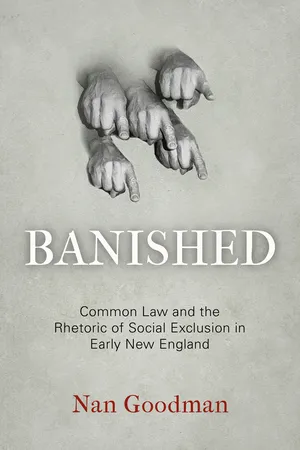
A community is defined not only by inclusion but also by exclusion. Seventeenth-century New England Puritans, themselves exiled from one society, ruthlessly invoked the law of banishment from another: over time, hundreds of people were forcibly excluded from this developing but sparsely settled colony. Nan Goodman suggests that the methods of banishment rivaled—even overpowered—contractual and constitutional methods of inclusion as the means of defining people and place. The law and rhetoric that enacted the exclusion of certain parties, she contends, had the inverse effect of strengthening the connections and collective identity of those that remained.
Banished investigates the practices of social exclusion and its implications through the lens of the period's common law. For Goodman, common law is a site of negotiation where the concepts of community and territory are more fluid and elastic than has previously been assumed for Puritan society. Her legal history brings fresh insight to well-known as well as more obscure banishment cases, including those of Anne Hutchinson, Roger Williams, Thomas Morton, the Quakers, and the Indians banished to Deer Island during King Philip's War. Many of these cases were driven less by the religious violations that may have triggered them than by the establishment of rules for membership in a civil society. Law provided a language for the Puritans to know and say who they were—and who they were not. Banished reveals the Puritans' previously neglected investment in the legal rhetoric that continues to shape our understanding of borders, boundaries, and social exclusion.
eBook - ePub
Banished
Common Law and the Rhetoric of Social Exclusion in Early New England
- 216 pages
- English
- ePUB (mobile friendly)
- Available on iOS & Android
eBook - ePub
About this book
Information
Publisher
University of Pennsylvania PressYear
2012Print ISBN
9780812244274
9780812244274
eBook ISBN
9780812206470
CHAPTER 1

“To Entertain Strangers”
It is worse for a common-wealth to receive a man whom they must cast out againe, than to deny him admittance.
—John Winthrop, Journal
GOVERNOR WINTHROP’S STATEMENT in the epigraph above reminds us that while banishment was popular among the Puritans, it was not the only nor even the most sensible means of ridding the community of undesirables. For one thing, it was arduous and time-consuming. All the legal actors and instruments required for a trial had to be marshaled—at least in those cases where trials were made available—and the punishment itself had to be enforced. When Roger Williams was banished, for example, guards were summoned to his house to insure that he was not hiding, and when Thomas Morton was banished, he had to be sequestered until a ship willing to take him on board arrived from England. Hence Winthrop’s belief that it was better to exclude people by preventing them from entering the colony in the first place than to go through all the motions of having to throw them out.
This chapter is concerned with some of these prophylactic measures for defining community and thus addresses the use and development of banishment somewhat obliquely. Moreover, as with each chapter, the notions developed here about community within the debate over banishment are determined in part by the specific versions of Puritanism and of the common law that were in place at the time. In these early years, when both Morton and Hutchinson were banished, Plymouth and the Massachusetts Bay Colony were in their infancy, and the nature of the religious provocations that led to their banishments was in some sense much clearer than it was in later years. These religious principles thus were in tension with the legal notions of community creation in slightly different ways than they were, say, in the case of the Quakers. By the same token, the common law’s conception of community was much less settled in these early years (although much less embattled as well) and so lent itself to greater manipulation. Yet the argument set forth here about the successes and failures of these measures sets the stage for the rapid rise of banishment and for the argument developed in the following chapters about the importance of the banishment narrative as a rhetorical device for shaping community. In particular this chapter tells the story of a split within the common law between its contradictory tendencies for peopling a place—one toward exclusion and one toward inclusion—and between those in the colonies who favored one version over the other.
Scholars have emphasized what are commonly seen as the colonies’ strict membership requirements. In the absence of a principle such as jurs solis, which had little relevance for the first generation of colonists, none of whom had been born in the colonies, there was an initial push toward strict admission standards. The most rigorous of these revolved around religious conversion, which when delivered in the form of a conversion narrative and voted on by the elders of a given Puritan church guaranteed full membership in the church (and in the Lord’s Supper) as well as in the community. However, while the conversion narrative was intellectually and emotionally daunting, it was also formulaic, familiar, and in many ways superfluous since, contrary to popular opinion, the vast majority of colonists who applied for membership in the Puritan churches and colonies had been thinking about their religious experiences for a long time and were poised to pass the test. Additional criteria were imposed on aspiring church members, including evidence of financial self-sufficiency, but this too proved a relatively easy bar to reach since most early colonists, at least those in Winthrop’s colony, came from the middle classes and had already amassed sufficient funds to establish themselves.1
This gap between the theory and the practice of the Puritans’ admission standards created an uncertainty within their law. As one legal historian noted in a disarmingly simple formulation, “the covenants by which the pilgrims formed their churches would have doubtless been sufficient to their needs except for the presence of persons not members of the church.”2 Put in terms of a membership paradigm and the language of social exclusion, it seemed as if the Puritans were incapable of imagining a population for their communities consisting of anyone but members and thus had no apparatus for dealing with those who did not fall into this category. Of course, there were many “persons not members of the church” who were considered to be legitimate settlers; as Samuel Morison has remarked, included in this designation were individuals who were “unknown to the Leyden Pilgrims or to their friends, who had to be taken along to . . . increase the number of colonists.”3 Indeed the legendary Miles Standish was in this category. But as it turns out, not all were as distinguished as he, and the first community included rabble-rousers, spies, Indians (at least at first), short-term visitors, and the shipwrecked—all of whom because of a taxonomic failure of the law figured simply as nonmembers or “strangers,” that is to say, people who were not part of the Puritan “us,” in Charles Tilly’s terms, but also not yet “them.”4
The absence of a more nuanced taxonomy for these “strangers” created social boundary issues that would begin to test the Puritans’ sense of community as a whole. Stories of encounters with “strangers” permeate the earliest descriptions of the new settlements, including Edward Winslow’s Good Newes from New England (1624), William Wood’s New England’s Prospect (1634), William Bradford’s Of Plymouth Plantation (1630–50), and John Winthrop’s Journal (1630–49). In the case of strangers whose less-than-stellar reputations preceded them, of course, the Puritan welcome was understandably lukewarm. Bradford’s account of the arrival of Sir Christopher Gardiner, “who was so great a persecutor of God’s Saints in Queen Mary’s days,” is a perfect example of this kind of description.5 But the tendency to consider everyone who was not a member as a “stranger” became a problem when the “stranger” showed no obvious signs of hostility, raised no suspicions, and yet chose for whatever reason not to undergo the conversion procedures.
In these cases the pressing question was, what obligation did the Puritans have toward strangers?, or to put it in Jacques Derrida’s terms, “to who or what turns up before any identification?”6 The most general mandate of the common law was to treat strangers with hospitality. Variously referred to as a “matrix of beliefs,” a “facility” or “institution,” an “obligation,” a “ministry,” or a “right,” hospitality, while not confined to strangers, had organized relations with strangers in Western and non-Western societies for centuries.7 A definition from the late seventeenth century is illuminating in this regard: “Hospitality,” George Wheler wrote, was “a Liberal Entertainment of all sorts of Men, at ones house, whether Neighbours or Strangers, with kindness, especially with Meat, Drink and Lodgings.”8 As English people, of course, the Puritans would have been steeped in the tradition of hospitality; they prided themselves on demonstrations of hospitality and had long considered them cultural practices that set them above neighboring nationalities. In his hagiography of John Winthrop, Cotton Mather rendered him with the highest praise by ascribing to him “the liberallity and hospitality of a gentleman.”9 Additionally, as devout Christians, the Puritans would have been especially sensitive to the many exhortations toward hospitality in the Bible, such as Hebrews 13:2, from which this chapter derives its title: “Be not forgetful to entertain strangers: for thereby some have entertained angels unawares.”
If the common law (and the Bible) seemed to mandate hospitality in the general case, however, they were less clear about what to do with strangers who proved unworthy of their welcome. This was the problem, for example, with John Oldham and John Lyford, visitors to Plymouth in 1624. Governor Bradford observed of Lyford: “When this man first came ashore, he saluted them [the Pilgrims] with that reverence and humility as is seldom to be seen,” and so the Pilgrims “gave him the best entertainment they could, in all simplicity, and a larger allowance of food out of the store than any other had.” On discovering that Lyford and Oldham had grown “very perverse, and showed a spirit of great malignancy,” the Pilgrims were in the uncomfortable position of not only having to rescind their offer of hospitality but also taking measures that would designate them both as unwelcome in the future, for which the only appropriate expression was banishment.10
For Derrida, to offer and then withdraw hospitality would not necessarily have seemed out of place, since for him hospitality was not an entirely friendly act. There is, Derrida wrote, “a moment of great indecision about the arrival of the stranger on another’s shores” that reveals how hospitality is “interlaced with hostility.”11 Indeed, as J. Hillis Miller has pointed out, the concept of what it means to be a host is fraught at the etymological level. Miller notes, “The relation of household master offering hospitality to a guest and the guest receiving it, of host and parasite in the original sense of ‘fellow guest,’ is inclosed within the word ‘host’ itself. A host in the sense of a guest, moreover, is both a friendly visitor in the house and at the same time an alien presence who turns the home into a hotel, a neutral territory.”12 Still, for a number of contemporary commentators on hospitality, to banish strangers, even after discovering some wrongdoing on their part, was a direct affront to the common-law mandate of hospitality. For these individuals, hospitality was driven by a spirit of inclusiveness that did not, like the requirements for residency and church membership, revolve around a process of selectivity but demanded to be played out in its absence through a sustained interaction between host and guest until some sort of understanding had been reached or a zone of cultural contact in the form of an alternative kind of community had been formed. Indeed in teasing out some of the ways in which the common law inscribed the concept of hospitality within its structure, we can begin to appreciate how it contained within it the seeds of many varied types of communities, all legal, and yet not often thought of in those terms. Indeed the kinds of communities imagined within the terms of hospitality are more easily understood in anthropological and sociological terms, and so we turn to the language of these disciplines later in the chapter for clarification.
The following discussion takes up the story of the struggle in the early years of the Bay Colony and Plymouth Plantation between those who, like Winthrop, as hospitable as he was, thought of hospitality as a limited endeavor and thus a means of giving the community definition through exclusion, and those who, like Anne Hutchinson and Thomas Morton, promoted a version of hospitality that opposed the exercise of such authority. Though Morton and Hutchinson are rarely if ever spoken of in the same breath—one was a renegade Anglican trader, the other an ostensibly pious Puritan—Morton’s New English Canaan (1637), Bradford’s Of Plymouth Plantation, Hutchinson’s trial testimony (1636), John Winthrop’s “Short History of the Rise and Ruine of Antinomianism” (1644), and Winthrop’s pamphlet debate with Henry Vane, the antinomian and onetime governor of the Bay Colony, reveal that their struggles against banishment—for both were famously banished in the end—were preceded and in many ways linked by a similar focus on hospitality. Hutchinson opened her house to strangers, sometimes hosting several hundred people, while Morton in setting up his community at Mare Mount styled himself “Mine Host” and welcomed people from all walks of life, including Indians. In both cases it was their hospitality more than anything else that was put on trial and led to their banishments.
Hospitality and Charity
Hospitality became a source of friction in the law of the Puritan colonies in part because of the political controversy it had already stirred in England. In her survey of the uses of hospitality, Felicity Heal suggests that while hospitality was still part of the belief system in England in the early modern period, it was on the wane in part as a result of the Protestant Reformation. According to Heal, the material aspects of hospitality—specifically the offer of food and lodging—that had been essential features of the practice since ancient times and were particularly significant during the Middle Ages came to be viewed by Protestants as yet another expression of the material pomp of the Catholic Church and began to be looked on with disfavor. As a result, starting in the late sixteenth to early seventeenth centuries, the kind of hospitality associated with household giving declined.13 So troubling was this decline that in 1623 it spurred King James I to issue a proclamation “commanding noblemen, knights, and gentlemen of quality, to repayre to their mansion houses in the country, to attend to their services, and keepe hospitality, according to the ancient and laudable customs of England.”14
That the king’s proclamation specifically directed his subjects to return to their “mansions” and to “keep hospitality” there speaks to another one of the changes wrought in the ritual of hospitality by the Protestant Reformation: a growing aversion to the household as a site of interacting with guests, or more specifically the poor. Along with a growing Protestant dislike for what was seen as the material excess of hospitable giving came a distinction, long noted in the scholarship on this period, between the worthy poor and the unworthy poor. Although what made a poor person worthy or unworthy was never entirely clear, the convention at the time was to consider officers, minstrels, and what were euphemistically called the “life cycle” poor to be worthy of aid, while rejecting the claims of “vagrants, beggars and idlers.”15 To the extent that one feature of traditional household hospitality encouraged the opening of one’s doors to the poor who, in seeking alms from householders, were by definition “vagrants” or “beggars,” it was seen as favoring the unworthy poor and was discouraged. As Steve Hindle points out, “condemnations of hospitality for its encouragement of begging undoubtedly derive from a literature whose rhetorical agenda (the encouragement of greater discrimination in the giving of alms) must be acknowledged.”16
One aspect of this newfound Protestant aversion to household giving that was of particular relevance to the Puritans’ response to Morton and Hutchinson was the disaggregation of the discourse of hospitality from the discourse of charity. By distinguishing between the worthy poor and the unworthy poor, the Protestant church made it clear that it was not abandoning the poor but merely replacing the conduit by which they were aided; specifically the church aimed to replace customary household giving with a more institutionalized form of giving to be administered under exclusively religious auspices. We might think of this as hospitality minus the host as well as the home, which in the end is what the church called charity. The virtue of charity over hospitality was obvious from a social point of view: church-based charity helped the needy without making them part of the community. “The virtues of conviviality and care for the helpless continued to be related,” Heal writes, “but were juxtaposed rather than integrated: good neighborhood was increasingly separated from the active doing of Christian good.”17
Given the growing religious emphasis on charity in relation to the community in colonial New England, tensions between the advocates of hospitality and the advocates of charity ran high. Indeed the stories of Hutchinson’s and Morton’s banishments are in part about how far the law could be stretched in one or the other direction: toward charity or back toward hospitality. Not surprisingly some of these tensions are visible in the founding documents of...
Table of contents
- Cover
- Half title
- Title
- Copyright
- Dedication
- Contents
- Introduction. A Banishment Primer
- 1. “To Entertain Strangers”
- 2. The “Predicament of Ubi”
- 3. “To Test Their Bloody Laws”
- 4. Deer Island and the Banishment of the Indians
- Conclusion. The Ends of Banishment: From the Puritan Colonies to the Borderlands
- Notes
- Index
- Acknowledgments
Trusted by 375,005 students
Access to over 1.5 million titles for a fair monthly price.
Study more efficiently using our study tools.
Frequently asked questions
Yes, you can cancel anytime from the Subscription tab in your account settings on the Perlego website. Your subscription will stay active until the end of your current billing period. Learn how to cancel your subscription
No, books cannot be downloaded as external files, such as PDFs, for use outside of Perlego. However, you can download books within the Perlego app for offline reading on mobile or tablet. Learn how to download books offline
Perlego offers two plans: Essential and Complete
- Essential is ideal for learners and professionals who enjoy exploring a wide range of subjects. Access the Essential Library with 800,000+ trusted titles and best-sellers across business, personal growth, and the humanities. Includes unlimited reading time and Standard Read Aloud voice.
- Complete: Perfect for advanced learners and researchers needing full, unrestricted access. Unlock 1.5M+ books across hundreds of subjects, including academic and specialized titles. The Complete Plan also includes advanced features like Premium Read Aloud and Research Assistant.
We are an online textbook subscription service, where you can get access to an entire online library for less than the price of a single book per month. With over 1.5 million books across 990+ topics, we’ve got you covered! Learn about our mission
Look out for the read-aloud symbol on your next book to see if you can listen to it. The read-aloud tool reads text aloud for you, highlighting the text as it is being read. You can pause it, speed it up and slow it down. Learn more about Read Aloud
Yes! You can use the Perlego app on both iOS and Android devices to read anytime, anywhere — even offline. Perfect for commutes or when you’re on the go.
Please note we cannot support devices running on iOS 13 and Android 7 or earlier. Learn more about using the app
Please note we cannot support devices running on iOS 13 and Android 7 or earlier. Learn more about using the app
Yes, you can access Banished by Nan Goodman in PDF and/or ePUB format, as well as other popular books in Literature & Early American History. We have over 1.5 million books available in our catalogue for you to explore.