For Vivian R. Pollak, Emily Dickinson's work is an extended meditation on the risks of social, psychological, and aesthetic difference that would be taken up by the generations of women poets who followed her. She situates Dickinson's originality in relation to her nineteenth-century audiences, including poet, novelist, and Indian rights activist Helen Hunt Jackson and her controversial first editor, Mabel Loomis Todd, and traces the emergence of competing versions of a brilliant but troubled Dickinson in the twentieth century, especially in the writings of Marianne Moore, Sylvia Plath, and Elizabeth Bishop.Pollak reveals the wide range of emotions exhibited by women poets toward Dickinson's achievement and chronicles how their attitudes toward her changed over time. She contends, however, that they consistently use Dickinson to clarify personal and professional battles of their own. Reading poems, letters, diaries, journals, interviews, drafts of published and unpublished work, and other historically specific primary sources, Pollak tracks nineteenth- and twentieth-century women poets' ambivalence toward a literary tradition that overvalued lyric's inwardness and undervalued the power of social connection. Our Emily Dickinsons places Dickinson's life and work within the context of larger debates about gender, sexuality, and literary authority in America and complicates the connections between creative expression, authorial biography, audience reception, and literary genealogy.
eBook - ePub
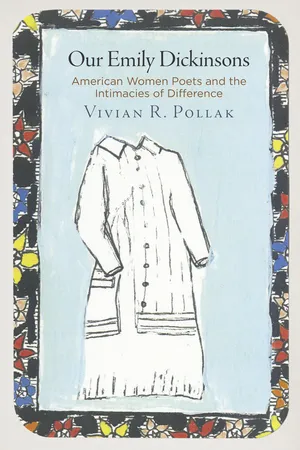
Our Emily Dickinsons
American Women Poets and the Intimacies of Difference
- 368 pages
- English
- ePUB (mobile friendly)
- Available on iOS & Android
eBook - ePub
About this book
Information
Chapter 1
Helen Hunt Jackson and Dickinson’s Personal Publics
I hope some day, somewhere I shall find you in a spot where we can know each other. I wish very much that you would write to me now and then, when it did not bore you. I have a little manuscript volume with a few of your verses in it—and I read them very often—You are a great poet—and it is a wrong to the day you live in, that you will not sing aloud. When you are what men call dead, you will be sorry you were so stingy.
—March 20, 1876
What portfolios of verses you must have.—
It is a cruel wrong to your “day & generation” that you will not give them light.—If such a thing should happen as that I should outlive you, I wish you would make me your literary legatee & executor. Surely, after you are what is called “dead,” you will be willing that the poor ghosts you have left behind, should be cheered and pleased by your verses, will you not?—You ought to be.—I do not think we have a right to with hold from the world a word or a thought any more than a deed, which might help a single soul.
—September 5, 1884
In a strongly gendered literary culture, what did it take to become a writer who used her personal traumas for the greater good? Helen Hunt Jackson thought she knew. In the letters quoted above, she urges Dickinson to be more compassionate and fully present. Eerily, she suggests that a dead Dickinson will regret her miserliness, her stubborn social isolation, her public silence. But what aspects of Dickinson’s poetry did Jackson admire and why? To understand what was at stake for each of them in their mainly long-distance friendship, I turn now to the beginning of Jackson’s career and to her interactions with the readers who were potentially Dickinson’s as well.
Becoming “H. H.”
In the bitterly cold winter of 1866, Helen Hunt met Thomas Wentworth Higginson in Newport, Rhode Island, where she was trying to put the pieces of her life back together. War widow and war hero, they bonded quickly, watching for signs of spring. Higginson kept assiduous records of the weather and, in her own way, so did Helen. He was handsome, gregarious, and eminently well-connected; she seemed cheerful (unlike his invalid wife Mary) and was certainly outspoken; in her youth, she had been a belle. As their friendship deepened, the pace of her literary productivity quickened. Drawing on Higginson’s energies and on her own connections, she published poems of sorrow, domestic advice columns, regionalist travel sketches, book reviews, and a free-standing little book for children that reworks the prodigal son motif. Bathmendi: A Persian Tale is a pun-filled prose fable about a family of four brothers, among them the poet “Sadder,” who roams the Orient looking for “Bathmendi,” or happiness. After many horrific adventures, Sadder and his brethren discover that happiness is best found at home.1
“Home” was a problematic concept for “H. H.,” whose childhood losses (she was an orphan) were compounded by the more recent bereavements. But her efforts paid off in 1869 when the Atlantic Monthly, which had rejected poem after poem, published her verse fable “Coronation,” in which a beggar teaches a king how to live. In this dreamscape, power does not buy happiness, and kings, who arouse anxieties about powerful men, can be replaced.2 Emerson admired both the poem and her persistence, and she returned the favor with “Tribute,” which speaks back to his “Days,” in which a humbled speaker fails to realize his “morning wishes.” In Jackson’s mid-summer “Tribute,” a deferential daughter of time determines to do better:
Midway in summer, face to face, a king
I met. No king so gentle and so wise.
He calls no man his subject; but his eyes,
In midst of benediction, questioning,
Each soul compel. A first-fruits offering
Each soul must owe to him whose fair land lies
Wherever God has his. No white dove flies
Too white, no wine too red and rich, to bring.
With sudden penitence for all her waste,
My soul to yield her scanty hoards made haste,
When lo! they shrank and failed me in that need,
Like wizard’s gold, by worthless dust replaced.
My speechless grief, the king, with tender heed,
Thus soothed: “These ashes sow. They are true seed.”
O king! in other summer may I stand
Before thee yet, the full ear in my hand!3
In “Tribute,” Jackson’s identification not only with “speechless grief” but with the power to compel is evident. As an astute reviewer noted in the Springfield Republican, “This author . . . does not find in equality and individuality all that her soul prompts her to seek.”4
Encouraged by her publications in middlebrow and elite periodicals, and by her personal popularity in genteel literary circles in Newport and New York, by 1870 “H. H” was eager to consolidate her gains in poetry, the art she prized most highly at the time. Thus, when the Boston publisher James T. Fields tried to dissuade her from gathering her periodical publications into a book, she agreed to pay for the stereotype plates herself. Her gamble paid off and Verses went into a second edition. When the Nation’s reviewer found the volume, despite some merits, “fatiguing” because of “a tension of feeling incompatible with prettiness,” she abandoned her mask of feminine humility and attempted to publish a rebuttal.5 Higginson, who remained her most sympathetic reader, welcomed this “new poetess” in the Woman’s Journal, where he classified her variety of subjects and tones. Far from faulting her want of feminine “prettiness,” he praised her as “a feminine knight.”6
To the extent that “H. H.” was a woman warrior, however, her politics remained paradoxically tied to middle-class norms of respectability, and she devised aesthetic strategies to test their limits. An allegory published in Scribner’s Monthly in December 1870 demonstrates her skill at both preserving and troubling the patriarchal status quo. “The Abbot Paphnutius” extends and complicates the wanderlust of Bathmendi, of “Coronation” (in which a king sheds his heavy burdens by eloping with a beggar), and of the subversive subplot of “Tribute.” “The Abbot” takes a self-scourging, sensitive intellectual into the (disguised, literary) marketplace, where he hopes to find a brother. Instead, he is desperately confused by what he sees and hears. “Cunning night” has “spread and lit her snares / For souls made weak by weariness and cares,” and the fastidious Abbot’s defenses against temptation and more specifically against lust begin to crumble:
With secret shudder, half affright, half shame,
Close cowled, he mingled in the babbling throng,
And with reluctant feet was borne along
To where, by torches’ fitful glare and smoke,
A band of wantons danced, and screamed, and spoke
Such words as fill pure men with shrinking fear;
“Good Lord deliver me! Can he be here,”
The frightened Abbot said, “the man I seek?”
From out of this nightmarish crowd there emerges a drunken flute player who accosts the fearful abbot “with ribald laughter, clutching him by gown / And shoulder.” Finding renewed courage in conversation, the abbot refuses to believe that the musician is as bad as he seems. With some prodding, the musician reveals that he once rescued a woman from captivity and gave her “three hundred pieces of good gold to free / Her husband and her sons from slavery” (italics mine). Nevertheless, the flute player remains faithful to his lurid past and the downcast, failed reformer returns to the cloister to go about his “patient, silent ways.” Three days later, he hears a low rapping on the cloister door. Enter the chastened musician, at which miraculous sight “Paphnutius rose, / His pale face kindled red with joyful glows.” Although the other monks are angered by the presence of a vagabond, brotherhood prevails. The moral is that “publicans and sinners may be saints” and that saints may be secret sinners.7 Again, the prodigal son, again the assimilation of an unruly sexual past. Again, the partial reconstruction of a decimated family. In one sense, patriarchal religious authority is validated; in another, it is democratized and transformed.
For “H. H.” in the early stages of her career, patriarchal authority, feminized and liberalized, was incarnated not only by Emerson but also by Higginson, an unchurched Unitarian minister who tended toward the even more liberal Universalist creed.8 In 1849, he had been forced out of his Newburyport, Massachusetts, pulpit because of his extreme abolitionism; he resigned to avoid being fired. Higginson explained, “I do not wish to be a fanatic,— but I have no fear of being called so. There are times and places where Human Feeling is fanaticism,—times and places where it seems that a man can only escape the charge of fanaticism by being a moral iceberg.”9 In 1854, he tried to rescue the fugitive slave Anthony Burns from a Boston courthouse, and Thoreau praised him as “the only Harvard Phi Beta Kappa, Unitarian minister, and master of seven languages who has led a storming party against a federal bastion with a battering ram in his hands.”10 In 1857, he headed the list of eighty-nine men who called for a Massachusetts Disunion Convention to consider “the practicality, probability and expediency of a separation between the free and slave states.”11 Like most members of her New Englandish social circle, Jackson had been a Unionist and her husband, Major Edward Hunt, had given his life for the cause. Higginson nevertheless explained, “She was by temperament fastidious, and therefore conservative. On the great slavery question she had always, I suspect, taken regular-army views; she liked to have colored people about her as servants, but was disposed to resent anything like equality.”12
In the first decade of her poetry career, “H. H.” repeatedly troped on various forms of servitude and of slavery (as she did in “The Abbot Paphnutius”), but with several exceptions she rarely wrote about the racial politics of the Civil War or the racial injustices of Reconstruction. Thus, the new and expanded Verses of 1873 does not complicate the repressed racial politics of the earlier volume; rather, it demonstrates her continuing eagerness to export the problem—to locate it in a vaguely mythological past.13 In 1874, however, the orientalism of Bathmendi, the story of ...
Table of contents
- Cover
- Half title
- Title
- Copyright
- Dedication
- Contents
- List of Abbreviations
- Introduction. Dickinson and the Demands of Intimacy
- Chapter 1. Helen Hunt Jackson and Dickinson’s Personal Publics
- Chapter 2. Mabel Loomis Todd and Dickinson’s Art of Sincerity
- Chapter 3. “The Wholesomeness of the Life”: Marianne Moore’s Unartificial Dickinson
- Chapter 4. Moore, Plath, Hughes, and “The Literary Life”
- Chapter 5. Plath’s Dickinson: On Not Stopping for Death
- Chapter 6. Elizabeth Bishop and the U.S.A. Schools of Writing
- Conclusion. Dickinson and the Demands of Difference
- Notes
- Works Cited
- Index of Dickinson’s Poems and Letters
- Genral Index
- Acknowledgments
Trusted by 375,005 students
Access to over 1.5 million titles for a fair monthly price.
Study more efficiently using our study tools.
Frequently asked questions
Yes, you can cancel anytime from the Subscription tab in your account settings on the Perlego website. Your subscription will stay active until the end of your current billing period. Learn how to cancel your subscription
No, books cannot be downloaded as external files, such as PDFs, for use outside of Perlego. However, you can download books within the Perlego app for offline reading on mobile or tablet. Learn how to download books offline
We are an online textbook subscription service, where you can get access to an entire online library for less than the price of a single book per month. With over 1.5 million books across 990+ topics, we’ve got you covered! Learn about our mission
Look out for the read-aloud symbol on your next book to see if you can listen to it. The read-aloud tool reads text aloud for you, highlighting the text as it is being read. You can pause it, speed it up and slow it down. Learn more about Read Aloud
Yes! You can use the Perlego app on both iOS and Android devices to read anytime, anywhere — even offline. Perfect for commutes or when you’re on the go.
Please note we cannot support devices running on iOS 13 and Android 7 or earlier. Learn more about using the app
Please note we cannot support devices running on iOS 13 and Android 7 or earlier. Learn more about using the app
Yes, you can access Our Emily Dickinsons by Vivian R. Pollak in PDF and/or ePUB format, as well as other popular books in Literature & Literary Criticism for Women Authors. We have over 1.5 million books available in our catalogue for you to explore.