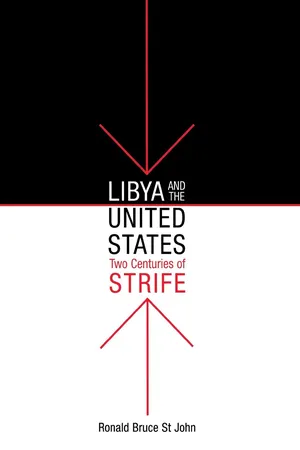
Diplomatic relations between the United States and Libya have rarely followed a smooth path. Washington has repeatedly tried and failed to mediate lasting solutions, to prevent recurrent crises, and to secure its own national interests in a region of increasing importance to the United States. Libya and the United States, Two Centuries of Strife provides a unique and up-to-date analysis of U.S.-Libyan relations, assessing within the framework of conventional historical narrative the interaction of the governments and peoples of Libya and the United States over the past two centuries.
Drawing on a wide range of new and unfamiliar material, Ronald Bruce St John, an expert with over thirty years of experience in international relations, charts the instances of ignorance, misunderstanding, treachery, and suffering on both sides that have shaped and limited commercial and diplomatic intercourse.
St John argues that Cold War strategies resulted in a paradoxical and ambiguous U.S. policy toward Libya during the Idris regime of the 1960s, strategies that contributed to the bankruptcy of that monarchy. Following the Libyan revolution, the U.S. wrongly believed Qaddafi would become an ally in support of U.S. policy to keep Soviet influence and communism out of the region; his failure to do so marked the beginning of an era of political tension and mutual distrust.
Libya and the United States, Two Centuries of Strife documents how long-standing policy differences over the Palestinian issue and such terrorist acts as the destruction of the U.S. embassy in Tripoli and the Pan Am explosion over Lockerbie in 1988 resulted in a sharp deterioration of relations. St John contends that the ensuing demonization of Libya and the U.S. policy of confrontation, which has spanned successive administrations in Washington, have ironically often not served American interests in the region but, rather, have facilitated Qaddafi's survival.
- 264 pages
- English
- ePUB (mobile friendly)
- Available on iOS & Android
eBook - ePub
Libya and the United States, Two Centuries of Strife
About this book
Information
Publisher
University of Pennsylvania PressYear
2013Print ISBN
9780812236729
9780812236729
eBook ISBN
9780812203219
Chapter 1
Dismal Record
Bilateral relations between Libya and the United States have been active, engaged, and positive for no more than twenty out of the last two hundred years, a dismal record with few parallels in the annals of American diplomatic history. Commercial and diplomatic intercourse between the United States and Libya began on a low note after the failure of desultory negotiations in the late eighteenth century led to armed conflict at the beginning of the nineteenth. Following a hiatus of almost a century and a half, diplomatic exchange expanded with expectation and promise, particularly on the Libyan side, in the aftermath of World War II. A little more than two decades later, relations between Libya and the United States entered the Qaddafi era, a period characterized from the outset by political tension and mutual mistrust that later deteriorated into open hostility.
No issue of foreign relations since American independence in 1776 has confounded and frustrated the policy makers of the United States more completely, repeatedly, and over a longer period of time than the problems of the Middle East. Washington has repeatedly tried and failed since 1945 to mediate lasting solutions, prevent recurrent crises, and secure its own national interests in a region that became increasingly important to the United States. The root cause of this failure was the inability of successive presidential administrations from Truman to Bush, often because of domestic political considerations, to harmonize and synthesize America’s four major interests in the Middle East—access to oil, the security of Israel, containment of communism and Soviet expansionism, and adherence to the principles of self-determination and the peaceful settlement of disputes. The preservation of the status quo was the real thrust and practical intent of all four of these objectives.
United States foreign policy toward Libya in the immediate postwar period mirrored American policy toward the Middle East and the world as a whole. In support of a Cold War strategy, grounded on a chain of air bases in the eastern Mediterranean and the Middle East, Washington’s first priority in Libya was to ensure long-term Western access to existing military facilities, especially Wheelus Field outside Tripoli. In support of this objective, the United States adamantly opposed Soviet attempts to secure similar facilities in Tripolitania. It also rejected a proposed UN trusteeship over Cyrenaica, the Fezzan, and Tripolitania because the administrator of a trust territory, under the UN system, could not establish military bases except in the case of a strategic trusteeship; and the Soviet Union was sure to veto in the Security Council any attempt to create a strategic trusteeship. As its options narrowed, the Truman administration later supported the Bevin-Sforza plan to establish a series of Western trusteeships over Libya. When this approach failed, Washington viewed an independent Libya as the best option available to achieve its strategic objectives in the region. Platitudes voiced at the time by American officials in support of self-determination and self-government were, at best, secondary considerations packaged as window dressing to disguise the real intent of U.S. policy. As the Cold War heated up, the primary interest of the United States was to secure a base agreement in Libya as soon as possible and preferably before independence strengthened the Libyan negotiating position.
With North Africa commanding the southern approaches to Europe and the western approaches to the Middle East, Arab nationalism, especially in the wake of the creation of Israel in 1948, was seen in Washington as a potent force that threatened Western interests in the region. Misreading the intent of Arab nationalists, American policy makers expressed mounting concern with the potential for communist infiltration of the region in conjunction with Arab nationalist activities. As a result, the United States, in a policy doomed from the start, opposed Arab nationalist movements in Libya for the first two decades of Libyan independence on the faulty premise that such movements would necessarily facilitate the spread of communism. In so doing, American officials throughout the 1950s and 1960s continually underestimated or ignored the potential impact of Arab nationalist movements on an isolated Libyan monarchy with transparent ties to the West. Viewing Libya after independence as a strategic asset as opposed to an important but sovereign ally, the U.S. government encouraged the regime of Sayyid Muhammad Idris al-Mahdi al-Sanusi to adopt foreign policy positions that were unpopular in the Arab world and thus contributed to the popular perception of Libya as a Western dependency. The discovery of oil in marketable quantities in the late 1950s offered an opportunity for Washington to reassess its regional policies; nevertheless, American policy toward Libya ended the decade of the 1950s exactly where it had begun.
As a result, the economic, military, and political dependence of Libya on the United States reached a dangerous level in the second decade of Libyan independence. This situation was the product of internal factors, forces, and interests in Libya together with the pursuit by the United States of its own economic, military, and political objectives. It was not the product of a Libyan commitment to Western ideals or traditions; on the contrary, the monarchy sought to minimize the impact of Western social structures and mores on the Libyan people. The Libyan government chose to maintain a close relationship with the United States and its allies because it believed they were in the best position to guarantee Libyan security. The monarchy’s position in this regard was later borne out in September 1969, when it asked the British government to intervene and restore it to power, an action the Labour government of Harold Wilson refused to take.
Under the circumstances, the position of the United States in Libya was rendered more and more paradoxical. As American foreign policy heightened the awareness of both governments as to the intricacy of their interests and relations, a growing number of Libyan citizens increasingly distrusted the United States and resented its extensive presence in significant aspects of Libyan internal and external affairs. The conflicting demands of Arab nationalism, and the need for ongoing cooperation with the United States to achieve many of Libya’s foreign and domestic goals, contributed to the growing ambiguity that characterized this complex and convoluted relationship.
In turn, policy makers in Washington saw Libya, together with the remainder of North Africa and the Middle East, as falling within a highly sensitive security zone. For this reason, Libyan foreign policy, despite Libya’s formal sovereignty, was effectively constrained by the bounds of U.S. tolerance. This left the Idris regime free to follow any policy it desired so long as its actions did not affect the security interests of the United States as defined by Washington. For the first decade of independence, Tripoli successfully accommodated itself to these restrictions; however, in the 1960s, a combination of developments inside and outside Libya posed an entirely new challenge for Washington. Mounting oil revenues reduced the dependency of the Libyan government on military base payments but increased the complexity of its socioeconomic and political problems. As economic conditions improved and social mobility increased, the Libyan people, especially the younger, urban population, yearned for political change coupled to a coherent new ideology. The Idris regime, detached and remote, attempted to respond to these needs but failed to understand them, just as it failed to comprehend and satisfy the demands of Arab nationalists. American officials, committed to the status quo in the region, also failed repeatedly to recognize the pressing need to accommodate Arab nationalist positions. In this sense, the policies of the United States and its Western allies made a major contribution to the political bankruptcy of the Idris regime in 1969.
After the overthrow of the monarchy, Mu’ammar al-Qaddafi articulated an increasingly comprehensive ideology which had strong Libyan antecedents but also enjoyed similarities with the ideologies of other Arab revolutionary movements. He skillfully blended the threads of nationalism, anti-imperialism, and pan-Islamic loyalties, which had emerged in Libya at the beginning of the twentieth century, with contemporary movements for Arab nationalism, Arab socialism, and Arab unity. Qaddafi based his variant of Arab nationalism, the central element of his ideology, on a glorification of Arab history and culture that conceived of the Arabic-speaking world as the Arab nation. Libya became the heart, the vanguard, and the hope of the Arab nation and thus the custodian of Arab nationalism. In the early months of the revolution, Qaddafi focused on highly symbolic acts of national independence, most especially an early termination of the base agreements with the United Kingdom and the United States. Once the bases were emptied, Qaddafi declared March 28, the day the British evacuated the Al-Adem Base, and June 11, the day the Americans evacuated Wheelus Field, official national holidays and commemorated them annually with popular festivities and a strongly nationalistic address.
If Arab nationalism was the core element of Qaddafi’s ideology, the concept of jihad (holy war) was the action element of that Arab nationalism. Qaddafi saw jihad as a means to achieve social justice inside and outside Libya. His unique approach to the traditional concept of jihad led the Libyan leader to support publicly an extremely wide range of liberation movements from the Irish Republican Army to militant Black groups in the United States to the African National Congress. In most of these cases, Libyan support was neither a question of doctrine nor of national interest; instead, Qaddafi saw such support as a practical means to strike at colonialism and imperialism.
The Libyan concept of jihad found its most pragmatic expression in early support for a variety of Palestinian groups. In Qaddafi’s mind, Palestine was an integral part of the Arab nation; and the latter could never be truly free and united until Palestine was completely liberated. The enemy was Zionism, together with the colonialist and imperialist powers, most especially the United States, responsible for visiting this indignity upon the Arab people. Qaddafi’s prolonged advocacy of the use of force against Israel later contributed to a bitter feud with Palestine Liberation Organization Chairman Yasser Arafat and also had an adverse impact on the Libyan leader’s aspirations to regional and international leadership. His support for liberation movements also brought Qaddafi into prolonged contact with groups and activities that the United States and its Western allies associated with terrorism. Consequently, he spent considerable effort in the 1980s and 1990s trying to differentiate between revolutionary violence, which he continued to support, and terrorism, which he purportedly opposed. American officials generally proved unable, at least officially, to differentiate between the two policies. On the other hand, Qaddafi was feted by fellow African heads of state, during the sanctions era and even more so once the UN sanctions on Libya were suspended, out of respect for a revolutionary leader whose support for liberation movements helped end colonialism on the continent.
The doctrine of positive neutrality was also an integral component of Qaddafi’s ideology. Critical of both capitalism and communism, which he described initially as two sides of the same coin, he rejected foreign influence or control in any form. As a result, early Libyan policy toward both the Soviet Union and the United States followed a dichotomous pattern. Highly critical of American foreign policy, the Libyan government maintained close ties with the West, selling oil to its European allies and using the proceeds to import massive amounts of Western technology. At the same time, Qaddafi criticized the Soviet Union, especially its policy of allowing Jews to immigrate to Israel, but purchased Soviet armaments in growing quantities.
At the outset of the One September Revolution, key American policy makers mistakedly believed the revolutionary government could become an ally in support of American policy to keep Soviet influence and communism out of the Middle East. This brief honeymoon period soon ended as Libya’s approach to the Arab-Israeli conflict and the Palestinian question quickly soured the prevailing policy mix. Before long, Libyan foreign policy was challenging the status quo in Africa and the Middle East at every opportunity. In so doing, the Qaddafi regime came into direct conflict with the four core interests of American foreign policy in the region. The 1973 October War, which was followed by Libyan nationalization of American oil interests, proved a watershed event in American-Libyan relations, which rapidly deteriorated in the second half of the decade.
Fundamental, long-standing policy differences were at the heart of the mounting impasse, the most significant being the Palestinian issue. The centrality of the Palestinian question to Qaddafi’s ideology and his approach to a resolution of the issue, particularly his open support of guerrilla movements, quickly dissipated whatever official or unofficial constituency existed in the United States for improved diplomatic relations. With the trashing of the U.S. embassy in Tripoli at the end of 1979, common ground for discussion disappeared. State-sponsored terrorism, according to the White House, was a weapon of unconventional war against the democracies of the West, a weapon that took advantage of their openness to build political hostility toward them. The subsequent closure of the U.S. embassy in 1980, together with the closure of the Libyan People’s Bureau (embassy) in Washington in 1981, proved the catalyst for a sharp deterioration in American-Libyan relations.
Falsely describing Libya as a Soviet puppet, the Reagan administration increased diplomatic, economic, and military pressure on the Qaddafi regime in a very systematic fashion. Eager to reassert American power and influence in the world, particularly in the Middle East, the confrontational policies of the U.S. government eventually led to the American bombing of Benghazi and Tripoli in 1986. A major difference between Reagan’s attack on Libya and Thomas Jefferson’s attack on Tripoli almost two centuries earlier was that Reagan appeared to target a head of state for destruction. Otherwise, the two actions were similar in that both administrations chose to punish a relatively weak, minor player in the region in support of broader policy objectives. For no apparent reason, Qaddafi hoped the end of the Reagan era would offer a window of opportunity for improved diplomatic relations with the United States. The first Bush administration soon dampened such enthusiasm with its adoption of the Rogue Doctrine.
It is instructive at this point to recall that the overwhelming majority of the European partners of the United States refused to support a confrontational approach to Libya. They had their own interests at stake and were not prepared to sacrifice them for what they saw as an American obsession. While few European governments denied that Qaddafi was often a negative influence, they argued that it was a mistake to isolate him by closing all Western doors to Libya. In their view, the punitive policies employed by Washington often exacted serious costs in human lives and credibility, yet failed to change regime behavior. Meanwhile, European companies, before and after the period of UN sanctions, remained well positioned to enjoy the lucrative contracts that Washington’s hardline approach denied their American counterparts. To this degree, the Libyan case clearly highlighted the need for closer consultation with European governments to involve them more directly in key decisions of American foreign policy. Diplomacy involving pressure on foreign governments to make decisions in American interests, but not in the interests of those foreign governments, might enjoy shortterm success. Unfortunately, the Libyan example suggested it would often do so at the expense of longerterm relationships.
A difficulty facing most African and Arab societies in the latter half of the twentieth century was the establishment of a meaningful relationship between aspirations and accomplishments. This was especially true of Libya under the Qaddafi regime. An enormous gap existed between the ideas, beliefs, and myths that constituted Qaddafi’s ideology and the respective realities they purported to describe or explain. This lacuna was especially wide in the areas of regime policy and performance but existed throughout the entire ideological spectrum. In part for this reason, Qaddafi’s ideology was greeted with widespread disbelief and disinterest throughout the Arab and African worlds where its anachronistic character was largely rejected. Qaddafi pursued energetically a stage larger than a nation of only a few million people, but his superficial treatment of worn ideas, in the end, effectively confined him to the Libyan playhouse.
In the post-Cold War period, elements of U.S. foreign policy, much like Qaddafi’s policies in the 1970s, became anachronistic. There was no longer a Cold War global system, a Cold War military, or a Cold War public. American foreign policy was more about managing weakness, the weakness of China, Japan, and the Commonwealth of Independent States, as opposed to projecting power and force around the world. All three of these world powers experienced wrenching internal adjustments to globalization that made the potential collapse of the Commonwealth of Independent States, in particular, more threatening to the United States than its former strength. Globalization itself, in terms of the speed, interconnectivity, and economic impact of global markets, was also a new and not clearly understood force. The Internet, in particular, offered the potential to become a powerful enabling device for nongovernmental organizations to influence in the future foreign policy formulation and execution to a far greater extent than in the past.
The United States in the post-Cold War world was not just a superpower but in reality the only superpower. In France, for example, analysts referred to the United States as a “hyperpower” to emphasize its unique position in the world. American military might was unrivaled, and its information technology was the envy of the entire world. At the same time, it was not omnipotent and was not capable of solving all the problems of the world. Attempts to do so were deeply resented by America’s allies as well as by its enemies. Other countries increasingly called on Washington for leadership, but at the same time they envied and resented the U.S. more than ever. No one could afford to be America’s enemy, but few wanted to be seen as its close friend and ally. As a result, whenever Washington proposed a bold initiative that threatened vested interests abroad, it risked a ferocious backlash from friends and rivals alike. For example, repeated American attempts to label the Qaddafi regime and other governments as “rogue states” and to punish them for alleged transgressions increasingly had the opposite effect. The strong-arm tactics employed by Washington, in the end, contributed to declining international support for multilateral sanctions instead of the American objective, which was to build support for them.
American observers, in this regard, seldom recognized that the policy of confrontation initiated by the United States in the 1980s often did not serve American interests in the Middle East or in Libya. The imposition of the American embargo resulted in the lost sale to European allies and others of an enormous quantity of goods and services, from capital equipment to consumer goods to consulting contracts. Politically, it strained American relations with key partners in Europe, like France, Germany, and Italy, as well as with allies in Africa and the Arab world. Academically, it stifled research by Americans in Libya and choked the flow of Libyan students to the United States. It also had a deleterious impact on the 1990s generation of American students of the Middle East and North Africa. Within Libya, on the other hand, U.S. policy served Qaddafi’s interests as it made it easier for him to survive, albeit with some modification in behavior. When American policy makers spoke of “sanctions fatigue” in the late 1990s, they were really acknowledging the bankruptcy of the confrontational policies initiated by President Reagan and later adopted by the Bush and Clinton administrations.
From the outset of the American-Libyan relationship, most Americans viewed Libya from the vantage point of the distant and deep cultural differences characterized as Orientalism by the contemporary Palestinian-American writer Edward W. Said. Together with the remainder of the Western world, Americans regarded Libya, if they were even aware of its existence, as a country shrouded in mystery and cloaked in the exotic, a mirror of their own dreams, desires, and extremes. Orientals in general and Libyans in particular were viewed as irrational, depraved, childlike, or simply different when compared to Westerners, who were rational, virtuous, mature, and normal. The Commission of Investigation dispatched to Libya by the Council of Foreign Ministers in 1948, for example, described the Libyan people as backward, childlike, and immature in their understanding of the responsibilities of independence. Contemporary American observers mirrored these attitudes. Benjamin Rivlin, a Harvard Uni...
Table of contents
- Cover
- Title
- Copyright
- Contents
- 1. Dismal Record
- 2. Desert Kingdom
- 3. In the Beginning
- 4. Postwar Gridlock
- 5. Independence at a Price
- 6. One September Revolution
- 7. Reagan Agonistes
- 8. U.S.-Libyan Relations in the Post-Cold War Era
- Notes
- Select Bibliography
- Index
- Acknowledgments
Trusted by 375,005 students
Access to over 1.5 million titles for a fair monthly price.
Study more efficiently using our study tools.
Frequently asked questions
Yes, you can cancel anytime from the Subscription tab in your account settings on the Perlego website. Your subscription will stay active until the end of your current billing period. Learn how to cancel your subscription
No, books cannot be downloaded as external files, such as PDFs, for use outside of Perlego. However, you can download books within the Perlego app for offline reading on mobile or tablet. Learn how to download books offline
Perlego offers two plans: Essential and Complete
- Essential is ideal for learners and professionals who enjoy exploring a wide range of subjects. Access the Essential Library with 800,000+ trusted titles and best-sellers across business, personal growth, and the humanities. Includes unlimited reading time and Standard Read Aloud voice.
- Complete: Perfect for advanced learners and researchers needing full, unrestricted access. Unlock 1.5M+ books across hundreds of subjects, including academic and specialized titles. The Complete Plan also includes advanced features like Premium Read Aloud and Research Assistant.
We are an online textbook subscription service, where you can get access to an entire online library for less than the price of a single book per month. With over 1.5 million books across 990+ topics, we’ve got you covered! Learn about our mission
Look out for the read-aloud symbol on your next book to see if you can listen to it. The read-aloud tool reads text aloud for you, highlighting the text as it is being read. You can pause it, speed it up and slow it down. Learn more about Read Aloud
Yes! You can use the Perlego app on both iOS and Android devices to read anytime, anywhere — even offline. Perfect for commutes or when you’re on the go.
Please note we cannot support devices running on iOS 13 and Android 7 or earlier. Learn more about using the app
Please note we cannot support devices running on iOS 13 and Android 7 or earlier. Learn more about using the app
Yes, you can access Libya and the United States, Two Centuries of Strife by Ronald Bruce St John in PDF and/or ePUB format, as well as other popular books in Politica e relazioni internazionali & Relazioni internazionali. We have over 1.5 million books available in our catalogue for you to explore.