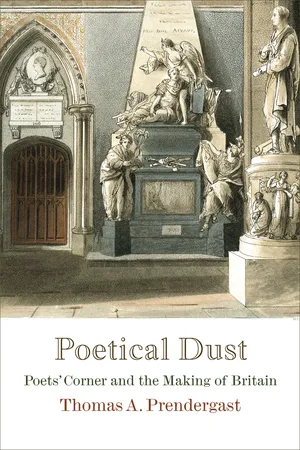
In the South Transept of Westminster Abbey in London, the bodies of more than seventy men and women, primarily writers, poets, and playwrights, are interred, with many more memorialized. From the time of the reburial of Geoffrey Chaucer in 1556, the space has become a sanctuary where some of the most revered figures of English letters are celebrated and remembered. Poets' Corner is now an attraction visited by thousands of tourists each year, but for much of its history it was also the staging ground for an ongoing debate on the nature of British cultural identity and the place of poetry in the larger political landscape.Thomas Prendergast's Poetical Dust offers a provocative, far-reaching, and witty analysis of Poets' Corner. Covering nearly a thousand years of political and literary history, the book examines the chaotic, sometimes fitful process through which Britain has consecrated its poetry and poets. Whether exploring the several burials of Chaucer, the politicking of Alexander Pope, or the absence of William Shakespeare, Prendergast asks us to consider how these relics attest to the vexed, melancholy ties between the literary corpse and corpus. His thoughtful, sophisticated discussion reveals Poets' Corner to be not simply a centuries-old destination for pilgrims and tourists alike but a monument to literary fame and the inevitable decay of the bodies it has both rejected and celebrated.
- 256 pages
- English
- ePUB (mobile friendly)
- Available on iOS & Android
eBook - ePub
About this book
Information
Publisher
University of Pennsylvania PressYear
2015Print ISBN
9780812247503
9780812247503
eBook ISBN
9780812291902
CHAPTER 1

Westminster Abbey and the Incorporation of Poets’ Corner
Sometime in the latter half of the seventeenth century, the notorious satirist Tom Brown narrated a kind of tour of London and Westminster that he supposedly conducted for an “Indian friend.” After visiting a number of different places (including a tavern and a bawdy house) they finally arrive at Westminster Abbey, where he observes
Edward the Confessor’s tomb is the chief piece of antiquity, who was the first royal empirick for scabs and scrophulous humours. He was a whimsical sort of a gentleman, that not being willing or capable to lye with his wife, was yet so jealous of her, that he caus’d her to pass the fiery trial of the Ordeal, which she did to the satisfaction of the beholders, but not of the king, who could never be brought to give her his royal benevolence, for which the monks make him a saint, and the nation was exposed to invasion and ruin, in William the bastard of Normandy, whom the monks call’d in a barbarous Latin, Conquestor or Conqueror.1
What stands out in this description is Brown’s denigration of the character of Edward and the bitter denunciation of the means by which “saints” were “made” in the Middle Ages. Such denunciations might be expected in a seventeenth-century England that has a vexed relationship with its Catholic past. Yet Brown’s satire reveals the extent to which the regal and the religious were popularly seen to coalesce in Edward’s body.
My argument in this chapter is that the uncorrupted wholeness of the Confessor’s body and, paradoxically enough, the failure of his cult originally produced the peculiarly timeless space of the Abbey.2 Four centuries later, it was the violation of this space and the murder and burial of a fourteenth-century knight by the name of Robert Hauley in the South Transept that led to the sanctification of a space within that space, locating the South Transept in time and shaping a prehistory of Poets’ Corner that led to the inclusion of its first poetical corpse, that of Geoffrey Chaucer. I use the term prehistory here advisedly. For much of what was written about the Abbey and the South Transept before 1400 has more the feel of legend than what we would call history. Even the space itself was different. Westminster Abbey in the fourteenth century not only lacked the distinctive towers designed by Nicholas Hawksmoor, but was still connected to part of the original (much lower) Norman nave. At its most basic level, then, the idea of understanding this space might seem at best speculative and at worst a well-meaning fantasy.
One could take an archaeological approach to the space. Like the psychoanalytical attempt to retrace original memories, it would seem to be possible to reconstruct or re-member space though traces of the original buildings. But as Freud suggested, and is now apparent, this analogy has its own problems, for
just as the archaeologist builds up the walls of a building from the foundations that have remained standing, determines the number and position of the columns from depressions in the floor and reconstructs the mural decorations and paintings from the remains found in the debris, so does the analyst proceed when he draws his inferences from the fragments of memories, from the associations and from the behaviour of the subject of the analysis. Both of them have an undisputed right to reconstruct by means of supplementing and combining the surviving remains. Both of them, moreover, are subject to many of the same difficulties and sources of error.3
Freud, of course, believed that such difficulties could be mitigated if not completely overcome. I believe that the archaeological reconstruction to which Freud refers is certainly possible and that even the so-called errors which proceed from it can lead us in a wandering sort of way to “truth.”4 And so I would claim that to get at and inhabit a space one needs to get at its aetiology (or at least its rationalized aetiology). This is not to say that nothing can be learned from entering space in medias res merely that to do so is to miss the beginning of what I have called the plot of such a space.
As I argued in the Preface, emplotment of space is not only the report of a succession of events through time, nor is it merely the notion of space conveyed by the meaning of the early modern variant of plot. It is also the plan, one might say the intent or scheme of the work. Poets’ Corner certainly can be read for the plot in the classical sense. There was often a plan (or plat) underlying the disposition of bodies, graves, and statues. And it is important to keep this public sense of Poets’ Corner in mind if we are to, in some sense, imaginatively inhabit it. But Poets’ Corner, being made of scores of monuments constructed at different times to public and private purposes, is also something of a romance. As Lorna Hutson has argued, Romance, with its errant knights, seems to suggest a lack of planning, or plot. But it is, in fact, in the errancy of the construction of Poets’ Corner, indeed of the Abbey itself, that the plot can be discerned. The intent, or ground plot of the Abbey, is most often perceived in the ways in which intent is turned on its head. As I suggest above, this is the great strength and the great weakness of the commemorative space of the Abbey. The order that should define the aesthetic object is often missing in the space of the South Transept precisely because plans are often never fulfilled, or if they are fulfilled, they result in unexpected outcomes. Yet the commemorative space often works precisely because ordered planning is frustrated. This organic idea of the South Transept gives a vitality to Poets’ Corner that is missing in other, more homogenous poetical commemorations. What I suggest here then is that the space of Poets’ Corner often has its own telos or end that is often unrecognized until it comes into being. Spaces, especially those that have both public and private uses, have their own logic. To truly inhabit a space is to be there at the beginning so that one can understand what it was projected to be and see how the practice of space transformed it into place.
The Project of Westminster Abbey
The narrative of the space formally known as the Collegiate Church of St. Peter and informally known as Westminster Abbey began with a corpse. If there is any doubt about the power of the corpse to “sanctify” a sense of place, we need only remember how the burial of the Hero Ktistes, or founding hero, often gave Greek colonial cities a “centre.”5 As the French philosopher Michel de Certeau has written, “An inert body always seems, in the West, to found a place and give it the appearance of a tomb.”6 When dealing with a national mausoleum like Westminster Abbey, or, more particularly, Poets’ Corner, such an assertion about the power of the dead to give meaning to place might seem self-evident. The sacred nature of the corpse in Christianity—evidenced by the veneration of relics and the theology of the resurrection of the body—has, of course, marked the medieval period as particularly redolent with what Robert Pogue Harrison has termed the “thereness” of places associated with dead bodies.7 A number of medievalists have detailed the establishment of saints’ cults thoughout medieval Europe, and what has become apparent is that modern notions of production and advertising are not out of place in discussions of these cults. Patrick Geary, for instance, narrates the establishment of the cult of Saint Helen of Athyra at Troyes in the thirteenth century, demonstrating that the promotion of a cult of this hitherto obscure saint was clearly the product of a need to repair the twin destructions of the cathedral in 1188 and 1228.8 The hope was that the promotion of her cult would lead to an increase of pilgrims to Troyes and an increase of offerings that could offset the enormous cost of rebuilding. Thus a vita was written to order (complete with spurious attribution to John Chrysostom), and “Helen’s publicists” promoted the portrait of a thaumaturgic Helen (as opposed to an excessively spiritual Helen) whose wonderworking would appeal to the general population.9 Like the cult of Helen, these cults almost always relied upon the existence of a previously acknowledged holy person (however unknown) and then used this raw material to invest a place with a specialness that would elicit alms as well as devotions.
The somewhat analogous attempt to make the Abbey of Westminster a special space that could at once produce reverence and money was a bit different from the larger medieval production of sacred space. For the cult that was associated with the Abbey in the High Middle Ages was not that of a local saint or of its patron, St. Peter (though the Abbey did rely on the apostle in its charters). Instead, the Abbey developed a cult that depended on its founder, Edward the Confessor. As we will see, Edward was far from the most popular saint in England; that title would have to go to Thomas Becket, who was given the title of martyr, while Edward was left with the term “confessor”—a kind of second-class martyr who had led a pious life and had been persecuted but had not been killed. Yet, save one small shrine in Dorset, it is Edward’s shrine alone that survived the dissolution of the monasteries in 1538, and it is his body that became the focus for what Dean Stanley called in 1868, “the centre of our national energies, the hearth of our national religion.”10 What was it, then, that made Edward different from other English saints? Certainly his status as king distinguished him. One could well argue that it is difficult to have the status of a temporal ruler while at the same time carrying out a life of such complete sanctity that one is canonized, but there are, of course, other examples of kingly saints. Edgar the Peaceful, Edmund of East Anglia, and Edwin of Northumbria were all popularly thought to be saints. Yet the case of Edward is, I argue, somewhat different—his canonization was stage-managed to a larger degree than other British kings. I would, in fact, argue that it was the implicit failure of Edward’s cult, along with the unpopularity of his feast day in the Middle Ages, that enabled him, or at least enabled his corpse, to provide the basis for what I have termed elsewhere a necronationalism.
Edward the Confessor, the last Saxon king of England, died in 1066. Before he died, however, he had his own mausoleum built. Finished in 1065, Westminster Abbey only awaited the signed charter from the king to complete its foundation. Unfortunately for Edward, the king’s signature preceded his burial before the High Altar by only nine days. Within a year, his tomb became an important political site. On Christmas Day 1066, William the Conqueror, standing on the Confessor’s gravestone, laid claim to the throne of England—not by victory but (as the Charter of Battle Abbey put it) by right of “his predecessor King Edward.”11 After William’s success in linking the place of Edward’s burial with his own claims to the throne, the rite of coronation was inalienably attached to the Abbey at Westminster. Not only the place of Edward’s death, but the actual regalia of Edward would supposedly invest the kings and queens who took the oath with the legitimacy of Edward’s mantle for almost five hundred years.
It is at this point that the story of Edward takes a strange turn. For, shortly after his burial, stories began circulating about miracles occurring at his tomb, and a life, commissioned by Edward’s widow, mentioned the miracles. This, in and of itself, is not abnormal. Miracles supposedly occurred at Thomas Becket’s tomb almost from the moment of his burial. Such miracles, in fact, usually set the stage for canonization. What is peculiar about Edward’s tomb is that, despite these miracles, there seems to have been no move to proclaim Edward a saint. In fact, the editor of the first life of the Confessor (which was probably written somewhere between 1066 and 1075) detects a certain amount of conscious ignorance, if not outright hostility, on the part of the Westminster monks to the cult of Edward.12
There are indications that this hostility was the result of a split between the courtly keepers of the cult and the monks of the Abbey, whose patron remained St. Peter (the “founder” of the Church), rather than Edward. And, in fact, one of the earliest “histories” of the church at Westminster omits any of the miracles associated with Edward. Instead, it focuses on what the eleventh-century monk Sulcard characterizes as the seventh-century foundation narrative of Abbey. In this narrative, St. Peter himself undertakes the consecration of the church in place of the first bishop of London, Mellitus.13 This hostility or uncertainty about Edward seems to have remained, for in 1102 the Confessor’s tomb was opened out of a combination of faith and skepticism concerning the dead king’s sanctity. A purported witness for this exhumation (related in the second life of Edward composed by Osbert of Clare) reports that “six and thirty years had Edward lain in the tomb, and many thought that like other men he had fallen to ashes after our common mortal lot. But some there were whose loving thoughts gave them a holy presentiment of somewhat divine attending one whose limbs had never known the loss of virgin purity, and whose body they could not doubt remained in a kind of resurrection glory.”14 The discovery of the incorrupt body of a venerated person or wonder at that incorruption is something of a topos or commonplace in saints’ lives; what is unusual here is that Osbert gives voice to those who apparently doubted Edward’s sanctity, or at the very least doubted that his sanctity would lead to the existence of his body as whole and unaged some thirty-six years after his death.
But this is not the most peculiar thing about Osbert’s Life, for, after the lid of the sarcophagus was taken off and Edward’s body ...
Table of contents
- Cover
- Half title
- Title
- Copyright
- Dedication
- Contents
- Preface
- Introduction
- Chapter 1. Westminster Abbey and the Incorporation of Poets’ Corner
- Chapter 2. Melancholia, Monumental Resistance, and the Invention of Poets’ Corner
- Chapter 3. Love, Literary Publicity, and the Naming of Poets’ Corner
- Chapter 4. Absence and the Public Poetics of Regret
- Chapter 5. Poetic Exhumation and the Anxiety of Absence
- Coda
- Poets’ Corner Graveplan
- Poets’ Corner Alphabetical Burial and Monument List
- Chronological List of Stones and Monuments in the South Transept
- Notes
- Bibliography
- Index
- Acknowledgments
Trusted by 375,005 students
Access to over 1.5 million titles for a fair monthly price.
Study more efficiently using our study tools.
Frequently asked questions
Yes, you can cancel anytime from the Subscription tab in your account settings on the Perlego website. Your subscription will stay active until the end of your current billing period. Learn how to cancel your subscription
No, books cannot be downloaded as external files, such as PDFs, for use outside of Perlego. However, you can download books within the Perlego app for offline reading on mobile or tablet. Learn how to download books offline
Perlego offers two plans: Essential and Complete
- Essential is ideal for learners and professionals who enjoy exploring a wide range of subjects. Access the Essential Library with 800,000+ trusted titles and best-sellers across business, personal growth, and the humanities. Includes unlimited reading time and Standard Read Aloud voice.
- Complete: Perfect for advanced learners and researchers needing full, unrestricted access. Unlock 1.5M+ books across hundreds of subjects, including academic and specialized titles. The Complete Plan also includes advanced features like Premium Read Aloud and Research Assistant.
We are an online textbook subscription service, where you can get access to an entire online library for less than the price of a single book per month. With over 1.5 million books across 990+ topics, we’ve got you covered! Learn about our mission
Look out for the read-aloud symbol on your next book to see if you can listen to it. The read-aloud tool reads text aloud for you, highlighting the text as it is being read. You can pause it, speed it up and slow it down. Learn more about Read Aloud
Yes! You can use the Perlego app on both iOS and Android devices to read anytime, anywhere — even offline. Perfect for commutes or when you’re on the go.
Please note we cannot support devices running on iOS 13 and Android 7 or earlier. Learn more about using the app
Please note we cannot support devices running on iOS 13 and Android 7 or earlier. Learn more about using the app
Yes, you can access Poetical Dust by Thomas A. Prendergast in PDF and/or ePUB format, as well as other popular books in Literature & British History. We have over 1.5 million books available in our catalogue for you to explore.