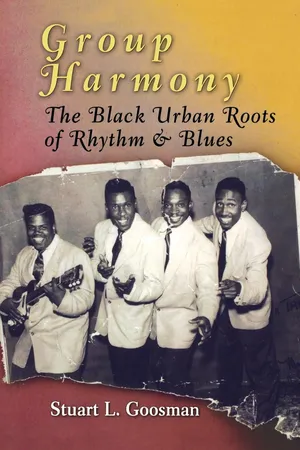
In 1948, the Orioles, a Baltimore-based vocal group, recorded "It's Too Soon to Know." Combining the sound of Tin Pan Alley with gospel and blues sensibilities, the Orioles saw their first hit reach #13 on the pop charts, thus introducing the nation to vocal rhythm & blues and paving the way for the most successful groups of the 1950s.
In the first scholarly treatment of this influential musical genre, Stuart Goosman chronicles the Orioles' story and that of myriad other black vocal groups in the postwar period. A few, like the Orioles, Cardinals, and Swallows from Baltimore and the Clovers from Washington, D.C., established the popularity of vocal rhythm & blues nationally. Dozens of other well-known groups (and hundreds of unknown ones) across the country cut records and performed until about 1960. Record companies initially marketed this music as rhythm & blues; today, group harmony continues to resonate for some as "doo-wop."
Focusing in particular on Baltimore and Washington and drawing significantly from oral histories, Group Harmony details the emergence of vocal rhythm & blues groups from black urban neighborhoods. Group harmony was a source of empowerment for young singers, for it provided them with a means of expression and some aspect of control over their lives where there were limited alternatives. Through group harmony, young black males celebrated and musically confounded, when they could not overcome, complex issues of race, separatism, and assimilation during the postwar period.
Group harmony also became a significant resource for the popular music industry. Goosman interviews dozens of performers, deejays, and industry professionals to examine the entrepreneurial promise of midcentury popular music and chronicle the convergence of music, place, and business, including the business of records, radio, promotion, and song writing.
Featured in the book's account of the black urban roots of rhythm & blues are the recollections of singers from groups such as the Cardinals, Clovers, Dunbar Four, Four Bars of Rhythm, Five Blue Notes, Hi Fis, Plants, Swallows, and many others, including Jimmy McPhail, a well-known Washington vocalist; Deborah Chessler, the manager and songwriter for the original Orioles; Jesse Stone, the writer and arranger from Atlantic Records; Washington radio personality Jackson Lowe; and seminal black deejays Al ("Big Boy") Jefferson, Maurice ("Hot Rod") Hulbert, and Tex Gathings.
- 304 pages
- English
- ePUB (mobile friendly)
- Available on iOS & Android
eBook - ePub
About this book
Information
Subtopic
Music History & Criticism1
Antecedents
Flow
Where did group harmony come from? Well, partly, it was just as Howard says.
“We just went with what’s easy, the flow, because we could do anything. If he wanted to do the tenor, no problem. Like I told you we go to the football games. When we sing the National Anthem—”
Howard Davis pauses to let Mel Lipscomb, who sits next to him, finish the thought. “It amazes us.”
The two of them have been friends since meeting at Washington, D.C, s Dunbar High School in 1943. They remained best friends for years after their harmony group the Hi Fis performed together. The other two members are gone, but occasionally Howard and Melvin sing when they happen to be together. They continue to exude that matter-of-fact attitude of “we could do anything.” Their reference is musical, but you get the feeling that there was more there, that “we could do anything” flowed from something deeply within. Bear witness to the optimistic and bright soul of black youth as it still radiates in these two men. You hear it today as you would have heard it in their music, in the 1950s. The flow that Howard said they went with is just as it has always been — one singer picks up a vocal part where the other leaves off. That was how they patterned their harmony, music, and sometimes even their lives. You notice that same principle at work in their social actions and in conversation, as Melvin completes Howard s thought.
Here, Howard describes how he and Melvin spontaneously exchange vocal parts (and attract some attention) when they sing the National Anthem at football games. This was just the way they performed in the 1950s, the way it has always been for them.
“And you see the people turn around. Because through the National Anthem, he’ll drop off to the baritone line and I go from the baritone, go right up to where he left off. You know. Or he might, say, in a song, ‘Do that,’ I mean, ‘You take that up there.’ And that’s all it’s ever been. And I don’t know a note. Well I don’t know the names for them, but I know what I feel.”
When young black males during the period around World War II got together to sing, they put music into their lives. Conversely, they put their lives — collective and individual attitudes, styles, and strategies—into the music. The result was that group harmony was as much a way of life as it was a musical activity. This played out in a myriad ways, but one nice example was the way Howard and Melvin—and other singers who appear in these pages—call and respond with each other in song as well as conversation. One picks up where the other leaves off. One expresses the other, answers the other, and affirms the other. They go with the flow of the moment.
What singers put into their music they culled from the city street, public school, church, family, home, and a shared history. The flow to which Howard alludes occurs from one singer to another and one friend to another, but it just as well roots one sphere of life in another and each generation in the previous one. Howard’s is a casual use of the word flow, as many of us would use it. Beneath the casual, there is something more meaningful, something deeply fundamental to black music culture and in the emergence of postwar group harmony.
The anthropologist Victor Turner wrote about the concept of “flow” in creative experience. Flow is a sensation present “when we act with total involvement.” Flow can occur when we are “in control of our actions, and in which there is little distinction between self and environment — or between past present and future.”1 Young singers socialized this notion of flow as they established relationships with each other and their surroundings. Music making was a way in which youngsters put themselves in control of their actions. And the nature of urban life made them do so in close relation to—if not quite in harmony with — their immediate, sometimes unfriendly environment.
These are defining qualities specifically in postwar group harmony and in black music culture more generally. One of these characteristics is a use of music in the everyday, a flow between shared values, home, school, church, and music. There is also another component to this, the flow from one generation to the next—a total involvement of another kind, with history, from past to present to future as one generation builds on the last. In all of these senses, “flow” transverses musical and social processes.
Another element of flow that seems particularly fitting here is this: “To flow is to be as happy as a human can be” (quoted in Turner 1982: 58). When these vocalists performed, even informally, out of difficult times, singing brought great joy. It is perhaps the one great, unvoiced truth here. Howard Davis alludes to it as he tries to connect music and urban, social circumstance for us:
“If I hear a funny chord, I get a chill. We used to sing, man, and you know what we used to do? The chords would be so good we’d almost have tears in our eyes. Say, what the hell are we doing? And where do we, where, you know, we come from different parts of the city, through kind of the same kind of stuff, you know?”
Behind what Howard tells us is a long road.
Antecedents
Black rhythm & blues vocal harmony had antecedents in older, historical traditions of vocal music, which in turn drew from a myriad of both African and European-derived vocal traditions that ranged broadly from church hymns to folk tunes. Harmony groups were an early part of modern gospel music, beginning in the 1920s, and had a place in both sacred and secular song performances much earlier. The Fisk University Jubilee Singers, for instance, was a group of about eight male and female voices. Their success from an 1871 concert tour to raise money for the school spawned a number of other black college groups in the 1870s, such as the Hampton Institute Singers. These groups focused on sacred music, and the result was a newer, formally arranged and harmonized version of older folk spirituals. Here was the beginning of “concert” harmony in black religious music that clearly drew as much from white traditions as black, but it later became an important element in the development of gospel quartets, after the late 1920s. It was also the beginning of spiritual performances intended for white audiences, which accounted in part for the formalized style. Concertized spirituals were also evidence of both generational and class differences emerging in black music, whereby young college students performed “cleaned up” spirituals, in a departure from the older folk style that some would have considered a vestige of enslavement.
Other types of black harmony singing most certainly occurred earlier, before the mid-nineteenth century. Although West Africans taken for the slave trade preferred multi-part singing, they did not use four-part, tonal harmony. As they encountered Europeans, though, they acquired it, used it, and adapted it for their own purposes as they learned Western music. As Lovell recounts (1986: 109), Frederick Law Olmstead wrote that he heard slaves harmonizing in the 1850s. Lynn Abbott s account of early harmony groups and their social setting establishes a black origin of barbershop harmony, a particular style of male quartet harmony that had a defining influence on “Americas cultural fabric” (Abbott 1992: 319) and on the black pop quartets that predated rhythm & blues. (That particular style of four or five part block harmony singing was a good example of how nineteenth-century African Americans learned and adapted European styles.)
Within this rich authoring by black harmony groups, there was a particular affection for harmonizing among male singers in quartets and quintets. The black writer James Weldon Johnson cites numerous examples of vocal quartets he heard in southern black communities during the late nineteenth century (Johnson and Johnson 1925: 35-36). Louis Armstrong, during the first decade of this century in New Orleans, sang for pennies on the sidewalks with a quartet of youngsters. Later Armstrong recounted listening, singing with, and presumably learning from male “barroom quartets” in New Orleans (Armstrong 1954: 86). Both sacred and secular male quartets and quintets flourished in different forms throughout the twentieth century.
Any narrative about rhythm & blues group harmony is inseparable from the desire to make recordings. The history of black vocal group performance recordings begins as early as 1893, with the Unique Quartet performing “Mamas Black Baby Boy.”2 In 1894, the Standard Quartette recorded both sacred and secular songs in Washington for Columbia (Funk 1991).3 Black vocal harmony—as performance and as a recorded commodity—continued to develop with early gospel groups such as the Dixie Hummingbirds, formed in 1928, and later ones like the Golden Gate Jubilee Quartet, popular in the 1940s. There were hundreds of other black groups throughout the 1930s, 1940s, and 1950s. Well-known secular groups included the Mills Brothers (formed 1920s) and Ink Spots (1930s), while the Deep River Boys (1936) and the Delta Rhythm Boys (1937) originated as college groups and had mixed repertoires of both secular and sacred material (Southern 1997: 513). Of all the groups that came of age before World War II, the Ink Spots seem to have made the most lasting impression on younger singers during the early and mid-1940s.4
The Ink Spots after 1939 became a uniquely popular and visible group. They made records, received a lot of recognition, and became solid crossover artists well-liked by both black and white audiences—a fact not lost on aspiring singers.
Before the R&B era, before the Ravens, Orioles, and Clovers, young black males who wanted to sing wanted to be just like Bill Kenny and the Ink Spots. The group had the sound and they had the look. During the 1950s, Harold Winley sang bass for the Clovers and remembered the impact of the Ink Spots.
“But, during that time,” he said, “you know, the groups that you would hear around on the corner singing were mostly singing Ink Spots. You hear cats going down the street, you know guys that had tenor voices man, in the morning, at night, singing Bill Kenny and doing the hands, like he used to do. It was either Bill Kenny or Billy Eckstine.5 Understand what I’m saying? Those were the voices you would hear.”
The peak years of the Ink Spots were the 1940s. Beginning in 1939, after Bill Kenny joined the group as lead tenor, the group consisted of Orville “Hoppy” Jones, bass/baritone vocal, Ivory “Deek” Watson, and Charlie Fuqua on background harmony and guitar. The Ink Spots perfected their distinctive sound with sweet, sentimental, Tin Pan Alley ballads. Between Kenny, the high tenor lead, and the low range of Jones, the group further popularized a high voice/low voice combination (already present in period gospel quartets), as well as Jones’s signature “talking choruses.” The Ink Spots had vocal superiors, to be sure, in the dynamism of the sacred music singers like the Golden Gate Jubilee Quartet, or in the abilities of jump vocal groups like the Delta Rhythm Boys, who were contemporaries. The Ink Spots, however, were better known, and the reasons were probably difficult for singers to ignore.
The group’s trademark sound was Bill Kenny’s airy tenor voice. The overall aesthetic of the group sound was staid, but Kenny had a polished voice, gorgeous tone, effective range, and perfect diction with rolling r’s equally reminiscent of Rudee Vallee and the Fisk Jubilee Singers. There remained, however, an unmistakable patina to the group’s sound.6 Behind Kenny were the quiet background harmonies, even-strumming guitar chords, and on some recordings a string bass and piano. It was a reassuring sound, perfect for the years of World War II. The group recorded for the Decca label and had fifty hits between 1939 and 1951 (Clarke 1989: 580).
The other thing about the Ink Spots, and Eckstine too, for that matter, was the look—white suits, flowers in the lapels; they were clean and pressed, but not over the top. Winley remembered that look. It transformed the group’s stage appearance, the formal posturing, “doing the hands,” the low-key gestures. There was no shuck, no jive, and no blackcrobatic dancing for white Hollywood. The Ink Spots were not stereotype. The only aspect of the group that by today’s standards disturbs is the Hoppy Jones talking chorus. He always maintained a contemplative, sad aspect to his voice—not clearly a submissive dialect, but very close on some recordings (e.g., “We’ll Meet Again”) to the stereotype of a 1930s-era world-weary black male. Talking choruses were not new and were used by both black and white singers in a great variety of genres, but Jones’s style was certainly copied and even parodied over the years. There is in this aspect of the group a kind of covert dynamism that straddled two worlds, one black, one white. The demeanor, sound, and success of the group empowered in that it looked to crossover, perhaps integrationist possibilities. The group certainly appealed in different ways to its constituents—to blacks, the group was successful and respected; to whites, talented and “respectful” enough to listen to.
But that talking chorus of Hoppy Jones, which appeared in many though not all songs, is something of a drag on contemporary ears. This was a juncture, because later black singers used talking choruses as well — or just talking through portions of a song—to great effect, but it was the younger, rhythm & blues-era singers that imbued a freshness and assertive-ness into that older concept. Ultimately black performers, from the 1960s on, transformed it into a distinct, powerful communicative tool within the context of a song.
Nevertheless, the Ink Spots were still cool, reserved, and respected. It was before the R&B vocal groups incorporated dance steps and their own postwar type of stylized posturing. The Ink Spots communicated “appealing” (read respectable) values in the sense that the group crossed lines of both race and class. Young singers appreciated the strategic aspect of that, the business side of music. They knew that the result of those values could mean success. White expectations often played off shuck and jive, which is absent with this group, and yet their demeanor had enormous appeal for those same whites, and Hoppy Jones as a foil to Bill Kenny was part of the formula. This is the crossover conundrum of black performance vis-à-vis white expectations—be black, but not too black. For African Americans of the time, however, the Ink Spots must have struck a dignified, successful pose. They smiled, but they did not grin, and got over.
“But we knew they were a smooth operation on that stage,” Winley said. “Yes. So you knew you had to dress well. You had to present yourself well, and you carried, you know, the demeanor.”
The Ink Spots, along with similar groups like the Mills Brothers, Cats and the Fiddle, Four Vagabonds, and Delta Rhythm Boys, drew from Tin Pan Alley to develop their crossover sounds in the 1930s and early 1940s. “Crossover” meant both black and white audience appeal and in that, greater commercial success. Groups maintained a kind of musical and racial middle ground, sometimes (but by no means always) by taking a standard song and rearranging it in a jump or jive style (it never went the other way).7
When youngsters in the later 1940s copied crossover groups like the Ink Spots, who performed standard material almost exclusively, they furthered a particular kind of black style and tradition — one more inclusive, rather than exclusive. They performed material they liked, and material that they thought an audience would identify with. They did material that they also thought was “classy” and commercially viable. For the latter, inevitably, white audiences had to be part of the formula, whether performers articulated the point or not—and the point was not to sell out to whites, but to buy in to success. This drive created some terrific ironies for black groups.
To some derisive industry insiders, for instance, Bill Kenny and the Ink Spots (as well as the Mills Brothers and other similar groups) “sugared” their sound to appeal to white audiences (Shaw 1978: xvii). Perhaps they did, but so what? Did that make them somehow less black? Black musicians like the Ink Spots were shrewd enough to play with the notion of blackness. They did so with obvious irony, in light of their fly-in-the-milk kind of name choice that called attention to color (as did the Ravens, the Lewis Bronzeville Five, Brown Dots, Cap-Tans, and numerous others).8This was decades before scholars wrote about social constructions of race, but these artists had long known the score of that game. Indeed, playing with the notion of blackness (which was not a new thing in the 1930s and continues into our present era under updated guises) must be predicated on the idea that “blackness” as a concept endures (albeit in changing ways over time) in opposition to a mainstream that isolated it to begin with. That said, you cannot play with the idea of “white” in quite the same way, unless it is in opposition to black (“white on!” as a sarcastic pun only works in opposition to the black affirmation, “right on!”). The point here is that groups like the Ink Spots, and subsequent ones, were forced to engage with race and concepts of “blackness.” The result was shifting perceptions of what “black” was or was supposed to be.
Clearly, the Ink Spots knew what they wanted to do musically and commercially (even if the entertainment world may have limited the choices to begin with). Clearly, the group appealed to young black males also, especially during the mid-1940s, and not just as a strategy for mainstream success. The group’s crossover success was part of the inspiration, yet black youngsters at that time were intuitive enough not to essentialize music. They went with the popular flow, took what came their way in those years, and eventually made something uniquely their own.
In cities like Baltimore and Washington that constituted a sound considerably more “mainstream” than blues, for instance, for which the old line black residents in those cites most likely had only a limited appreciation, and the Ink Spots, though unapologetically black, were definitely not blue.9
Blues, just like Tin Pan Alley standards, was an undeniable influence on American popular music as a ...
Table of contents
- Cover
- Title
- Copyright
- Contents
- Preface
- 1 Antecedents
- 2 Time and Place
- 3 Entrepreneurship
- 4 Mediators
- 5 Patterns
- Epilogue
- Appendix
- Notes
- Bibliography
- Index
- Acknowledgments
Trusted by 375,005 students
Access to over 1.5 million titles for a fair monthly price.
Study more efficiently using our study tools.
Frequently asked questions
Yes, you can cancel anytime from the Subscription tab in your account settings on the Perlego website. Your subscription will stay active until the end of your current billing period. Learn how to cancel your subscription
No, books cannot be downloaded as external files, such as PDFs, for use outside of Perlego. However, you can download books within the Perlego app for offline reading on mobile or tablet. Learn how to download books offline
Perlego offers two plans: Essential and Complete
- Essential is ideal for learners and professionals who enjoy exploring a wide range of subjects. Access the Essential Library with 800,000+ trusted titles and best-sellers across business, personal growth, and the humanities. Includes unlimited reading time and Standard Read Aloud voice.
- Complete: Perfect for advanced learners and researchers needing full, unrestricted access. Unlock 1.5M+ books across hundreds of subjects, including academic and specialized titles. The Complete Plan also includes advanced features like Premium Read Aloud and Research Assistant.
We are an online textbook subscription service, where you can get access to an entire online library for less than the price of a single book per month. With over 1.5 million books across 990+ topics, we’ve got you covered! Learn about our mission
Look out for the read-aloud symbol on your next book to see if you can listen to it. The read-aloud tool reads text aloud for you, highlighting the text as it is being read. You can pause it, speed it up and slow it down. Learn more about Read Aloud
Yes! You can use the Perlego app on both iOS and Android devices to read anytime, anywhere — even offline. Perfect for commutes or when you’re on the go.
Please note we cannot support devices running on iOS 13 and Android 7 or earlier. Learn more about using the app
Please note we cannot support devices running on iOS 13 and Android 7 or earlier. Learn more about using the app
Yes, you can access Group Harmony by Stuart L. Goosman in PDF and/or ePUB format, as well as other popular books in Media & Performing Arts & Music History & Criticism. We have over 1.5 million books available in our catalogue for you to explore.