The phrase "Pennsylvania German architecture" likely conjures images of either the "continental" three-room house with its huge hearth and five-plate stoves, or the huge Pennsylvania bank barn with its projecting overshoot. These and other trademarks of Pennsylvania German architecture have prompted great interest among a wide audience, from tourists and genealogists to architectural historians, antiquarians, and folklorists. Since the nineteenth century, scholars have engaged in field measurement and drawing, photographic documentation, and careful observation, resulting in a scholarly conversation about Pennsylvania German building traditions. What cultural patterns were being expressed in these buildings? How did shifting social, technological, and economic forces shape architectural changes? Since those early forays, our understanding has moved well beyond the three-room house and the forebay barn.
In Architecture and Landscape of the Pennsylvania Germans, 1720-1920, eight essays by leading scholars and preservation professionals not only describe important architectural sites but also offer original interpretive insights that will help advance understanding of Pennsylvania German culture and history. Pennsylvania Germans' lives are traced through their houses, barns, outbuildings, commercial buildings, churches, and landscapes. The essays bring to bear years of field observation as well as engagement with current scholarly perspectives on issues such as the nature of "ethnicity," the social construction of landscape, and recent historiography about the Pennsylvania Germans. Dozens of original measured drawings, appearing here for the first time in print, document important works of Pennsylvania German architecture, including the iconic Bertolet barns in Berks County, the Martin Brandt farm complex in Cumberland County, a nineteenth-century Pennsylvania German housemill, and urban houses in Lancaster.
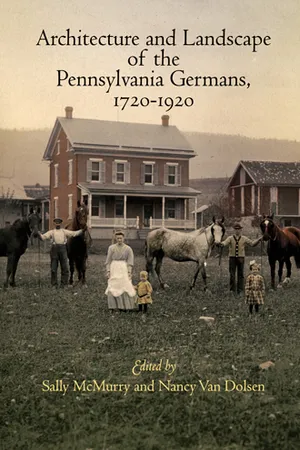
eBook - PDF
Architecture and Landscape of the Pennsylvania Germans, 1720-1920
- 268 pages
- English
- PDF
- Available on iOS & Android
eBook - PDF
Architecture and Landscape of the Pennsylvania Germans, 1720-1920
About this book
Information
Publisher
University of Pennsylvania PressYear
2011Print ISBN
9780812242782
9780812242782
eBook ISBN
9780812204957
Topic
ArchitectureSubtopic
Architecture GeneralTable of contents
- Cover
- Contents
- List of Illustrations
- INTRODUCTION: Architecture and Landscape of the Pennsylvania Germans, 1720–1920
- CHAPTER ONE: Landscapes
- CHAPTER TWO: Rural Houses
- CHAPTER THREE: Domestic Outbuildings
- CHAPTER FOUR: Barns and Agricultural Outbuildings
- CHAPTER FIVE: Town House: From Borough to City, Lancaster's Changing Streetscape
- CHAPTER SIX: Commerce and Culture: Pennsylvania German Commercial Vernacular Architecture
- CHAPTER SEVEN: Religious Landscapes
- Notes
- Selected Bibliography
- List of Contributors
- Index
- Acknowledgments
Trusted by 375,005 students
Access to over 1.5 million titles for a fair monthly price.
Study more efficiently using our study tools.
Frequently asked questions
Yes, you can cancel anytime from the Subscription tab in your account settings on the Perlego website. Your subscription will stay active until the end of your current billing period. Learn how to cancel your subscription
No, books cannot be downloaded as external files, such as PDFs, for use outside of Perlego. However, you can download books within the Perlego app for offline reading on mobile or tablet. Learn how to download books offline
Perlego offers two plans: Essential and Complete
- Essential is ideal for learners and professionals who enjoy exploring a wide range of subjects. Access the Essential Library with 800,000+ trusted titles and best-sellers across business, personal growth, and the humanities. Includes unlimited reading time and Standard Read Aloud voice.
- Complete: Perfect for advanced learners and researchers needing full, unrestricted access. Unlock 1.5M+ books across hundreds of subjects, including academic and specialized titles. The Complete Plan also includes advanced features like Premium Read Aloud and Research Assistant.
We are an online textbook subscription service, where you can get access to an entire online library for less than the price of a single book per month. With over 1.5 million books across 990+ topics, we’ve got you covered! Learn about our mission
Look out for the read-aloud symbol on your next book to see if you can listen to it. The read-aloud tool reads text aloud for you, highlighting the text as it is being read. You can pause it, speed it up and slow it down. Learn more about Read Aloud
Yes! You can use the Perlego app on both iOS and Android devices to read anytime, anywhere — even offline. Perfect for commutes or when you’re on the go.
Please note we cannot support devices running on iOS 13 and Android 7 or earlier. Learn more about using the app
Please note we cannot support devices running on iOS 13 and Android 7 or earlier. Learn more about using the app
Yes, you can access Architecture and Landscape of the Pennsylvania Germans, 1720-1920 by Sally McMurry, Nancy Van Dolsen, Sally McMurry,Nancy Van Dolsen in PDF and/or ePUB format, as well as other popular books in Architecture & Architecture General. We have over 1.5 million books available in our catalogue for you to explore.