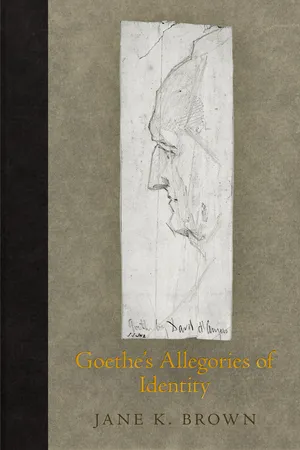
A century before psychoanalytic discourse codified a scientific language to describe the landscape of the mind, Johann Wolfgang von Goethe explored the paradoxes of an interior self separate from a conscious self. Though long acknowledged by the developers of depth psychology and by its historians, Goethe's literary rendering of interiority has not been the subject of detailed analysis in itself. Goethe's Allegories of Identity examines how Goethe created the essential bridge between the psychological insights of his contemporary, Jean-Jacques Rousseau, and the psychoanalytic theories of his admirer Sigmund Freud.
Equally fascinated and repelled by Rousseau's vision of an unconscious self, Goethe struggled with the moral question of subjectivity: what is the relation of conscience to consciousness? To explore this inner conflict through language, Goethe developed a unique mode of allegorical representation that modernized the long tradition of dramatic personification in European drama. Jane K. Brown's deft, focused readings of Goethe's major dramas and novels, from The Sorrows of Young Werther to Elective Affinities, reveal each text's engagement with the concept of a subconscious or unconscious psyche whose workings are largely inaccessible to the rational mind. As Brown demonstrates, Goethe's representational strategies fashioned a language of subjectivity that deeply influenced the conceptions of important twentieth-century thinkers such as Freud, Michel Foucault, and Hannah Arendt.
- 240 pages
- English
- ePUB (mobile friendly)
- Available on iOS & Android
eBook - ePub
Goethe's Allegories of Identity
About this book
Information
Publisher
University of Pennsylvania PressYear
2014Print ISBN
9780812245820
9780812245820
eBook ISBN
9780812209389
Table of contents
- Cover
- Half title
- Title
- Copyright
- Contents
- Dedication
- Part I. The Problem
- Part II. Experiments in Subjectivity
- Part III. The Language of Interiority
- Conclusion: Classicism and Goethe’s Emotional Regime
- Notes
- Works Cited
- Index
- Acknowledgments
Trusted by 375,005 students
Access to over 1.5 million titles for a fair monthly price.
Study more efficiently using our study tools.
Frequently asked questions
Yes, you can cancel anytime from the Subscription tab in your account settings on the Perlego website. Your subscription will stay active until the end of your current billing period. Learn how to cancel your subscription
No, books cannot be downloaded as external files, such as PDFs, for use outside of Perlego. However, you can download books within the Perlego app for offline reading on mobile or tablet. Learn how to download books offline
Perlego offers two plans: Essential and Complete
- Essential is ideal for learners and professionals who enjoy exploring a wide range of subjects. Access the Essential Library with 800,000+ trusted titles and best-sellers across business, personal growth, and the humanities. Includes unlimited reading time and Standard Read Aloud voice.
- Complete: Perfect for advanced learners and researchers needing full, unrestricted access. Unlock 1.5M+ books across hundreds of subjects, including academic and specialized titles. The Complete Plan also includes advanced features like Premium Read Aloud and Research Assistant.
We are an online textbook subscription service, where you can get access to an entire online library for less than the price of a single book per month. With over 1.5 million books across 990+ topics, we’ve got you covered! Learn about our mission
Look out for the read-aloud symbol on your next book to see if you can listen to it. The read-aloud tool reads text aloud for you, highlighting the text as it is being read. You can pause it, speed it up and slow it down. Learn more about Read Aloud
Yes! You can use the Perlego app on both iOS and Android devices to read anytime, anywhere — even offline. Perfect for commutes or when you’re on the go.
Please note we cannot support devices running on iOS 13 and Android 7 or earlier. Learn more about using the app
Please note we cannot support devices running on iOS 13 and Android 7 or earlier. Learn more about using the app
Yes, you can access Goethe's Allegories of Identity by Jane K. Brown in PDF and/or ePUB format, as well as other popular books in Literature & German Literary Criticism. We have over 1.5 million books available in our catalogue for you to explore.