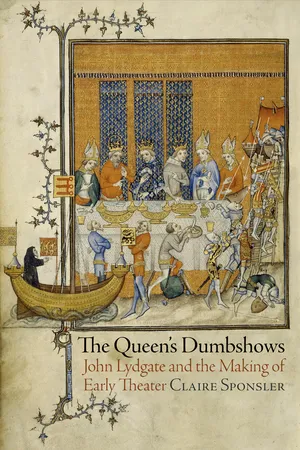
No medieval writer reveals more about early English drama than John Lydgate, Claire Sponsler contends. Best known for his enormously long narrative poems The Fall of Princes and The Troy Book, Lydgate also wrote numerous verses related to theatrical performances and ceremonies. This rich yet understudied body of material includes mummings for London guildsmen and sheriffs, texts for wall hangings that combined pictures and poetry, a Corpus Christi procession, and entertainments for the young Henry VI and his mother.
In The Queen's Dumbshows, Sponsler reclaims these writings to reveal what they have to tell us about performance practices in the late Middle Ages. Placing theatricality at the hub of fifteenth-century British culture, she rethinks what constituted drama in the period and explores the relationship between private forms of entertainment, such as household banquets, and more overtly public forms of political theater, such as royal entries and processions. She delineates the intersection of performance with other forms of representation such as feasts, pictorial displays, and tableaux, and parses the connections between the primarily visual and aural modes of performance and the reading of literary texts written on paper or parchment. In doing so, she has written a book of signal importance to scholars of medieval literature and culture, theater history, and visual studies.
- 320 pages
- English
- ePUB (mobile friendly)
- Available on iOS & Android
eBook - ePub
About this book
Information
Publisher
University of Pennsylvania PressYear
2014Print ISBN
9780812245950
9780812245950
eBook ISBN
9780812209471
CHAPTER 1

Shirley’s Hand
Unlike other fifteenth-century writers of short poems, Lydgate appears not to have kept a portfolio of his shorter verses, including those for performance, or to have supervised its circulation in authorized collections.1 In fact, the survival of Lydgate’s dramatic texts is due almost entirely to John Shirley, who included them in three anthologies he compiled between the late 1420s and the late 1440s. Whether or not Lydgate played any role in Shirley’s compilations, and there is no evidence that he did, in copying Lydgate’s performance pieces, Shirley provided crucial information about the circumstances of their original performance as well as their afterlife. The decisions Shirley made about what to copy and how to present it on the manuscript page say a good deal about what happened when a visual and aural form such as drama entered the written record. His copies also include information that helps piece together the circumstances of their original performance and written afterlife. Shirley’s copies also help answer questions about the nature of the textual evidence for drama before print. What do manuscripts tell us about early performances? Should the canon of early theater be expanded to include texts that do not look like plays but may have been performed? How does the archive of written scripts and references to performances relate to the plays people in medieval England put on and watched? How do we know what was a play and what was not?
The place to which scholars have usually turned in trying to answer these questions has not been Shirley’s compilations but rather the Toronto-based Records of Early English Drama (REED) project, whose goal since its inception in the 1970s has been to identify and publish all extant external references to early drama in Britain.2 It is no exaggeration to say that REED’s findings have radically revised scholarly assumptions about medieval drama. REED has shown, for instance, that the so-called Corpus Christi cycles were in most cases loosely put-together, episodic biblical dramas that could be performed on Corpus Christi but also at Whitsun; that folk dramas, such as Robin Hood plays, were the most frequent kinds of performances; that folk and other secular plays often took place on holy days and in religious settings; that the distinction between “medieval” and “renaissance” drama is hard to maintain (with a roughly 200-year performance span, the biblical plays of Coventry, Chester, and York lasted until 1575 or longer, while the manuscripts in which the biblical plays survive are chiefly Tudor documents, and “medieval” morality plays flourished alongside sixteenth-century school plays); and that the commercial theater, in the form of companies of traveling players, existed well before the age of Shakespeare.3 REED has also shown that surviving play-texts do not accurately reflect the kinds and amounts of early drama: the large-scale biblical cycle plays such as York’s, for instance, which have long been taken as the quintessential form of medieval drama, in actuality represent only a small fraction of extant performance records (David Bevington estimates it at 16 percent), and morality plays were even rarer.4
In the midst of all these surprises, perhaps the most unexpected finding is what REED has not discovered: new texts of plays. After years of diligent archival work, the corpus of Middle English drama still consists of the same long-known handful of texts from northern and southeastern England, as well as Cornwall. That handful includes four extant collections of biblical-history plays from the north: the York Register, which contains forty-seven pageants (1460s to 1470s through the mid-sixteenth century), the Towneley manuscript (mid-sixteenth century), two pageants from Coventry (both of them revisions by Robert Croo dated 1534), and five manuscripts of the Chester cycle (1591–1607).5 The plays from the southeast, while more diverse than those from the north, are for the most part contained in three manuscripts. They are the Digby plays (Mary Magdalene, dating to the end of the fifteenth century; The Killing of the Children, ca. 1512, a farcical Slaughter of the Innocents; The Conversion of Saint Paul, 1500–1525; and a fragment of Wisdom, ca. 1470–75, all in Oxford, Bodleian Library MS Digby 133, owned in the mid-sixteenth century by Myles Blomefeld, a collector of books), the Macro plays (Castle of Perseverance, 1400–1425; Mankind, 1474–79; a complete version of Wisdom, all in Washington, D.C., Folger Shakespeare Library MS V.a.354, which was owned at some point by a monk named Hyngham of Bury St. Edmunds), and the N-Town plays (a compilation of plays originally of separate and earlier origin brought together by a scribe-compiler in or after the last decade of the fifteenth century, contained in London, British Library MS Cotton Vespasian D.8; the N-Town plays are also sometimes, confusingly, referred to as the Ludus Coventriae because of a flyleaf note giving them that name and are also sometimes called “the Hegge manuscript” based on the name of a family that once owned the manuscript).6 Along with a few other fragments and single-pageant manuscripts, these constitute for the most part the same body of medieval plays in English identified by nineteenth-century scholars and antiquarians.
What these manuscripts suggest is that in most cases, the scripts of Middle English plays survived only under unusual circumstances, often involving antiquarian or recusant interests, and that they were recorded in the form in which they were preserved for posterity after—sometimes long after—they had been performed. Before the end of the fourteenth century, as Alexandra Johnston has noted, and indeed for much of the fifteenth century as well, nearly all of the evidence for the existence of theater in England is incidental, and that evidence for the most part does not include scripts of plays.7
One reason for the lack of surviving scripts is that many early plays probably originally existed in forms that were bad candidates for preservation, such as part sheets, roles, or performance copies not often of a status deemed worth preserving.8 Dramatic texts may have been treated as ephemera, to be disposed of once the performance was over, no matter how elaborate or expensive that performance had been. That might explain why we find incidental mention of performances in account books, chronicles, and other public and private records but infrequent copying of the spoken lines. Another reason for the lack of surviving play-texts might be that mimetic dramas featuring spoken lines may have been relatively rare; miming, dumbshows, tableaux vivants, and other types of visual spectacle, perhaps accompanied by music, may have been the predominant forms of performance for most of the medieval period, rather than what we would now identify as plays structured around dialogue.
It is also possible, however, that more plays have survived than we suspect and that they lie hidden within manuscripts that conceal their distinctively performative features. At least since the time of Karl Young, who in his monumental Drama of the Medieval Church considered as dramas only those texts that contained rubrics explicitly describing costume and action, scholars have relied on overt signs of staging to identify early plays.9 But agreeing on what constitutes signs of a performance has proven hard. Lawrence Clopper, for instance, has raised questions about references to saints’ ludi that are often taken to signal plays but that in his view point to games, processions, or other nondramatic activities associated with the saint’s day rather than plays proper.10 If terminology and genre definitions are a problem for the identification of medieval dramas, as Clopper suggests, so too are scribal techniques that do not always differentiate speaking parts or include stage directions, much less descriptions of costumes or stage properties, with the result that plays do not always look distinctively like plays. The upshot, as Ian Lancashire has said, is that at times “what is and what is not dramatic is not obvious.”11
The case of Lydgate is instructive in thinking about what is and is not a play. When Shirley made his copies of Lydgate’s mummings and entertainments, he often included rubrics describing them as specific kinds of performances and mentioning the occasions and audiences for which they were designed. This information is crucial, since while internal evidence sometimes allows us to guess at some sort of performance context, without Shirley’s rubrics, few of these texts would today be identified as performances of any kind. Take away Shirley, and we would have little reason for thinking that Lydgate had ever turned his hand to writing verses for theatrical events.12 Shirley’s copies of Lydgate’s short performance pieces serve, then, as crucial documents of performance that provide us with our best sense of how, why, where, and for whom Lydgate wrote his verses for ceremonies and entertainments. They also serve as good support for David Scott Kastan’s assertion that “the material form and location in which we encounter the written word are active contributors to the meaning of what is read.”13
Despite identifying them in his headnotes as having been performed at specific times and places and before specific audiences, Shirley does not generally preserve markers of performance in his copies of Lydgate’s mummings and other dramatic works. That his copies do not appear to present dramas reflects Carol Symes’s observation that in most cases, “the formats of plays were as flexible as those of other texts, which were routinely tailored to conform to the overall presentation of the parent codex.” Shirley’s anthologies show such tailoring, a tailoring that was shaped by his aims in compiling them. The layout, rubrication, and extra-textual material in Shirley’s copies of Lydgate’s play-texts also support Symes’s broader claim that such features “indicate that the generic definition of a play as such was in flux for most of the Middle Ages.”14 Shirley’s copies reveal how the fluid relations that drama had with other cultural forms—such as liturgy, literature, and games—were transferred to the physical appearance of performance pieces when they were copied into manuscripts. His copies also demonstrate how the aims of individual scribes and the intended uses of specific codices could influence the look of dramatic works copied into them.
The manuscript matrix of Lydgate’s performance pieces, with their mise-en-page at Shirley’s hand, offers another instance where manuscript contexts have been inadequately examined or misunderstood. As Jessica Brantley has shown in her perceptive analysis of the meditative dramas in British Library MS Additional 37049, careful scrutiny of page layouts and the interplay of various features of the text and illustrations can help us envision how various forms of religious and secular writing were used by their readers.15 Similarly, recent studies of the English dramatic manuscripts copied by Tudor and Stuart antiquarians and recusants, including the Towneley family and the scholars who made the five copies of the Chester plays, have drawn attention to peculiarities in those manuscripts and have reshaped knowledge about the processes of revision and transmission that gave us the surviving texts of medieval biblical plays in England.16 Painstaking examination by Peter Happé, Barbara Palmer, and Malcolm Parkes of the “idiosyncratic assemblage of material from a variety of sources” that constitutes the Towneley manuscript has shown, for example, that the manuscript is not the scripts from a medieval cycle play from Wakefield but a Tudor dramatic anthology from Lancashire and Yorkshire. Similarly, the textual analyses of R. M. Lumiansky, David Mills, and Lawrence Clopper have revealed the strong desire to preserve and recuperate the city’s past that animates the Chester plays.17 As this and other work on manuscript formats and contexts has demonstrated, how we identify medieval texts and how we reckon with how they were received often hinge on how well we interpret the evidence left on the manuscript page.
Shirley as Copyist
Shirley’s importance as a preserver and disseminator of English literary texts is well established. A number of Middle English poems are known only from his manuscripts, and attributions and contexts are available for other texts only on the basis of information contained in his headings and marginal glosses. Shirley is especially crucial for establishing the Lydgate canon and is the sole authority for a number of Lydgate’s minor poems, including nearly all of his dramatic texts (among the few that do not survive in Shirlean manuscripts are the 1432 entry of Henry VI into London, the subtleties for Henry’s 1429 coronation banquet, and the Pageant of Knowledge).18
Although there is agreement about Shirley’s crucial role as a disseminator of texts, the precise nature of his scribal activities has been a matter of debate; some scholars view him as a commercial publisher with a London scriptorium, while others see him as an antiquarian who copied books chiefly for his own pleasure.19 Margaret Connolly has convincingly argued, however, that Shirley was neither a commercial publisher nor an antiquarian book lover but instead a compiler working within a context formed by the “culture of service” that shaped his long career in the household of Richard Beauchamp, the earl of Warwick.20 It was from inside this culture of service that Shirley compiled his anthologies, with the assumption that they would be read by “bothe the gret and the commune” of Beauchamp’s household, as Shirley states in the preface to the first of the anthologies.
Shirley’s goal of producing compilations that would appeal to members of Beauchamp’s household is evident in his choice of texts for inclusion in them. It is apparent from their contents that, far from being an antiquarian collector of authors from the past, Shirley was interested in copying the writings of contemporaries and especially the work of Lydgate. All three of Shirley’s anthologies contain a substantial number of poems by Lydgate, along with other items of verse and prose in French, English, and Latin. The earliest (London, British Library MS Additional 16165, compiled in the late 1420s) contains fourteen poems by Lydgate, none of them apparently designed for performance, as well as some forty-five texts that encompass works by John Trevisa; Chaucer; Edward of Norwich, duke of York; and Beauchamp. Shirley’s second anthology (Cambridge,...
Table of contents
- Cover
- Half title
- Title
- Copyright
- Contents
- List of Abbreviations
- Introduction: Theater History as a Challenge to Literary History
- Chapter 1. Shirley’s Hand
- Chapter 2. Vernacular Cosmopolitanism: London Mummings and Disguisings
- Chapter 3. Performing Pictures
- Chapter 4. Performance and Gloss: The Procession of Corpus Christi
- Chapter 5. Inscription and Ceremony: The 1432 Royal Entry
- Chapter 6. Edible Theater
- Chapter 7. The Queen’s Dumbshows
- Chapter 8. On Drama’s Trail
- Afterword
- Notes
- Works Cited
- Index
- Acknowledgments
Trusted by 375,005 students
Access to over 1.5 million titles for a fair monthly price.
Study more efficiently using our study tools.
Frequently asked questions
Yes, you can cancel anytime from the Subscription tab in your account settings on the Perlego website. Your subscription will stay active until the end of your current billing period. Learn how to cancel your subscription
No, books cannot be downloaded as external files, such as PDFs, for use outside of Perlego. However, you can download books within the Perlego app for offline reading on mobile or tablet. Learn how to download books offline
Perlego offers two plans: Essential and Complete
- Essential is ideal for learners and professionals who enjoy exploring a wide range of subjects. Access the Essential Library with 800,000+ trusted titles and best-sellers across business, personal growth, and the humanities. Includes unlimited reading time and Standard Read Aloud voice.
- Complete: Perfect for advanced learners and researchers needing full, unrestricted access. Unlock 1.5M+ books across hundreds of subjects, including academic and specialized titles. The Complete Plan also includes advanced features like Premium Read Aloud and Research Assistant.
We are an online textbook subscription service, where you can get access to an entire online library for less than the price of a single book per month. With over 1.5 million books across 990+ topics, we’ve got you covered! Learn about our mission
Look out for the read-aloud symbol on your next book to see if you can listen to it. The read-aloud tool reads text aloud for you, highlighting the text as it is being read. You can pause it, speed it up and slow it down. Learn more about Read Aloud
Yes! You can use the Perlego app on both iOS and Android devices to read anytime, anywhere — even offline. Perfect for commutes or when you’re on the go.
Please note we cannot support devices running on iOS 13 and Android 7 or earlier. Learn more about using the app
Please note we cannot support devices running on iOS 13 and Android 7 or earlier. Learn more about using the app
Yes, you can access The Queen's Dumbshows by Claire Sponsler in PDF and/or ePUB format, as well as other popular books in Médias et arts de la scène & Critique littéraire anglaise. We have over 1.5 million books available in our catalogue for you to explore.