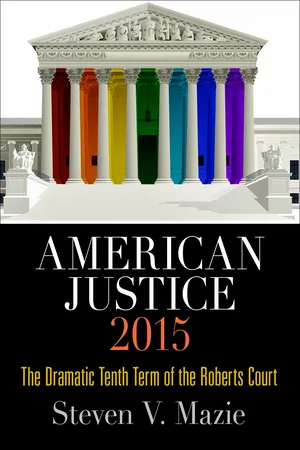
American Justice 2015: The Dramatic Tenth Term of the Roberts Court is the indispensable guide to the most controversial and divisive cases decided by the Supreme Court in the 2014-15 term. Steven Mazie, Supreme Court correspondent for The Economist, examines the term's fourteen most important cases, tracing the main threads of contention and analyzing the expected impacts of the decisions on the lives of Americans. Legal experts and law students will be drawn to the lively summaries of the issues and arguments, while scholars and theorists will be engaged and provoked by the book's elegant introduction, in which Mazie invokes John Rawls's theory of "public reason" to defend the institution of the Supreme Court against its many critics.Mazie contends that the Court is less ideologically divided than most observers presume, issuing many more unanimous rulings than 5-4 decisions throughout the term that concluded in June 2015. When ruling on questions ranging from marriage equality to freedom of speech to the Affordable Care Act, the justices often showed a willingness to depart from their ideological fellow travelers—and this was particularly true of the conservative justices. Chief Justice Roberts joined his liberal colleagues in saving Obamacare and upholding restrictions on personal solicitation of campaign funds by judicial candidates. Justice Samuel Alito and the chief voted with the liberals to expand the rights of pregnant women in the workplace. And Justice Clarence Thomas floated to the left wing of the bench in permitting Texas to refuse to print a specialty license plate emblazoned with a Confederate flag. American Justice 2015 conveys, in clear, accessible terms, the arguments, decisions, and drama in these cases, as well as in cases involving Internet threats, unorthodox police stops, death-penalty drugs, racial equality, voting rights, and the separation of powers.
- 180 pages
- English
- ePUB (mobile friendly)
- Available on iOS & Android
eBook - ePub
About this book
Information
Publisher
University of Pennsylvania PressYear
2015Print ISBN
9780812248067
9780812248067
eBook ISBN
9780812292275
Chapter 1
Freedom of Religion: The Religious Liberty of Inmates and Employees
Holt v. Hobbs; Equal Employment Opportunity Commission v. Abercrombie & Fitch Stores
It was the year of the Muslim at the Supreme Court. During October Term 2013, conservative Christians won Supreme Court battles over the constitutionality of monthly town-board prayers (Town of Greece v. Galloway) and the enforceability of the Affordable Care Act’s contraceptive mandate on certain religious employers (Burwell v. Hobby Lobby). But in October Term 2014, American Catholics and evangelical Protestants had no religious-liberty cases before the justices. (They did win Reed v. Town of Gilbert, a case involving municipal sign regulations, but that concerned the freedom of speech.) Instead, in OT 2014, the religious beliefs of two American Muslims took center stage.
The individuals in question could not be more different. Samantha Elauf was a seventeen-year-old Oklahoma woman whose traditional headscarf, or hijab, cost her a job at a kids’ branch of clothing retailer Abercrombie & Fitch in 2008. Gregory Holt, who adopted the name Abdul Maalik Muhammad after his conversion to Islam in 2011, was serving time in an Arkansas prison for stabbing his girlfriend in the course of an altercation between the two. He claimed that the prison’s grooming policy prevented him from fulfilling a religious duty to grow a beard. Neither Elauf nor Holt relied on the First Amendment’s free exercise clause to stake their claims. Elauf’s case was one of employment discrimination, focused on the meaning of Title VII of the Civil Rights Act of 1964, while Holt brought his complaint under the Religious Land Use and Institutionalized Persons Act (RLUIPA), a law Congress passed unanimously in 2000 to protect prisoners and churches from behavioral rules and zoning regulations that impinged on their religious interests.
Holt v. Hobbs
On October 7, the second day of oral arguments in October Term 2014, the Supreme Court heard its first religious liberty case since recognizing the right of pious employers to deny birth control coverage to their employees in Burwell v. Hobby Lobby the previous June. At issue was whether the grooming policy at the Arkansas Department of Corrections, which regards beards as “opportunities for disguise and for transport of contraband and weapons,” violated RLUIPA, which says that prisons may only prohibit inmates’ religious conduct if there is a “compelling governmental interest” at stake and they use the “least restrictive means” of doing so.
In light of the quarter-inch beards Arkansas permits for inmates with dermatological problems and noting that forty-four other state and federal prison systems allow their inmates to grow beards, Holt’s lawyer, Douglas Laycock, an expert in religious liberty and a professor at the University of Virginia law school, contended the state had no good reason to fight the stubble. While prison officials are due a degree of deference, he argued, they need to provide “a reasoned and well-considered and informed explanation” for policies that interfere with inmates’ rights. After a relatively smooth turn for Laycock, David Curran, the deputy attorney general of Arkansas, took the lectern. It was clear early in his thirty minutes that Curran would have a tough time defending the prison’s policy.
Justice Alito, the court’s staunchest defender of the freedom of religious exercise, proved to be Curran’s toughest questioner. In 1999, seven years before he was promoted to the Supreme Court by President George W. Bush, Alito issued a decision as a judge on the Third Circuit Court of Appeals that spoke directly to the issue in Holt. Then-judge Alito ruled that the Newark police department could not prevent two Muslim officers from growing beards for religious reasons. Given that the officers with medical justifications were permitted to grow beards, Alito wrote, “[w]e are at a loss to understand why religious exemptions threaten important city interests but medical exemptions do not.” The department policy, he ruled, “cannot be sustained.”
Given this, Curran should have been better prepared for Justice Alito’s sharp questioning. He took aim first at Curran’s contention that shifting facial hair patterns make prisoners dangerously unrecognizable to prison officials. When Curran warned that with an option to grow a beard, “an inmate could get into the barracks where he is not supposed to be” after working out in the fields, Justice Alito traced the highly unlikely sequence of events that would facilitate such a ruse: “While he’s out there, he shaves, then he wants to come back and go into barracks B. And how’s he going to get into barracks B if he has an ID that says barracks A? Now you say he’s going to trade with another prisoner? Then he will have a different picture on the ID . . . they’re going to alter the IDs also while they’re out there in the fields?” In response, Curran could only say, “Prisoners are capable of doing a lot of mischief in prison.”
Next, Justice Alito dove into the contraband rationale for the policy. Here Curran seemed almost embarrassed by his own brief’s contention that half-inch beards provided prisoners with handy places to stash darts, razors, and SIM cards. “[W]hy can’t the prison just give the inmate a comb?” Justice Alito proposed, drawing laughter in the courtroom. “If there’s a SIM card in there or . . . a tiny revolver . . . it’ll fall out.”
After the oral argument, the question was not whether Holt would prevail but if there were any justices willing to vote against him. The answer came on January 20, 2015. In a unanimous decision, the court ruled that although RLUIPA “affords prison officials ample ability to maintain security,” it requires officials to demonstrate that a rule substantially burdening an inmate’s religion is actually necessary. “The Department has failed to show,” Justice Alito’s opinion read, “that its policy is the least restrictive means of furthering its compelling interests.”
The analysis in the Holt decision was clear and straightforward; Justice Alito’s opinion ran a modest sixteen pages. The direct implications were not very far-reaching: the case liberates inmates in six states to grow religiously inspired half-inch beards. So a few pious incarcerated whiskers may see the light of day as a result. The case has broader significance, however.
Justice Alito’s opinion clarifies the rather extraordinary expansion of religious liberty that has occurred under RLUIPA—both for inmates and for their odd-bedfellow statutory cousins, religious institutions. And it reinforces the breadth of the “compelling interest test” that RLUIPA shares with the Religious Freedom Restoration Act (RFRA), the 1993 statute under which religious corporations, in the Hobby Lobby ruling, won an exemption from Obamacare’s contraceptive mandate.
This pair of religious rights laws was passed in the wake Employment Division v. Smith, a deeply unpopular Supreme Court ruling from 1990 in which Justice Scalia significantly dialed back the protections available to individuals under the Constitution’s free exercise clause. In Smith, Alfred Smith and Galen Black had lost their jobs at a drug rehabilitation facility for taking peyote, a hallucinogenic drug, during their (off-the-job) Native American Church rites. When Smith and Black applied for unemployment compensation, Oregon turned them down on the grounds that they had been fired for misconduct. The men then sued, winning in the Oregon Supreme Court but ultimately losing in the US Supreme Court. Justice Scalia’s majority opinion stated that neutral laws of general applicability—like Oregon’s drug statutes—are not unconstitutional since they do not treat religious beliefs or rituals differently from similar acts done for secular reasons. While states may offer religious exemptions to generally applicable laws, Justice Scalia wrote, they need not do so.
The reaction from Congress was swift and decisive. RFRA, passed unanimously in the House and by a vote of 97–3 in the Senate, restored the broader protections that reigned in the nearly three decades bookended by Sherbert v. Verner, the 1963 case laying out the “compelling interest” test, and Smith. But RFRA soon faced challenges of its own, and in 1997, the Supreme Court ruled, in City of Boerne v. Flores, that the law was unconstitutional as applied to state and local governments. Section 5 of the Fourteenth Amendment, Justice Anthony Kennedy wrote for the 6–3 majority, did not authorize Congress to enact such restrictions against the states. To partially repair the hole left by City of Boerne, Congress then passed RLUIPA to protect prisoners and religious institutions.
Justice Ginsburg signed on to Justice Alito’s opinion in Holt but wrote separately to distinguish Holt’s request to grow a beard from Hobby Lobby’s request for an exemption from the contraceptive mandate of the Affordable Care Act in Burwell v. Hobby Lobby. In Hobby Lobby, on the final day of October Term 2013, the owners of the crafts store were granted the exemption by a 5–4 vote. As evangelical Christians, David Green and his family members asserted that they could not, in good conscience, pay to supply their employees with birth control devices and drugs they considered to be abortifacients. Justice Ginsburg filed a fiery, full-throated dissent in Hobby Lobby. Her central contention was that the majority refused to consider “the impact that accommodation may have on third parties who do not share the corporation owners’ religious faith.” So in Holt v. Hobbs, she felt the need to explain why beards in prison are different from contraceptive coverage at work. “Unlike the exemption this Court approved in Burwell v. Hobby Lobby Stores,” she wrote, “accommodating petitioner’s religious beliefs in this case would not detrimentally affect others who do not share petitioner’s beliefs.”
Part of the court’s investigation in considering whether to grant religious exemptions from generally applicable laws, as in Hobby Lobby, or from prison grooming regulations, as in Holt, is whether and in what way the accommodation will impact the lives of other people. No one suffers when Holt lets his stubble grow a bit. But when a corporation with twenty-three thousand employees refuses to provide a benefit available under federal law, thousands of women are directly impacted. In the typical case, they would have to buy their own birth control pills or shell out $1,000 for an IUD. The Hobby Lobby majority maintained that this was not the typical case, because the government had already devised a reliable means for providing free contraception to all female employees without requiring the employer to pay for it, contract for it, or arrange for it. The impact on employees, according to the majority, would be “precisely zero,” though the dissenters did not see it that way.
In a case from 1985, Estate of Thornton v. Caldor, Inc., the Supreme Court struck down a law granting every employee the right not to come in to work on his or her Sabbath. This law, the justices found, constituted a “substantial burden” on employers, who had to offer higher pay to persuade workers to come in on the weekend. And it represented a “significant burden” on nonreligious employees who had to fill in for their Sabbath-observant colleagues: “The unyielding weighting in favor of Sabbath observers over all other interests contravenes a fundamental principle of the Religion Clauses: the First Amendment gives no one the right to insist that in pursuit of their own interests others must conform their conduct to his own religious necessities.”
Ian Millhiser overstated things when he wrote at Think Progress that Justice Ginsburg’s Holt concurrence, in line with the reasoning in Caldor, is “everything you need to know about religious liberty.” While there are cases like Hobby Lobby and Holt in which an accommodation either does or doesn’t bring harm to third parties, there are plenty of cases that are more difficult to classify.
No one appears to be harmed when a Seventh-Day Adventist gets an unemployment check after being fired for refusing to come to work on Saturday. But think again: taxpayers foot that bill. And it’s not quite true that nobody is negatively affected when the Amish win an exemption from mandatory schooling laws after the eighth grade, as they did in Wisconsin v. Yoder in 1972. What about the children who have their education (and therefore career and life opportunities) cut short? And what about the wider society, which may benefit if talented Amish people opt for a life outside the church? Should the interests of these third parties factor into the analysis when religious people request exemptions?
Not all impacts on third parties, like adding a penny to everybody’s tax bill in order accommodate the Seventh-Day Adventist, are specific or onerous enough to be truly worrisome. But it is hard to pinpoint at which stage the burden becomes a problem worth worrying about. Those seeking clarity for future claims of religious free exercise will not find it in Justice Ginsburg’s haiku-like concurrence in Holt. Nor will they reach a clear answer by studying the majority opinions in Holt or Hobby Lobby. But moving forward, it seems clear that the accommodations of religious individuals’ special requests under RFRA and RLUIPA will be uneasy and may conflict with another provision from the First Amendment: the establishment clause, which prohibits official state support for religion and preferential treatment for religious people. As Brooklyn Law School professor Nelson Tebbe said in his testimony before the House Judiciary Committee on February 13, 2015, “Costs incurred by protecting religious liberty should be paid by the government or the public, not by other private citizens.” Professor Tebbe recommends that RFRA and RLUIPA be amended to clarify that they do not sanction accommodations for corporate entities or exemptions that “would result in meaningful harm to identifiable third parties.”
EEOC v. Abercrombie & Fitch Stores
Samantha Elauf was seventeen when, in 2008, she applied for a job selling children’s clothes at a branch of Abercrombie Kids in Tulsa, Oklahoma. Elauf had begun wearing a “hijab,” the traditional Muslim headscarf, a few years earlier, and she wore it to her Abercrombie interview, along with jeans and a t-shirt. The meeting went well, and Elauf earned solid marks from Heather Cooke, the interviewer, for the categories “appearance and sense of style,” “outgoing and promotes diversity,” and “sophistication and aspiration.” Her scores were high enough to secure the job.
But when Cooke mentioned Elauf’s black headscarf to a manager, she was instructed to lower the applicant’s “appearance” score and deny her the position. The company’s “look policy,” which requires employees to adopt the “preppy look of the Ivy League,” bars them from wearing “caps” or black clothing. A friend of Elauf had mentioned the look policy to her before her interview, but Abercrombie never told her that her headscarf violated the rules.
Elauf turned to the Equal Employment Opportunity Commission (EEOC), which sued the store on her behalf. A federal district court in Oklahoma ruled that in refusing to hire Elauf because of her religious practice, Abercrombie had violated the rule in Title VII of the Civil Rights Act of 1964 barring employers from failing to hire someone because of “race, color, religion, sex or national origin.” On appeal, the Tenth Circuit court reversed and held for the company. The onus of offering a religious accommodation was not on Abercrombie, the Tenth Circuit held. If Elauf needed an exemption from the look policy, she should have asked for it—even if she didn’t know she needed it, because Abercrombie had not told her that her headscarf violated any policy.
The crux of the disagreement in Abercrombie involved whether the employee or the employer had the responsibility to initiate a discussion about religious accommodation. Does the job applicant have to alert the interviewer to religious beliefs or practices that conflict with workplace policies? Or must the employer proactively offer an exemption from those policies upon inferring that an applicant needs one unless, as the law says, doing so would pose “undue hardship” on the business? Abercrombie said that since Elauf did not explain the significance of her hijab or request an exception from the no-hats policy, the store was under no obligation to hire her. The company also contended that giving Elauf a pass on the policy would make it impossible to do business in the breezy, East Coast prep-school style that defined its merchandise.
In the oral argument on February 25, 2015, two unlikely allies, Justice Kagan and Justice Alito, teamed up to demonstrate exactly what was wrong with the store’s position. Justice Alito posed a reality-check hypothetical, calling into question Abercrombie’s faux-naive contention that it didn’t know Elauf would require a look-policy accommodation. “All right,” he began. “Let’s say four people show up for a job interview at Abercrombie. And this is going to sound like a joke, but, you know, it’s not. (Laughter.) So the first is a Sikh man wearing a turban, the second is a Hasidic man wearing a hat, the third is a Muslim woman wearing a hijab, the fourth is a Catholic nun in a habit. Now, do you think . . . that those people have to say, ‘We just want to tell you, we’re dressed this way for a religious reason. We’re not just trying to make a fashion statement?’”
Shay Dvoretzky, the company’s lawyer, could muster only a rather weak hedge: “One can certainly imagine cases in which it is more obvious than others that a particular . . . garb is likely worn for religious purposes.” And it wasn’t clear, he insisted to an incredulous Justice Alito, that Elauf’s headscarf really was a hijab. (Cooke’s testimony at the district court that she “figured that the headscarf signified that it was a religious headscarf,” as Deputy Solicitor General Ian Gershengorn said in his defense of the EEOC position, pretty clearly undercut Dvoretzky’s claim.) A few minutes later, Justice Alito sliced to the crux of the matter. “The reason that she was rejected,” he said to Dvoretzky, “was because you assumed she was going to do this every day and the only reason why she would do it every day is because she had a religious reason.”
Justice Kagan was just as cutting in her take-down of another of Dvoretzky’s argu...
Table of contents
- Cover
- Title Page
- Copyright Page
- Dedication
- Contents
- Preface
- Introduction. The Supreme Court on Trial
- 1. Freedom of Religion: The Religious Liberty of Inmates and Employees—Holt v. Hobbs; Equal Employment Opportunity Commission v. Abercrombie & Fitch Stores
- 2. Freedom of Speech: Threats, Judges, and License Plates—Elonis v. United States; Williams-Yulee v. Florida Bar; Walker v. Texas Division, Sons of Confederate Veterans
- 3. The Right to Privacy: Police Latitude in Traffic Stops—Heien v. North Carolina; Rodriguez v. United States
- 4. Cruel and Unusual Punishment: Death Penalty Drugs—Glossip v. Gross
- 5. Racial Equality: Disparate Impact Survives—Texas Department of Housing and Community Affairs v. Inclusive Communities Project
- 6. The Right to Vote: Race, Democracy, and Redistricting—Alabama Legislative Black Caucus v. Alabama; Arizona State Legislature v. Arizona Independent Redistricting Commission
- 7. Gender Equality: Pregnancy Discrimination in the Workplace—Young v. United Parcel Service
- 8. The Separation of Powers: Congress, the President, and Foreign Policy—Zivotofsky v. Kerry
- 9. The Fate of Obamacare: The ACA Survives, Again—King v. Burwell
- 10. Same-Sex Marriage: “Equal Dignity” and the Constitution—Obergefell v. Hodges
- Epilogue. Four Cases to Watch in October Term 2015
- Appendix. Biographies of Current Justices of the Supreme Court
Trusted by 375,005 students
Access to over 1.5 million titles for a fair monthly price.
Study more efficiently using our study tools.
Frequently asked questions
Yes, you can cancel anytime from the Subscription tab in your account settings on the Perlego website. Your subscription will stay active until the end of your current billing period. Learn how to cancel your subscription
No, books cannot be downloaded as external files, such as PDFs, for use outside of Perlego. However, you can download books within the Perlego app for offline reading on mobile or tablet. Learn how to download books offline
Perlego offers two plans: Essential and Complete
- Essential is ideal for learners and professionals who enjoy exploring a wide range of subjects. Access the Essential Library with 800,000+ trusted titles and best-sellers across business, personal growth, and the humanities. Includes unlimited reading time and Standard Read Aloud voice.
- Complete: Perfect for advanced learners and researchers needing full, unrestricted access. Unlock 1.5M+ books across hundreds of subjects, including academic and specialized titles. The Complete Plan also includes advanced features like Premium Read Aloud and Research Assistant.
We are an online textbook subscription service, where you can get access to an entire online library for less than the price of a single book per month. With over 1.5 million books across 990+ topics, we’ve got you covered! Learn about our mission
Look out for the read-aloud symbol on your next book to see if you can listen to it. The read-aloud tool reads text aloud for you, highlighting the text as it is being read. You can pause it, speed it up and slow it down. Learn more about Read Aloud
Yes! You can use the Perlego app on both iOS and Android devices to read anytime, anywhere — even offline. Perfect for commutes or when you’re on the go.
Please note we cannot support devices running on iOS 13 and Android 7 or earlier. Learn more about using the app
Please note we cannot support devices running on iOS 13 and Android 7 or earlier. Learn more about using the app
Yes, you can access American Justice 2015 by Steven V. Mazie in PDF and/or ePUB format, as well as other popular books in Law & Public Law. We have over 1.5 million books available in our catalogue for you to explore.