The New Deal left a host of political, institutional, and economic legacies. Among them was the restructuring of the government into an administrative state with a powerful executive leader and a large class of unelected officials. This "leviathan" state was championed by the political left, and its continued growth and dominance in American politics is seen as a product of liberal thought—to the extent that "Big Government" is now nearly synonymous with liberalism. Yet there were tensions among liberal statists even as the leviathan first arose. Born in crisis and raised by technocrats, the bureaucratic state always rested on shaky foundations, and the liberals who built and supported it disagreed about whether and how to temper the excesses of the state while retaining its basic structure and function.
Debating the American State traces the encounter between liberal thought and the rise of the administrative state and the resulting legitimacy issues that arose for democracy, the rule of law, and individual autonomy. Anne Kornhauser examines a broad and unusual cast of characters, including American social scientists and legal academics, the philosopher John Rawls, and German refugee intellectuals who had witnessed the destruction of democracy in the face of a totalitarian administrative state. In particular, she uncovers the sympathetic but concerned voices—commonly drowned out in the increasingly partisan political discourse—of critics who struggled to reconcile the positive aspects of the administrative state with the negative pressure such a contrivance brought on other liberal values such as individual autonomy, popular sovereignty, and social justice. By showing that the leviathan state was never given a principled and scrupulous justification by its proponents, Debating the American State reveals why the liberal state today remains haunted by programmatic dysfunctions and relentless political attacks.
eBook - ePub
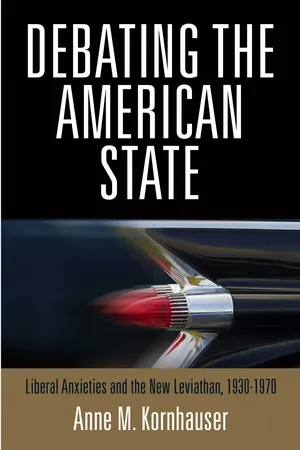
Debating the American State
Liberal Anxieties and the New Leviathan, 1930-1970
- 336 pages
- English
- ePUB (mobile friendly)
- Available on iOS & Android
eBook - ePub
About this book
Information
Publisher
University of Pennsylvania PressYear
2015Print ISBN
9780812246872
9780812246872
eBook ISBN
9780812291155
Chapter 1

Leviathan and Its Discontents
In response to ongoing concerns about the legitimacy of the administrative state, historians and scholars of American political development have sought the origins of the modern liberal state further and further back in time. The tacit premise behind this “myth of deep roots” is that the older the modern state, the more legitimate.1 As with the Commonwealth studies of the 1940s, historians today have looked for governmental intervention in the distant past to vindicate an active state in the present.2 Once a product of the New Deal, then constituted by the progressives’ “age of reform,” now the modern American state may increasingly be found in the interstices of the last several decades of the nineteenth century, in the beginnings of civil service reform and the establishment of the Interstate Commerce Commission of 1887.3
To start the story of the administrative state and its discontents in the 1930s is to chafe against the scholarly vogue, though it is hardly without precedent.4 When one looks at the state in its mature form and not simply at its gestation, it becomes clear that the state of the early twentieth century was not only smaller and less centralized but also of less moment than the state the New Deal liberals built. The hallmarks of the future administrative state were all present—the expansion of agency government, the concentration of executive power, the more limited use of formal law. Yet they were halting in their arrival, inconsistent in their application, and lacking in an unwavering commitment. During this initial age of reform, then, one can hear a few distant rumblings of concern from liberal state builders, and even these came in response to the first glimpse into the future of the administrative state that flashed before them during World War I.5 These pioneers began the liberal debate over the administrative state, but they were not definitive of it. That debate would arrive only in the 1930s when “the administrative system became a distinct locus of power . . . [a] source of political initiatives and problems.”6
The relative absence of unease among liberal state builders before the 1930s suggests that the administrative state did not present a conceptual or institutional problem to be solved much different from the long-standing skepticism about centralized power and bureaucratic mechanisms that permeated American political culture at various points in the country’s history.7 Until World War I, the old ways continued to compete with new administrative and regulatory institutions and norms: federalism remained largely untouched and the relations among the branches of government little changed. For example, President Theodore Roosevelt’s failed efforts to establish control over his government’s administrative agencies confirmed that the prevalent view in the early twentieth century still favored administrative accountability to the legislative branch, not to the executive.8Only in the 1930s would the new political bureaucracy have to be justified and explained, and only then would troubled liberals start to examine much more pointedly the threats that administrative governance posed to American constitutional democracy.
Although the progressives were determined and popular state builders, throughout the decades-long reform era that began in the 1880s and culminated in World War I, the crafting of the new leviathan proceeded in fits and starts, under three presidents, and at the state and local levels more than the federal.9 The wide berth of progressivism suggested a certain degree of chaos in the state-building process of the time, but it also revealed the powerful appeal of progressive ideas. The progressives created a truly “national regime” of reform politics.10 Broadly, progressives stood for ordering an increasingly pluralistic society, establishing controls over corporate capitalism, mitigating the social costs to modernization, and democratizing the polity and society.11 In addition, they believed fervently that scientific and social scientific knowledge ought to guide these endeavors.
Progressive intellectuals were much less certain about what kinds of institutions could achieve these goals. While they may have agreed that government “should actively pursue the public interest,” they had very little idea of how it might do so.12 Their ideas varied widely even within the mind of a single individual. Over the course of a few years, for example, Herbert Croly, the leading progressive thinker, changed his views about regulatory commissions, the relative importance of centralized government, and the mechanisms of direct democracy, such as the initiative and referendum. Walter Lippmann, a fellow journalist who with Croly produced much of progressive political thought, imagined a variety of vaguely constituted institutions that could educate Americans to steer the ship of state in a progressive direction. And in the wake of President Wilson’s unilateral decision to keep the United States out of World War I, both revised their commitment to democracy at all costs. Americans could not be a “self-governing people” when it came to their country’s very existence, they noted, approving of Wilson’s stance.13
The inchoate administrative state itself limited the progressive imagination. The idea that a centralized administration would become a governing branch unto itself, let alone one that would institutionally and normatively dominate all others, did not appear to be immanent in the state’s structure, even as a succession of presidents attempted various administrative reforms in the name of efficiency, the professionalization of government employees, and a more powerful executive branch. Although they embraced the idea of disinterested unelected officials as important to democratic governance, even the most nationalist of progressives, such as Croly, Lippmann, and Walter Weyl, could not fully imagine what their institutional role would be, how much power they would have in relation to Congress and the president, or how the public might gain access to them or they to the public.14 Some believed that administrative commissions would likely “disappear” absent a popularly agreed upon program for them to implement or if they proved “defective.” Others expected administrative officials’ newfound discretion to wane once ad hoc decisions congealed into more general rules that could be then inscribed in law.15
Intellectual and political presuppositions of the Progressive era also contributed to the erratic nature of administrative state building and the ambiguity of the administrative ideology necessary to sustain it. Several strains in progressive thought militated against systematic thinking about political institutions and thus—in contrast to the 1930s—a mature debate over the administrative state. First, many progressives were not sure how desirous they were of a highly bureaucratized central state, all the more so after World War I. Croly did not embrace centralized public power as an unalloyed virtue, fearing ill-advised interference in economic institutions, a threat to federalism, and the coerciveness of a concentrated bureaucracy.16 In many instances, progressive intellectuals found the soft coercion of moral suasion and education more appealing than the hard force of direct government intervention. As the political scientist Marc Stears has argued, the nationalist progressives were not “dedicated to any knee-jerk rejection or confirmation of the central state.” Instead, they were “committed to experimenting with a series of new political mechanisms in the search for an institutional settlement which would allow them to realize a series of more fundamental ideals.”17
Second, nationalist progressives conceived of administrative governance as an experiment. Therefore how and when to use it and how to constrain its power required further thought and investigation. As Croly observed well after Roosevelt had taken office, “No sufficient attention has yet been paid to the way in which [the administrative aspect of government] is to be modified. A prolonged period of investigation and experimentation will be necessary before a satisfactory reorganization can be carried out.”18 An additional ambiguity arose from the industrial economy. Large corporations were too new, their economic and social impact too unclear to know whether they should be regulated or, perhaps in some cases, taken over altogether. Both these policy choices would involve an expanding administrative state, but they would require very different kinds of institutions.
Finally, progressive intellectuals viewed the state instrumentally. This understanding of the state did not lead to any great interest in its inner workings. Political institutions existed to help citizens form the communal attachments necessary to sustain a democracy and to nurture the public good latent in the minds of the public.19 They ought not in themselves become the aim of statist politics. In fact, Lippmann complained that reformers were overly interested in the architectonics of politics and not enough in human character: They “concentrate attention on institutions and . . . slight men,” he lamented. “A small step further,” Lippmann shuddered, and “institutions become an end in themselves.”20 Instead, reformers should train their attention on the people who constructed these institutions. They mattered much more to a democratic society based on the public good than “the little mechanical devices of suffrage and primaries and tariffs.”21
The progressive state was an educative state, a shaper of individual character and the social environment, but also one heavily dependent on expertise. One tension that emerged for the nationalist progressives was that the strengthening of national unity and purpose presupposed a strengthening of national political institutions, the only ones, they believed, that could transcend party bosses and local interests. Conversely, a truly national public opinion could exert itself most effectively on national institutions.22 But aside from national elections, how might the public influence the course of the federal government? And which national mechanisms could fulfill the state’s educative and character building functions? Did it matter if they were coercive? That they sacrificed democratic participation or the rule of law ideal? How might the specialized expert administrators the progressives coveted capture the public imagination? These unanswered and often paradoxical questions help to explain why much progressive thinking about institutions focused on state and local institutions, for they were the most obvious vehicle for educating the public and responding to its will.
Without basic agreement among progressive intellectuals or politicians as to how to construct a centralized administrative state, its path was uncertain, and therefore concrete worries about its excesses or legitimacy were rare. “The growth of the federal administrative system has been comparatively slow and singularly free from oppressive features calculated to arouse public hostility or criticism,” one observer remarked.23 Even the Supreme Court, the bete noire of the early New Deal, did not seem much bothered by the progressives’ national undertakings, often permitting administrative discretion and the delegation of legislative power to bureaucrats in the executive branch.24 To be sure, many businessmen and Democrats scorned the new regulation and any hint of the centralization of government. A decade into the twentieth century one could find a handful of critical intellectuals, such as Nicholas Murray Butler, president of Columbia University, denouncing the “proposals to overturn our form of government.” But as Butler himself noted, there was little debate on such matters.25 That would change in the 1930s.
The Roots of American Bureaucracy?
While the growth of the administrative state can be traced to the last quarter of the nineteenth century, the singular commitment to the hegemony of the administrative form and its dominance within the American polity emerged only in the 1930s. For the first time, the federal government came to be associated primarily with administering and managing rather than legislating and judging. Administrative norms and practices—expertise, informal rule making as opposed to formal law, appointive rather than elective officials, the concentration of executive power, and hierarchical rather than deliberative decision making—pervaded the centralized state. All of these elements predated the New Deal, but a difference in degree can become a difference in kind. A search for the “origins” of the administrative state can obscure the degree of change by downplaying the state’s shifting contours and the state builders’ commitment to seeing their project through. The testimony of contemporaries points to the existence of both these factors in the 1930s. One may debate precisely what changed with the New Deal, but this much is certain: New Deal boosters and skeptics alike believed they were witnessing a transformative moment in American political development when effective political rule had come to be equated with administrative governance—hence its “hegemony.” The administrative state had become a full-fledged leviathan; its emergence represented the first major achievement of statist liberalism as well as its first major challenge.26
Precipitating the new liberal concerns about the administrative state was not only the growth and nature of that state, as it butted up against existing liberal democratic norms of democratic consent, the rule of law, and individual autonomy, but also the technocratic nature of the ideology that supported it.27 For ardent New Deal partisans, the state was essentially self-justifying, in part because they saw it as less an overbearing commander than a public servant fending off economic and geopolitical crises and fulfilling the public’s needs. If bureaucracy was required to effectuate the state’s new posture, then it was justifiable. Under this form of governance, New Dealers insisted, “administrative action is no longer an expression of the sovereign state oppressing individuals, through ‘bureaucratic’ action, but is the characteristic expression of the modem state seeking the welfare of the individual and of the society of which he is a component part.”28 Those who thought otherwise, those who saw threats to individual autonomy, democratic institutions, and legal norms, were reactionaries who had failed to change with the times. They misunderstood the form that the national gov...
Table of contents
- Cover
- Half title
- Title
- Copyright
- Dedication
- Contents
- Introduction
- Chapter 1. Leviathan and Its Discontents
- Chapter 2. Democracy and Accountability in the Administrative State
- Chapter 3. The Rule of Law When the State Goes to War
- Chapter 4. Liberal Democracy Conducts an Occupation and a War Crimes Tribunal
- Chapter 5. Individual Autonomy and the Modern American State: The Philosophy of John Rawls
- Epilogue
- Notes
- Index
- Acknowledgments
Trusted by 375,005 students
Access to over 1.5 million titles for a fair monthly price.
Study more efficiently using our study tools.
Frequently asked questions
Yes, you can cancel anytime from the Subscription tab in your account settings on the Perlego website. Your subscription will stay active until the end of your current billing period. Learn how to cancel your subscription
No, books cannot be downloaded as external files, such as PDFs, for use outside of Perlego. However, you can download books within the Perlego app for offline reading on mobile or tablet. Learn how to download books offline
We are an online textbook subscription service, where you can get access to an entire online library for less than the price of a single book per month. With over 1.5 million books across 990+ topics, we’ve got you covered! Learn about our mission
Look out for the read-aloud symbol on your next book to see if you can listen to it. The read-aloud tool reads text aloud for you, highlighting the text as it is being read. You can pause it, speed it up and slow it down. Learn more about Read Aloud
Yes! You can use the Perlego app on both iOS and Android devices to read anytime, anywhere — even offline. Perfect for commutes or when you’re on the go.
Please note we cannot support devices running on iOS 13 and Android 7 or earlier. Learn more about using the app
Please note we cannot support devices running on iOS 13 and Android 7 or earlier. Learn more about using the app
Yes, you can access Debating the American State by Anne M. Kornhauser in PDF and/or ePUB format, as well as other popular books in History & North American History. We have over 1.5 million books available in our catalogue for you to explore.