Liturgical Subjects examines the history of the self in the Byzantine Empire, challenging narratives of Christian subjectivity that focus only on classical antiquity and the Western Middle Ages. As Derek Krueger demonstrates, Orthodox Christian interior life was profoundly shaped by patterns of worship introduced and disseminated by Byzantine clergy. Hymns, prayers, and sermons transmitted complex emotional responses to biblical stories, particularly during Lent. Religious services and religious art taught congregants who they were in relation to God and each other.
Focusing on Christian practice in Constantinople from the sixth to eleventh centuries, Krueger charts the impact of the liturgical calendar, the eucharistic rite, hymns for vigils and festivals, and scenes from the life of Christ on the making of Christian selves. Exploring the verse of great Byzantine liturgical poets, including Romanos the Melodist, Andrew of Crete, Theodore the Stoudite, and Symeon the New Theologian, he demonstrates how their compositions offered templates for Christian self-regard and self-criticism, defining the Christian "I." Cantors, choirs, and congregations sang in the first person singular expressing guilt and repentence, while prayers and sermons defined the collective identity of the Christian community as sinners in need of salvation. By examining the way models of selfhood were formed, performed, and transmitted in the Byzantine Empire, Liturgical Subjects adds a vital dimension to the history of the self in Western culture.
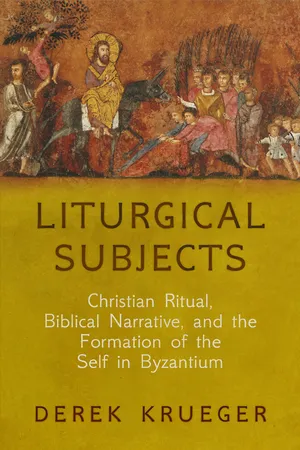
eBook - PDF
Liturgical Subjects
Christian Ritual, Biblical Narrative, and the Formation of the Self in Byzantium
- 324 pages
- English
- PDF
- Available on iOS & Android
eBook - PDF
Liturgical Subjects
Christian Ritual, Biblical Narrative, and the Formation of the Self in Byzantium
About this book
Information
Publisher
University of Pennsylvania PressYear
2014Print ISBN
9780812224108
9780812246445
eBook ISBN
9780812290158
Topic
Theology & ReligionSubtopic
History of ChristianityTable of contents
- Cover
- Title
- Copyright
- Contents
- Abbreviations and a Note on Texts
- Chapter 1. Shaping Liturgical Selves
- Chapter 2. Romanos the Melodist and the Christian Self
- Chapter 3. Calendar and Community in the Sixth Century
- Chapter 4. Eucharistic Prayers: Compunction and the History of Salvation
- Chapter 5. The Penitential Bible and the Great Kanon of Andrew of Crete
- Chapter 6. The Voice of the Sinner in First-Person Hymns of the Lenten Triodion
- Chapter 7. Liturgies of the Monastic Self in Symeon the New Theologian
- Conclusion. A Communion of Savable Sinners
- Notes
- Bibliography
- Index of Biblical Citations
- General Index
- Acknowledgments
Trusted by 375,005 students
Access to over 1.5 million titles for a fair monthly price.
Study more efficiently using our study tools.
Frequently asked questions
Yes, you can cancel anytime from the Subscription tab in your account settings on the Perlego website. Your subscription will stay active until the end of your current billing period. Learn how to cancel your subscription
No, books cannot be downloaded as external files, such as PDFs, for use outside of Perlego. However, you can download books within the Perlego app for offline reading on mobile or tablet. Learn how to download books offline
Perlego offers two plans: Essential and Complete
- Essential is ideal for learners and professionals who enjoy exploring a wide range of subjects. Access the Essential Library with 800,000+ trusted titles and best-sellers across business, personal growth, and the humanities. Includes unlimited reading time and Standard Read Aloud voice.
- Complete: Perfect for advanced learners and researchers needing full, unrestricted access. Unlock 1.5M+ books across hundreds of subjects, including academic and specialized titles. The Complete Plan also includes advanced features like Premium Read Aloud and Research Assistant.
We are an online textbook subscription service, where you can get access to an entire online library for less than the price of a single book per month. With over 1.5 million books across 990+ topics, we’ve got you covered! Learn about our mission
Look out for the read-aloud symbol on your next book to see if you can listen to it. The read-aloud tool reads text aloud for you, highlighting the text as it is being read. You can pause it, speed it up and slow it down. Learn more about Read Aloud
Yes! You can use the Perlego app on both iOS and Android devices to read anytime, anywhere — even offline. Perfect for commutes or when you’re on the go.
Please note we cannot support devices running on iOS 13 and Android 7 or earlier. Learn more about using the app
Please note we cannot support devices running on iOS 13 and Android 7 or earlier. Learn more about using the app
Yes, you can access Liturgical Subjects by Derek Krueger in PDF and/or ePUB format, as well as other popular books in Theology & Religion & History of Christianity. We have over 1.5 million books available in our catalogue for you to explore.