The years following the Great Awakening in New England saw a great theological struggle between proponents of Calvinism and the champions of Christian liberty, setting the stage for American Unitarianism. The adherents of Christian liberty, who were branded Arminians by their opponents, were contending for the liberty of the mind and the soul to pursue truth and salvation free from prior restraint.
The Arminian movement took shape as a major, quasi-denominational force in New England under the guidance of particular clergymen, most notably Ebenezer Gay, minister of the First Parish in Hingham, Massachusetts, from 1718 to 1787. Despite his ubiquitous presence in the history of Arminianism, however, Gay has been a historical enigma. Robert J. Wilson's purpose in this biography is to trace Gay's long and fascinating intellectual odyssey against the evolving social, political, and economic life of eighteenth-century Hingham as well as the religious history of the coastal region between Boston and Plymouth.
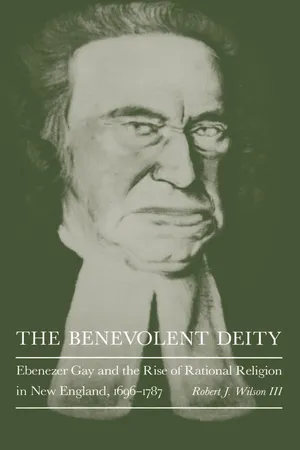
eBook - ePub
The Benevolent Deity
Ebenezer Gay and the Rise of Rational Religion in New England, 1696-1787
- 328 pages
- English
- ePUB (mobile friendly)
- Available on iOS & Android
eBook - ePub
The Benevolent Deity
Ebenezer Gay and the Rise of Rational Religion in New England, 1696-1787
About this book
Information
Publisher
University of Pennsylvania PressYear
2015Print ISBN
9780812278910
9780812278910
eBook ISBN
9781512809480
Topic
Theology & ReligionSubtopic
Religious BiographiesNotes

Abbreviations to Notes
HCRThe records of the First Church and Parish in Hingham; deposited with the Massachusetts Historical Society. The material is organized in forty-nine books and boxes, and covers the period from 1635 to 1958.
MHSThe Massachusetts Historical Society.
PROLOGUE
1. Claude M. Newlin, Philosophy and Religion in Colonial America (New York, 1962), 140; Charles W. Akers, Called unto Liberty: A Life of Jonathan Mayhew, 1720–1766 (Cambridge, Mass., 1964), 79.
2. Alan Heimert, Religion and the American Mind: From the Great Awakening to the Revolution (Cambridge, Mass., 1966), 209.
3. Charles F. Adams, ed. The Works of John Adams, 10 vols. (Boston, 1850–56), 10:287–88; Sydney Howard Gay to Solomon Lincoln, New York, November 7, 1861 (Courtesy of John P. Richardson of Hingham); Samuel A. Eliot, ed., Heralds of a Liberal Faith (Boston, 1910), 2; Clifford K. Shipton, ed., Sibley’s Harvard Graduates (Boston, 1942), 6:62.
4. Ebenezer Gay, The Mystery of the Seven Stars in Christ’s Right Hand (Boston, 1752), 19.
5. Ebenezer Gay, A Beloved Disciple of Jesus Christ Characterized (Boston, 1766), 10–11.
6. Ebenezer Gay, The Character and Work of a Good Ruler, and the Duty of an Obliged People (Boston, 1745), 26.
CHAPTER I
Dedham
1. Ebenezer Gay, St. John’s Vision of the Woman Cloathed with the Sun (Boston, 1766), 27–28; Frederick Lewis Gay, John Gay of Dedham, Massachusetts, and Some of His Descendants (Boston, 1879), 4.
2. The classic study of the social history of early Dedham is Kenneth A. Lockridge’s A New England Town: The First Hundred Years (New York, 1970).
3. Frank Smith, A History of Dedham, Massachusetts (Dedham, 1936), 169; F. L. Gay, John Gay, 4, 5; Don Gleason Hill, ed., The Early Records of the Town of Dedham, Mass., 1635–1706 (Dedham, 1899), 5:149; Julius H. Tuttle, ed., Early Records of Dedham, 1706–1736 (Dedham, 1936), 6:188.
4. F. L. Gay, John Gay, 4; Estate of Nathaniel Gay, Sr., 1712, Suffolk County Registry of Probate, #3391; Ebenezer Gay to Frederick L. Gay, Boston, February 3, 1879 (New England Historical and Genealogical Society). The name Ebenezer means a stone erected to God in thankfulness for his help. Since the name does not seem to occur in the Gay family before this point, it provides another indication that Nathaniel may have set aside this child from birth as a sort of living tithe.
5. Ebenezer Gay, A Call from Macedonia (Boston, 1768), 27. For one assessment of the impact of a major commercial road intruding into a village, see Paul Boyer and Stephen Nissenbaum, Salem Possessed: The Social Origins of Witchcraft (Cambridge, Mass., 1974), 100–102.
6. F. L. Gay, John Gay, 3; Lockridge, A New England Town, 61; Smith, History of Dedham, 3–4, 8, 20; Robert C. Anderson, “A Note on the Gay-Borden Families in Early New England,” New England Historical and Genealogical Register 130 (January 1976): 35–39. John Gay (possibly with a father also named John) arrived in the New World in 1630, settling in Watertown. He was descended from an old Norman family, but the pre-migration genealogy of the Gays is obscure.
7. Middlesex County Court Records, Folder 51–54; Hill, Early Records of Dedham 5:161, 230, 237, 250, 286.
8. Burgis Pratt Starr, A History of the Starr Family (Hartford, 1879), 6–9; Erastus Worthington, The History of Dedham: 1635–1827 (Boston, 1827), 42, 49, 50; Proceedings of the Two Hundred and Fiftieth Anniversary of the Incorporation of the Town of Dedham, Mass. (Cambridge, Mass., 1887), 64–65; Lockridge, A New England Town, 45; Edward Johnson, Wonder-Working Providence, 1628–1651, ed. J. Franklin Jameson (New York, 1910), 143. In his will, Eleazer Lusher bequeathed “to Liddia Starre, the daughter of my wife’s sister, who hath lived with me from her infancy, £100.” See Frederick Lewis Gay, “Lusher Wills,” Dedham Historical Register 2 (October 1891): 132.
9. Edward M. Cook, Jr., “Social Behavior and Changing Values in Dedham, Massachusetts, 1700–1775,” William and Mary Quarterly, 3d ser., 27 (1970): 562–63; Lusher Gay to Mary Gay Ballantine, Dedham, January 5, 1742 (Kent Memorial Library, Suffield, Conn.); F. L. Gay, John Gay, 6, 9.
10. Cook, “Social Behavior in Dedham,” 561–63; Will of John Gay, December 18, 1686, Howe Family Papers (MHS); Lockridge, A New England Town, 103–6, 111–14.
11. Cook, “Social Behavior in Dedham,” 559–63; Samuel Dexter Diary (Dedham Historical Society), 300. See also George Willis Cooke, A History of the Clapboard Trees or Third Parish, Dedham, Massachusetts (Boston, 1887).
12. Hill, Early Records of Dedham 5:238; Smith, History of Dedham, 52–55, 384. The house presently known as the Timothy Gay Tavern stands on the old Nathaniel Gay home lot, and a portion of Nathaniel’s dwelling may be incorporated in the present structure.
13. Lockridge, A New England Town, 86–87; Clifford K. Shipton, ed., Sibley’s Harvard Graduates (Cambridge, Mass., 1933), 4:28, 29; Cook, “Social Behavior in Dedham,” 560.
14. Ebenezer Burgess, ed., Dedham Pulpit (Boston, 1840), 167, 169.
15. Shipton, Sibley’s Harvard Graduates (Boston, 1937), 5:512–14.
16. Ibid., 515.
17. Samuel Eliot Morison, The Intellectual Life of Colonial New England, 2d. ed. (New York, 1956), 68, 105–6, 110–11; Estate of Nathaniel Gay, Sr.
CHAPTER II
Harvard
1. Perry Miller, The New England Mind: From Colony to Province (Cambridge, Mass., 1953), 455. The term “Latitudinarian” refers to those English Churchmen who embraced a reasonable faith, avoiding thorny dogmatic questions whenever possible. Led by Archbishop Tillotson in the 1690s, they were concerned principally with virtue and man’s moral obligations.
2. For two discussions of the Leverett administration at Harvard, and the various conflicts with the Mathers, see chap. 4, “The Great Leverett” in Samuel Eliot Morison’s Three Centuries of Harvard: 1636–1936 (Cambridge, Mass., 1936), 53–75; also chap. 27, “The Death of an Idea” in Miller’s Colony to Province, 447–63. Most of the clerical support for Leverett, with the exceptions of Colman and the Reverend Benjamin Wadsworth, came from outside Boston.
3. Cotton Mather, Magnalia Christi Americana: or, the Ecclesiastical History of New England, 1st Amer. ed. (Hartford, 1820), vol. 2, bk. 4, pt. 1, 16; Morison, Harvard, 31; Benjamin Rand, “Philosophical Instruction in Harvard University from 1636 to 1900,” Harvard Graduates Magazine 37 (1928–29):32.
4. Clifford K. Shipton, ed., Sibley’s Harvard Graduates (Cambridge, Mass., 1933), 4:163, 165, 300–303, 533.
5. Morison, Harvard, 54, 64.
6. Morison, Harvard, 26–27; Shipton, Sibley’s Harvard Graduates (Boston, 1942), 6:6–7, 59. In Clifford Shipton’s introduction to the Class of 1714, he observed that the class ranking “cannot be explained by what we know of the social standing, piety, or intellectual promise of the students.”
7. Morison, Harvard, 29–30; Massachusetts Gazette, March 30, 1787.
8. Morison, Harvard, 29–30; Rand, “Philosophical Instruction,” 32; Claude M. Newlin, Philosophy and Religion in Colonial America (New York, 1962), 6–7; Joseph J. Ellis, The New England Mind in Transition: Samuel Johnson of Connecticut, 1696–1772 (New Haven, 1973), 56; Perry Miller, in The New England Mind: The Seventeenth Century (New York, 1939), discussed the seemingly unlikely affinity of the Dialecticae of Petrus Ramus with the world of the Enlightenment. See Miller’s c...
Table of contents
- Cover
- Half title
- Title
- Copyright
- Dedication
- Contents
- Illustrations
- Prologue
- I Dedham
- II Harvard
- III Hingham: The Early Years
- IV The Great Noise About Arminianism
- V The Great Awakening: The Noisy Passions A-Float
- VI The Great Awakening: The Captain Kept His Place
- VII Pure and Undefiled Religion
- VIII A Benevolent Planet with His Satellites
- IX The Father of Lights
- X Family and Community: The Arminian Patriarch in Changing Times
- XI A Rank Tory
- XII The Old Man’s Calendar
- Notes
- Selected Bibliography
- Appendices
- Index
Trusted by 375,005 students
Access to over 1.5 million titles for a fair monthly price.
Study more efficiently using our study tools.
Frequently asked questions
Yes, you can cancel anytime from the Subscription tab in your account settings on the Perlego website. Your subscription will stay active until the end of your current billing period. Learn how to cancel your subscription
No, books cannot be downloaded as external files, such as PDFs, for use outside of Perlego. However, you can download books within the Perlego app for offline reading on mobile or tablet. Learn how to download books offline
Perlego offers two plans: Essential and Complete
- Essential is ideal for learners and professionals who enjoy exploring a wide range of subjects. Access the Essential Library with 800,000+ trusted titles and best-sellers across business, personal growth, and the humanities. Includes unlimited reading time and Standard Read Aloud voice.
- Complete: Perfect for advanced learners and researchers needing full, unrestricted access. Unlock 1.5M+ books across hundreds of subjects, including academic and specialized titles. The Complete Plan also includes advanced features like Premium Read Aloud and Research Assistant.
We are an online textbook subscription service, where you can get access to an entire online library for less than the price of a single book per month. With over 1.5 million books across 990+ topics, we’ve got you covered! Learn about our mission
Look out for the read-aloud symbol on your next book to see if you can listen to it. The read-aloud tool reads text aloud for you, highlighting the text as it is being read. You can pause it, speed it up and slow it down. Learn more about Read Aloud
Yes! You can use the Perlego app on both iOS and Android devices to read anytime, anywhere — even offline. Perfect for commutes or when you’re on the go.
Please note we cannot support devices running on iOS 13 and Android 7 or earlier. Learn more about using the app
Please note we cannot support devices running on iOS 13 and Android 7 or earlier. Learn more about using the app
Yes, you can access The Benevolent Deity by Robert J. Wilson III in PDF and/or ePUB format, as well as other popular books in Theology & Religion & Religious Biographies. We have over 1.5 million books available in our catalogue for you to explore.