Before 1882, the U.S. federal government had never formally deported anyone, but that year an act of Congress made Chinese workers the first group of immigrants eligible for deportation. Over the next forty years, lawmakers and judges expanded deportable categories to include prostitutes, anarchists, the sick, and various kinds of criminals. The history of that lengthening list shaped the policy options U.S. citizens continue to live with into the present.
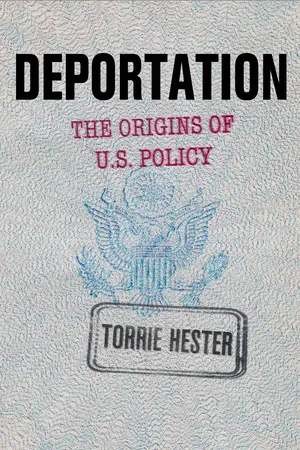
Deportation covers the uncertain beginnings of American deportation policy and recounts the halting and uncoordinated steps that were taken as it emerged from piecemeal actions in Congress and courtrooms across the country to become an established national policy by the 1920s. Usually viewed from within the nation, deportation policy also plays a part in geopolitics; deportees, after all, have to be sent somewhere. Studying deportations out of the United States as well as the deportation of U.S. citizens back to the United States from abroad, Torrie Hester illustrates that U.S. policy makers were part of a global trend that saw officials from nations around the world either revise older immigrant removal policies or create new ones.
A history of immigration policy in the United States and the world, Deportation chronicles the unsystematic emergence of what has become an internationally recognized legal doctrine, the far-reaching impact of which has forever altered what it means to be an immigrant and a citizen.
- 252 pages
- English
- PDF
- Available on iOS & Android
eBook - PDF
About this book
Information
Publisher
University of Pennsylvania PressYear
2017Print ISBN
9781512824766
9780812249163
eBook ISBN
9780812294026
Table of contents
- Cover
- Contents
- List of Abbreviations
- Introduction
- Chapter 1. Creating U.S. Deportation Policy
- Chapter 2. The International Regime
- Chapter 3. Deportation and Citizenship Status
- Chapter 4. From Protection to Punishment
- Chapter 5. The Limits of Deportation Power
- Chapter 6. From Racial to Economic Grounds
- Conclusion
- Notes
- Index
- Acknowledgments
Trusted by 375,005 students
Access to over 1.5 million titles for a fair monthly price.
Study more efficiently using our study tools.
Frequently asked questions
Yes, you can cancel anytime from the Subscription tab in your account settings on the Perlego website. Your subscription will stay active until the end of your current billing period. Learn how to cancel your subscription
No, books cannot be downloaded as external files, such as PDFs, for use outside of Perlego. However, you can download books within the Perlego app for offline reading on mobile or tablet. Learn how to download books offline
Perlego offers two plans: Essential and Complete
- Essential is ideal for learners and professionals who enjoy exploring a wide range of subjects. Access the Essential Library with 800,000+ trusted titles and best-sellers across business, personal growth, and the humanities. Includes unlimited reading time and Standard Read Aloud voice.
- Complete: Perfect for advanced learners and researchers needing full, unrestricted access. Unlock 1.5M+ books across hundreds of subjects, including academic and specialized titles. The Complete Plan also includes advanced features like Premium Read Aloud and Research Assistant.
We are an online textbook subscription service, where you can get access to an entire online library for less than the price of a single book per month. With over 1.5 million books across 990+ topics, we’ve got you covered! Learn about our mission
Look out for the read-aloud symbol on your next book to see if you can listen to it. The read-aloud tool reads text aloud for you, highlighting the text as it is being read. You can pause it, speed it up and slow it down. Learn more about Read Aloud
Yes! You can use the Perlego app on both iOS and Android devices to read anytime, anywhere — even offline. Perfect for commutes or when you’re on the go.
Please note we cannot support devices running on iOS 13 and Android 7 or earlier. Learn more about using the app
Please note we cannot support devices running on iOS 13 and Android 7 or earlier. Learn more about using the app
Yes, you can access Deportation by Torrie Hester in PDF and/or ePUB format, as well as other popular books in History & North American History. We have over 1.5 million books available in our catalogue for you to explore.