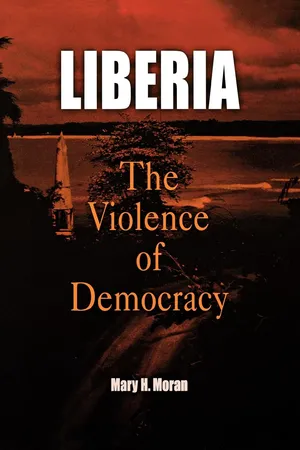
Liberia, a small West African country that has been wracked by violence and civil war since 1989, seems a paradoxical place in which to examine questions of democracy and popular participation. Yet Liberia is also the oldest republic in Africa, having become independent in 1847 after colonization by an American philanthropic organization as a refuge for "Free People of Color" from the United States. Many analysts have attributed the violent upheaval and state collapse Liberia experienced in the 1980s and 1990s to a lack of democratic institutions and long-standing patterns of autocracy, secrecy, and lack of transparency. Liberia: The Violence of Democracy is a response, from an anthropological perspective, to the literature on neopatrimonialism in Africa.
Mary H. Moran argues that democracy is not a foreign import into Africa but that essential aspects of what we in the West consider democratic values are part of the indigenous African traditions of legitimacy and political process. In the case of Liberia, these democratic traditions include institutionalized checks and balances operating at the local level that allow for the voices of structural subordinates (women and younger men) to be heard and be effective in making claims. Moran maintains that the violence and state collapse that have beset Liberia and the surrounding region in the past two decades cannot be attributed to ancient tribal hatreds or neopatrimonial leaders who are simply a modern version of traditional chiefs. Rather, democracy and violence are intersecting themes in Liberian history that have manifested themselves in numerous contexts over the years.
Moran challenges many assumptions about Africa as a continent and speaks in an impassioned voice about the meanings of democracy and violence within Liberia.
- 200 pages
- English
- ePUB (mobile friendly)
- Available on iOS & Android
eBook - ePub
About this book
Information
Table of contents
- Cover
- Title
- Copyright
- Contents
- Introduction: Liberia, Violence, and Democracy
- Chapter: 1. The Case for Indigenous Democracy
- Chapter: 2. Contested Histories
- Chapter: 3. Civilization and the Liberian Nation
- Chapter: 4. The Promise and Terror of Elections
- Chapter: 5. The Lock on the Outhouse Door: Discourses of Development
- Chapter: 6. The Crisis of Youth and the Promise of the Future
- Chapter: 7. Conclusion: A Wedding and a Funeral
- References
- Index
- Acknowledgments
Trusted by 375,005 students
Access to over 1.5 million titles for a fair monthly price.
Study more efficiently using our study tools.
Frequently asked questions
Yes, you can cancel anytime from the Subscription tab in your account settings on the Perlego website. Your subscription will stay active until the end of your current billing period. Learn how to cancel your subscription
No, books cannot be downloaded as external files, such as PDFs, for use outside of Perlego. However, you can download books within the Perlego app for offline reading on mobile or tablet. Learn how to download books offline
Perlego offers two plans: Essential and Complete
- Essential is ideal for learners and professionals who enjoy exploring a wide range of subjects. Access the Essential Library with 800,000+ trusted titles and best-sellers across business, personal growth, and the humanities. Includes unlimited reading time and Standard Read Aloud voice.
- Complete: Perfect for advanced learners and researchers needing full, unrestricted access. Unlock 1.5M+ books across hundreds of subjects, including academic and specialized titles. The Complete Plan also includes advanced features like Premium Read Aloud and Research Assistant.
We are an online textbook subscription service, where you can get access to an entire online library for less than the price of a single book per month. With over 1.5 million books across 990+ topics, we’ve got you covered! Learn about our mission
Look out for the read-aloud symbol on your next book to see if you can listen to it. The read-aloud tool reads text aloud for you, highlighting the text as it is being read. You can pause it, speed it up and slow it down. Learn more about Read Aloud
Yes! You can use the Perlego app on both iOS and Android devices to read anytime, anywhere — even offline. Perfect for commutes or when you’re on the go.
Please note we cannot support devices running on iOS 13 and Android 7 or earlier. Learn more about using the app
Please note we cannot support devices running on iOS 13 and Android 7 or earlier. Learn more about using the app
Yes, you can access Liberia by Mary H. Moran in PDF and/or ePUB format, as well as other popular books in Social Sciences & Democracy. We have over 1.5 million books available in our catalogue for you to explore.