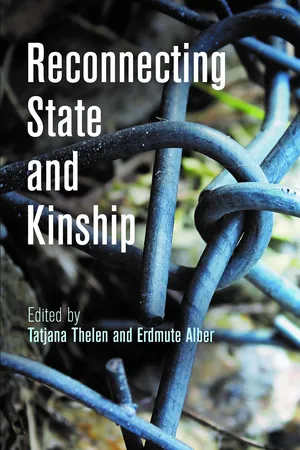
Within the social sciences, kinship and statehood are often seen as two distinct modes of social organization, sometimes conceived of as following each other in a temporal line and sometimes as operating on different scales. Kinship is traditionally associated with small-scale communities in stateless societies. The state, meanwhile, is viewed as a development away from kinship as political order toward rational, impersonal, and functional forms of rule. In recent decades, theoretical and empirical scholarship has challenged these notions, but the underlying presumption of a deep-rooted opposition between kinship and the (modern) state has remained surprisingly stable.
That this binary is so deeply engrained in Western self-understanding and knowledge production poses a considerable challenge to decoding their coproduction. Reconnecting State and Kinship seeks to trace the historical shifts and boundary work implied in the ongoing reproduction of these supposedly discrete or even opposing units of analysis. Contributors ask whether concepts associated with one sphere —including corruption, patronage, lineage, and incest—surface in the other. Policies and interventions modeled upon the assumed polarity can have lasting consequences for mechanisms of marginalization and exclusion, including decisions about life and death.
Reconnecting State and Kinship not only explores the boundary-related and classificatory practices that reinforce the kinship/statehood binary but also tracks the traveling of these concepts and their underlying norms through time and space ultimately demonstrating the ways that kinship and "the state" are intertwined.
Contributors: Erdmute Alber, Apostolos Andrikopoulos, Helle Bundgaard, Jeanette Edwards, Karen Fog Olwig, Victoria Goddard, Michael Herzfeld, Eirini Papadaki, Frances Pine, Ivan Rajković, Tatjana Thelen, Thomas Zitelmann.
- 257 pages
- English
- PDF
- Available on iOS & Android
eBook - PDF
Reconnecting State and Kinship
About this book
Information
Publisher
University of Pennsylvania PressYear
2017Print ISBN
9780812249514
9780812249514
eBook ISBN
9780812294415
Table of contents
- Cover
- Contents
- Reconnecting State and Kinship: Temporalities, Scales, Classifications
- Part I. Traveling Concepts: Temporalities, Scales, and the Making of Political Order
- Part II. Classifying Kinship and the Making of Citizens
- List of Contributors
- Index
- Acknowledgments
Trusted by 375,005 students
Access to over 1.5 million titles for a fair monthly price.
Study more efficiently using our study tools.
Frequently asked questions
Yes, you can cancel anytime from the Subscription tab in your account settings on the Perlego website. Your subscription will stay active until the end of your current billing period. Learn how to cancel your subscription
No, books cannot be downloaded as external files, such as PDFs, for use outside of Perlego. However, you can download books within the Perlego app for offline reading on mobile or tablet. Learn how to download books offline
Perlego offers two plans: Essential and Complete
- Essential is ideal for learners and professionals who enjoy exploring a wide range of subjects. Access the Essential Library with 800,000+ trusted titles and best-sellers across business, personal growth, and the humanities. Includes unlimited reading time and Standard Read Aloud voice.
- Complete: Perfect for advanced learners and researchers needing full, unrestricted access. Unlock 1.5M+ books across hundreds of subjects, including academic and specialized titles. The Complete Plan also includes advanced features like Premium Read Aloud and Research Assistant.
We are an online textbook subscription service, where you can get access to an entire online library for less than the price of a single book per month. With over 1.5 million books across 990+ topics, we’ve got you covered! Learn about our mission
Look out for the read-aloud symbol on your next book to see if you can listen to it. The read-aloud tool reads text aloud for you, highlighting the text as it is being read. You can pause it, speed it up and slow it down. Learn more about Read Aloud
Yes! You can use the Perlego app on both iOS and Android devices to read anytime, anywhere — even offline. Perfect for commutes or when you’re on the go.
Please note we cannot support devices running on iOS 13 and Android 7 or earlier. Learn more about using the app
Please note we cannot support devices running on iOS 13 and Android 7 or earlier. Learn more about using the app
Yes, you can access Reconnecting State and Kinship by Tatjana Thelen, Erdmute Alber, Tatjana Thelen,Erdmute Alber in PDF and/or ePUB format, as well as other popular books in Social Sciences & Anthropology. We have over 1.5 million books available in our catalogue for you to explore.