According to the received history, the Cistercian order was founded in Cîteaux, France, in 1098 by a group of Benedictine monks who wished for a stricter community. They sought a monastic life that called for extreme asceticism, rejection of feudal revenues, and manual labor for monks. Their third leader, Stephen Harding, issued a constitution, the Carta Caritatis, that called for the uniformity of custom in all Cistercian monasteries and the establishment of an annual general chapter meeting at Cîteaux.
The Cistercian order grew phenomenally in the mid-twelfth century, reaching beyond France to Portugal in the west, Sweden in the north, and the eastern Mediterranean, ostensibly through a process of apostolic gestation, whereby members of a motherhouse would go forth to establish a new house. The abbey at Clairvaux, founded by Bernard in 1115, was alone responsible for founding 68 of the 338 Cistercian abbeys in existence by 1153. But this well-established view of a centrally organized order whose founders envisioned the shape and form of a religious order at its prime is not borne out in the historical record.
Through an investigation of early Cistercian documents, Constance Hoffman Berman proves that no reliable reference to Stephen's Carta Caritatis appears before the mid-twelfth century, and that the document is more likely to date from 1165 than from 1119. The implications of this fact are profound. Instead of being a charter by which more than 300 Cistercian houses were set up by a central authority, the document becomes a means of bringing under centralized administrative control a large number of loosely affiliated and already existing monastic houses of monks as well as nuns who shared Cistercian customs. The likely reason for this administrative structuring was to check the influence of the overdominant house of Clairvaux, which threatened the authority of Cîteaux through Bernard's highly successful creation of new monastic communities.
For centuries the growth of the Cistercian order has been presented as a spontaneous spirituality that swept western Europe through the power of the first house at Cîteaux. Berman suggests instead that the creation of the religious order was a collaborative activity, less driven by centralized institutions; its formation was intended to solve practical problems about monastic administration. With the publication of The Cistercian Evolution, for the first time the mechanisms are revealed by which the monks of Cîteaux reshaped fact to build and administer one of the most powerful and influential religious orders of the Middle Ages.
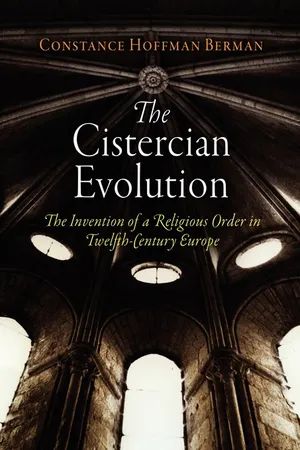
eBook - PDF
The Cistercian Evolution
The Invention of a Religious Order in Twelfth-Century Europe
- 407 pages
- English
- PDF
- Available on iOS & Android
eBook - PDF
The Cistercian Evolution
The Invention of a Religious Order in Twelfth-Century Europe
About this book
Information
Table of contents
- Cover
- Contents
- List of Tables and Illustrations
- Preface
- 1. Twelfth-Century Narratives and Cistercian Mythology
- 2. Charters, "Primitive Documents," and Papal Confirmations
- 3. From Cîteaux to the Invention of a Cistercian Order
- 4. Charters, Patrons, and Communities
- 5. Rewriting the History of Cistercians and Twelfth-Century Religious Reform
- Appendix One: Chronological Summary
- Appendix Two: "Primitive Documents" Manuscripts: Relevant Contents
- Appendix Three: Southern-French Cistercian Abbeys by Province and Diocese
- Appendix Four: Calixtus II Documents from 1119 and 1120
- Appendix Five: Restored 1170 Letter from Alexander III
- List of Abbreviations
- Notes
- Bibliography
- Index
Trusted by 375,005 students
Access to over 1.5 million titles for a fair monthly price.
Study more efficiently using our study tools.
Frequently asked questions
Yes, you can cancel anytime from the Subscription tab in your account settings on the Perlego website. Your subscription will stay active until the end of your current billing period. Learn how to cancel your subscription
No, books cannot be downloaded as external files, such as PDFs, for use outside of Perlego. However, you can download books within the Perlego app for offline reading on mobile or tablet. Learn how to download books offline
Perlego offers two plans: Essential and Complete
- Essential is ideal for learners and professionals who enjoy exploring a wide range of subjects. Access the Essential Library with 800,000+ trusted titles and best-sellers across business, personal growth, and the humanities. Includes unlimited reading time and Standard Read Aloud voice.
- Complete: Perfect for advanced learners and researchers needing full, unrestricted access. Unlock 1.5M+ books across hundreds of subjects, including academic and specialized titles. The Complete Plan also includes advanced features like Premium Read Aloud and Research Assistant.
We are an online textbook subscription service, where you can get access to an entire online library for less than the price of a single book per month. With over 1.5 million books across 990+ topics, we’ve got you covered! Learn about our mission
Look out for the read-aloud symbol on your next book to see if you can listen to it. The read-aloud tool reads text aloud for you, highlighting the text as it is being read. You can pause it, speed it up and slow it down. Learn more about Read Aloud
Yes! You can use the Perlego app on both iOS and Android devices to read anytime, anywhere — even offline. Perfect for commutes or when you’re on the go.
Please note we cannot support devices running on iOS 13 and Android 7 or earlier. Learn more about using the app
Please note we cannot support devices running on iOS 13 and Android 7 or earlier. Learn more about using the app
Yes, you can access The Cistercian Evolution by Constance Hoffman Berman in PDF and/or ePUB format, as well as other popular books in History & European Medieval History. We have over 1.5 million books available in our catalogue for you to explore.