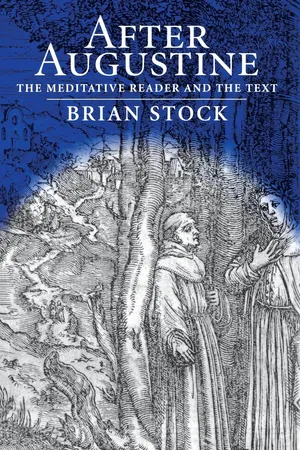
Augustine of Hippo was the most prolific and influential writer on reading between antiquity and the Renaissance, though he left no systematic treatise on the subject. His reluctance to synthesize his views on other important themes such as the sacraments suggests that he would have been skeptical of any attempt to bring his statements on reading into a formal theory. Yet Augustine has remained the point of reference to which all later writers invariably return in their search for the roots of problems concerning reading and interpretation in the West.
Using Augustine as the touchstone, Brian Stock considers the evolution of the meditative reader within Western reading practices from classical times to the Renaissance. He looks to the problem of self-knowledge in the reading culture of late antiquity; engages the related question of ethical values and literary experience in the same period; and reconsiders Erich Auerbach's interpretation of ancient literary realism.
In subsequent chapters, Stock moves forward to the Middle Ages to explore the attitude of medieval Latin authors toward the genre of autobiography as a model for self-representation and takes up the problem of reading, writing, and the self in Petrarch. He compares the role of the reader in Augustine's City of God and Thomas More's Utopia, and, in a final important move, reframes the problem of European cultural identity by shifting attention from the continuity and change in spoken language to significant shifts in the practice of spiritual, silent reading in the Middle Ages and Renaissance. A richly rewarding reflection on the history and nature of reading, After Augustine promises to be a centerpiece of discussions about the discovery of the self through literature.
- 144 pages
- English
- ePUB (mobile friendly)
- Available on iOS & Android
eBook - ePub
About this book
Information
Publisher
University of Pennsylvania PressYear
2013Print ISBN
9780812236026
9780812236026
eBook ISBN
9780812203042
Chapter One
Reading and Self-Knowledge
The late ancient and medieval periods inherited a number of techniques for dealing with the classical philosophical problem of self-knowledge. The theme of this chapter is the influence of the culture of reading on the transformation of these techniques.1
My major purpose is to address an issue that arises out of the thought of Augustine of Hippo. This is the connection between reading, the search for self-knowledge, and the writing of autobiography. Augustine raised fundamental questions concerning the use of ancient contemplative practices in his treatment of self-knowledge and self-expression. The first part of this chapter takes up these questions in the context of late ancient thought. The second part turns to response during the Middle Ages.
It is desirable, I believe, at the outset, to distance ourselves somewhat from the perspective on self-knowledge that has been created by the contemporary history of autobiography. Since the Romantic period, we have associated the questions of self-knowledge and self-representation with the writing of autobiographies. But the word “autobiography” appears to have been first employed in English by Richard Southey in 1809, and scholarly interest in the subject does not go back much beyond the nineteenth century.
One of the historians responsible for generating this interest was Jacob Burckhardt, who saw the appearance of first-person life histories in Renaissance Italy as a sign of renewed concern with individualism, in contrast to what he believed to be the collectivist mentality of the Middle Ages. Another influential figure who touched on the subject was Max Weber, who initially associated the early modern interest in the individual with the emphasis on self-examination in Protestantism, but later extended his research to other religions in an effort to characterize the features of Western “innerworldly asceticism.” Studies of biography and autobiography were deepened by the reflections of Wilhelm Dilthey, especially in his life of Schleiermacher, and by the several volumes of the Geschichte der Autobiographie undertaken by his son-in-law, Georg Misch, in 1900. Misch was indebted to Dilthey’s conception of das Leben as life experienced prior to conceptual knowledge and thought, an idea that found its way into the diverse approaches to self-knowledge in Bergson, Husserl, and Heidegger. Dilthey was preceded in this line of thought by Herder, Novalis, and Nietzsche, who believed that every great philosophy was in some sense the confession of its author. By the turn of the century, it was difficult to carry out an inquiry into self-knowledge without the accompanying notion that autobiographical writing was a privileged means of inquiring into that knowledge. Our time has seen a reaction against this type of thinking that Yves Bonnefoy has aptly called “les illusions du cogito.”
In general, ancient thinkers did not make a connection between the study of the self, the soul, or self-understanding and the composition of autobiographies. The very idea that the self could be configured adequately in a literary or artistic form was a subject of debate. Medieval students of self-knowledge did not write many autobiographies either, although first-person histories are found more frequently during the Middle Ages than in antiquity. It was only at the end of the medieval period, or, as some would prefer, on the eve of the Renaissance, that a clearly definable autobiographical tradition emerged in authors like Margery Kempe, Petrarch, Christine de Pizan, Benvenuto Cellini, and Jerome Cardano. Among ancient literary works the exception would appear to be Augustine’s Confessions, which is routinely taken as a point of departure in contemporary histories of autobiography. But the Confessions is not merely the bishop of Hippo’s self-portrait of his early years; the work also incorporates several ancient literary genres, among them a spiritual exercise, a story of conversion, a treatise on interpretation, and a guide to self-improvement through ascetic practices. In sum, there would appear to be a tradition of thinking on the problem of self-knowledge in ancient and medieval thought, but no single literary genre for dealing with representations of the self, the person, or the individual before the early modern period.
Georg Misch spoke of the lack of ancient autobiographies as a limitation of the Greek spirit. Yet it is not their absence that has to be explained as much as their appearance. The non-autobiographical approach to self-knowledge had an obvious attraction for ancient thinkers as a response to the potential arguments of skeptics. If the self was not represented in the literary or artistic manner the writing of a first-person life-history necessitated, then these types of representation could not be criticized for their inadequacies. Autobiography could remain a problem in the field of self-knowledge rather than pretending to be the solution. The majority of ancient authors preferred to explore the topic of self-description through the concept of bios, which referred not to physical or historical life, as it does in the word autobiography, but to a mode of life or a manner of living, in particular to aspects of lifestyle that could be shaped inwardly by the will. In the ancient view, a person’s life could be guided by writings, for example, by the hypomnemata or commentarii that served as memoirs for Seneca and Marcus Aurelius, but writings could not in themselves take the place of lived experience. A form of discourse and a form of life had to make a harmonious whole, a plenitude (plenitudo), as Augustine said in De Beata Vita, that was not simply a mass of circumstantial detail (abundantia). What made a life exemplary by ancient standards was not setting down events in a permanent form but living in an ethically informed manner. It was not clear to ancient thinkers that the writing of an autobiography could advance this program, since the distant origins of autobiography were in rhetoric rather than philosophy. The literary or pictorial presentation of the person could even create illusions about what was essential to the self, as Plotinus observed in his trenchant refusal to have his portrait painted or his life-history set down by his students.
Just as there were different ways of talking about self-knowledge, there were different literary or philosophical genres for representing the self. Rather than offering a single interpretation of the subject, the literary genres of ancient philosophy reflected the conceptions of their authors, schools, and religious groups concerning the moral and ethical expectations of their respective audiences. The question that was implicitly asked in such writings was how a particular configuration of the self would function within the practices of a community, or, alternately, how a behavioral ideal agreed on by the group could be implemented in the life of the individual. The authors of such accounts rarely provide the type of information that would be expected in a modern autobiography, that is, dates, events, places, and extensive descriptions. If we call their writings “autobiographies,” we do so on the understanding that the recording of details was less important than the distancing of the senses, the adoption of methods of self-examination, and the rigorous implementation of ethical principles. Within such a plan for living, autobiographical statements frequently related what their authors had learned about themselves, and they reminded readers, who were the potential practitioners of the same mental disciplines, what they did not as yet know about themselves. Self-knowledge was the goal: the literary or artistic representation of the self was a way of indicating the presence or absence of such knowledge in the intended or implied audience.
Augustine renewed the literary and philosophical principles of this tradition. The Confessions became the Western model for the literary genre he called the soliloquium. This was envisaged as a type of discourse in which a person and his rational spirit entered into debate in the interior of the soul on the preconditions and limitations of self-knowledge. In the Confessions the characters in the dialogue were changed, but the philosophical objectives remained the same. There is no doubt about the influence of the Confessions on subsequent writings concerned with self-analysis. In his extensive study of the literary history of the Confessions, Pierre Courcelle demonstrated that Augustine’s masterpiece was widely read in the centuries before Petrarch ceremoniously carried his copy to the top of Mt. Ventoux in 1336. Petrarch thereby helped create the modern interpretation of the work, which consists in viewing it chiefly as an autobiography. Yet it is important to recognize that there are some features of Augustine’s story of his early years that make it an exception both to ancient practices in autobiographical writing, to the degree they existed before him, and to medieval works that touch on the life-histories of their authors, such as Petrarch’s own autobiographical dialogue, the Secretum.
Augustine shared the ancient view that philosophy should be a way of life, but he differed from his predecessors in setting out deliberately to relate the story of his life in detail. He revised the story a number of times, telling it in anecdotal form in his early dialogues and retelling a part of it in his Retractions in the form of a doctrinal history of the books he had written. If we study the successive versions of Augustine’s life, we do not arrive at a definitive life-history. Instead, we discover that in his understanding of the issues the revision of a way of life as it is lived and the revision of the story that is told about that life have something in common, inasmuch as they are both narratives. This is a literary method in the service of philosophy.
Augustine likewise differed from earlier writers on the theme of self-knowledge in making the investigation of his subjective experience the point of departure for his self-examination. His belief in the value of subjectivity was indirectly supported by the argument of the cogito, in which he anticipated Descartes. In response to the skeptical view that our knowledge of ourselves is as problematical as our knowledge of everything else, he asserted that the one thing he knew for sure was the irrefutable fact of his own existence. This proof provided him with a firm foundation for inquiring into other aspects of his self-knowledge. He also reevaluated the role of personal memories in establishing the continuity of this knowledge. The story of the soul’s progress or education, which was a theme common to many ancient inquiries into self-knowledge after Plato, thereby became associated with the account of a particular life as it proceeded in historical time through stages of incertitude, self-understanding, and ethical conduct.
Within this interpretation of the notion of bios, Augustine differed from earlier philosophers in according an important status to rhetoric. He abandoned the widespread ancient belief that a person engaged in philosophical inquiry should be capable of attaining an ethically satisfactory way of life through the use of reason alone. In place of this view, he adopted the position that reason had to be reinforced by persuasion. Using his personal life-history to support his case, he argued that none of life’s fundamental problems can be solved by philosophical reasoning, since the possibility of rational choice only arises when a person is in possession of enough facts to make an objective judgment among potentially different courses of action. In the passage of a life, as it is simultaneously lived and reflected upon, no human is in this happy situation. The beginning and the end of the story are unknown, since they go respectively beyond the individual’s memory and experience; and the information he or she possesses is biased, since much of it is based on the subjective evaluation of sense-perceptions.
Augustine was convinced that knowledge acquired through the external senses is transitory, and that it reflects the spatial and temporal situation of the observer. The person who relates his own life, as he did, tells the story within the limits of the knowledge available, not as it would be told by an omniscient author who has all the relevant facts at his disposal. Because this relating appears in a narrative form, Augustine believed that the questions of self-knowledge and self-representation cannot be separated. This was his contribution to the longstanding debate between rhetorical and philosophical approaches to self-knowledge that went back to Isocrates’s Antidosis and Plato’s criticism of rhetoric. Augustine’s synthesis of these positions was as important as his pioneering of the literary genre of autobiography, and possibly broader in its influence in the early modern period: it was this approach, rather than the writing of first-person life-histories, that was imitated in the confessional styles of Petrarch, Montaigne, Erasmus, Descartes, and Pascal–authors who were among Augustine’s heirs in the search for self-knowledge but who did not write formal autobiographies. In a single masterpiece, Augustine effectively transformed an ancient contemplative practice into a new type of mental exercise that had both literary and spiritual dimensions.

Augustine brought about this change by identifying the reflective self with the reader. The Confessions thereby inaugurated the age of the self-conscious reader/thinker in Western literature.
There were of course thinkers before Augustine who read books, but no one before him had inquired so systematically into the role reading might play in support of the life of the mind. In Confessions, books 1 to 9, he told the story of the progress of his soul toward God as the evolution of a reader who proceeded from pagan and sectarian views toward the truth of the Bible. In books 10 to 13, he presented an outline of a theory of reading in relation to ancient teachings on grammar, rhetoric, and interpretation. In parallel with his account of reading in the Confessions, he outlined a theory of signs that was adapted to the needs of readers of the Bible in De Doctrina Christiana. As a result of this theory, his readers, unlike the students of Cicero’s Tusculan Disputations or Seneca’s Moral Epistles, were able to connect the relating of a personal life-history to the traditional search for self-knowledge through a consistently argued philosophy of language.
Augustine’s achievement took place within a widespread growth of interest in readers and readership in the late ancient period. Reflective reading, including, in the imperial age, extensive reading of earlier philosophical texts, became a major method of inquiry by which individuals attempted to work out ethically informed philosophies of life. The foundations of this type of inquiry in Hellenistic philosophy were ably described by Pierre Hadot in his inaugural lecture at the Collége de France in 1983. Hadot spoke at length of the deep interest of Hellenistic and Roman thinkers in “a form of life” that was “typified by an ideal of wisdom . . . , a fundamentally interior disposition of mind” that emphasized “self-control” and “meditation.”2
It would be fair to say that Christian thinkers in late antiquity and the Middle Ages shared the search for wisdom with the ancients. They cultivated the interior life. They engaged in a variety of spiritual exercises that emphasized self-control and meditation. Yet, in contrast to their Hellenistic predecessors, much of whose work has vanished, they left behind a large corpus of writings. We possess only a part of this literary heritage, but what we have is substantial enough to lead us to suppose that its survival was not an accident of history: these writings were deliberately created as a literature of meditation, self-governance, and the spiritual life. They differed from their Hellenistic predecessors in their Christian orientation and in their strengthening of the already established connection between meditation, as a spiritual exercise, and reading. As a consequence, the style of thinking about the self that is envisaged in the spiritual literature of this thousand-year period is difficult to separate from the way in which its principal writings are designed to be read.
The connection between reading, devotion, and contemplative practice was not immediately accepted by Christian thinkers. The Lives of the desert fathers are rich in stories about religious men and women who distrusted books and the urbanity of the literary life. Comparable attitudes are found in Eastern spiritual writings: the eighteenth-century collection known as the Philokalia records the case of the admirable Arsenius, who never wrote or received letters and even considered speaking to be a sign of vanity. The early Christian suspicion of book-learning is an occasional theme in the ascetic literature of the Latin Middle Ages. However, as a rule, medieval authors agreed with Gregory the Great, who observed that as students of the Bible “we should transform what we read within ourselves, so that the mind, roused by the ears, brings together and puts into practice what we have heard by means of our way of life.”3 The rise of oral reading as a Christian contemplative practice was an important development in Western spirituality. We have as yet only a partial and incomplete history of the techniques in question and their relationship to earlier forms of contemplative thinking.
The new interest in reading in Western spiritual writings can be illustrated summarily through the evolution of the Latin verb meditari. In classical Latin meditari means to think about something constantly, ponder, or reflect (as later in Descartes); it also has the sense of contemplating a course of action, devising, planning, rehearsing, or exercising. A meditatio (a meditation) is consequently a type of thinking, a mental exercise or practice. Ancient and Hellenistic spiritual exercises occasionally included reading, as in the case of Epicurus’s letter to Menoeceus and the Therapeutae described by Philo of Alexandria, but it was in late and medieval Latin that meditari was most frequently associated with the verb legere, to read. The writers who made this connection, such as Augustine, Gregory the Great, Isidore, and Bede, were heirs to a system of meditation through reading whose roots were not only in Greco-Roman spiritual exercises but also, and perhaps principally, in the asceticism associated with Judeo-Christian biblical studies. As Jean Leclercq remarked, “In Christ...
Table of contents
- Cover
- Title
- Copyright
- Contents
- Introduction
- 1. Reading and Self-Knowledge
- 2. Ethical Values and the Literary Imagination
- 3. Later Ancient Literary Realism
- 4. The Problem of Self-Representation
- 5. Petrarch’s Portrait of Augustine
- 6. Two Versions of Utopia
- 7. Lectio Spiritualis
- Notes
- Index
- Acknowledgments
Trusted by 375,005 students
Access to over 1.5 million titles for a fair monthly price.
Study more efficiently using our study tools.
Frequently asked questions
Yes, you can cancel anytime from the Subscription tab in your account settings on the Perlego website. Your subscription will stay active until the end of your current billing period. Learn how to cancel your subscription
No, books cannot be downloaded as external files, such as PDFs, for use outside of Perlego. However, you can download books within the Perlego app for offline reading on mobile or tablet. Learn how to download books offline
Perlego offers two plans: Essential and Complete
- Essential is ideal for learners and professionals who enjoy exploring a wide range of subjects. Access the Essential Library with 800,000+ trusted titles and best-sellers across business, personal growth, and the humanities. Includes unlimited reading time and Standard Read Aloud voice.
- Complete: Perfect for advanced learners and researchers needing full, unrestricted access. Unlock 1.5M+ books across hundreds of subjects, including academic and specialized titles. The Complete Plan also includes advanced features like Premium Read Aloud and Research Assistant.
We are an online textbook subscription service, where you can get access to an entire online library for less than the price of a single book per month. With over 1.5 million books across 990+ topics, we’ve got you covered! Learn about our mission
Look out for the read-aloud symbol on your next book to see if you can listen to it. The read-aloud tool reads text aloud for you, highlighting the text as it is being read. You can pause it, speed it up and slow it down. Learn more about Read Aloud
Yes! You can use the Perlego app on both iOS and Android devices to read anytime, anywhere — even offline. Perfect for commutes or when you’re on the go.
Please note we cannot support devices running on iOS 13 and Android 7 or earlier. Learn more about using the app
Please note we cannot support devices running on iOS 13 and Android 7 or earlier. Learn more about using the app
Yes, you can access After Augustine by Brian Stock in PDF and/or ePUB format, as well as other popular books in Literature & Medieval & Early Modern Literary Criticism. We have over 1.5 million books available in our catalogue for you to explore.