In contrast to the economic and cultural dominance by the south and the east coast over the past several centuries, influence in China in the early Middle Ages was centered in the north and featured a significantly multicultural society. Many events that were profoundly formative for the future of East Asian civilization occurred during this period, although much of this multiculturalism has long been obscured due to the Confucian monopoly of written records. Multicultural China in the Early Middle Ages endeavors to expose a number of long-hidden non-Sinitic characteristics and manifestations of heritage, some lasting to this very day.
Sanping Chen investigates several foundational aspects of Chinese culture during this period, including the legendary unicorn and the fabled heroine Mulan, to determine the origin and development of the lore. His meticulous research yields surprising results. For instance, he finds that the character Mulan is not of Chinese origin and that Central Asian influences are to be found in language, religion, governance, and other fundamental characteristics of Chinese culture. As Victor Mair writes in the Foreword, "While not everyone will acquiesce in the entirety of Dr. Chen's findings, no reputable scholar can afford to ignore them with impunity."
These "foreign"-origin elements were largely the legacy of the Tuoba, whose descendants in fact dominated China's political and cultural stage for nearly a millennium. Long before the Mongols, the Tuoba set a precedent for "using the civilized to rule the civilized" by attracting a large number of sedentary Central Asians to East Asia. This not only added a strong pre-Islamic Iranian layer to the contemporary Sinitic culture but also commenced China's golden age under the cosmopolitan Tang dynasty, whose nominally "Chinese" ruling house is revealed by Chen to be the biological and cultural heir of the Tuoba.
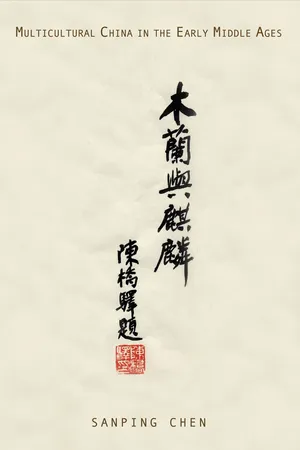
- 296 pages
- English
- ePUB (mobile friendly)
- Available on iOS & Android
eBook - ePub
Multicultural China in the Early Middle Ages
About this book
Information
Publisher
University of Pennsylvania PressYear
2012Print ISBN
9780812243703
9780812243703
eBook ISBN
9780812206289
Chapter 1
The Legacy of the Tuoba
Xianbei: The Tang Dynasty
Xianbei: The Tang Dynasty
An Old Open Secret
In late autumn of the thirteenth year of Zhenguan (AD 639), under the reign of the second monarch of the Tang dynasty, Emperor Taizong, a major libel case broke out in the capital: a Taoist priest, Qin Shiying, accused Falin, a leading Buddhist monk in the metropolitan region, of “defaming the royal ancestry” by refuting the official claim that the imperial Li family descended from Laozi, the legendary founder of Taoism.1 The catalyst of the case was the Tang imperial house's series of actions to promote the “native” Chinese religion allegedly created by their self-claimed sage/sacred forefather at the expense of the “foreign” Buddhism, raising the status of the former above that of the latter and resulting in strong reactions from the Buddhist establishment.
It should be added that the incident occurred in an era during which family origins and clan membership were of critical importance, not just politically, but often more importantly for commanding cultural prestige. A few dozen old Hàn clans with their roots in northern China had for centuries dominated high society and consequently the officialdoms in both northern and southern China. They formed a quasi-aristocracy extremely difficult for outsiders to penetrate, whether ethnic Hàn or “Barbarian.” While politically trying to suppress the status of these families, the Tang imperial house was simultaneously compelled to play the same game by claiming its more recent pedigree from the prestigious Li clan of the Longxi region in northern China. Falin's “defamation” of the royal ancestry thus threatened not only the religious halo transmitted from the founder of Taoism but also the self-asserted Sinitic Longxi ancestry. The latter was, naturally, part and parcel of the Tang house's claim to legitimacy for ruling the vast Hàn populace.
Monk Falin was duly arrested and went through several months of court proceedings, defending himself against various incriminating accusations. Finally, on a day in the last month of the Chinese year (January 640 of the Julian calendar), during an inquisition session attended by Emperor Taizong himself, the brave monk plainly declared, “According to my knowledge, the Dashe [clan] of the Tuoba is known in Tang language as the Li. From this descended Your Majesty's family, which did not come from the Longxi (Li) clan going back to Laozi.”2 This blasphemous statement was followed by further scandalous declarations about the self-claimed royal Longxi Li lineage, including the accusation that the clan was the offspring of a slave turned impostor. Quoting Buddhist sutras and metaphors, Falin equated the Tang imperial house's forfeiture of its northern lineage from the “god-king” of the Tuoba of the Yin Mountains in Mongolia, and their adoption of the Taoist pedigree, to “replacing gold with chalcopyrite (copper iron sulfide),” “exchanging fine silk for burlap,” and even “abandoning a ‘jewel princess’ in order to liaise with a female slave.”3
The emperor was naturally outraged, yet befitting his posthumous fame as one of the most tolerant and just monarchs in Chinese history, with a prankish sense of humor, he granted Falin seven days to practice what the hapless monk had previously preached in a Buddhism treatise, namely that reciting the name of the bodhisattva Avalokiteśvara (Chinese name Guanyin) would produce a religious miracle, saving the pious caller of the sacred name from the executioner's ax. Evidently not quite ready for immediate martyrdom, Falin beat a humiliating retreat, which incidentally made the Buddhist source on which our story is based all the more believable: By claiming, on the day the miracle was due, that he had in the past seven days merely recited the emperor's name instead of that of Avalokiteśvara, Falin secured an imperial pardon, or rather the commuting of the death penalty to exile in remote Sichuan. More intriguingly, faced with the opposition of imperial court judges who wanted to uphold the mandatory capital punishment, Emperor Taizong explained that Falin's defamation of the royal ancestry “was not without foundation.”
Emperor Taizong apparently recognized that the imperial clan's genealogical connections to the Tuoba nobles and other “Barbarian” families were open contemporary knowledge. For one thing, his own grandmother née Dugu, his mother née Dou, and his principal consort (and mother of the heir apparent) née Zhangsun were all indisputably of core Tuoba and other Xianbei descent. What monk Falin tried to reveal was that the Li clan's lineage on the paternal side very likely originated from the Tuoba too. The newest proof is the recent archaeological discovery that shows that another prominent Li clan of the period, namely that of Li Xian, a general-in-chief of the Northern Zhou, with the same claim to Longxi ancestry, was in fact of unmistakable Tuoba Xianbei descent.4
Nonetheless, Falin's declaration, albeit an open secret to his contemporaries, finally crossed the line the imperial house had drawn in the sand for establishing and defending its legitimacy, that is, being the son of heaven in the Central Kingdom. In this context, Emperor Taizong's handling of the Falin case was a masterstroke, for in sparing Falin's life it showed the imperial benevolence, but in expelling the famous monk with many high-level political connections to a remote place from the metropolis, it sent a clear message about the high price to pay for defaming the royal ancestry. There is little doubt that measures were taken too to eliminate any compromising evidence such as that cited by the brave monk.
The simple fact is that, after Falin's death, or one may say deferred martyrdom, on the twenty-third day of the seventh month in the lunar calendar, or August 15, 740, in Sichuan, barely seven months after his banishment from the Tang capital, the “Barbarian” origin of the Tang imperial house was never openly brought up again until more than five centuries later, in the Southern Song dynasty (1127–1279), albeit at that time few solid records still remained to allow concrete and detailed examination of the real origin and characteristics of the Tang imperial house.
A one-time open secret had become a true enigma.
The Ethnic Identity of the Tang Imperial House
The Tang went on to become one of the most splendid dynasties in Chinese history, as well as one of the most written about. But as foretold by the above story from Buddhist sources, the Tang royal family's own ethnic origin has been a controversy oft debated as a result of conflicting evidence, the well-documented fact that it had intermarried with various Tuoba Xianbei and other non-Hàn families for generations notwithstanding. The best and most important example is perhaps the noted Tang studies authority Chen Yinke (1890–1969), who wrote no fewer than four articles trying to prove the Li clan's native Hàn origin on the paternal side.5
It may be observed that Chen's studies were written during a period of Japan's growing military threat to China and encroachment on Chinese territories, which led to increasing sensitivity toward alien rule, ancient as well as modern, in China. Despite his extensive experience in studying abroad, Chen Yinke came from a late Qing aristocratic family with strong nationalistic inclinations. Chen's aged father died in 1937 after refusing food and medicine as a principled protest against the full-fledged Japanese military invasion of China. These events and sentiments certainly colored Chen's studies. Chen's position as a highly respected educator during his lifetime and his near-cult posthumous status as an unsurpassed modern historian certainly impeded any questioning of his results. For example, one of Chen's students, Liu Pansui, hastily concluded a pioneering and stimulating study of the Tang royal family's many “Barbarian” traits by endorsing, without the slightest reservation, his teacher's conclusion of the family's paternal Hàn origin.6
Nonetheless, the opposite proposition, namely that the Li descended from the Tuoba Xianbei, had equally solid if not stronger evidence, as acknowledged by, for example, a relatively recent biography by Hu Rulei of Li Shimin, otherwise known as Emperor Taizong, the extremely powerful second emperor of the Tang Dynasty.7 Moreover, despite Chen Yinke's admittedly politically influenced objective of demonstrating the Li clan's alleged Hàn Chinese origin, the studies by him and others have also shown that the official histories compiled during the Tang had been subjected to much political doctoring in order to conceal the imperial house's “Barbarian” background.
A related and equally portentous issue is the convenient but somewhat arbitrary categorization by which various Chinese dynasties were classified as either a “native” or a “conquest” regime. This dichotomy is largely based on the standard historiography but now appears quite well entrenched. In this scheme the Sui and Tang, though with undoubted strong “Northern influences,” were invariably regarded as native regimes. This conclusion is based on the observation that the process of sinicization or sinification, yet another popular but nebulous notion, of the “Barbarian” Xiongnu and Xianbei groups in northern China was considered completed by then.
In his study of “nomadic sinification” in China, David Honey seems to be the only exception, by trying to include the Tang in the “conquest dynasties.”8 Yet in addition to his very curious exclusion of the preceding Sui, he still considers the Tang house “basically sinified.” Therefore in his otherwise colorful essay on nomadic sinicization covering the entire Chinese history from the late Shang to the Qing, not a single item or case pertaining to the Tang is included.
From the point of view of sinification, ethnic origin, an issue for which the monk Falin paid a heavy personal price, is not of real significance here. Some persistent or occasional “atavistic” appearances of Northern influences notwithstanding, one could argue that little is found in the standard (i.e., official) histories to suggest that the Li regime was culturally anything but a “native” Chinese dynasty.
To address this issue, one might first ask a different question: Despite the fact that various Xiongnu and Xianbei groups dominated the political arena in northern China for almost three hundred years between the collapse of the Western Jin and the founding of the Sui, and the usually unacknowledged fact that their descendants continued to do so for several hundred more years, as the comments by the Yuan dynasty historian Hu Sanxing quoted in the Introduction clearly stated, why is it that one can learn so little about their cultural heritage in traditional historiography? Even the linguistic affinity of the Tuoba Xianbei remains to this day a matter of controversy, a subject I shall further elaborate in an appendix.
In his narration of the Turco-Persian Ghaznavid sultanate in the eastern Iranian world, David Morgan made this interesting observation: “Although the Ghaznawids were of Turkish origin, there seems to have been little that was identifiably Turkish about the way in which their empire was run, or indeed about the culture they patronized. We should, however, remember that our sources were written by Persian contemporaries, who might have been unlikely to lay much stress on the non-Persian…elements that may have been present.”9 Similarly, Herbert Franke, while discussing the legitimation of the most conspicuous “conquest” dynasty in Chinese history, commented, “A Chinese official history like the Yüan-shi is not very explicit about the Buddhist and Lamaist elements inherent in Yüan statehood, and one has to turn to the Tibetan and Mongol sources, even though the latter ones are mostly relatively late and sometimes unreliable and fanciful.”10
As one will see, Morgan's and Franke's observations are also pertinent to the Tang records. However, unlike the case of the Ghaznavids, which was contested by Fuad Köprülü, a modern Turkish historian,11 there is not a single Xianbei soul left today to question the “all-Chinese” Tang history; and unlike the Yuan world, there were few alternative sources on the Tang, which totally dominated, not only politically, but also culturally, the vast land from Samarkand to the Sea of Japan.
In her study of early modern China, Pamela Crossley contends that the term “sinicization” or “sinification” is an obsolete concept.12 “Ethnicity,” or ethnic study, would appear to be, at least morphologically (and politically), a more correct substitute. However, even she seems to admit that an abstract notion of ethnicity is no more self-evident or more clearly defined than the obsolete concept of sinicization.
The question of appropriate nomenclature notwithstanding, I shall try to demonstrate in the remainder of this chapter the marked contrast between the Tang and other native imperial houses regarding succession and other politico-cultural attributes of a dynasty, as well as the conspicuous cultural gap between the Tang imperial house and the contemporary Confucian gentry class. Finally, I raise serious doubts about the correctness of characterizing the Tang as a “native” or “basically sinified” imperial house. Borrowing the etymology Xianbei < *Särbi first suggested by Edwin Pulleyblank and adopted by Peter Golden, I contend that the first half of the Tang might be more aptly called a Särbo-Chinese (or Xianbeo-Chinese) regime.13
The Cultural Gap
The conventional view that the Tang represented a native Chinese dynasty very much depends on the premise that the Lis were either of Hàn origin or had “basically sinified” by the time of the founding of the dynasty. I shall contend that neither was true.
The earlier quotations regarding the Ghaznavids and on the Yuan clearly demonstrate how one-sided sources created biased or even false politico-cultural images of an ethnic regime. Careful examination of the historical sources of the era reveals many cases of the Li clan's non-Hàn cultural traits and identity. What may be more important is the marked distance between the imperial house and the traditional Chinese gentry regarding these issues as well as the contemporary awareness of this difference. Following is a brief summary of some of the most notable examples.
1. Language. In a later chapter I show that the Tuoba Xianbei tongue continued to be used by the Li clan as their first or family language. Moreover, even the term Guoyu, “national language,” was kept for a while during the Tang. Liu Pansui, Chen Yinke's student, first made this important discovery based on an entry in Xin Tang shu (The New History of the Tang Dynasty, 44.1160). The contemporary Chinese gentry's attitude toward this was best reflected in a noted passage in Yanshi jiaxun (Family Instructions for the Yan Clan):
There was a court official who once said to me, “I have a son who is seventeen and has quite a good epistolary style. I shall teach him the Xianbei language and to play the pipa (a favored foreign instrument), in the hope that he will gain a certain degree of proficiency in these. With such accomplishments he is sure to gain favour with men in high places. This is a matter of some urgency.” At that time I hung my head and made no reply. Strange indeed is the way this fellow teaches his son. Even if, by such means, you could become a minister, I would not wish you to do so.14
2. Affinity. The Tang was the last Chinese dynasty before the Manchus to marry off royal princesses to the Steppe khans and chieftains. This practice was clearly documented in the official compilation of Tang officialdom and institutions (Tang huiyao [Institutional History of the Tang]). There are also more detailed modern studies.15 The practice was so prevalent that the word konchuy, transcribing the Chinese term gongzhu, “princess,” was simply regarded by Ziya Gökalp, an early twentieth-century proponent of Pan-Turkism, as an ancient Turkic word for “wife.”16 In the meantime, the leading Chinese gentry families steadfastly refused to establish matrimonial relations with the imperial house. More strikingly, their rejection of the honor of an imperial marriage persisted for more than two centuries, lasting well into the late Tang era, despite the royal family's repeated initiatives (Xin Tangshu 119.4306, 172.5205–6; ZZTJ248.8036.17
3. Clan relationship. The Tang represented a unique case in Chinese history in which the imperial house bestowed its own clan name, Li, not only on a few Hàn Chinese persons but more frequently on ethnic leaders and chieftains, be they Turk, Tangut, Uighur, Kitan, or Iranian/Persian. In the same study of the marriage practice of Tang royal princesses, Wang Tongling compiled a rather extensive table on this issue.18 As the Yuan dynasty historian Hu Sanxing particularly noted (ZZTJ 172.8879), the Zhuxie Shatuo Turkic tribe founded the Later Tang dynasty based largely on having received this imperial honor. I also add a rather revealing case missing in Wang Tongling's exhaustive table: As late as the Huichang period (841–46), the main business for a Kirghiz embassy, per an imperial edict by Emperor Wuzong (reign 840–46), was to register themselves with the imperial clan office (X...
Table of contents
- Cover Page
- Title Page
- Copyright Page
- Dedication Page
- Contents
- Foreword: Old Wine in New Bottles
- Introduction
- 1. The Legacy of the Tuoba Xianbei: The Tang Dynasty
- 2. From Mulan to Unicorn
- 3. Brotherly Matters and the Canine Image: The Invasion of “Barbarian” Tongues
- 4. The Huns and the Bulgars: The Chinese Chapter
- 5. The Mystery of the “White-Drake” Oracle: The Iranian Shadows
- 6. Son of Heaven and Son of God
- 7. Bai Juyi and Central Asia
- Appendix. Turkic or Proto-Mongolian? A Note on the Tuoba Language
- Notes
- Bibliography
- Index
- Acknowledgments
Trusted by 375,005 students
Access to over 1.5 million titles for a fair monthly price.
Study more efficiently using our study tools.
Frequently asked questions
Yes, you can cancel anytime from the Subscription tab in your account settings on the Perlego website. Your subscription will stay active until the end of your current billing period. Learn how to cancel your subscription
No, books cannot be downloaded as external files, such as PDFs, for use outside of Perlego. However, you can download books within the Perlego app for offline reading on mobile or tablet. Learn how to download books offline
Perlego offers two plans: Essential and Complete
- Essential is ideal for learners and professionals who enjoy exploring a wide range of subjects. Access the Essential Library with 800,000+ trusted titles and best-sellers across business, personal growth, and the humanities. Includes unlimited reading time and Standard Read Aloud voice.
- Complete: Perfect for advanced learners and researchers needing full, unrestricted access. Unlock 1.5M+ books across hundreds of subjects, including academic and specialized titles. The Complete Plan also includes advanced features like Premium Read Aloud and Research Assistant.
We are an online textbook subscription service, where you can get access to an entire online library for less than the price of a single book per month. With over 1.5 million books across 990+ topics, we’ve got you covered! Learn about our mission
Look out for the read-aloud symbol on your next book to see if you can listen to it. The read-aloud tool reads text aloud for you, highlighting the text as it is being read. You can pause it, speed it up and slow it down. Learn more about Read Aloud
Yes! You can use the Perlego app on both iOS and Android devices to read anytime, anywhere — even offline. Perfect for commutes or when you’re on the go.
Please note we cannot support devices running on iOS 13 and Android 7 or earlier. Learn more about using the app
Please note we cannot support devices running on iOS 13 and Android 7 or earlier. Learn more about using the app
Yes, you can access Multicultural China in the Early Middle Ages by Sanping Chen in PDF and/or ePUB format, as well as other popular books in History & Chinese History. We have over 1.5 million books available in our catalogue for you to explore.