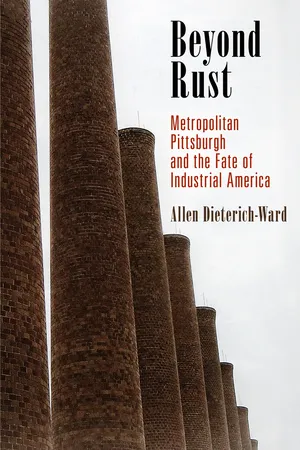
Beyond Rust chronicles the rise, fall, and rebirth of metropolitan Pittsburgh, an industrial region that once formed the heart of the world's steel production and is now touted as a model for reviving other hard-hit cities of the Rust Belt. Writing in clear and engaging prose, historian and area native Allen Dieterich-Ward provides a new model for a truly metropolitan history that integrates the urban core with its regional hinterland of satellite cities, white-collar suburbs, mill towns, and rural mining areas.
Pittsburgh reached its industrial heyday between 1880 and 1920, as vertically integrated industrial corporations forged a regional community in the mountainous Upper Ohio River Valley. Over subsequent decades, metropolitan population growth slowed as mining and manufacturing employment declined. Faced with economic and environmental disaster in the 1930s, Pittsburgh's business elite and political leaders developed an ambitious program of pollution control and infrastructure development. The public-private partnership behind the "Pittsburgh Renaissance," as advocates called it, pursued nothing less than the selective erasure of the existing social and physical environment in favor of a modernist, functionally divided landscape: a goal that was widely copied by other aging cities and one that has important ramifications for the broader national story. Ultimately, the Renaissance vision of downtown skyscrapers, sleek suburban research campuses, and bucolic regional parks resulted in an uneven transformation that tore the urban fabric while leaving deindustrializing river valleys and impoverished coal towns isolated from areas of postwar growth.
Beyond Rust is among the first books of its kind to continue past the collapse of American manufacturing in the 1980s by exploring the diverse ways residents of an iconic industrial region sought places for themselves within a new economic order.
eBook - ePub
Beyond Rust
Metropolitan Pittsburgh and the Fate of Industrial America
- 360 pages
- English
- ePUB (mobile friendly)
- Available on iOS & Android
eBook - ePub
About this book
Information
Topic
HistoriaSubtopic
Historia de NorteaméricaPART I
The Steel Valley
IN THE SPRING of 1894, four “pilgrims”—historian Reuben Gold Thwaites, his ten-year-old son Frederick, his wife Jessie, and his brother-in-law William Turvill—set off from Brownsville, Pennsylvania, on a 1,000 mile journey down the Monongahela and Ohio Rivers. Thwaites said he “wished to know the great waterway intimately in its various phases [and] to see with my own eyes what the borderers saw; in imagination, to redress the pioneer stage, and repeople it.”1 Through Thwaites’s 1898 memoir, we, too, can recapture the past and a vision of a region in transition. By the turn of the nineteenth century, the Upper Ohio Valley had already passed through at least two distinct phases since its time as a colonial frontier in the 1700s—a “Gateway to the West” superseded by a riverine culture of steamboats and mercantile exchange—and it remained in the throes of an industrial revolution, the signs of which were ever-present from the travelers’ riverfront vantage.
Thwaites and his companions deliberately eschewed the comforts of the steamboat (“there are too many modern distractions about such a mode of progress”) for camping and travel by raft “alert to the whisperings of Nature.” As a result, one can learn a great deal about turn-of-the-century Pittsburgh’s landscape from the published account of their journey, Afloat on the Ohio, even as the natural and cultural often blurred together in the descriptions. The Monongahela “comes down gaily enough from the West Virginia hills,” they reported of their launch from historic Redstone Creek at the western terminus of Braddock’s Road, until it was converted into a mere millpond at Brownsville by the four navigation dams between there and Pittsburgh. Henceforth the stream, Thwaites declared, was lined with mill towns that were “literally abutting one upon the other all of the way down to Pittsburg.” “Often,” he concluded, “four or five full-fledged cities are at once in view from our boat, the air is thick with sooty smoke belched from hundreds of stacks, the ear is almost deafened with the whirr and bang of milling industries.”
As the Pilgrim (the name chosen for their skiff) made its way downstream, the visitors frequently bore witness to the changing industrial landscape of the region. The transformation of the Upper Ohio Valley into the Steel Valley had been so rapid in the closing decades of the nineteenth century that “both banks of the [Monongahela] river were lined with village after village, city after city … not recorded on our map, which bears the date of 1882.” Indeed, while the purpose of the voyage may have been to recreate the past, much of their account focused on the process of steel making, railroad building, and coal mining at the heart of the new regional economy. By 1894 “the iron horse has almost eclipsed … the steamboat,” Thwaites journaled early in the voyage; “Either bank is lined with railways, in sight of which we shall almost continually float.” Similarly, “tipples of bituminous coal-shafts are ever in sight,” lining the riverbanks to fill the waiting trains and river barges headed to towns and cities downstream. At the other end of the line, “factories and mills … sewer-pipe and vitrified-brick works, and iron and steel plants abound on the narrow bottoms.”
One can also get a sense, flavored by the travelers’ particular class and ethnic background, of the region’s culture, communities, and residents. In the spring of 1894, the fledgling United Mine Workers union had just called for a walkout, and Thwaites duly noted the “miners loafing out the duration of a strike” when they set out on May 4. Less than two weeks later, company guards near Uniontown, only fifteen miles from Brownsville, armed with carbines and machine guns, held off an attack by an “Army of Intimidation” composed of 1,500 strikers, killing five.2 At Homestead he contrasted “the famous great bank of ugly slag at the base of the steel mills, where the barges housing the Pinkerton guards were burned by the mob” less than two years earlier, with his views of “the electric cars, following either side of the stream as far down as Pittsburg, crowded to suffocation with gaily-attired folk … enjoying their Sunday afternoon outing.” On the other end of the spectrum, west of the city (and thus upwind of the factory smoke) where “the hills are lower, less precipitous, more graceful,” the city’s merchants’ and manufacturers’ “beautiful villas occupy commanding situations on hillsides and hilltops [with] spires and cupolas … peeping above the trees; and now and then a pretty suburban railway station.”
Perhaps most fascinating about Afloat on the Ohio was the way the multiple stages of metropolitan Pittsburgh’s history existed simultaneously as part of the region’s social and physical landscape. For all their attention to the urban-industrial development, the travelers also observed “small rustic towns in plenty.” Despite the decline in importance of the rivers as transportation arteries, the cities all had broad wharfs with “steamers … closely packed,” while they frequently met fishermen “setting their nets,” as well as “houseboats, dozens of which we see daily.” That said, the ability to use the rivers as anything other than industrial canals and urban sinks was rapidly fading due to “the appalling havoc which … industries are making with the once beautiful banks of the river.” “Fifty years hence,” Thwaites predicted, if these enterprises multiplied, “the Upper Ohio will roll between continuous banks of clay and iron offal, down to Wheeling and beyond.” This dire vision of a region crippled by the environmental consequences of an extractive economy was already foreshadowed in 1894 in the form of the deserted mining villages the pilgrims passed on their journey—“the shaft having been worked out, or an unquenchable fire left to smolder in neglect. Here the tipple has fallen into creaking decrepitude; the cabins are without windows or doors, while the black offal of the pit, covering deep the original beauty of the once green slope, is in turn being veiled with climbing weeds—such is Nature’s haste, when untrammeled, to heal the scars wrought by man.”
As Afloat on the Ohio suggests, the transformation of the Upper Ohio Valley into the Steel Valley resulted in an economy based on a nexus of coal, steel and rail that linked Pittsburgh, Steubenville, Wheeling and their hinterlands in a process of natural resource extraction. Industrial entrepreneurs pioneered the development of the vertically integrated corporation, creating an interconnected system of mammoth steel mills, coking plants, and mines extending from the heavily industrialized river valleys to the mining camps of the region’s mountainous interior. Residents had a common culture shaped by the topography and grounded in a celebration of industrial triumph over nature. The logic of industrial capital reshaped the natural landscape, but so too did the region’s rivers, mineral deposits, and rugged topography structure growth patterns in ways that were unique among the nation’s great manufacturing areas. As a result, each stage in the social evolution of metropolitan Pittsburgh required a cultural reimagining of the relationship between humans and the natural world.
By 1900 competition for control of the Ohio headwaters had given way to a regional community, with Steubenville and Wheeling on the periphery of the metropolitan core in southwestern Pennsylvania. At the heart of this framework were the mines and mills themselves, which bound together distant areas in a sophisticated production process that resulted both in finished goods and the social inequalities observed by Thwaites. Expanding communities and industrial sites placed heavy demands on the environment, which decreased standards of living even as social reformers faced a fractious administrative and political system often dominated by large industrial corporations. By World War II, a social crisis rooted in increasing economic and environmental problems eventually resulted in a new public-private partnership in Pittsburgh that sought to remake the region both physically and symbolically. Taking the full measure of Pittsburgh’s “Renaissance” first requires exploring the complicated ways in which the economic and political realignments that created the Steel Valley set in place patterns of land use, social interactions, and cultural assumptions that proved difficult to change.

FIGURE 2. Metropolitan Pittsburgh: the Steel Valley.
CHAPTER 1
Building the Region
A cacophony of strange lights, sounds, and smells confronted wide-eyed Valentine “Val” Reuther in 1899 when he stepped off the train in Wheeling, West Virginia. Greeted by his brother Jake at the station, the eighteen-year-old German émigré had just made the trip from his family’s farm in Illinois to seek his fortune in the city. Turn-of-the-century Wheeling, like the rest of the Pittsburgh metropolitan region, was bursting with vitality and Val quickly found quarters in a “very proletarian” boarding house in South Wheeling, an area full of “Germans, Poles, Scandinavians, Yugoslavs, and Irishmen.” He soon started as a laborer at the Riverside Ironworks, located in a nearby industrial suburb, where he worked seventy-two hours a week for $1.50 a day. Through hard work and a personal relationship with the foreman, Reuther climbed his way up the labor ladder, eventually landing a job as a “heater” in the rolling mill and earning ten to twelve dollars for the same twelve-hour shift.1
In 1899, it had been more than 125 years since the Zane family first settled the east bank of the Ohio River as an outpost of the British Empire. Merchants in Pittsburgh, Wheeling, and Steubenville prospered as western markets expanded, using the river and its tributaries to gather produce and distribute manufactured goods from Europe and the Atlantic seaboard. The railroad had superseded the river as a mode of transportation by the end of the century, but industrial infrastructure merged with the natural landscape and vestiges of a riverine society to foster a common culture shared by residents throughout the region. “The mine, the mills, and the river made a fascinating setting for exploring boys,” recalled Valentine’s son Victor of his youth on the banks of the Ohio. “Calliope organs resounding from the river drew us to the banks to watch the steamers go by, creating great waves with their side or rear paddle wheels. We fished and swam; it was a rite of adolescence for each boy to make it all the way to the other side of the water.”2
Reuther’s story provides an important reminder that the fraught conversion to a post-industrial society that would take place a century later was not the region’s first challenging transition. From the late eighteenth to the mid-nineteenth centuries, the Upper Ohio Valley’s strategic position at the headwaters of the vast Ohio-Mississippi river system made it politically significant and provided access to the economic markets of the western frontier. On the one hand, we can see the beginning of a regional community defined by its rough topography, distance from other metropolitan regions, and orientation to its rivers. On the other hand, Steubenville, Wheeling, and Pittsburgh each vied for control of the headwaters with local boosters touting the advantages of their respective cities in terms of location and access to mineral resources, especially coal. In a pattern that would reemerge, especially after World War II, the success of local communities during this earlier era depended to a large extent on the ability to harness resources on the state level: a factor that further underscores the ways tensions between intra-regional bonds and barriers will matter to the subsequent story.
The expansion of the railroads lessened the area’s importance as a transportation node, but trains also sparked a new industrial phase and eventually attracted investment in manufacturing, especially iron and steel making. By the end of the nineteenth century, the region had evolved into the Steel Valley, which formed the center of heavy industrial manufacturing in the United States. An extensive web of railroads connected the densely settled mill towns of the narrow river valleys with mining camps and villages in the surrounding mountainous countryside. In addition to these economic bonds, residents shared a regional culture shaped by the topography and grounded in a celebration of industrial triumph over nature. This shift had cultural, social and material ramifications as heavy industry replaced a riverine society and Pittsburgh increasingly served as the hub of a complex metropolitan landscape. While Steubenville and Wheeling were drawn into Pittsburgh’s orbit as economic satellites, however, the creation of the Ohio River as a state boundary ensured that political rivalries would also play a key role in circumscribing regional development.3
Controlling the Headwaters
The difficulty in crossing the rugged Appalachians was a key factor in establishing the regional connections between communities in the Upper Ohio Valley, a theme that would remain centrally important throughout the nineteenth and twentieth centuries as well. The area lies in the northwestern part of Appalachia, the mountainous region stretching from southern Quebec to central Alabama. The landscape ranges from the steep hillsides of the Allegheny Mountains in southwestern Pennsylvania and northern West Virginia to the gently rolling hills of the Appalachian Plateau in southeastern Ohio. Numerous rivers and streams punctuate the terrain with the two largest, the Monongahela and Allegheny, merging in what is now Pittsburgh to form the Ohio River. Unlike the Chesapeake colonies, where the major east-west river system passed through deep gorges, the Susquehanna River from Baltimore through Harrisburg was easily traversed. From there British soldiers and settlers followed a Native American trail, the Allegheny Path, along the ridge tops farther and farther westward.4
On the other hand, even after the defeat of the French in the Seven Years’ War, competition continued between Virginia and Pennsylvania for control of the headwaters and by 1776 rival trans-Appalachia routes ran to the Ohio River at Pittsburgh (Forbes Road) and northwestern Virginia near Wheeling (Braddock Road). The victory over the British Army by American colonists in the 1780s hastened a massive influx of white residents and land speculators that continued as the new federal government opened the Northwest Territory for settlement. Continuing a colonial rivalry that had been simmering for decades, Pennsylvania authorities frequently clashed with Virginian settlers and land speculators over the exact location of the state boundary line. Though one contingent to the Continental Congress proposed resolving the territorial dispute by creating a new state of “Westsylvania,” an acknowledgement of the diverging regional interests of both Richmond and Philadelphia elites from residents of the western Appalachians, the southwestern edge of Pennsylvania was finally established in 1784. A year later, the passage of the Land Ordinance of 1785 defined how the lands across the Ohio would be surveyed and sold to settlers.5
As a result, while Pittsburgh remained part of the state of Pennsylvania, by the turn of the eighteenth century it was separated politically from its hinterlands to the south and west. By 1820, the city’s population had topped 7,200, making it second in size only to Cincinnati along the length of the Ohio. Wheeling scored an important coup in 1818 when it became the western terminus of a new National Road that connected the port of Baltimore with the Ohio River. Anglo-American settlers laid out the village of Steubenville, Ohio, in 1797 near a fort established to protect surveyors. Twenty years later the community boasted three thousand residents and a variety of manufacturers. Town lots for smaller communities also began appearing on local tax assessment records. The southwestern Pennsylvania community of Falls City, later renamed Ohiopyle, was founded adjacent to a series of rapids along the Youghiogheny River, a tributary of the Monongahela, shortly after the American Revolution by residents attracted by the availability of water power for mills. Ohiopyle’s population then slowly expanded after construction of the National Road in 1811 provided easier access to the markets of the east. Over the next century, residents were involved in the farming, mining and timber industries particularly after the arrival of the Baltimore & Ohio Railroad in 1871.6
This relationship between geography, market conditions and transportation technology drove metropolitan development within the region. While the Upper Ohio Valley had a temperate climate and relatively fertile soils replenished by seasonal flooding, the hilly landscape limited areas suitable for intensive agriculture and placed a premium on the level lands of the river and stream valleys. On reaching the flatter, fertile area just west of the Ohio River escarpment after weeks in the mountains, one early traveler on the National Road from Wheeling reportedly declared “This must be the land of Egypt,” a name that stuck to the small farming community of Egypt Valley in southeastern Ohio. The early market towns and river cities followed a development pattern of expansion outward on the relatively narrow flatlands between the riverbanks and the steep escarpment of the surrounding hills. These small towns served a number of important functions in frontier society, clustering together a variety of skills, professional services, and economic opportunities for the region’s residents. Even by 1790, Washington, Pennsylvania, located west of the Braddock Road between Pittsburgh and Wheeling, boasted sixteen retailers, thirty merchants and more than ninety-three other artisans and tradesmen, including such new trades as Windsor chair makers and coppersmiths.7
By the 1830s, the regional identity binding the trans-Appalachian West was overshadowed by an increasing identification along state lines. This transition was due in part to the decline in the importance of the rivers for inter-regional transportation and marketing in the face of road and canal construction. The arrival of the National Road in 1818 held out the possibility that Wheeling might challenge Pittsburgh’s supremacy, but the city struggled to attract investment when infrastructure development funds from Richmond were not forthcoming. President Andrew Jackson’s veto of the federal Maysville Road proposal in 1830 further heightened the role of individual states in determining the route of new transportation corridors, thus shifting the emphasis away from...
Table of contents
- Cover
- Title Page
- Copyright
- Contents
- Prologue
- Introduction. The City and Its Region
- Part I. The Steel Valley
- Part II. A Region of Contrasts
- Part III. Post-Industrial Pittsburgh
- Epilogue
- Sources
- Notes
- Index
- Acknowledgments
Trusted by 375,005 students
Access to over 1.5 million titles for a fair monthly price.
Study more efficiently using our study tools.
Frequently asked questions
Yes, you can cancel anytime from the Subscription tab in your account settings on the Perlego website. Your subscription will stay active until the end of your current billing period. Learn how to cancel your subscription
No, books cannot be downloaded as external files, such as PDFs, for use outside of Perlego. However, you can download books within the Perlego app for offline reading on mobile or tablet. Learn how to download books offline
Perlego offers two plans: Essential and Complete
- Essential is ideal for learners and professionals who enjoy exploring a wide range of subjects. Access the Essential Library with 800,000+ trusted titles and best-sellers across business, personal growth, and the humanities. Includes unlimited reading time and Standard Read Aloud voice.
- Complete: Perfect for advanced learners and researchers needing full, unrestricted access. Unlock 1.5M+ books across hundreds of subjects, including academic and specialized titles. The Complete Plan also includes advanced features like Premium Read Aloud and Research Assistant.
We are an online textbook subscription service, where you can get access to an entire online library for less than the price of a single book per month. With over 1.5 million books across 990+ topics, we’ve got you covered! Learn about our mission
Look out for the read-aloud symbol on your next book to see if you can listen to it. The read-aloud tool reads text aloud for you, highlighting the text as it is being read. You can pause it, speed it up and slow it down. Learn more about Read Aloud
Yes! You can use the Perlego app on both iOS and Android devices to read anytime, anywhere — even offline. Perfect for commutes or when you’re on the go.
Please note we cannot support devices running on iOS 13 and Android 7 or earlier. Learn more about using the app
Please note we cannot support devices running on iOS 13 and Android 7 or earlier. Learn more about using the app
Yes, you can access Beyond Rust by Allen Dieterich-Ward in PDF and/or ePUB format, as well as other popular books in Historia & Historia de Norteamérica. We have over 1.5 million books available in our catalogue for you to explore.