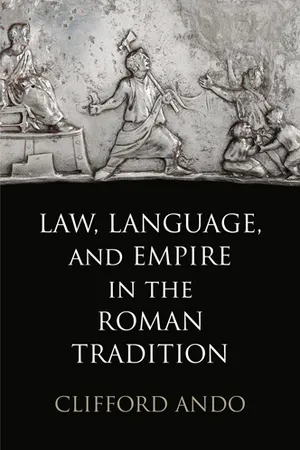
The Romans depicted the civil law as a body of rules crafted through communal deliberation for the purpose of self-government. Yet, as Clifford Ando demonstrates in Law, Language, and Empire in the Roman Tradition, the civil law was also an instrument of empire: many of its most characteristic features developed in response to the challenges posed when the legal system of Rome was deployed to embrace, incorporate, and govern people and cultures far afield.
Ando studies the processes through which lawyers at Rome grappled with the legal pluralism resulting from imperial conquests. He focuses primarily on the tools—most prominently analogy and fiction—used to extend the system and enable it to regulate the lives of persons far from the minds of the original legislators, and he traces the central place that philosophy of language came to occupy in Roman legal thought.
In the second part of the book Ando examines the relationship between civil, public, and international law. Despite the prominence accorded public and international law in legal theory, it was civil law that provided conceptual resources to those other fields in the Roman tradition. Ultimately it was the civil law's implication in systems of domination outside its own narrow sphere that opened the door to its own subversion. When political turmoil at Rome upended the institutions of political and legislative authority and effectively ended Roman democracy, the concepts and language that the civil law supplied to the project of Republican empire saw their meanings transformed. As a result, forms of domination once exercised by Romans over others were inscribed in the workings of law at Rome, henceforth to be exercised by the Romans over themselves.
- 181 pages
- English
- PDF
- Available on iOS & Android
eBook - PDF
Law, Language, and Empire in the Roman Tradition
About this book
Information
Publisher
University of Pennsylvania PressYear
2011Print ISBN
9780812243543
9780812243543
eBook ISBN
9780812204889
Topic
StoriaSubtopic
Storia dell'antica RomaTable of contents
- Cover
- Contents
- Preface
- Chapter 1. Citizen and Alien before the Law
- Chapter 2. Law’s Empire
- Chapter 3. Empire and the Laws of War
- Chapter 4. Sovereignty and Solipsism in Democratic Empires
- Chapter 5. Domesticating Domination
- Appendix. Work-arounds in Roman Law: The Fiction and Its Kin
- Notes
- Bibliography
- Index
- Acknowledgments
Trusted by 375,005 students
Access to over 1.5 million titles for a fair monthly price.
Study more efficiently using our study tools.
Frequently asked questions
Yes, you can cancel anytime from the Subscription tab in your account settings on the Perlego website. Your subscription will stay active until the end of your current billing period. Learn how to cancel your subscription
No, books cannot be downloaded as external files, such as PDFs, for use outside of Perlego. However, you can download books within the Perlego app for offline reading on mobile or tablet. Learn how to download books offline
Perlego offers two plans: Essential and Complete
- Essential is ideal for learners and professionals who enjoy exploring a wide range of subjects. Access the Essential Library with 800,000+ trusted titles and best-sellers across business, personal growth, and the humanities. Includes unlimited reading time and Standard Read Aloud voice.
- Complete: Perfect for advanced learners and researchers needing full, unrestricted access. Unlock 1.5M+ books across hundreds of subjects, including academic and specialized titles. The Complete Plan also includes advanced features like Premium Read Aloud and Research Assistant.
We are an online textbook subscription service, where you can get access to an entire online library for less than the price of a single book per month. With over 1.5 million books across 990+ topics, we’ve got you covered! Learn about our mission
Look out for the read-aloud symbol on your next book to see if you can listen to it. The read-aloud tool reads text aloud for you, highlighting the text as it is being read. You can pause it, speed it up and slow it down. Learn more about Read Aloud
Yes! You can use the Perlego app on both iOS and Android devices to read anytime, anywhere — even offline. Perfect for commutes or when you’re on the go.
Please note we cannot support devices running on iOS 13 and Android 7 or earlier. Learn more about using the app
Please note we cannot support devices running on iOS 13 and Android 7 or earlier. Learn more about using the app
Yes, you can access Law, Language, and Empire in the Roman Tradition by Clifford Ando in PDF and/or ePUB format, as well as other popular books in Storia & Storia dell'antica Roma. We have over 1.5 million books available in our catalogue for you to explore.