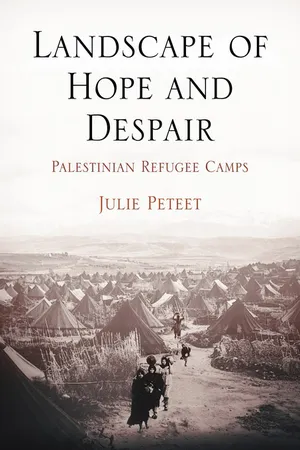
Nearly half of the world's eight million Palestinians are registered refugees, having faced partition and exile. Landscape of Hope and Despair examines this refugee experience in Lebanon through the medium of spatial practices and identity, set against the backdrop of prolonged violence. Julie Peteet explores how Palestinians have dealt with their experience as refugees by focusing attention on how a distinctive Palestinian identity has emerged from and been informed by fifty years of refugee history. Concentrating ethnographic scrutiny on a site-specific experience allows the author to shed light on the mutually constitutive character of place and cultural identification.
Palestinian refugee camps are contradictory places: sites of grim despair but also of hope and creativity. Within these cramped spaces, refugees have crafted new worlds of meaning and visions of the possible in politics. In the process, their historical predicament was a point of departure for social action and thus became radically transformed. Beginning with the calamity of 1948, Landscape of Hope and Despair traces the dialectic of place and cultural identification through the initial despair of the 1950s and early 1960s to the tumultuous days of the resistance and the violence of the Lebanese civil war and its aftermath. Most significantly, this study invokes space, place, and identity to construct an alternative to the received national narratives of Palestinian society and history.
The moving stories told here form a larger picture of these refugees as a people struggling to recreate their sense of place and identity and add meaning to their surroundings through the use of culture and memory.
- 277 pages
- English
- PDF
- Available on iOS & Android
eBook - PDF
About this book
Information
Table of contents
- Cover
- Title Page
- Copyright Page
- Table of Contents
- Chapter 1: Introduction: Palestinian Refugees
- Chapter 2: Prelude to Displacement: Producing and Enacting Knowledge
- Chapter 3: Aid and the Construction of the Refugee
- Chapter 4: Producing Place, Spatializing Identity, 1948–68
- Chapter 5: Landscape of Hope and Despair
- Chapter 6: The Geography of Terror and Reconfinement
- Conclusion: Refugee Camps and the Wall
- Notes
- Bibliography
- Index
- Acknowledgments
- Back Cover
Trusted by 375,005 students
Access to over 1.5 million titles for a fair monthly price.
Study more efficiently using our study tools.
Frequently asked questions
Yes, you can cancel anytime from the Subscription tab in your account settings on the Perlego website. Your subscription will stay active until the end of your current billing period. Learn how to cancel your subscription
No, books cannot be downloaded as external files, such as PDFs, for use outside of Perlego. However, you can download books within the Perlego app for offline reading on mobile or tablet. Learn how to download books offline
Perlego offers two plans: Essential and Complete
- Essential is ideal for learners and professionals who enjoy exploring a wide range of subjects. Access the Essential Library with 800,000+ trusted titles and best-sellers across business, personal growth, and the humanities. Includes unlimited reading time and Standard Read Aloud voice.
- Complete: Perfect for advanced learners and researchers needing full, unrestricted access. Unlock 1.5M+ books across hundreds of subjects, including academic and specialized titles. The Complete Plan also includes advanced features like Premium Read Aloud and Research Assistant.
We are an online textbook subscription service, where you can get access to an entire online library for less than the price of a single book per month. With over 1.5 million books across 990+ topics, we’ve got you covered! Learn about our mission
Look out for the read-aloud symbol on your next book to see if you can listen to it. The read-aloud tool reads text aloud for you, highlighting the text as it is being read. You can pause it, speed it up and slow it down. Learn more about Read Aloud
Yes! You can use the Perlego app on both iOS and Android devices to read anytime, anywhere — even offline. Perfect for commutes or when you’re on the go.
Please note we cannot support devices running on iOS 13 and Android 7 or earlier. Learn more about using the app
Please note we cannot support devices running on iOS 13 and Android 7 or earlier. Learn more about using the app
Yes, you can access Landscape of Hope and Despair by Julie Peteet in PDF and/or ePUB format, as well as other popular books in Social Sciences & Human Rights. We have over 1.5 million books available in our catalogue for you to explore.