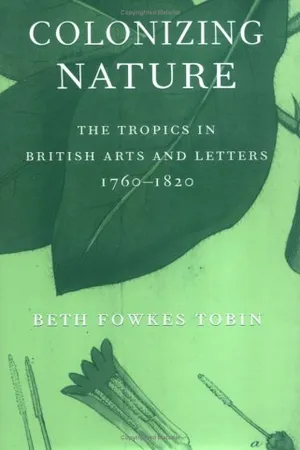
With its control of sugar plantations in the Caribbean and tea, cotton, and indigo production in India, Britain in the eighteenth and nineteenth centuries dominated the global economy of tropical agriculture. In Colonizing Nature, Beth Fowkes Tobin shows how dominion over "the tropics" as both a region and an idea became central to the way in which Britons imagined their role in the world.
Tobin examines georgic poetry, landscape portraiture, natural history writing, and botanical prints produced by Britons in the Caribbean, the South Pacific, and India to uncover how each played a crucial role in developing the belief that the tropics were simultaneously paradisiacal and in need of British intervention and management. Her study examines how slave garden portraits denied the horticultural expertise of the slaves, how the East India Company hired such artists as William Hodges to paint and thereby Anglicize the landscape and gardens of British-controlled India, and how writers from Captain James Cook to Sir James E. Smith depicted tropical lands and plants.
Just as mastery of tropical nature, and especially its potential for agricultural productivity, became key concepts in the formation of British imperial identity, Colonizing Nature suggests that intellectual and visual mastery of the tropics—through the creation of art and literature—accompanied material appropriations of land, labor, and natural resources. Tobin convincingly argues that the depictions of tropical plants, gardens, and landscapes that circulated in the British imagination provide a key to understanding the forces that shaped the British Empire.
- 274 pages
- English
- PDF
- Available on iOS & Android
eBook - PDF
About this book
Information
Publisher
University of Pennsylvania PressYear
2011Print ISBN
9780812238358
9780812238358
eBook ISBN
9780812203684
Topic
LittératureSubtopic
Critique littéraire anglaiseTable of contents
- Cover
- Title
- Copyright
- Contents
- List of Illustrations
- Preface
- Introduction: Troping the Tropics and Aestheticizing Labor
- Chapter 1 Tropical Bounty, Local Knowledge, and the Imperial Georgic
- Chapter 2 Provisional Economies: Slave Gardens in the Writings of British Sojourners
- Chapter 3 Land, Labor, and the English Garden Conversation Piece in India
- Chapter 4 Picturesque Ruins, Decaying Empires, and British Imperial Character in Hodges's Travels in India
- Chapter 5 Seeing, Writing, and Revision: Natural History Discourse and Captain Cook's A Voyage towards the South Pole, and Round the World
- Chapter 6 Domesticating the Tropics: Tropical Flowers, Botanical Books, and the Culture of Collecting
- Epilogue: Decolonizing Garden History
- Notes
- Select Bibliography
- Index
- Acknowledgments
Trusted by 375,005 students
Access to over 1.5 million titles for a fair monthly price.
Study more efficiently using our study tools.
Frequently asked questions
Yes, you can cancel anytime from the Subscription tab in your account settings on the Perlego website. Your subscription will stay active until the end of your current billing period. Learn how to cancel your subscription
No, books cannot be downloaded as external files, such as PDFs, for use outside of Perlego. However, you can download books within the Perlego app for offline reading on mobile or tablet. Learn how to download books offline
Perlego offers two plans: Essential and Complete
- Essential is ideal for learners and professionals who enjoy exploring a wide range of subjects. Access the Essential Library with 800,000+ trusted titles and best-sellers across business, personal growth, and the humanities. Includes unlimited reading time and Standard Read Aloud voice.
- Complete: Perfect for advanced learners and researchers needing full, unrestricted access. Unlock 1.5M+ books across hundreds of subjects, including academic and specialized titles. The Complete Plan also includes advanced features like Premium Read Aloud and Research Assistant.
We are an online textbook subscription service, where you can get access to an entire online library for less than the price of a single book per month. With over 1.5 million books across 990+ topics, we’ve got you covered! Learn about our mission
Look out for the read-aloud symbol on your next book to see if you can listen to it. The read-aloud tool reads text aloud for you, highlighting the text as it is being read. You can pause it, speed it up and slow it down. Learn more about Read Aloud
Yes! You can use the Perlego app on both iOS and Android devices to read anytime, anywhere — even offline. Perfect for commutes or when you’re on the go.
Please note we cannot support devices running on iOS 13 and Android 7 or earlier. Learn more about using the app
Please note we cannot support devices running on iOS 13 and Android 7 or earlier. Learn more about using the app
Yes, you can access Colonizing Nature by Beth Fowkes Tobin in PDF and/or ePUB format, as well as other popular books in Littérature & Critique littéraire anglaise. We have over 1.5 million books available in our catalogue for you to explore.